



Hi, dear flight-report members and readers!
This year I've spent quite a lot of time in Central Asia and part of this trip was devoted to visiting China. As a result a have a lot of avgeek content and will share it with you in the coming weeks.
In this special FR I'd like to present a detailed review of Air China Boeing 747-8i on a short domestic flight from Beijing Capital (PEK) to Shanghai Hongqiao (SHA).
Intro
Having flown 2 operators of B748 - Lufthansa (between FRA and MEX in 2016 and 2017) and Korean Air (between CDG and ICN in 2023) - I've finally made it to fly the 3rd operator: Air China.
Whereas LH and KE flights were international long-hauls, my flights on Chinese B748s were domestic short-hauls (actually - the world's shortest B748 flights). Currently CA flies B748s internationally from its PEK hub only to US and Germany - to JFK (5 times/week), IAD (2 times/week) and FRA (3 times/week) and in between these flights the Jumbos make domestic rotations from PEK on trunk routes to Shanghai Hongqiao (SHA) and Guangzhou (CAN).
These CA domestic flights are very prone to change of aircraft type (one of the reasons why CA is called "Air Change") or cancellations. Below I'll try to explain the principles of how B748s are assigned on these domestic flights and how I managed to choose the dates that provided B748s on both legs PEK-SHA-PEK.
But firstly let's overview the current state of B748 fleets of all the 3 operators of the type.
B747-8 Passengers Operators And Their Routes
As of late March 2026, there are still three operators of passenger B748s: Lufthansa, Air China and Korean Air. In my FR of Korean Air ICN-CDG flight I already made an overview of their fleets, but it needs an update due to some noticeable changes that have taken place since.
Lufthansa (Star Alliance member).
LH has by far the world's largest (18 units) and oldest (2012-2015 built) B748 fleet with tail numbers D-ABYA/C/F/G and D-ABYH…U. All these units have very premium-heavy 4-class layout. By the end of 2026 D-ABYG will leave the fleet (which thus will be down to 17 units), being sold to the US Government for spare parts for USAF1 and E-4Cs. D-ABYD has already shared this fate.
In late 2025 it was announced that the oldest B748 - D-ABYA was going to be reconfigured into the new hybrid semi-Allegris layout F8_C80_W40_Y220, featuring new Allegris business cabin on the main deck (with different - more spacious - product compared to more narrow A359s and B789s), new premium economy seats with fixed shell and new economy seats (probably Recaro R3), but at the same time the first class cabin in the nose and the upper deck business cabin should remain the old ones (Allegris first class suites and business class seats, designed for installing into the widest part of widebody fuselages, don't fit in the nose and on the upper deck and thus need special tailoring). But this plan has (expectedly, given that how messy are LH Group and its solutions) failed - currently all the 18 LH B748 still feature the old F8_C80_W32_Y244 layout.
I don't have a crystall ball, but I'm more than sure that LH's B748 fleet will be fully "allegrized" no earlier than 2030.
LH B748 fly a lot of routes from FRA - some are year-round (like MEX, GRU, EZE, HND), some have season-wise capacity (like most US and some East Asian routes) and can be downgauged to smaller widebodies (A346, A343, B789) based in FRA.
HND-FRA flight (in this namely direction), which flies via North Pacific, Arctics and North Atlantics (due to closure of Russian airspace since March 2022) is the world's longest B747 flight by flight distance (and also the world's northernmost), with the second-longest also being LH's FRA-EZE.
Thus, LH is the easiest way to fly a B748, but I don't recommend flying it in economy (given that all their routes are long-hauls). Having flown twice in their Recaro CL3520 "Star Plus" economy between FRA and MEX, I was extremely exhausted and disappointed. The new Recaro R3 economy will be just marginally better.
Korean Air (SkyTeam member).
KE, having finished the transfer of its older five 2015-2016 built B748s to Sierra Nevada for E-4C conversion, now is down to the world's smallest (4 units) and youngest (2016-2017 built) B748 fleet with tail numbers HL7638, HL7637, HL7642 and HL7644 (the latter is the last passenger B748 built), featuring 3-class F6_C48_Y314 layout (the least premium-heavy compared to the LH and CA ones) with first class Kosmo Suites in the nose, with business class Prestige Suites (B/C Aerospace Apex) on the main deck in 2-2-2 layout and on the upper deck in 2-2 layout, and with comfortable Safran Z300 economy seats (one of the best modern seat models for long-haul flying). The economy upholstery has recently been changed to a motley one like in KE B78Xs and A21Ns. HL7638 features the new KE livery which promotes the identity of the united KE-OZ brand, and, probably, the rest 3 units will also be repainted into the new livery. These last B748s are expected to stay in the fleet until early 2030s (depending on if/when B779 is eventually certified and if/when the deliveries begin).
With the size of the fleet down to just 4 it is expected that KE B748s will primarily serve US routes like ATL, JFK and LAX with occasional (and rather unpredictable) rotations to HKG, TPE, SIN or TYO. Currently (December 2025) KE B748s serve just two US destinations - LAX and HNL. If some US routes will be upgauged to A380 in the summer schedule, one can expect that KE can put B748 to one of its European destination for a while (last year it was LHR).
ATL-ICN (when served by B748, which is not the case in the 2025-2026 winter) shares the title of the world's longest B747 route with LH's HND-FRA.
Thankfully, I flew KE B748s on long-haul flights between CDG and ICN in 2023 (when it was the easiest option to try them) and I deeply recommend them for long-haul flying in economy. Comfort- and service-wise Korean Air is 10 heads above Lufthansa.
Air China (Star Alliance member).
CA is the operator of the second-youngest B748 passenger fleet, which is just marginally larger than KE's one. CA has 7 pax B748s, but 2 of them are in VIP config for governmental use, and 5 are in scheduled passenger operation: namely 2014-built B-2485, B-2487 and B-2486, and 2015-built B-2482 and B-2480. It's quite common for CA that only 3 of these 5 are active (thus being the world's smallest active B748 passenger fleet) while 2 are undergoing maintenance or stored. But sometimes period of time when all the 5 are active do happen, like was in December 2025 - January 2026.
CA B748s have 3.5-class layout F12_C54_Y+66_Y233 with the most unusual location of the first class among the 3 B748 operators: it is located between 1L/R and 2L/R doors. The reason is that the first class suites (Zodias Aerospace Venus) are designed for the widest part of the large widebody fuselages (the similar suites are also installed in CA's 3-class B77Ws) and simply don't fit in the tapered Jumbo's nose due to their vast size. Also, considering the number of F suites (1.5 times larger than the current LH's one and 2 times larger than KE's one), this location of F provides better weight balance of the aircraft. First class doesn't occupy the entire space between 1L/R and 2L/R doors: 2 rows of business class in 2-2-2 layout are located between 1L/R and F cabin - right where the fuselage starts tapering toward the nose. Business class also occupies the nose (2-2 layout) and the upper deck (2-2 layout). The business class seat model is quite obsolete Collins Parallel Diamond, lacking privacy and direct aisle access. The model name sounds similar to LH's Collins Diamond Parallel business seats, but in reality these models differ so significantly that it creates one of the non-obvious peculiarities of CA B748s, as I'll show in this FR. The economy+ and economy seat model is B/E Aerospace Star Plus (a "spin-off" from well-known Collins Pinnacle; I'll tell further about its provenance).
Before late January 2026 only 2 CA's routes guaranteed B748 service anytime: PEK-JFK-PEK (CA981/982, 5 times/week) and PEK-IAD-PEK (CA817/818, 2 times/week). From late January 2026 CA returned B748 on PEK-FRA-PEK flights after the 1.5-year hiatus (since late June 2024). Whereas initially CA seemingly didn't have certain plans for the longevity of its FRA B748 service (the plan was to withdraw B748s from these flights from April 26), the Iran war, which started 28 February 2026 and disrupted EU - East Asia ways via the Gulf countries, resulted in the spike of demand for the safe routes (like the ones via China) and this made CA to prolong this service indefinitely. Until the end of the 2026 summer schedule the CA FRA service will see B748s 3 times/week on the CA931/932 frequencies; in the winter 2026-2027 schedule B748s will be switched to the CA965/966 frequencies, also 3 times/week. All the other daily frequencies to FRA are served by 3-class B77Ws with super comfortable 3-3-3 economy.
Moreover, due to the temporary spike of demand even PEK-CDG-PEK flights (which have never seen CA B748s before!) got B748s 3 times in the middle of March 2026, but only as one-off services on CA933/934 frequencies. Usually CDG flights get high-density 2-class B77Ws with 3-4-3 economy.
IAD-PEK is the world's third-longest B747 route.
PEK-CAN and PEK-SHA are the only 2 domestic B748 flights in the world with the latter (covered in this FR) being the world's shortest B748 flight.
Also worth noting that among the three B748 pax operators Air China is the only one who never operated A380s (LH operates 8 whalejets, and KE operates 6 whalejets). But another major Chinese airline - China Southern (the largest airline in Asia) - had a small fleet of 5 A380s until 2022.
China's Avgeek Potential
Avgeek-wise, China with its large number of airlines and various and vast fleets has a lot to offer on domestic flights. Starting with B748 domestic flights PEK-CAN-PEK and PEK-SHA-PEK, continuing with B77Ws with one of the world's coolest economy cabins with 3-3-3 layout (CA's ones with B-20XX regs, operating from PEK, and CZ's ones, operating from CAN), A339 (HU's one, which has just recently joined the fleet), B788s (MF's ones with first class, which is unique), and I don't speak about numerous, but boring A359s, B789s, A333s and A332s. Narrowbody fleets stands out by having Chinese-produced C919s (CA, MU, CZ), ARJ21s (CA, MU, CZ, EU, G5, 9D, RY, UQ), and rare A19Ns (CA, CZ, TV, PN).
Before pandemic it was even possible to fly CZ A380 with their cool layout, having an upper-deck economy cabin, domestically between CAN and PEK. But, sadly, CZ retired their last whalejets in November 2022, when China was still closed due to pandemic. Anyway, in late 2024 I was lucky to fly an OZ whalejet in the upper-deck economy from NRT to ICN.
If I had more time and energy, I could've also tried to fly CZ B77W and someone's C919, ARJ21 and A19N. But China, being a huge country with deep culture, deserves at least several visits, so, hopefully, I'll be able to realize these plans in the future.
How To Fly Air China B748 Domestically In 2026
To be able to estimate a probability of getting a B748 on CA's trunk domestic routes (to SHA and CAN), it's important to understand how B748s are deployed on CA's international routes, because the domestic SHA and CAN routes are residual for them and CA has a lot of daily frequences to SHA and CAN on smaller widebodies (B77W, A359, B789, A333, A332) which can easily substitute B748, thus making the situation very random.
As I said earlier, currently only 3 CA international routes are constantly (any time year-round) served by B748s (the departure/arrival times below correspond to the winter schedule):
PEK-JFK (CA981) departs 5 times per week: Monday (19:35), Wednesday (19:35), Thursday (19:45), Saturday (20.00) and Sunday (19:45). It returns to PEK (as CA982) 2 days later, respectively on Wednesday (06:50), Friday (06:50), Saturday (06:50), Monday (06:50) and Tuesday (06:50).
PEK-IAD (CA817) departs 2 times per week: Tuesday (16:00) and Friday (16:00). It returns to PEK (as CA818) 2 days later, respectively on Thursday (03:55) and Sunday (03:55).
Currently, temporarily - from 27 January 2026 until 28 April 2026 - CA also serves with B748 the route to the main Star Alliance hub in EU:
PEK-FRA (CA931 until the end of the 2026 summer schedule) sees B748 3 times per week: Tuesday (13:50), Friday (13:50) and Sunday (13:40). It returns to PEK (as CA932 until the end of the 2026 summer schedule) the next day, respectively on Wednesday (11:25), Saturday (11:30) and Monday (11:30).
CA931/932 frequencies are served by B77Ws the other days of the week. Also CA usually have 1-2 more daily frequencies to FRA on B77Ws.
As one can quite easily figure out, these international flights on CA B748s needs 3 frames to fulfill the schedule. At least one more frame is needed as a spare in the case when one of the B748s has tech problems.
As of late March 2026 4 CA B748s are active: B-2485, B-2486, B-2487 and B-2482, whereas B-2480 is stored.
This situation leaves not that much room for domestic deployment of these 3 B748s. Some examples of domestic rotations to CAN and SHA that pair well with the current B748 international schedule:
1) A B748 arrives from FRA on Monday, then operates CA1327/1328 rotation to CAN, then spends the night in PEK, then on Tuesday operates CA1507/1508 or CA1501/1502 rotations to SHA and departs for IAD.
2) A B748 arrives from JFK on Wednesday, then operates CA1531/1532 or CA1557/1558 rotations to SHA, then departs to JFK.
And so on.
It's crucially important to understand that even if there's enough window for certain CAN or SHA rotations between the international flights for a certain B748, it doesn't guarantee that this frame will be assigned to these rotations. Tracking the currently active CA B748s on flightradar24, one can conclude that CA definitely underutilizes these frames between their international flights. One can guess that CA tries to save some life of its B748s this way due to tense relationships with US (where Boeing and GE Aviation reside).
Also worth noting that from early January 2026 CA reactivated its 2 last ancient B744s (in 3-class F10_C42_Y292 layout, which also has non-standard first class location), which serve some domestic rotations to CAN, SHA and SZX. Speaking of CAN and SHA flights, CA website and app don't show which modification of 747 is assigned to the flight, so one should use expertflyer.com to see the LOPA and thus figure out whether it's -8i or -400.
As of late March 2026, CAN quite rarely sees B748s but quite often sees B744s, whereas SHA sees B748s quite often.
Price-wise, worth noting that PEK-SHA flights are usually much cheaper than PEK-CAN flights if booking quite in advance (sometimes prices hold on the same level up to few days before departure) which is logical, taking into account that CAN is twice further from PEK than SHA. Usually PEK-SHA tickets cost around 600 RMB (plus some little taxes) one-way (but sometimes can be as low as 500 RMB), and PEK-CAN tickets cost 1200+ RMB (but sometimes the price can be 900 RMB and, in the rare cases, even down to 600 RMB!).
Also worth noting that if CA domestic legs often come as a bonus if combined with CA international flights in a single ticket (for example, LHR-PEK-CAN-PEK-LHR) and the price is the same regardless of the domestic destination (CAN, SHA, SZX, etc). But one has to remember that T3 PEK (the home of CA) can be notorious for the queues at the immigration. Considering this factor, some CA international flights may not pair well with B748-served domestic flights.
How I Gambled On B748 SHA Flights
I initially booked PEK-SHA-PEK flights (CA1557+CA1558) in a single ticket on 22-26 November via Air China app (though, I failed to create an account there, because it requires receiving an SMS which never came - I guess, it's only doable with Chinese number inside China). I was able to select seats on both flights via "manage booking" section of CA website without creating an account. The ticket price was 1280 RMB (156 EUR) with checked luggage included. This is one of the cheapest options in the world for 2 flights on B748s.
I made my way to Beijing by train from Huoerguosi (Khorgas), which is a small town on Chinese - Kazakhstan border and similarly did the way back. I had enough days to spare in Beijing (thankfully, Beijing is rich for sightseeing to fill the days). Every day I was checking CA app to be sure that B748s remain to be announced on my flights, but in the evening of November 20 I discovered that the my CA1557 flight disappeared from the schedule for 22 November. Having checked e-mail, I discovered that my flight was cancelled. CA "by default" offered CA1533 (operated by a dull A333) with departure time 12:30 instead. This was definitely not a way to go, and next morning I went to the CA Beijing office (located near Lianmaqiao subway station in the Air China Century building) to find a better solution.
In the office I was told that a flight cancellation gives the passenger a lot of flexibility with the right to change once for free both flights in the ticket (not only the cancelled one!) for any date and any flight number on the ticketed route. It was definitely much better scenario than being stuck with an unwanted aircraft type in case of aircraft change instead of cancellation!
After quite a consultation with my intuition, I put the trigger on CA1557 flight on November 23 and CA1558 flight on November 26 (the original date of the return). The CA staff in the office were extremely nice and welcoming, and after issuing the updated ticket they helped me to check-in (I was unable to do it, as I failed to create an accout in CA app) and choose the seat for CA1557 (online check-in for CA Express Line opens 48 hours before departure).
As an illustration how wild the assignment of B748s to SHA flights can go, here's what happened on the dates close to the my ones:
November 20: CA1557/1558 rotation was cancelled. Instead, a B748 operated CA1507/1508 in the morning and then a rotation to CAN in the afternoon.
November 24: B748 was announced on CA1523/1524 rotation and actually made it.
November 25: B748 was announced on CA1501/1502 rotation, but was changed to B77W.
November 28: two B747s were announced on adjacent rotations: B744 on CA1523/1524 and B748 on CA1557/1558. It looked very temptating to try an old Jumbo (which also have nonstandard first class location between 1L/R and 2L/R doors) on the way back, but I had a gutfeel that one of these rotations will suffer an aircraft change, thus decided to stay safer with CA1558 on November 26. In reality, CA1523/1524 got a B748 (which then made one more rotation to SHA the same day) and CA1557/1558 got a boring A333.
If I heard to the "avanturistic" part of my intuition and made my bet on the fake "B744", I would've been better rewarded with also getting a B748, but on a better timed CA1524 flight (which lands in PEK before darkness in late November), not speaking about 2 more days in magnificent Shanghai. So, sometimes risky bets are rewarded better than safer ones…
Beijing Capital Airport (PEK)
Beijing has 2 major airports - the older Capital (PEK) and the newer Daxing (PKX), whose terminal was designed by Zaha Hadid. Both are easily accessible by airport express lines, integrated into the city's subway system. Though, the fare - 25 RMB - is significantly higher than city subway fares (4-8 RMB).
PEK has 2 terminals - T2 and T3, the latter being home for Air China. T3, designed by Foster + Partners architect bureau and finished in 2008, consists of 3 separate concources: gates C and gates D for domestic flights and gates E for international flights.
Concourse C houses the airport express station, check-in hall for all the T3 flights and domestic gates.
Concourse D houses Air China domestic flights.
Concourse E houses international flights and Hong Kong, Macao and Taiwan flights (which China considers as kind of "domestic").
Due to the limitation of 150 photos per FR, I wouldn't be able to add photos of T3 PEK, because I need to reserve this limit for the aircraft, which definitely deserves it.
I decided to use the advantage of included checked baggage and to check my backpack (to get rid of extra weight to ease the load on my aging back), taking into aircraft only little light backpack with devices. There are a lot of automated drop-off counters for CA Express Line (this is how CA calls its PEK-CAN and PEK-SHA routes) passengers, but I decided to drop off the luggage on the conventional counter and was handed a paper statement to sign that my luggage complies safety requirements.
Having done with the luggage, I made my way to the airside - firstly to C-gates. I like spaciousness and quietness of this concourse, which contrasts with bustling check-in hall. My flight was departing from D-gates, which are connected with C-gates by the shuttle train (which continues to the international E-gates).
D-gates turned to be even more spacious and quiet. At this time there were only 2 aircrafts at the gates of this concourse, and both were B748s.
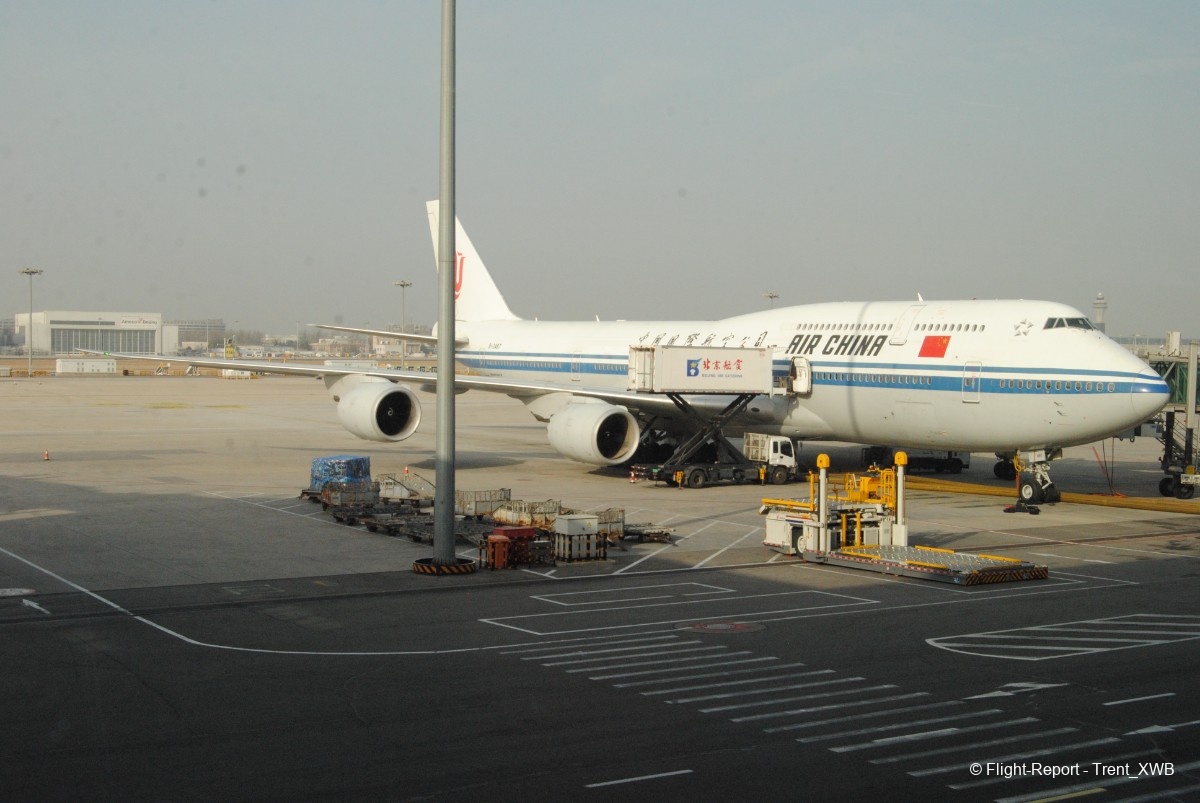
B-2487 in the morning light, being prepared to CA1315 flight to CAN (she also operated my CA1558 flight 3 days later).
The Aircraft
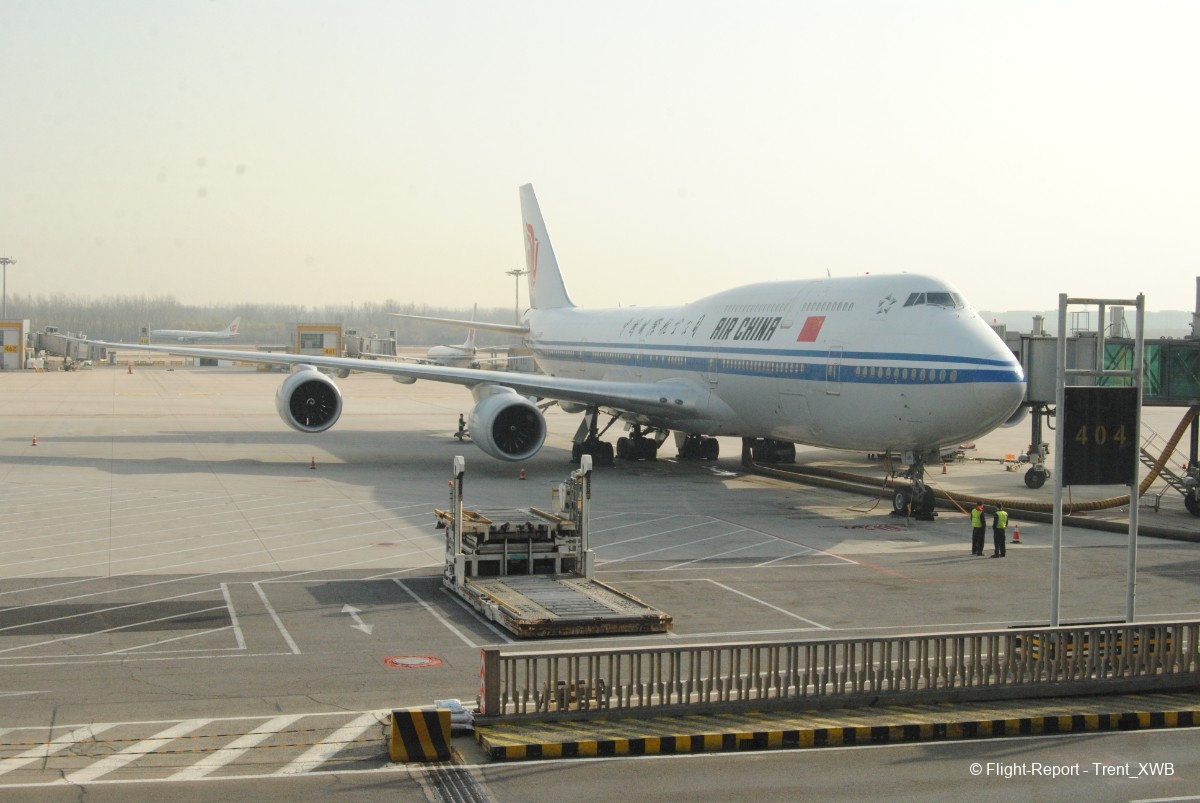
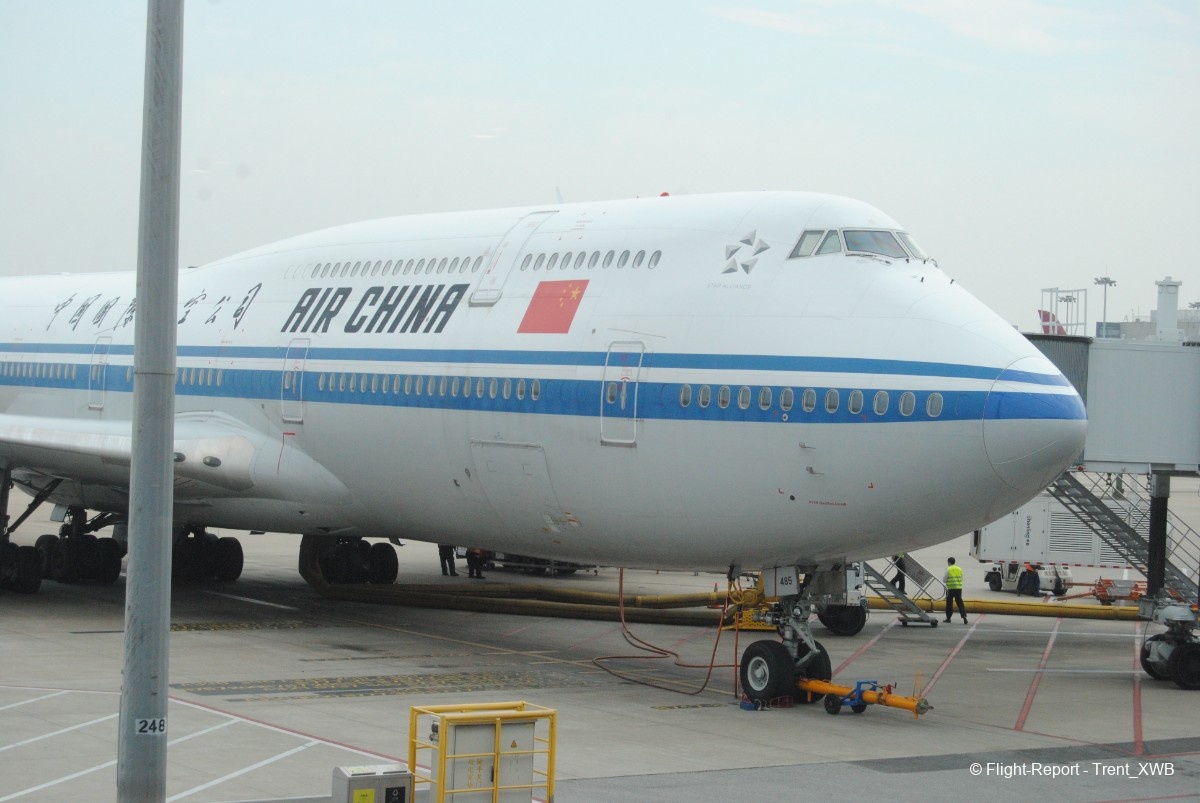
And here, near the D03 gate in the counter-light, is the aircraft of today - 2014-built B-2485, the very first B748 in CA fleet, which arrived from IAD earlier this morning.
Boarding
Boarding on CA domestic flight doesn't use groups. There are 2 boarding lines - one for first class, business class, premium economy and holders of high tiers of Phoenix Miles loyalty program (boarding via 1L door), and one for economy (boarding via 2L door).
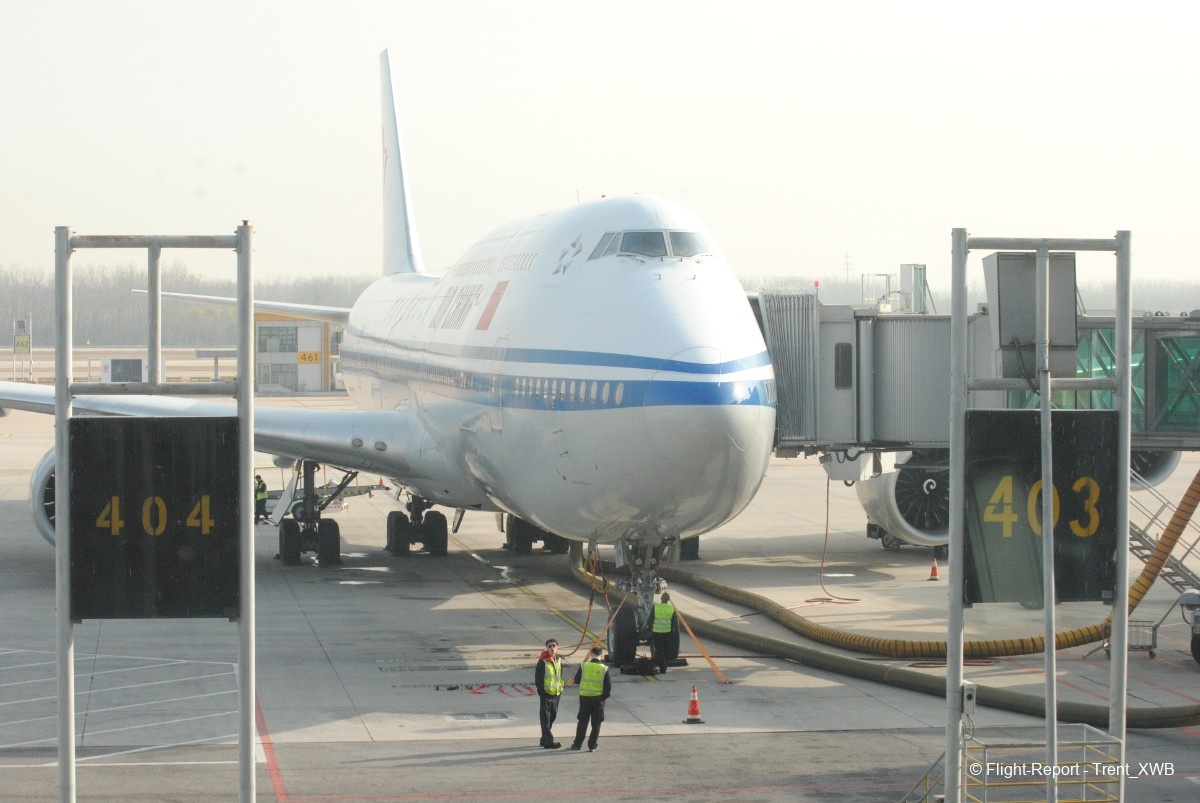
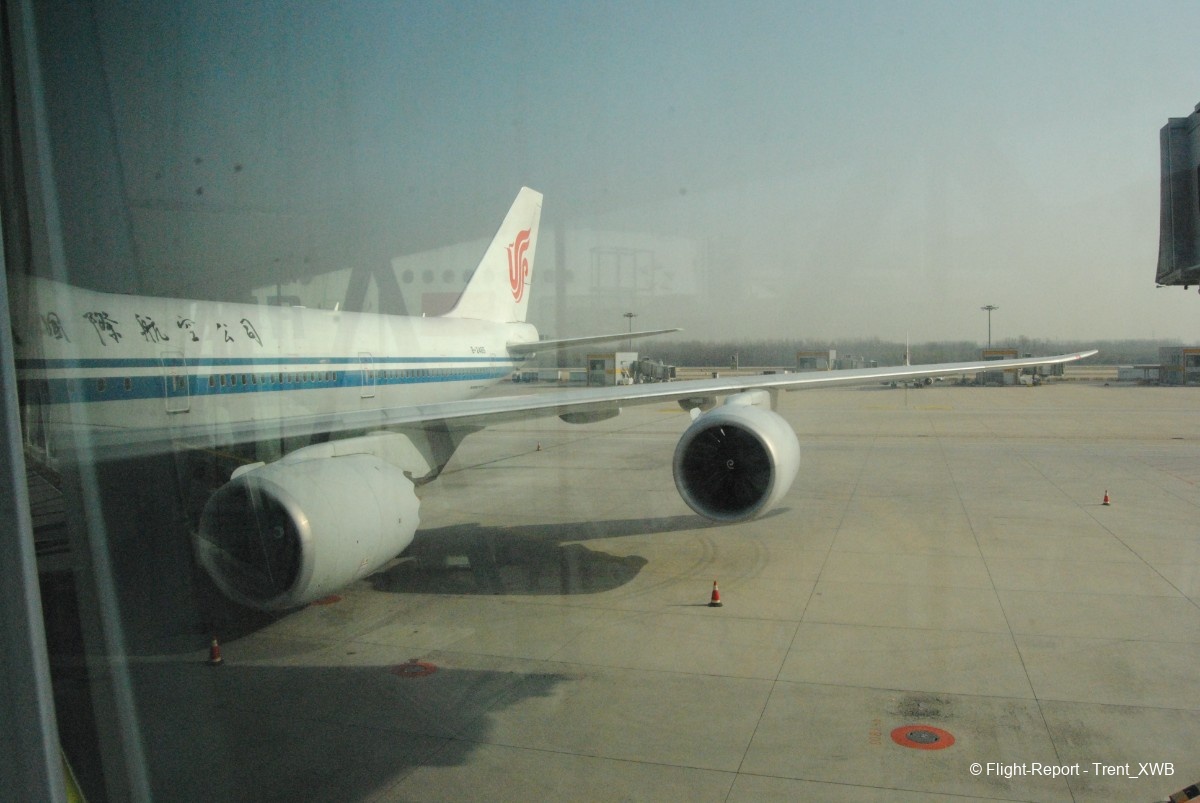
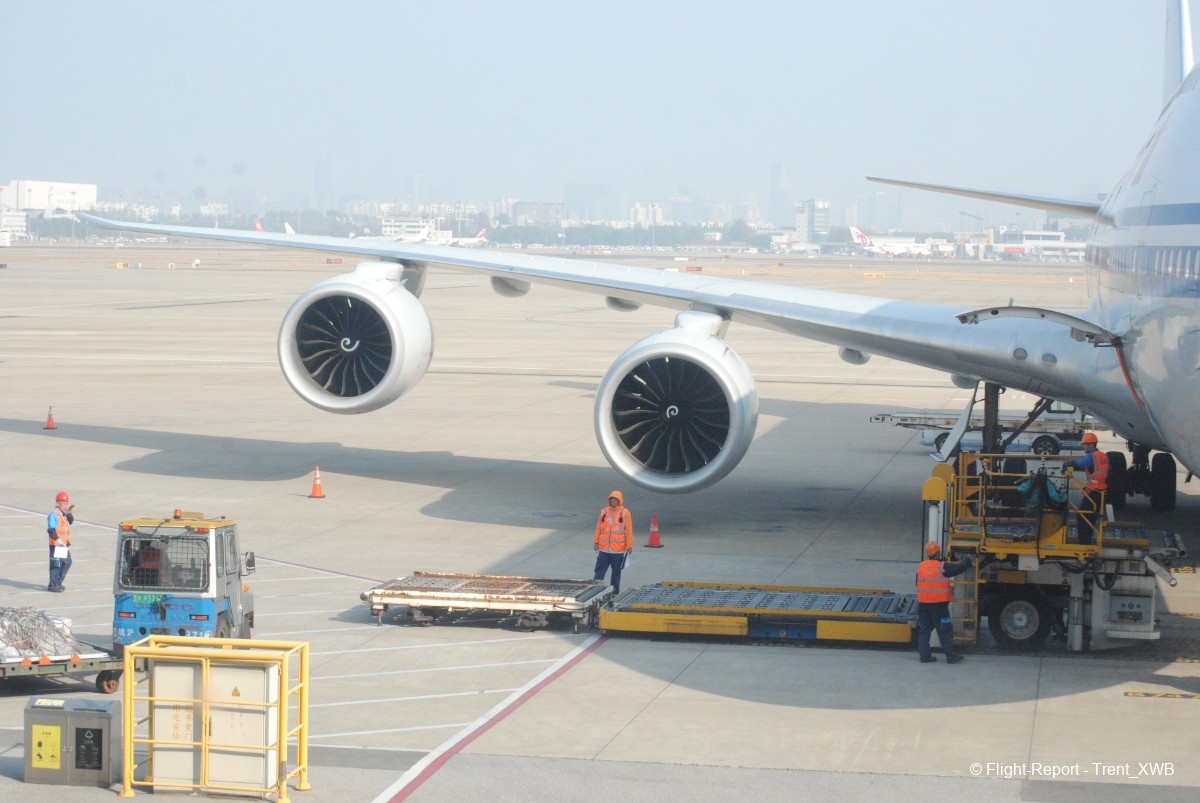
A view of our Jumbo from the gate and the views of the wing and the portside GEnX engines on the way to 2L door.
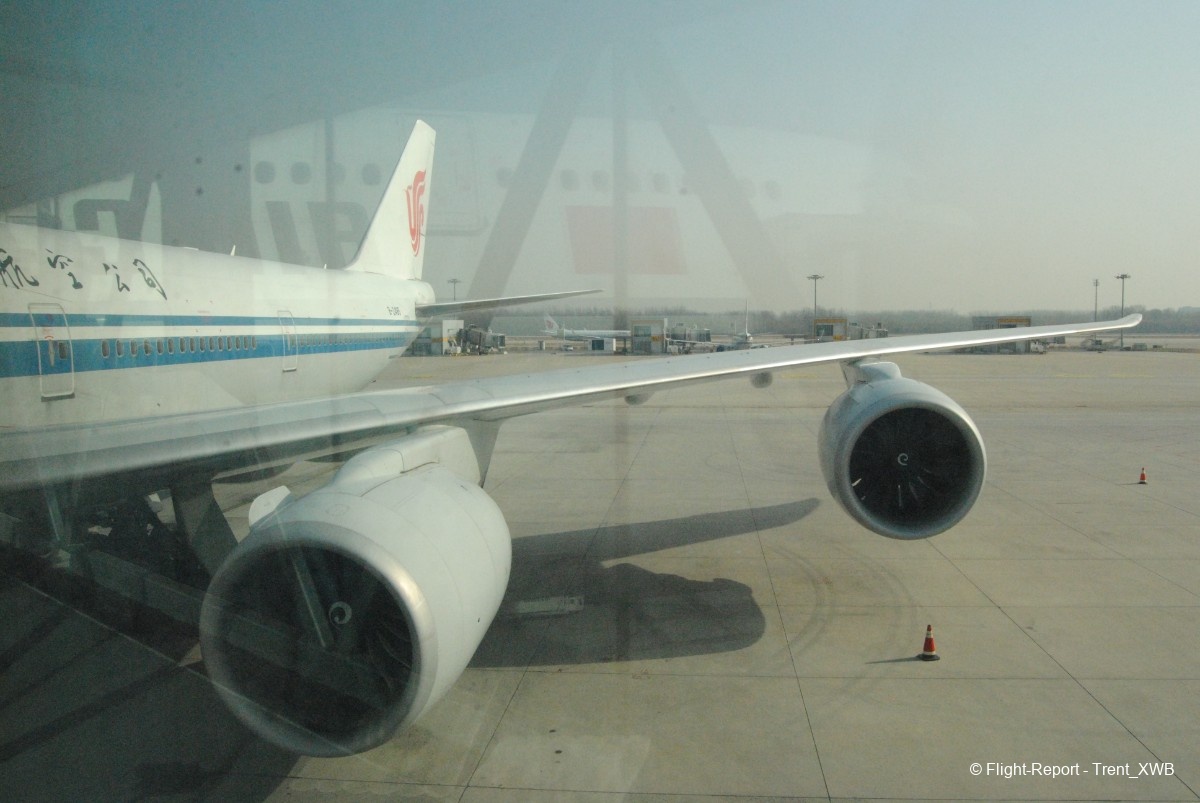
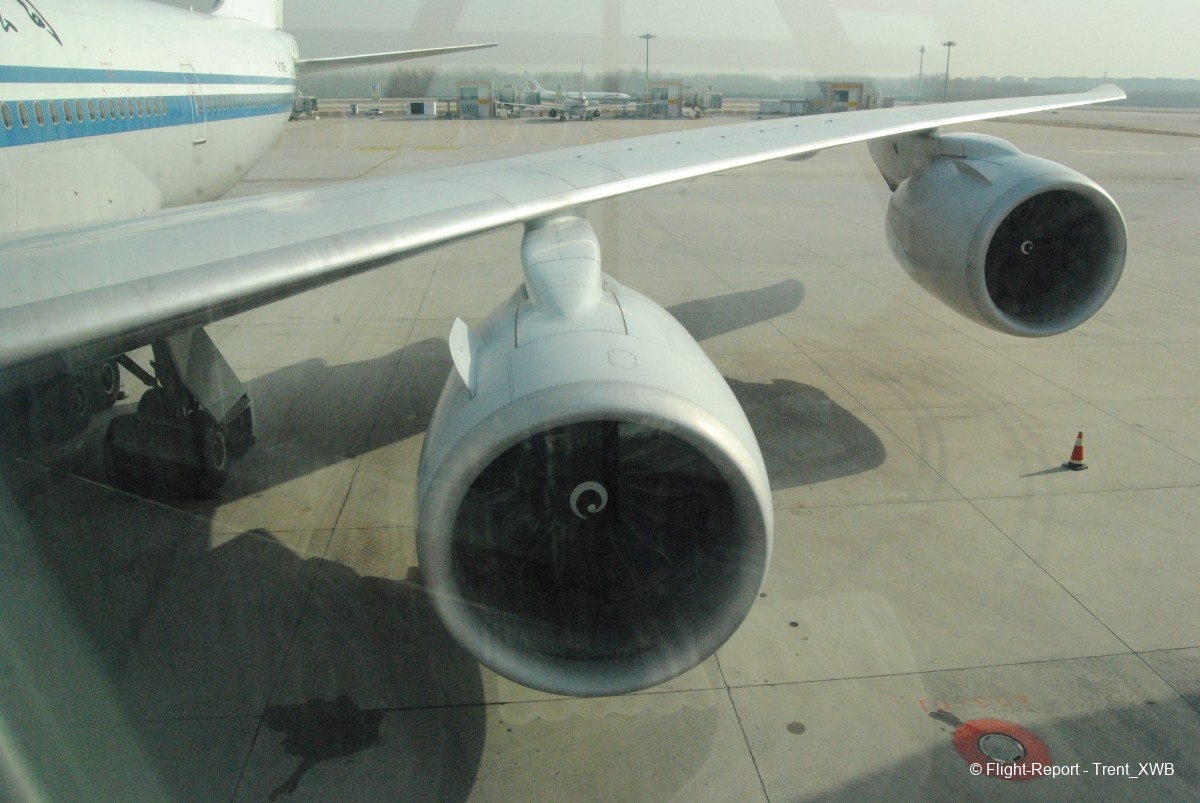
The 2L door.
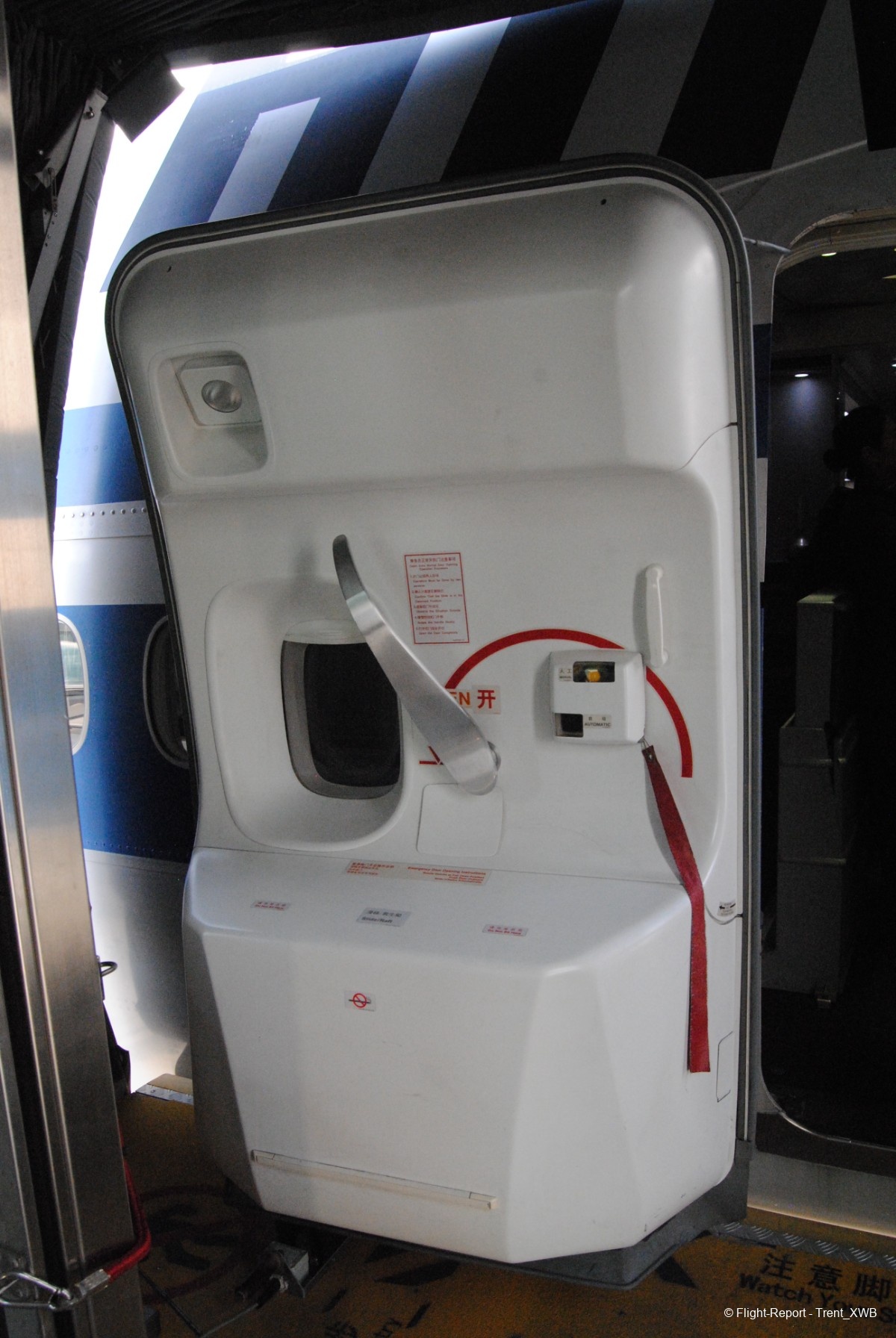
Instead of turning right, I turned left and spent some time exploring premium cabins in the front part of the aircraft.
The First Class Cabin
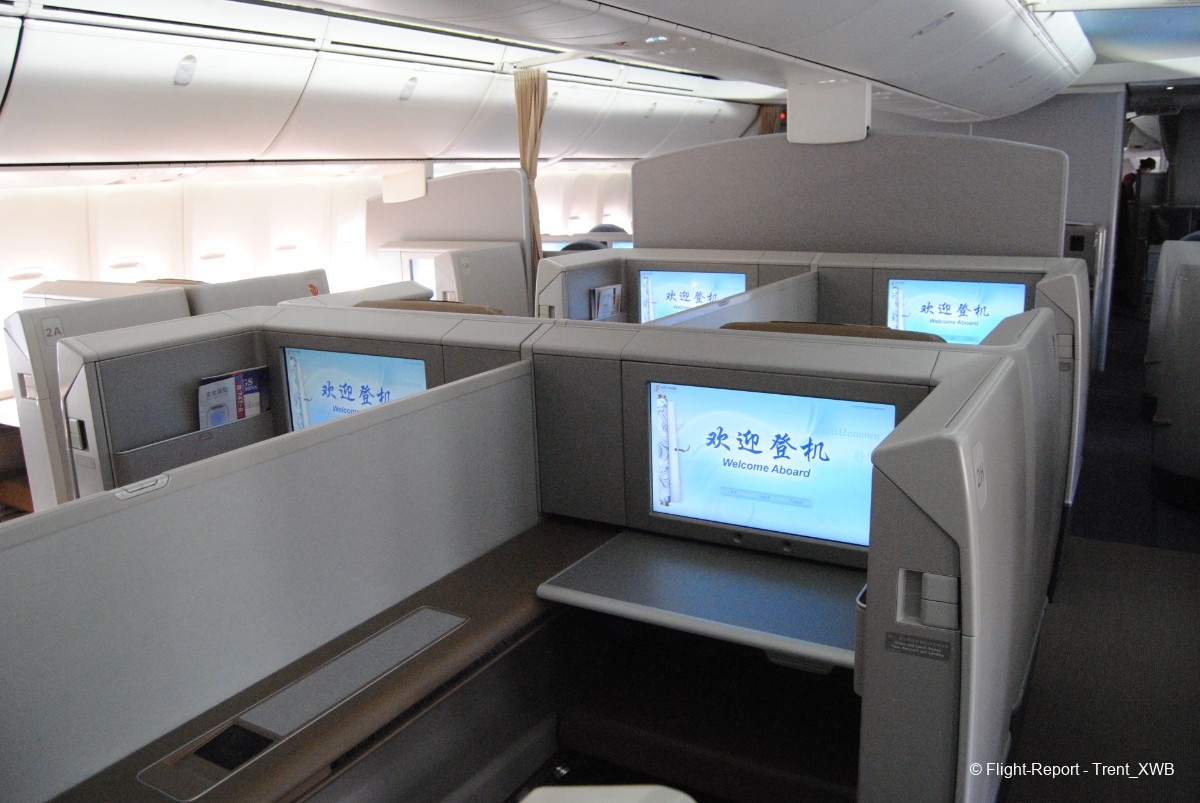
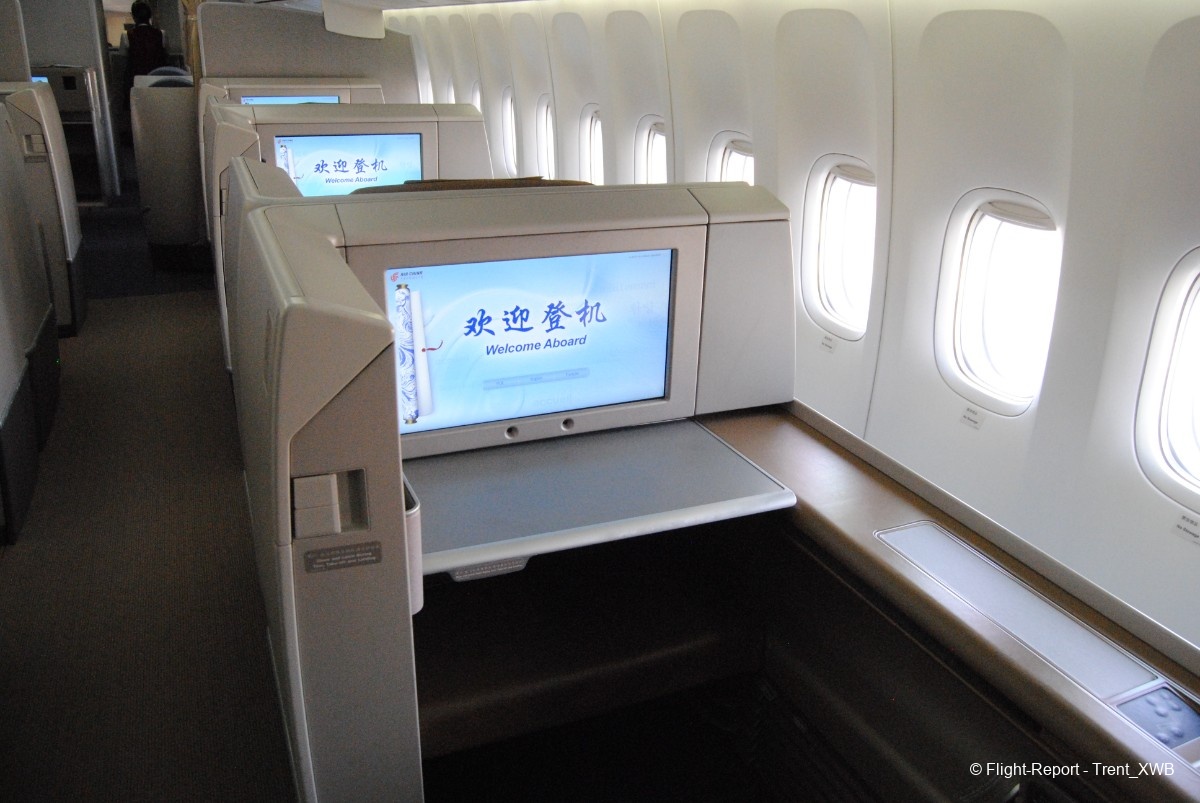
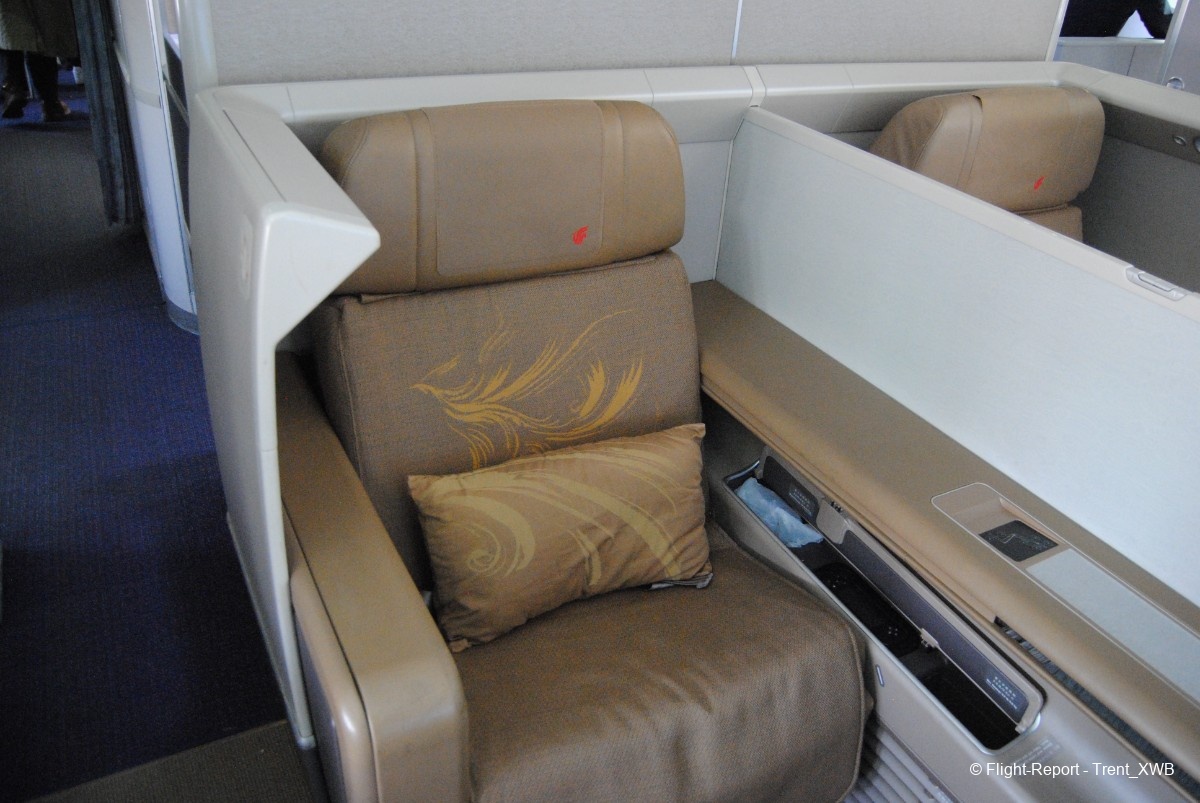
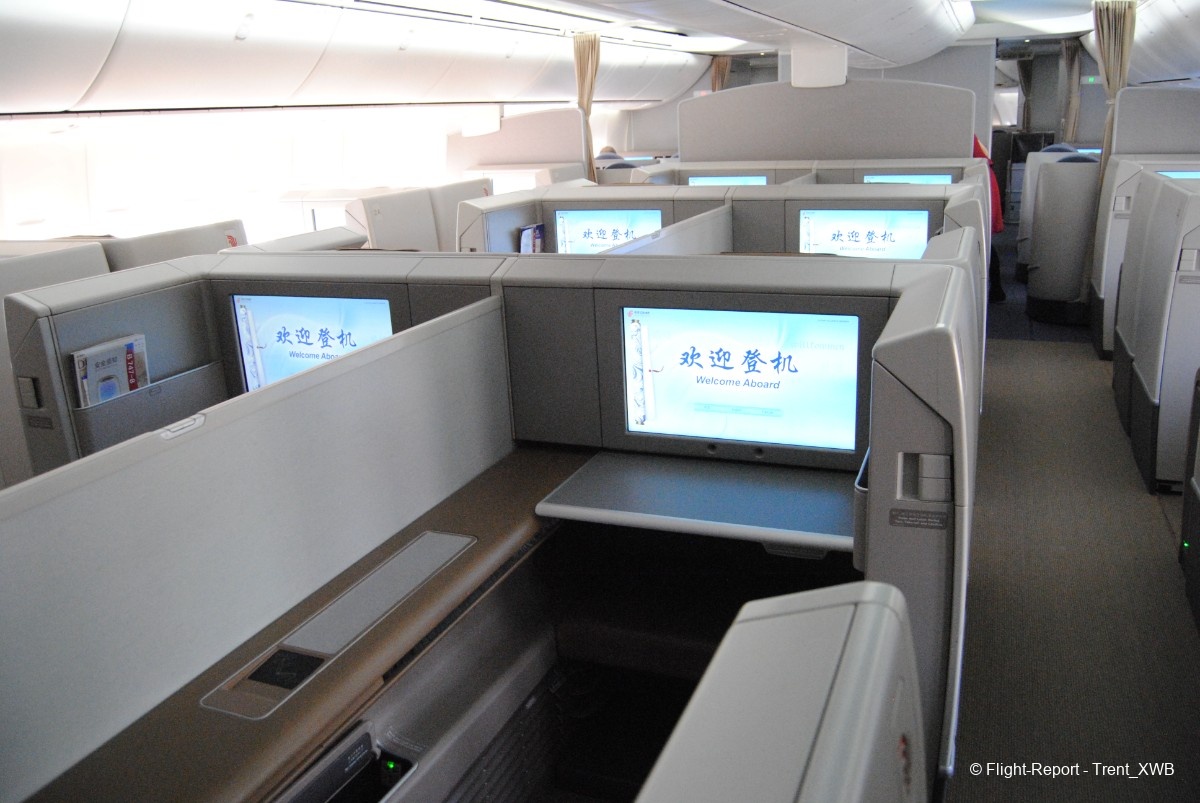
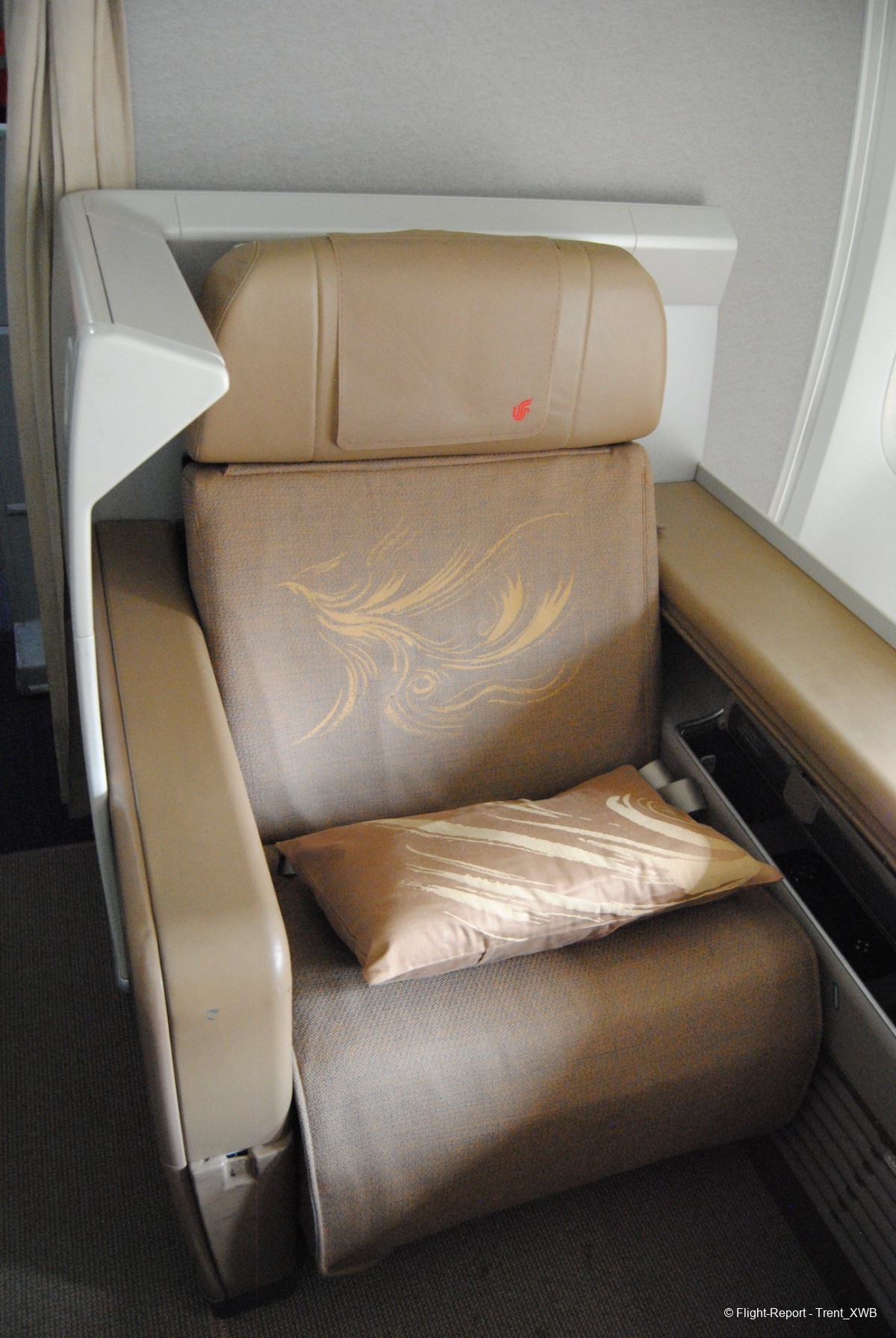
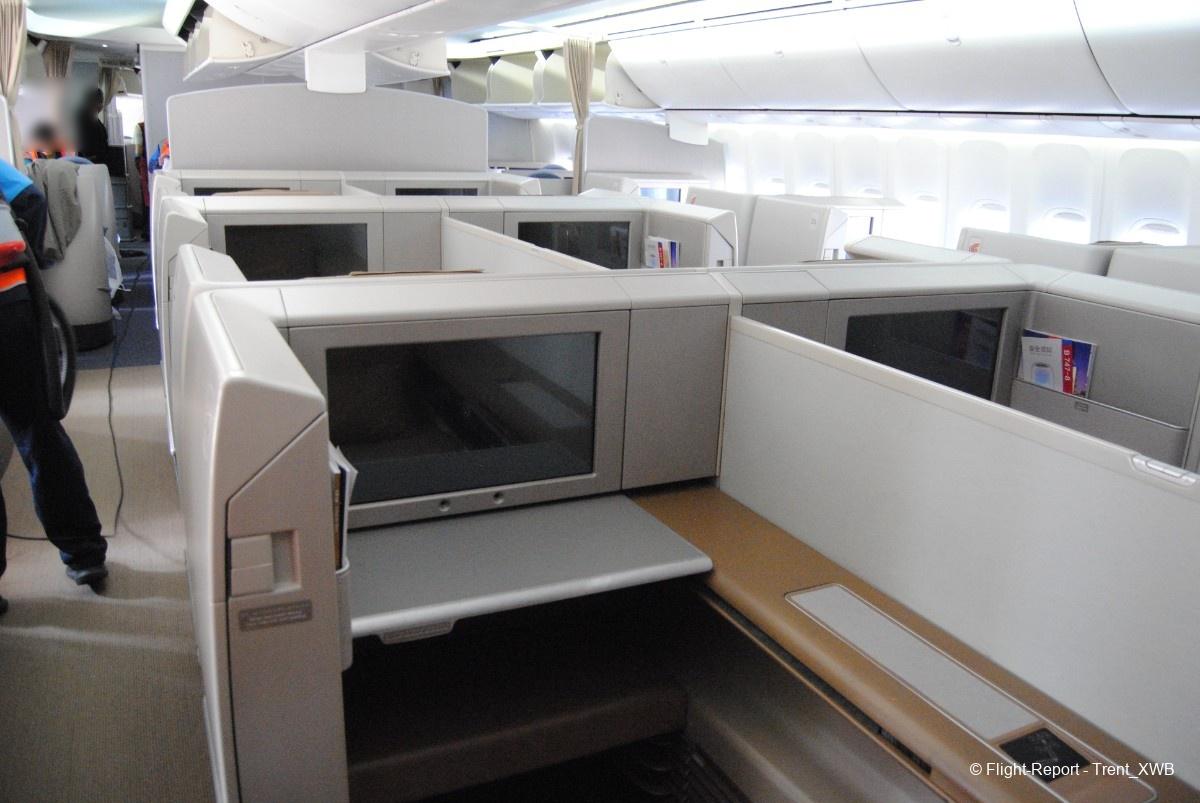
The large first class cabin, consisting of 12 Zodiac Aerospace Venus suites, arranged in 1-2-1 layout in 3 rows (rows 1 to 3), is located in front of 2L/R doors. As was said before, these suites are designed for installing into the widest part of B747 or B777 fuselages and thus don't fit into the tapered nose of B747. Comparing to China Eastern B77W first class suites, I'd say that MU's product is definitely superior, but CA's product also looks very solid. BTW, this short FR of CA first class in B77W (with the similar suites) by Sewey135 sheds the light on how CA first class service on domestic flights looks like.
Overhead bins were closed, making a "like inflight" vibe in the cabin.
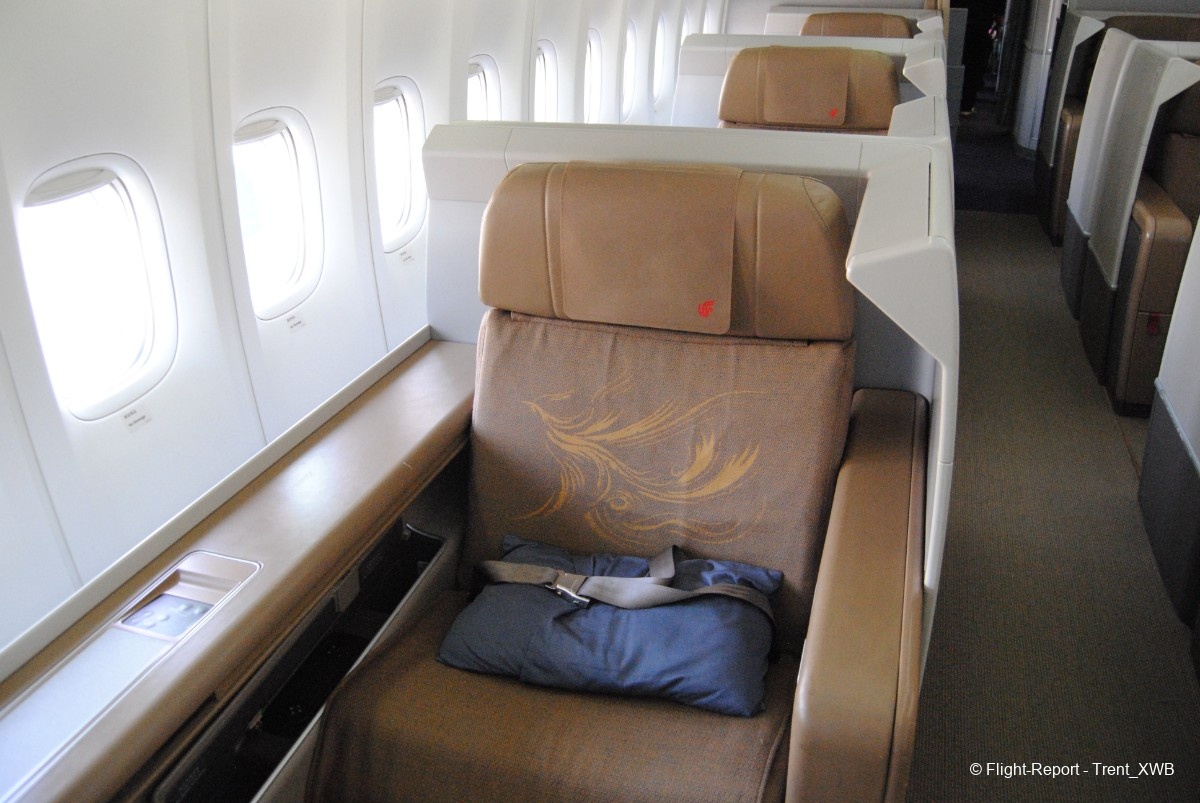
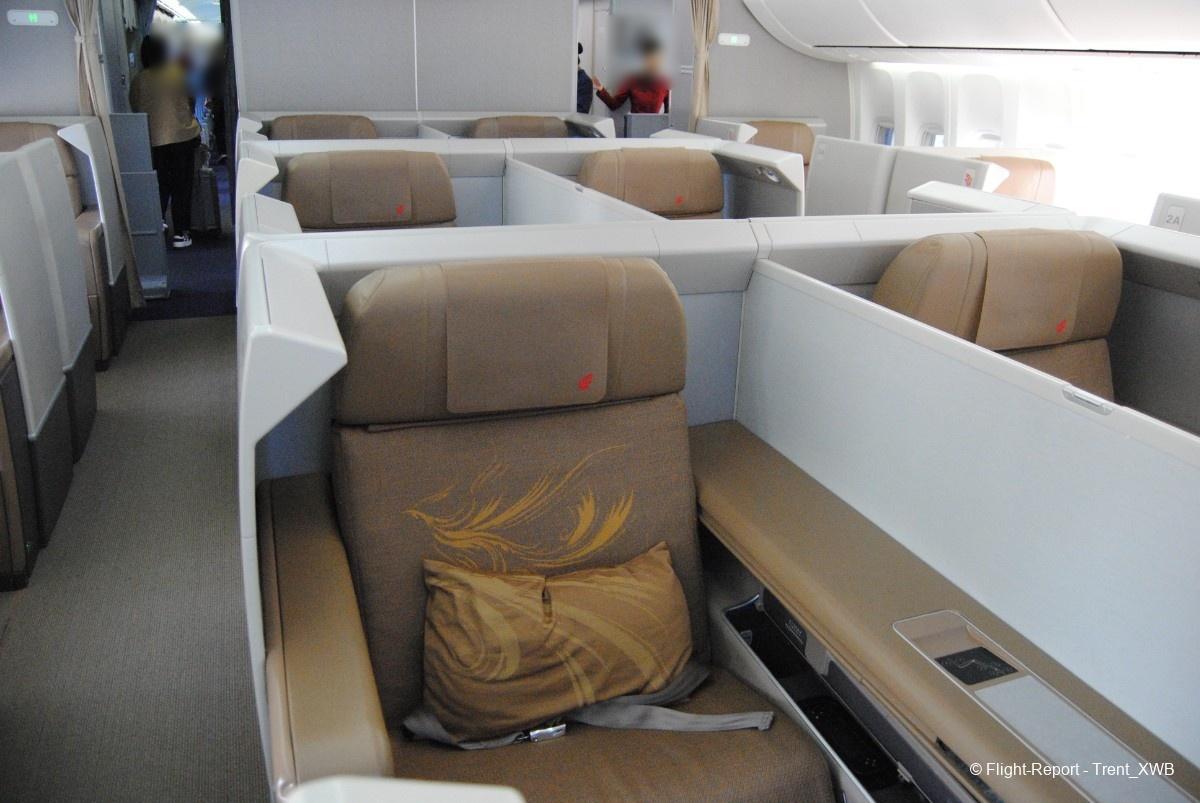
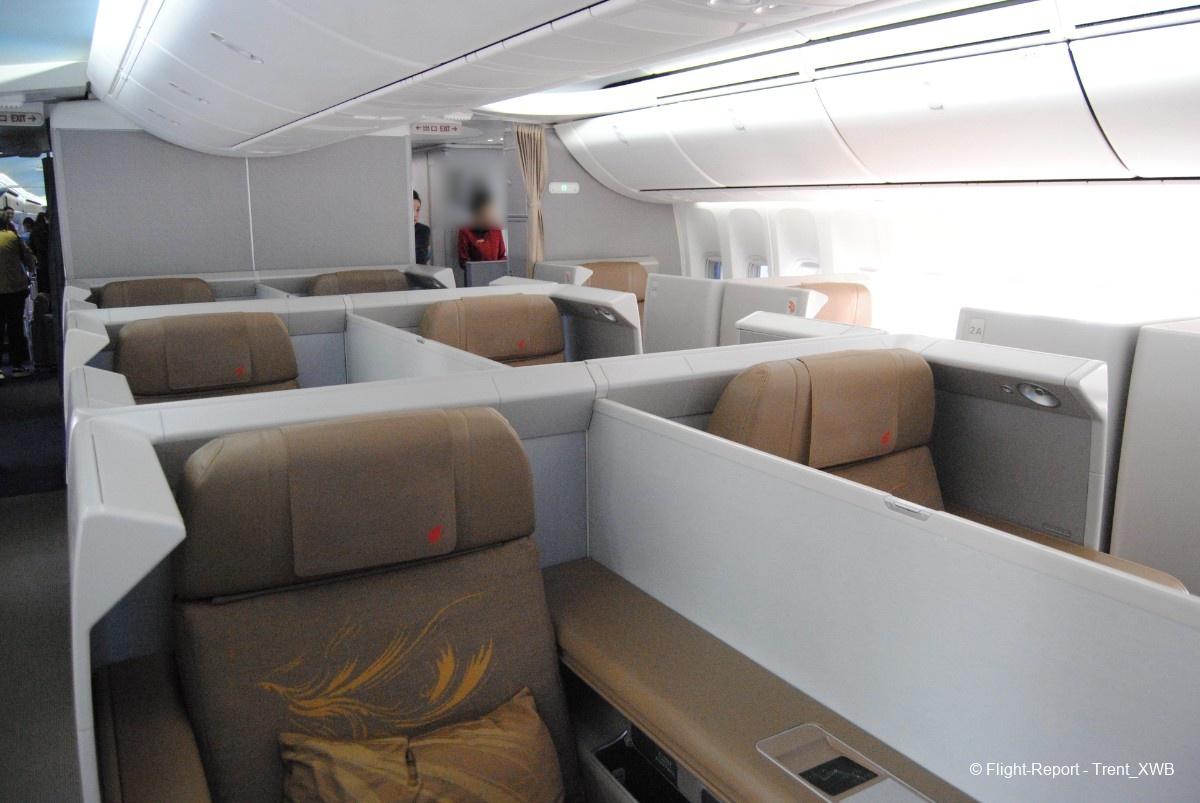
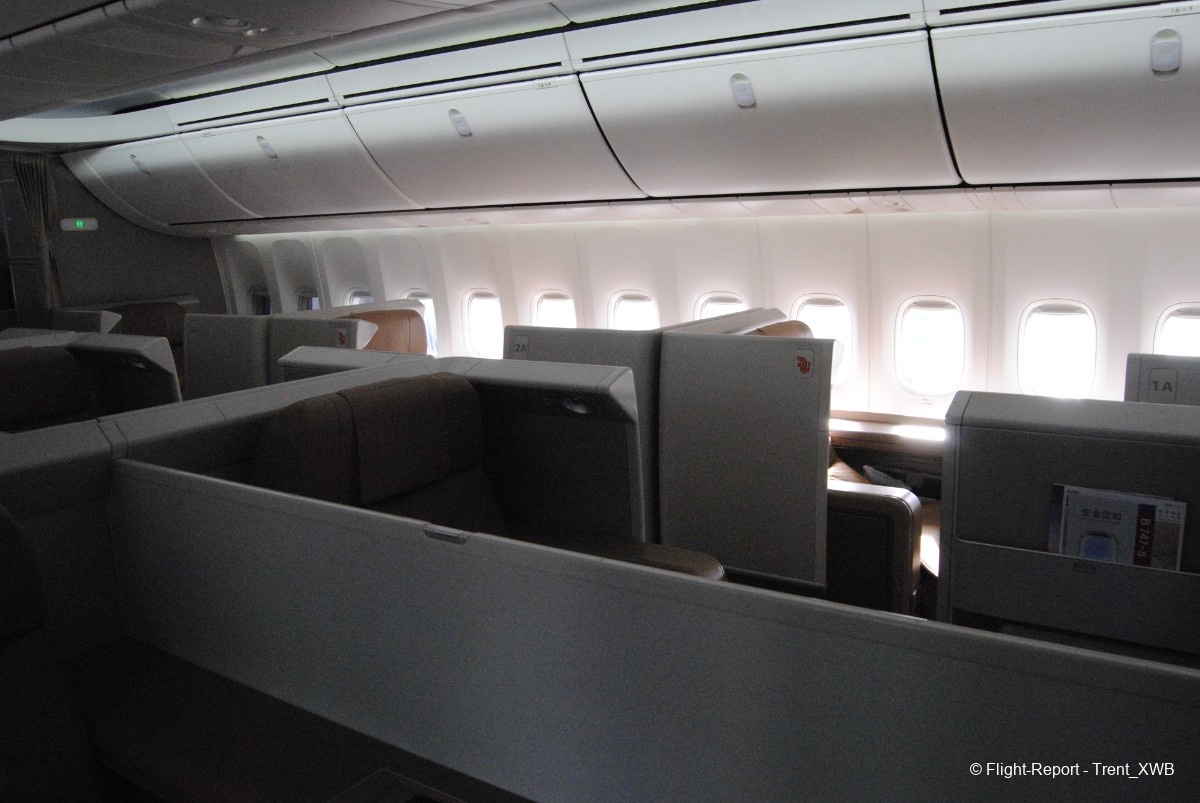
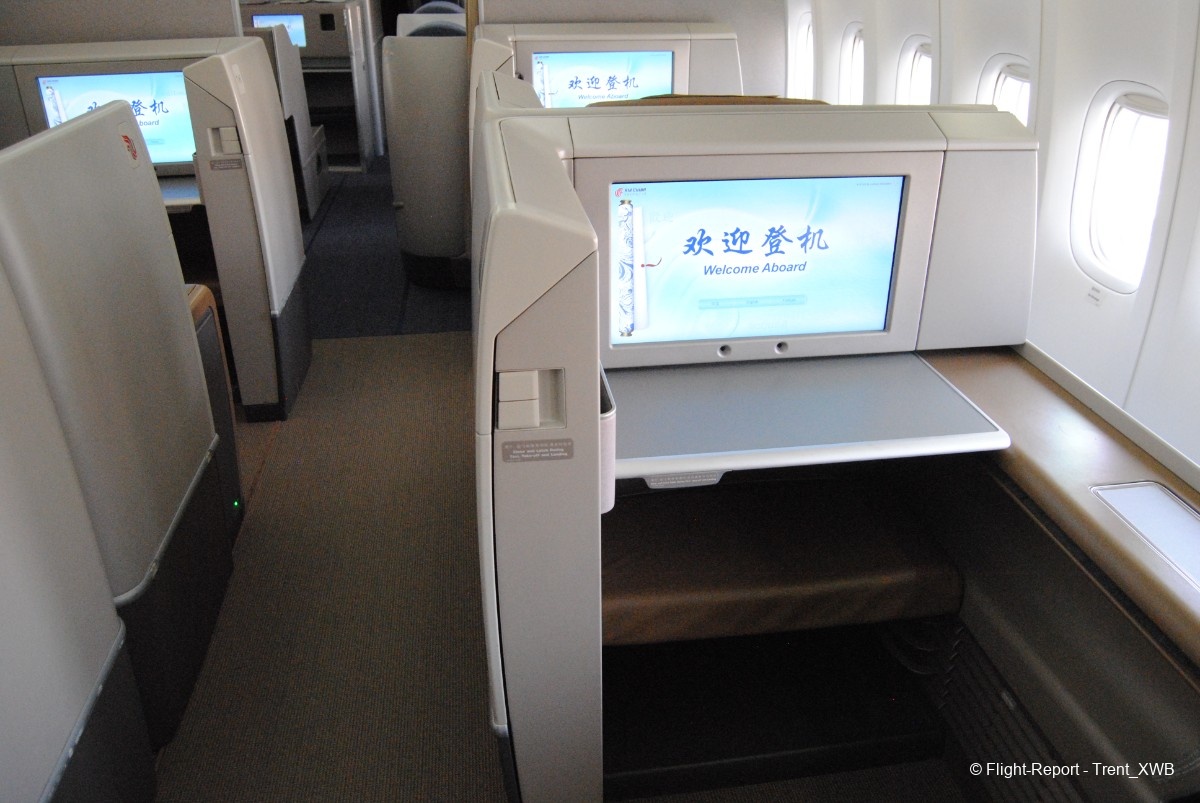
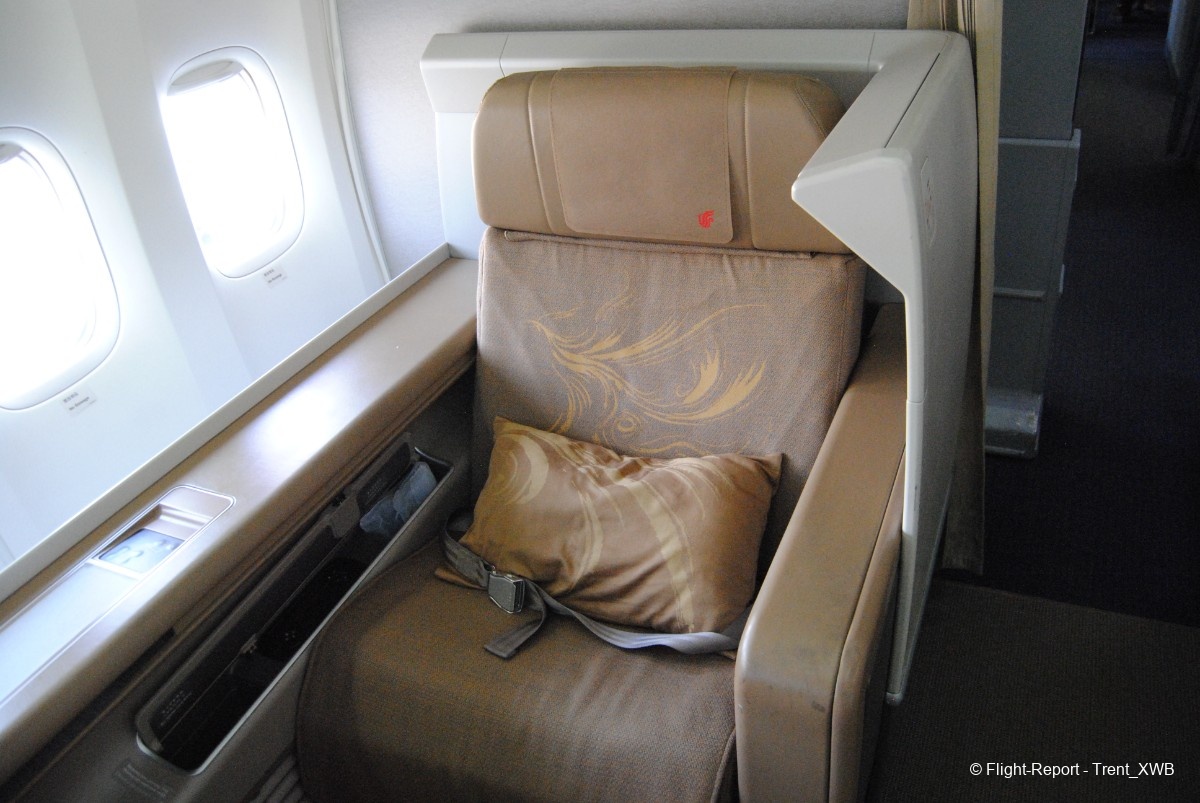
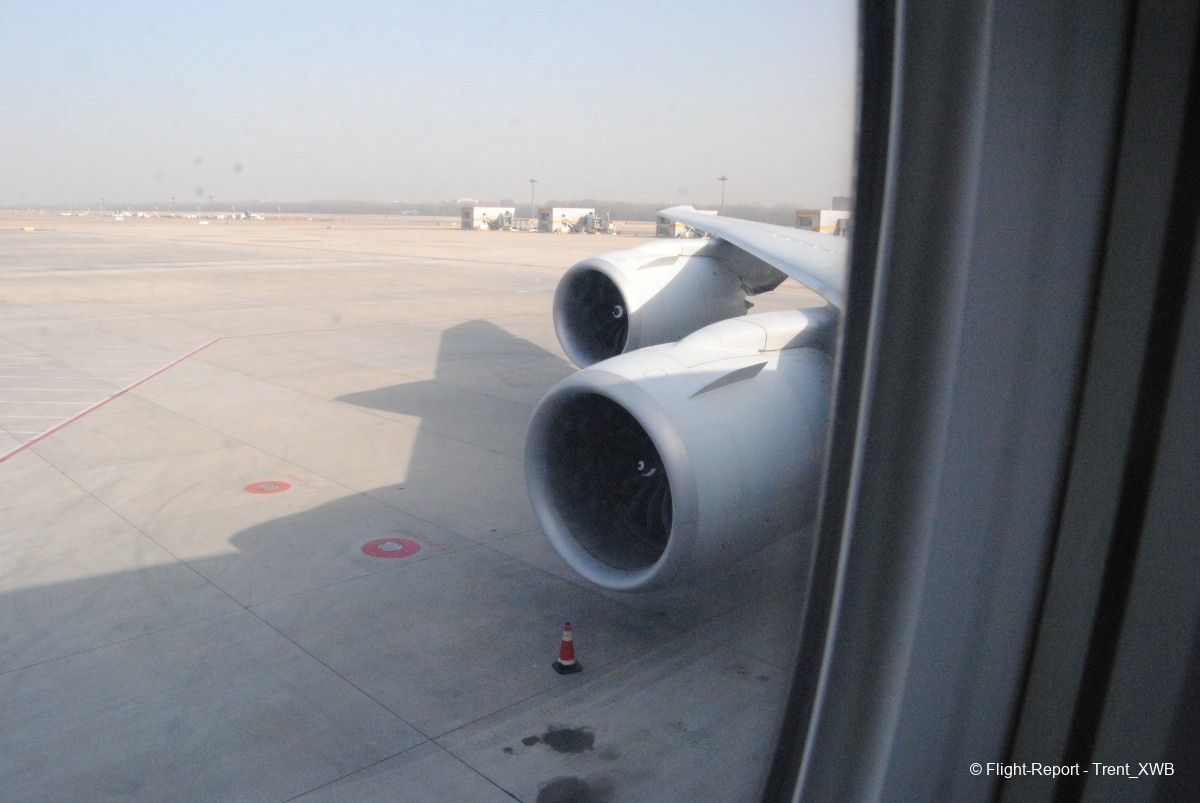
A magnificent view of the starboard GEnX engines from 3L first class suite.
The Nose Business Class Cabin
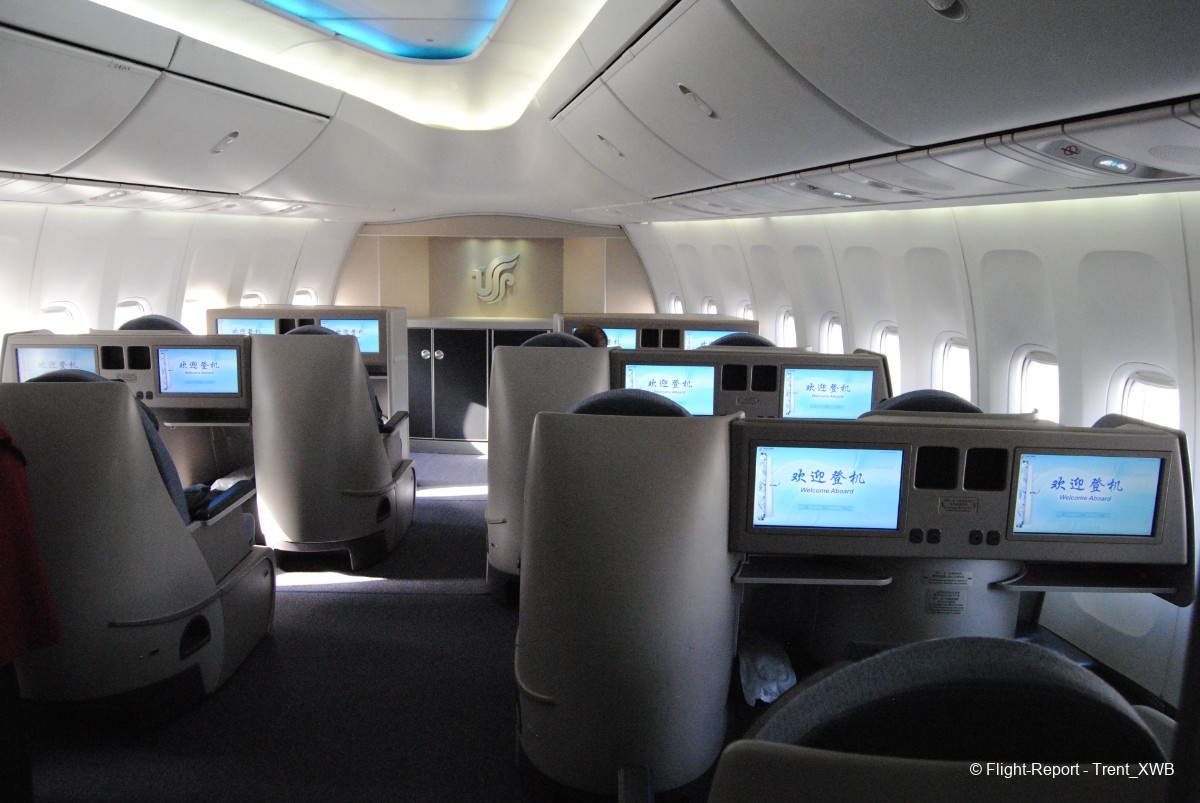
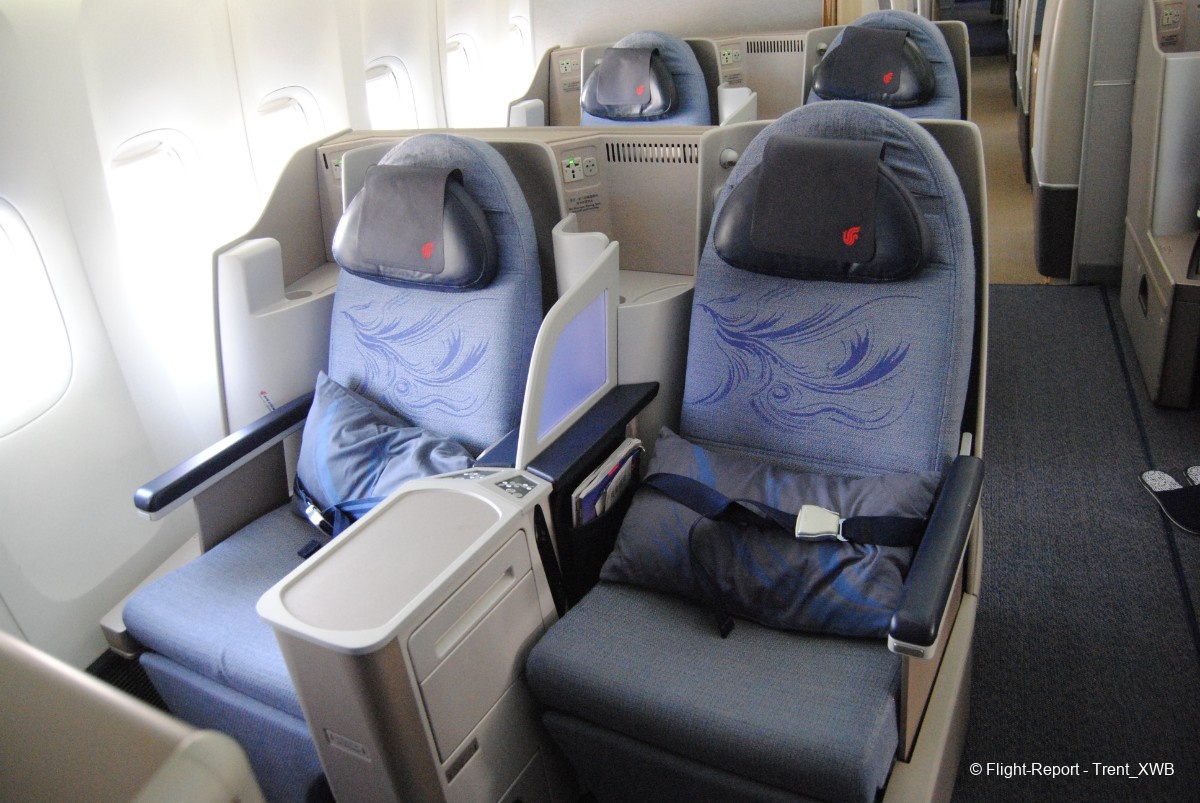
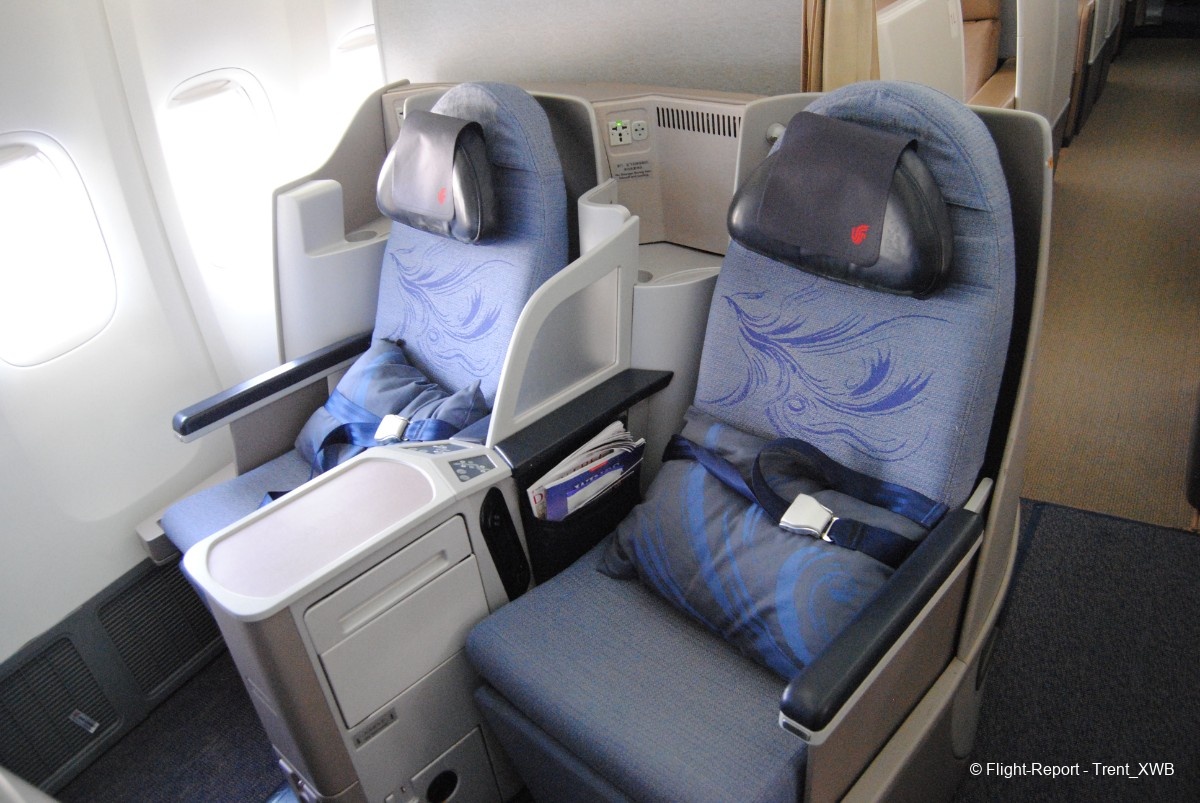
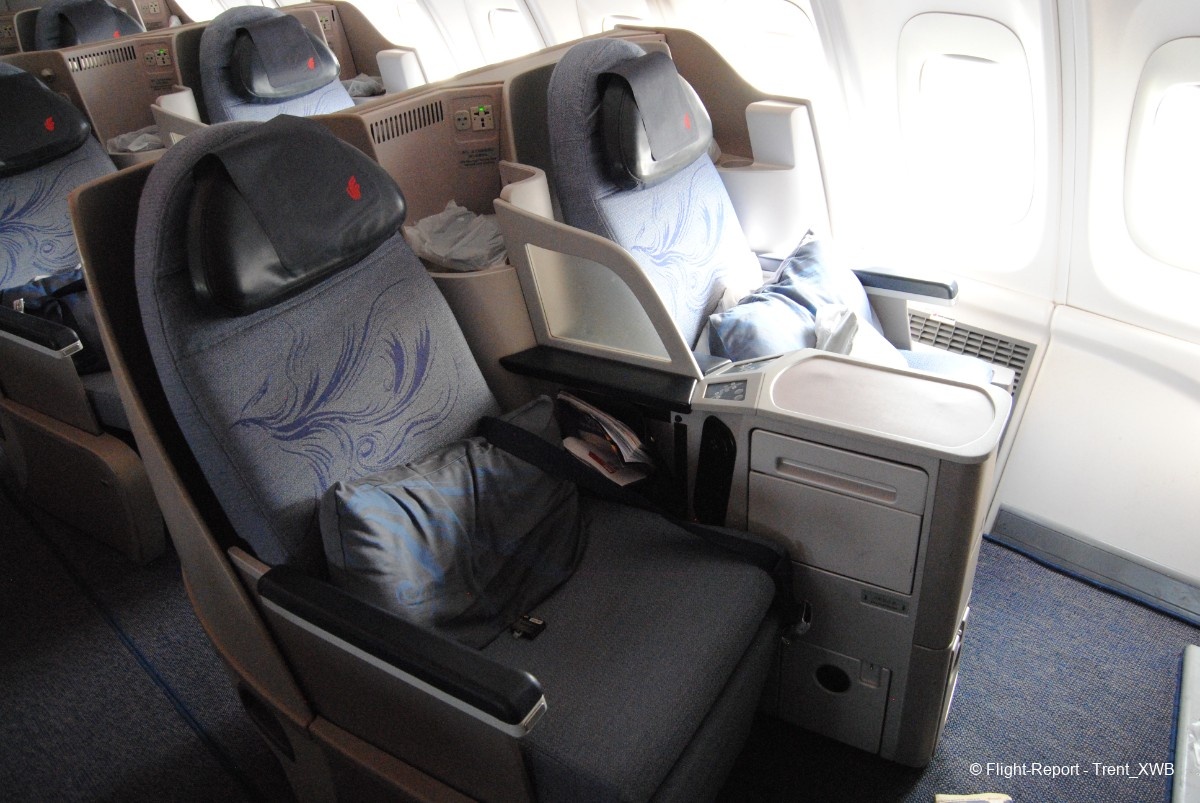
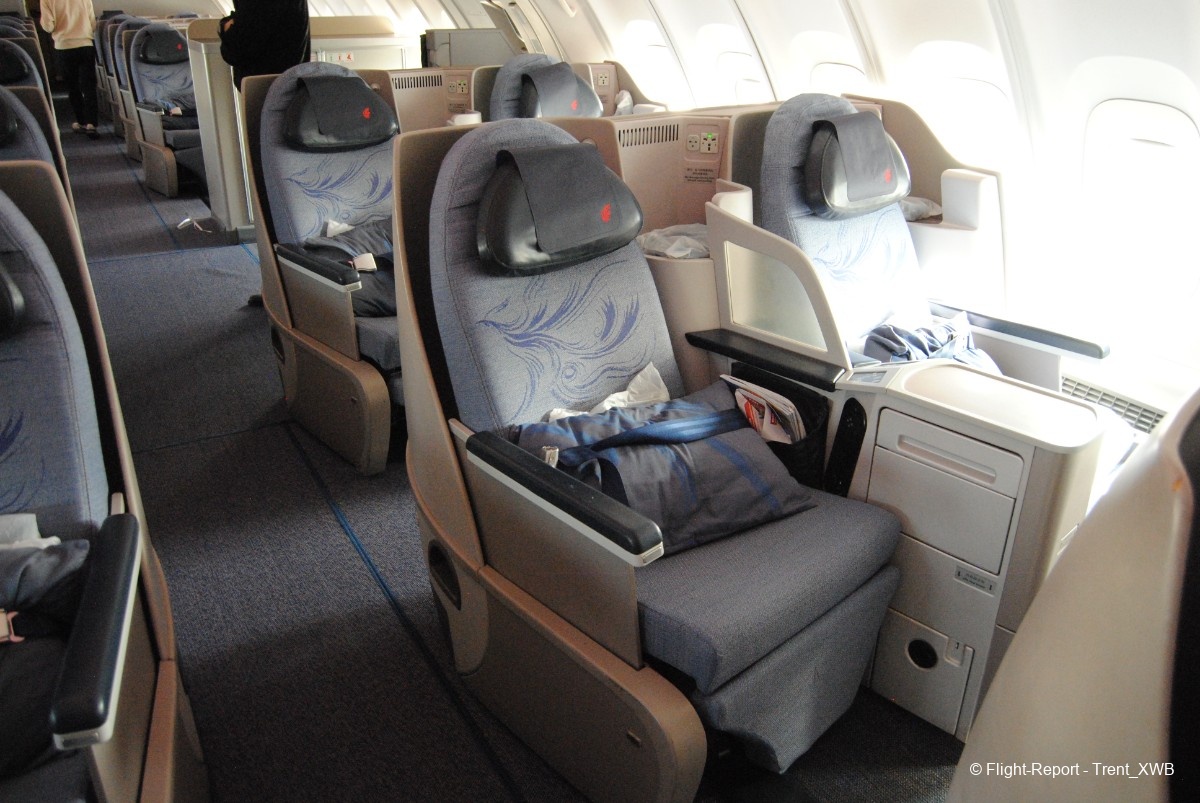
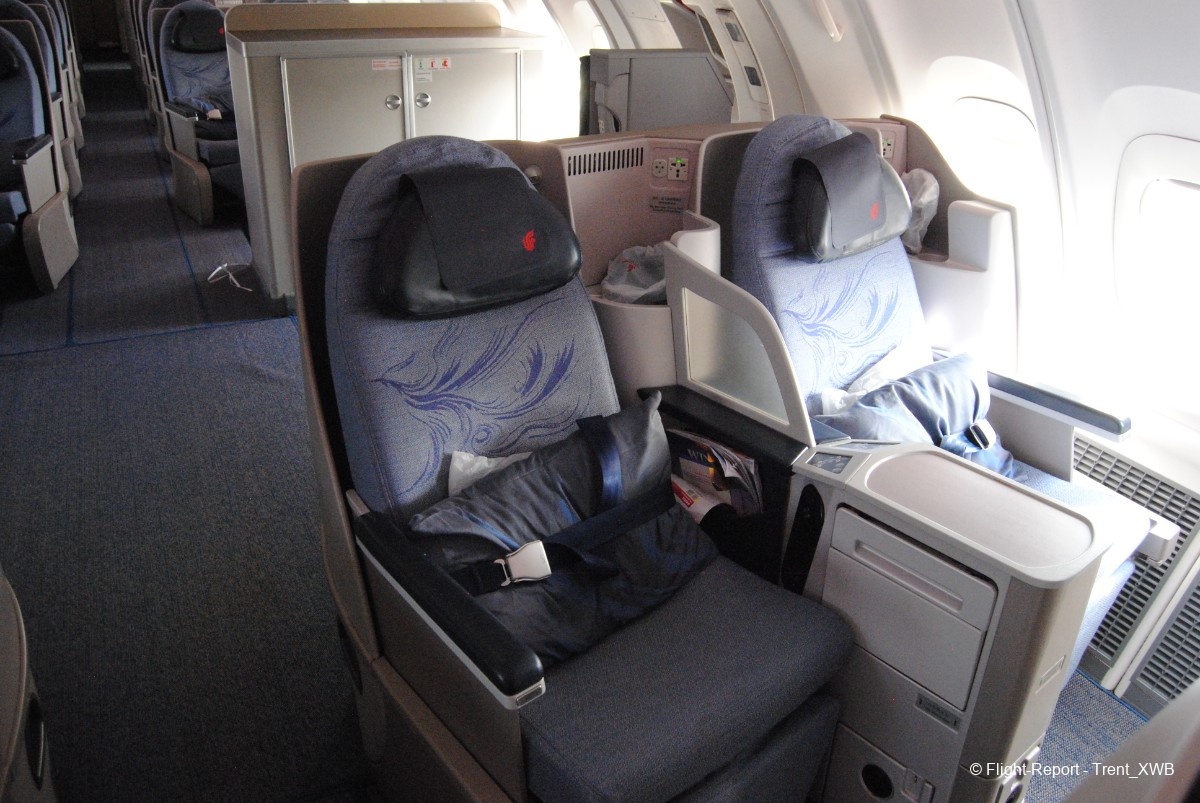
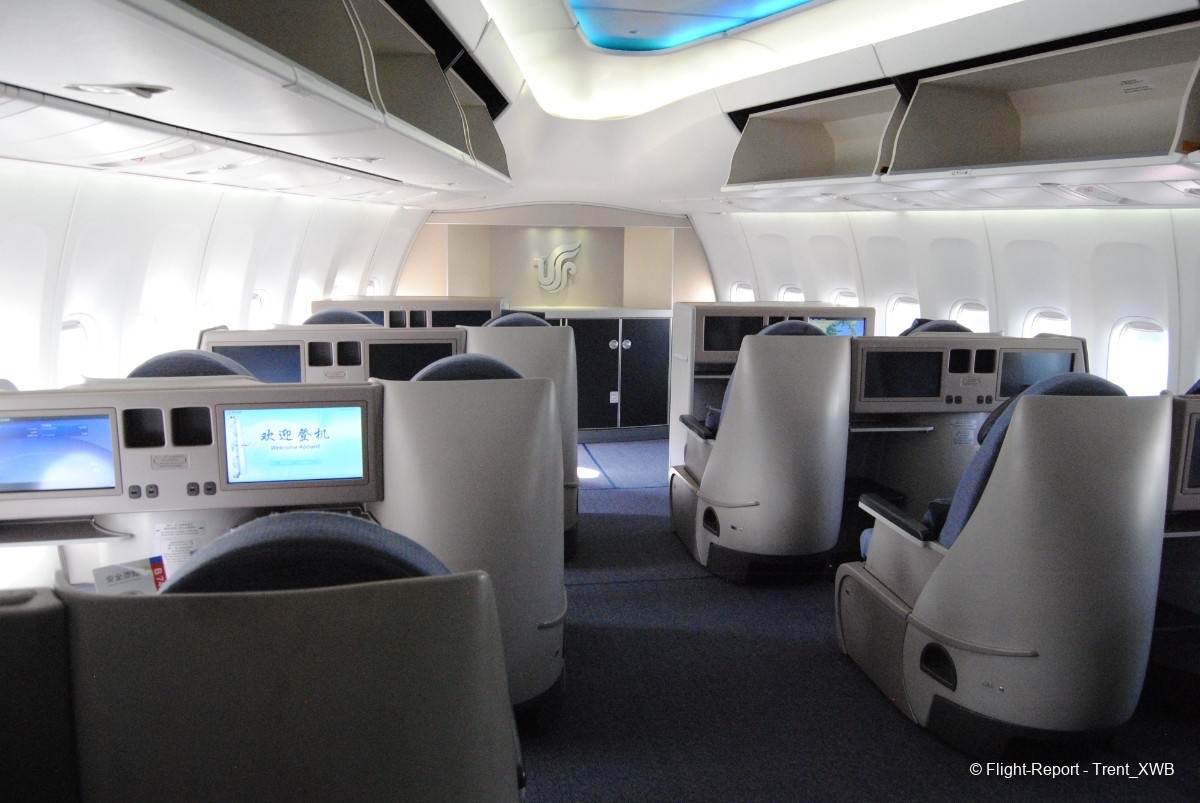
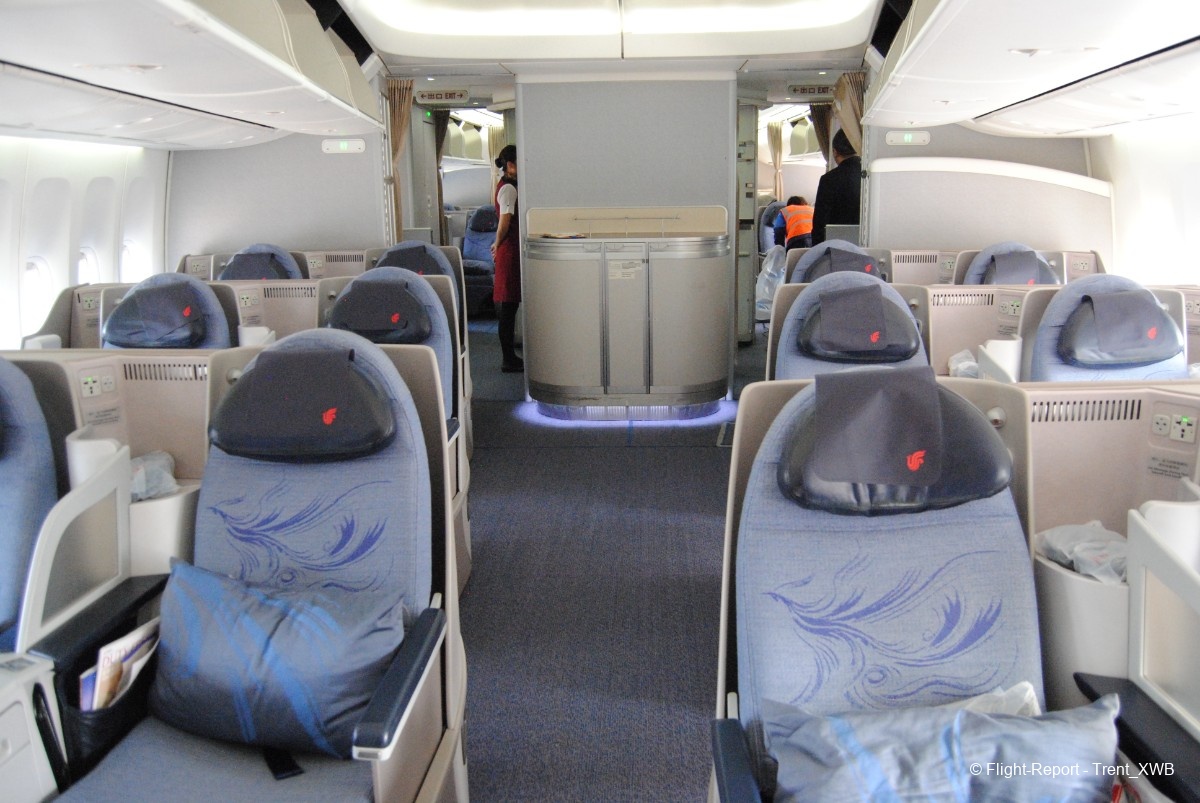
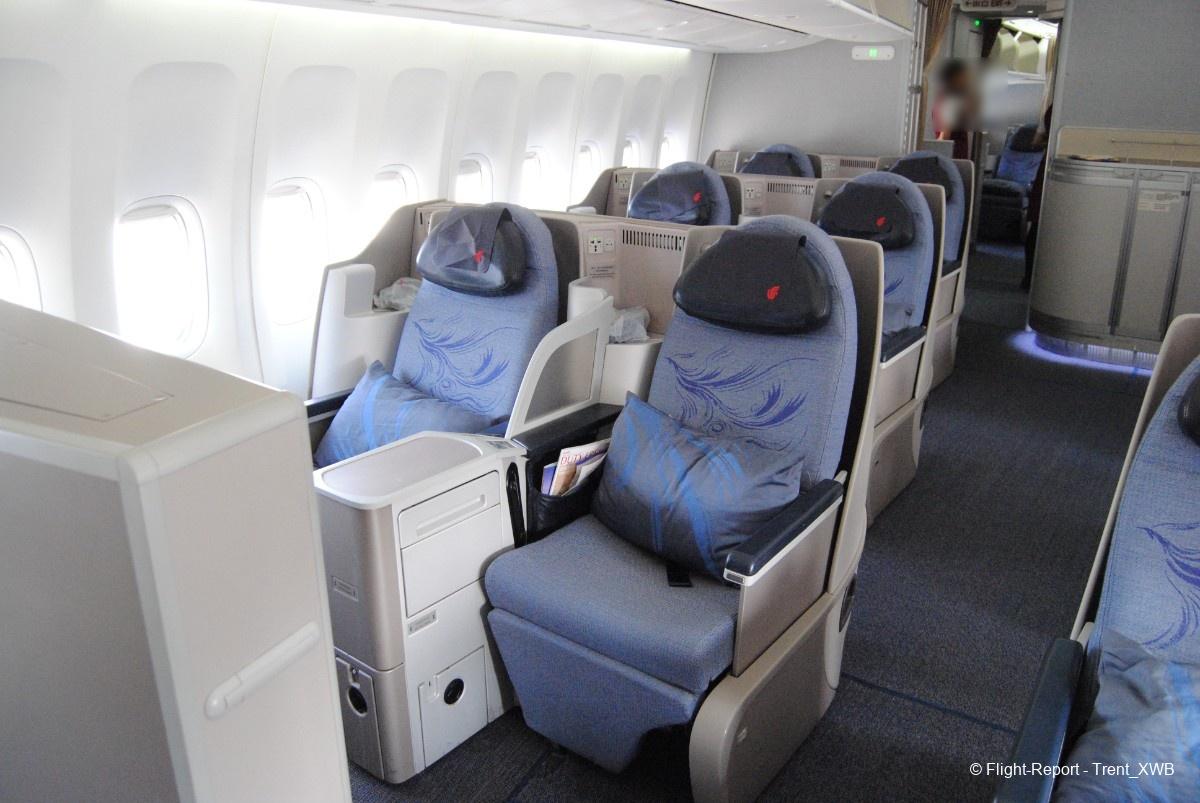
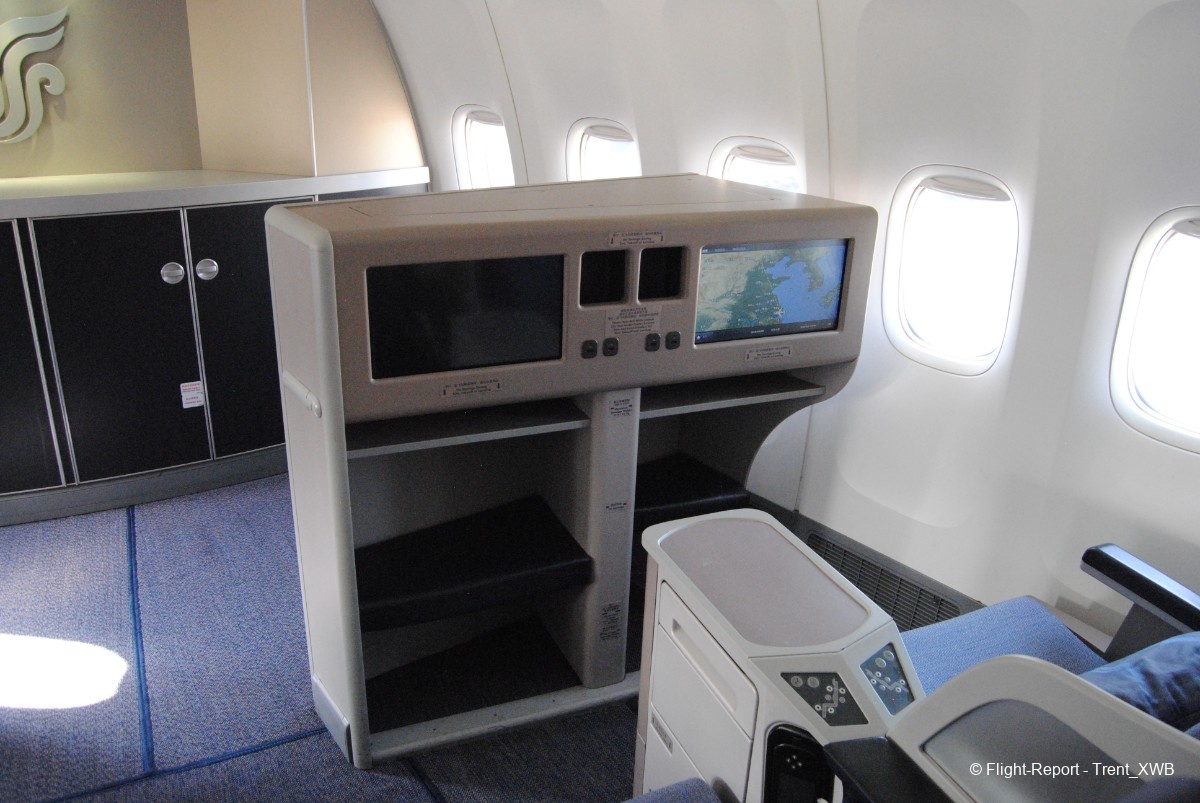
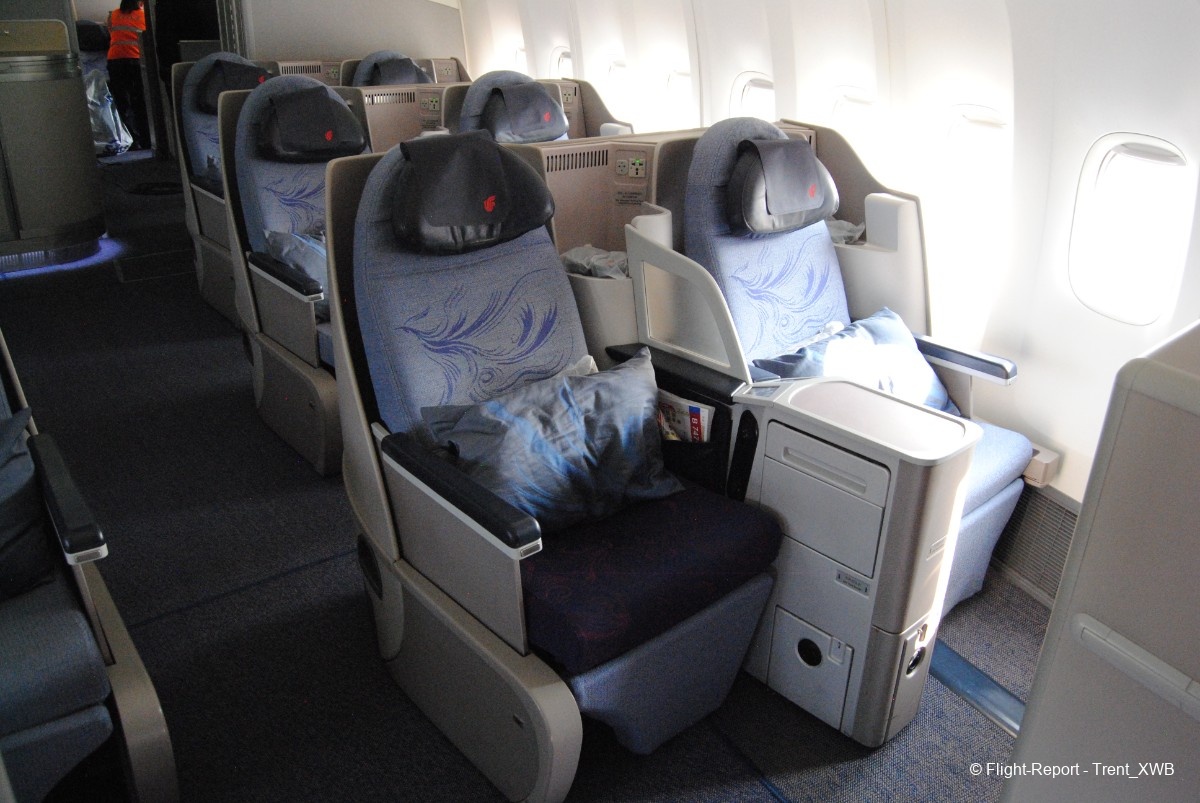
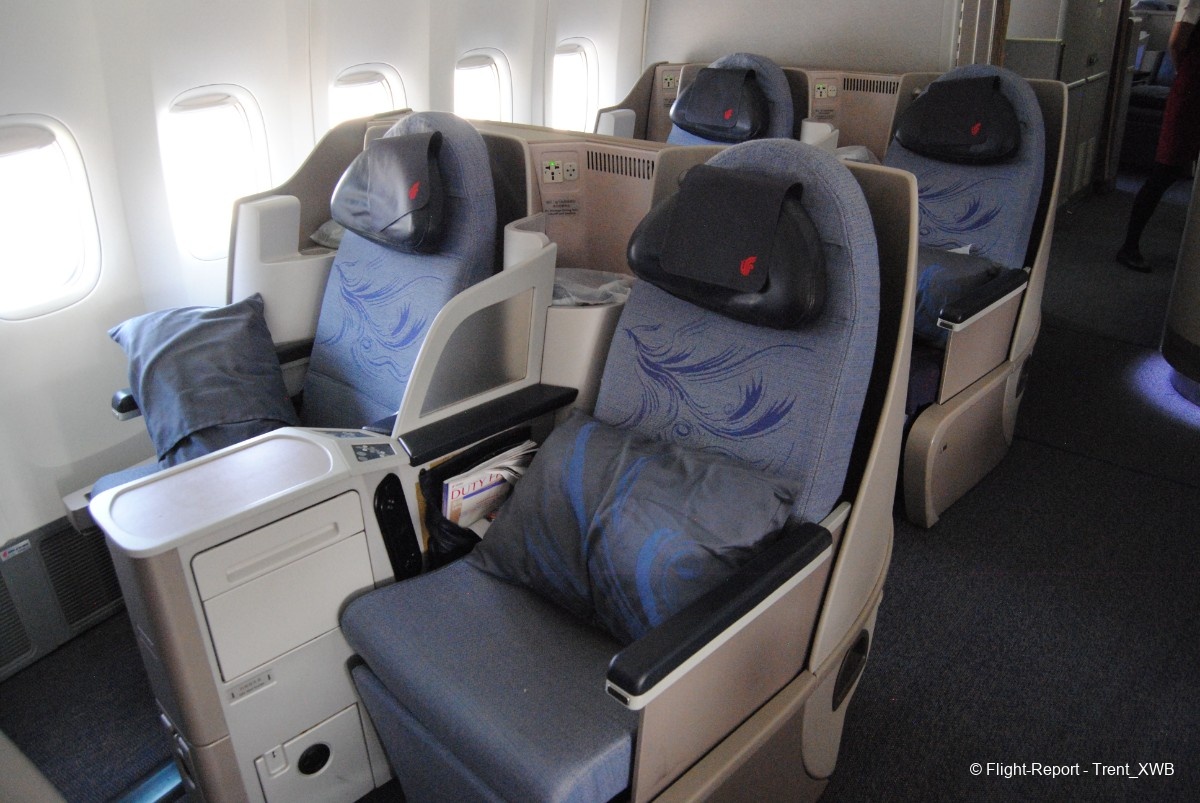
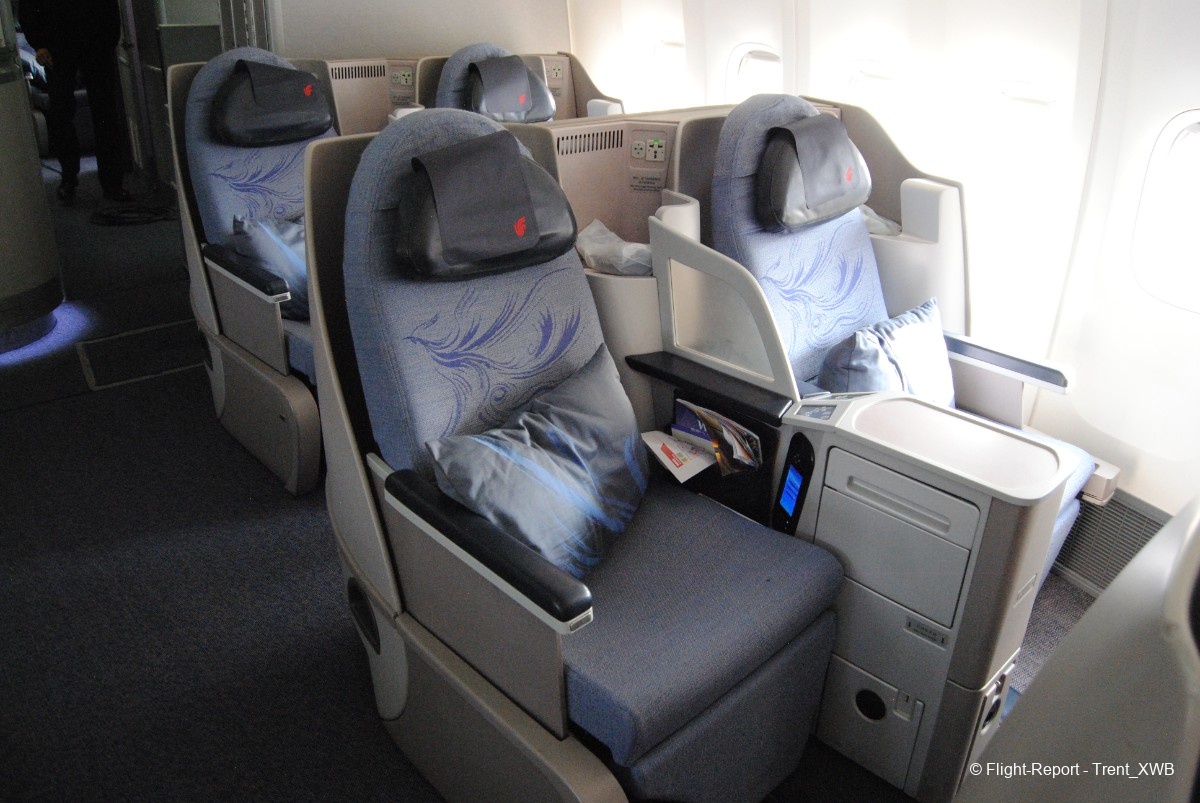
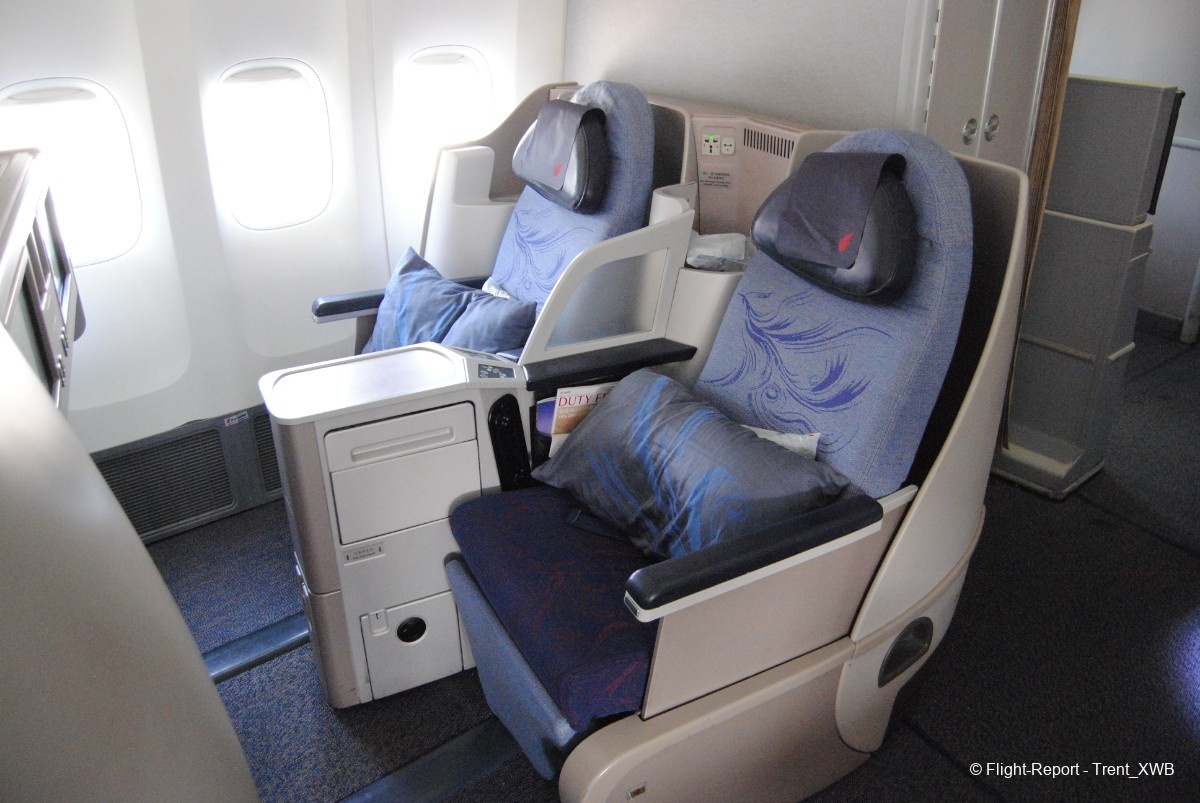
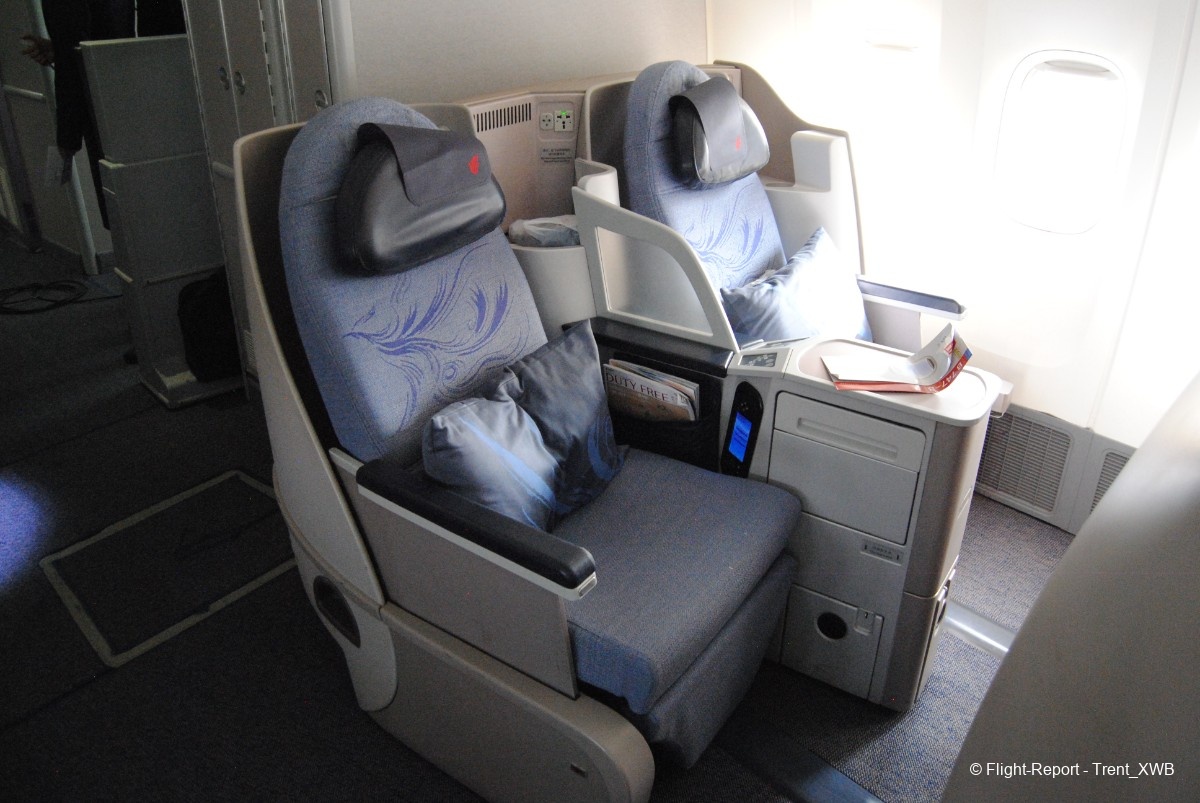
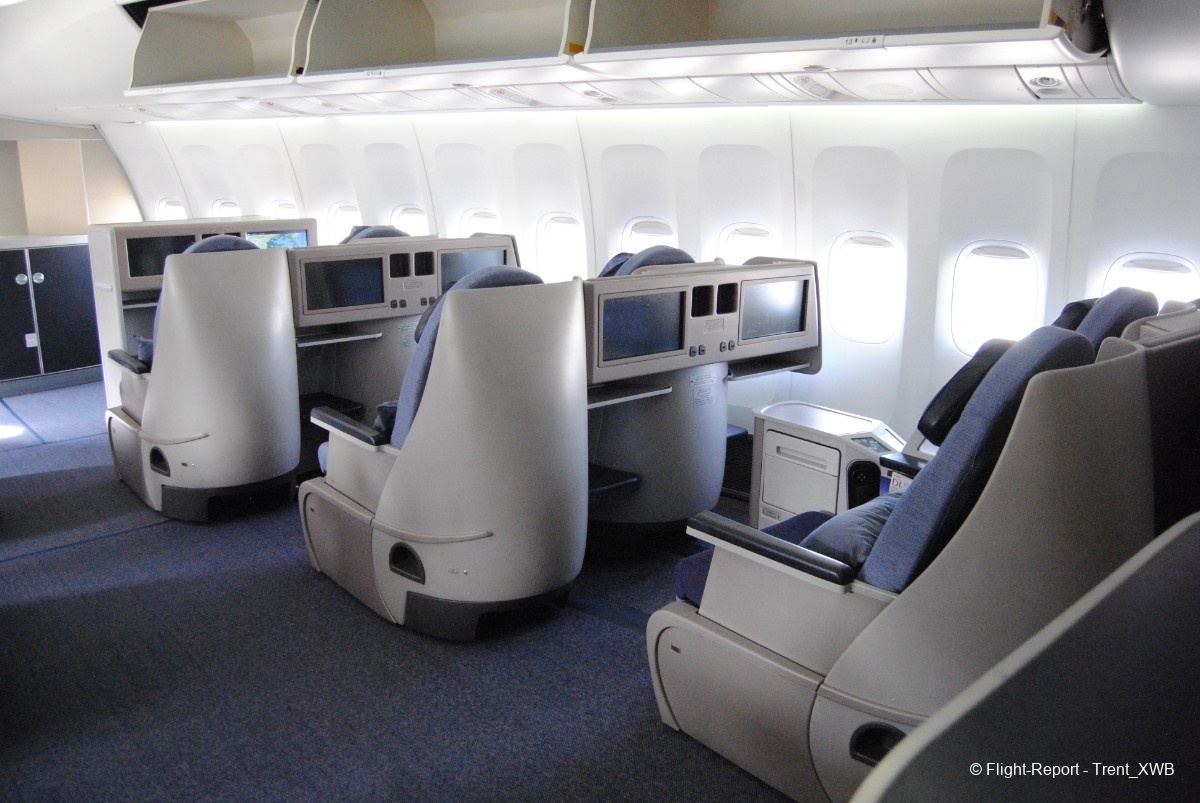
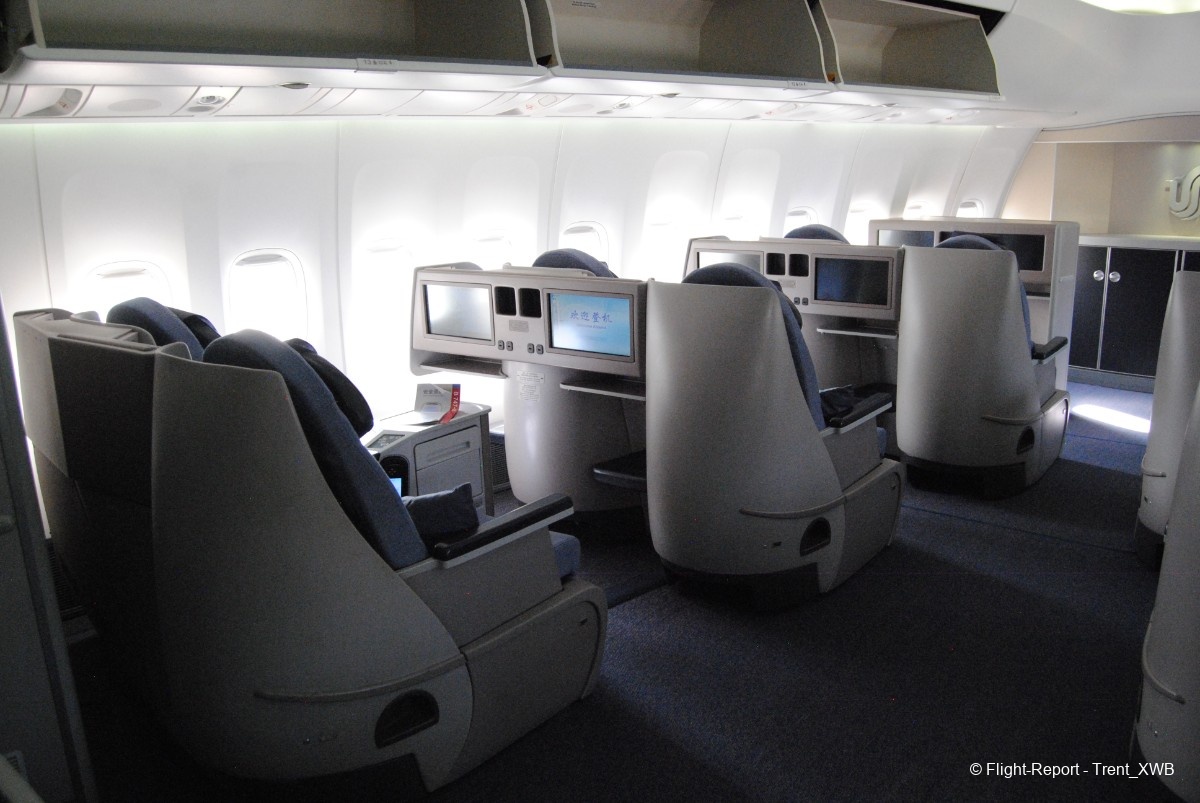
The front business class cabin is located in the Jumbo's nose and consists of 12 Collins Parallel Diamond seats, arranged in 3 rows (rows 11 to 13) with 2-2 layout. Overhead bins were closed and moodlighting turned on, making "like inflight" vibe in the cabin. The detailed views of this cabin will be shown further.
The Second Business Class Main Deck Cabin
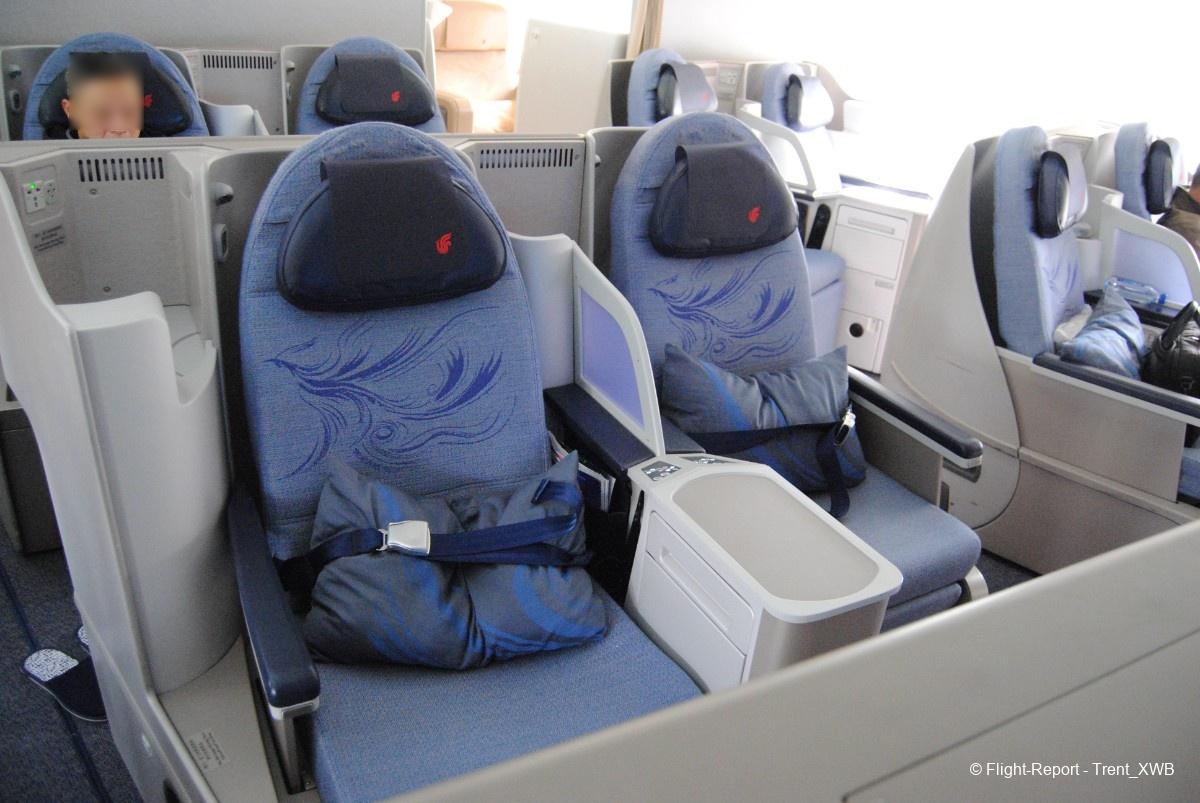
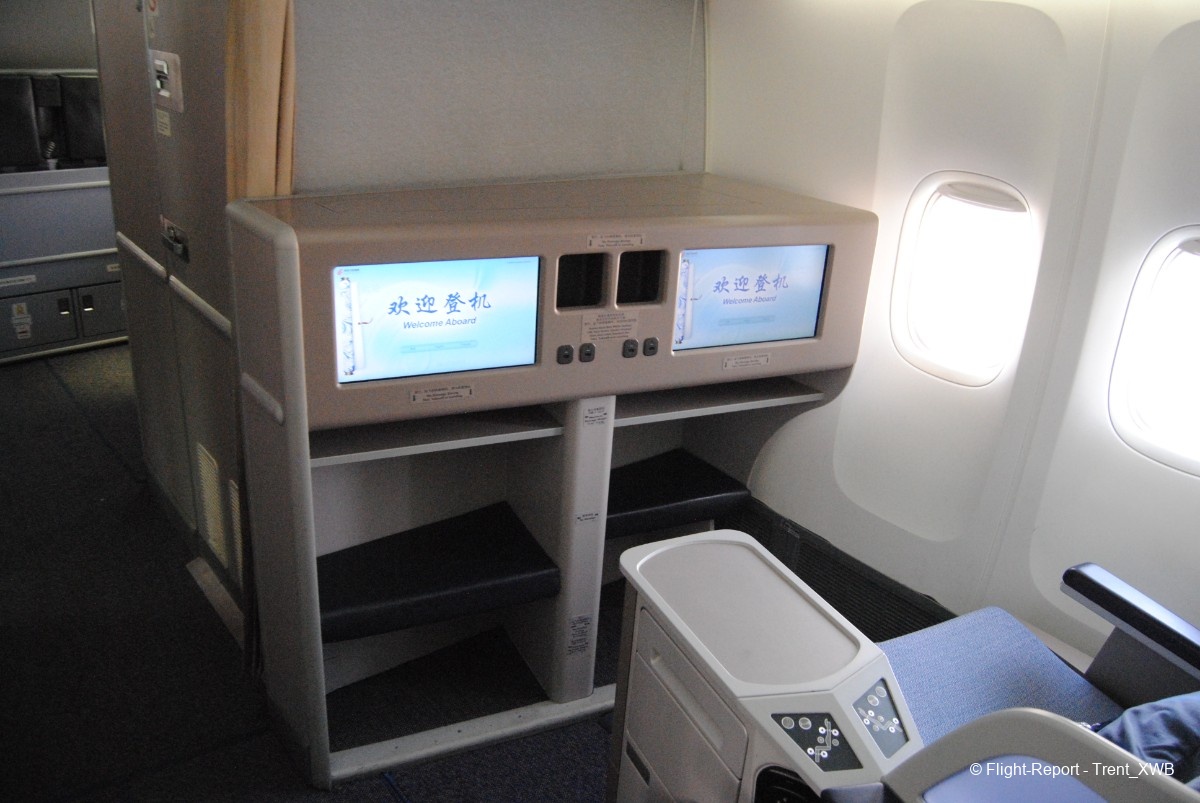
The 2nd business class cabin, consisting also of 12 Collins Parallel Diamond seats, arranged in 2 rows (rows 14-15) with 2-2-2 layout, is located between 1L/R doors and the first class cabin. This is where the fuselage tapering (towards nose) begins, so it's rather unsuitable for Zodiac Aerospace Venus first class suites, and CA's decision to install here 2 rows of business seats seems reasonable.
The Stair
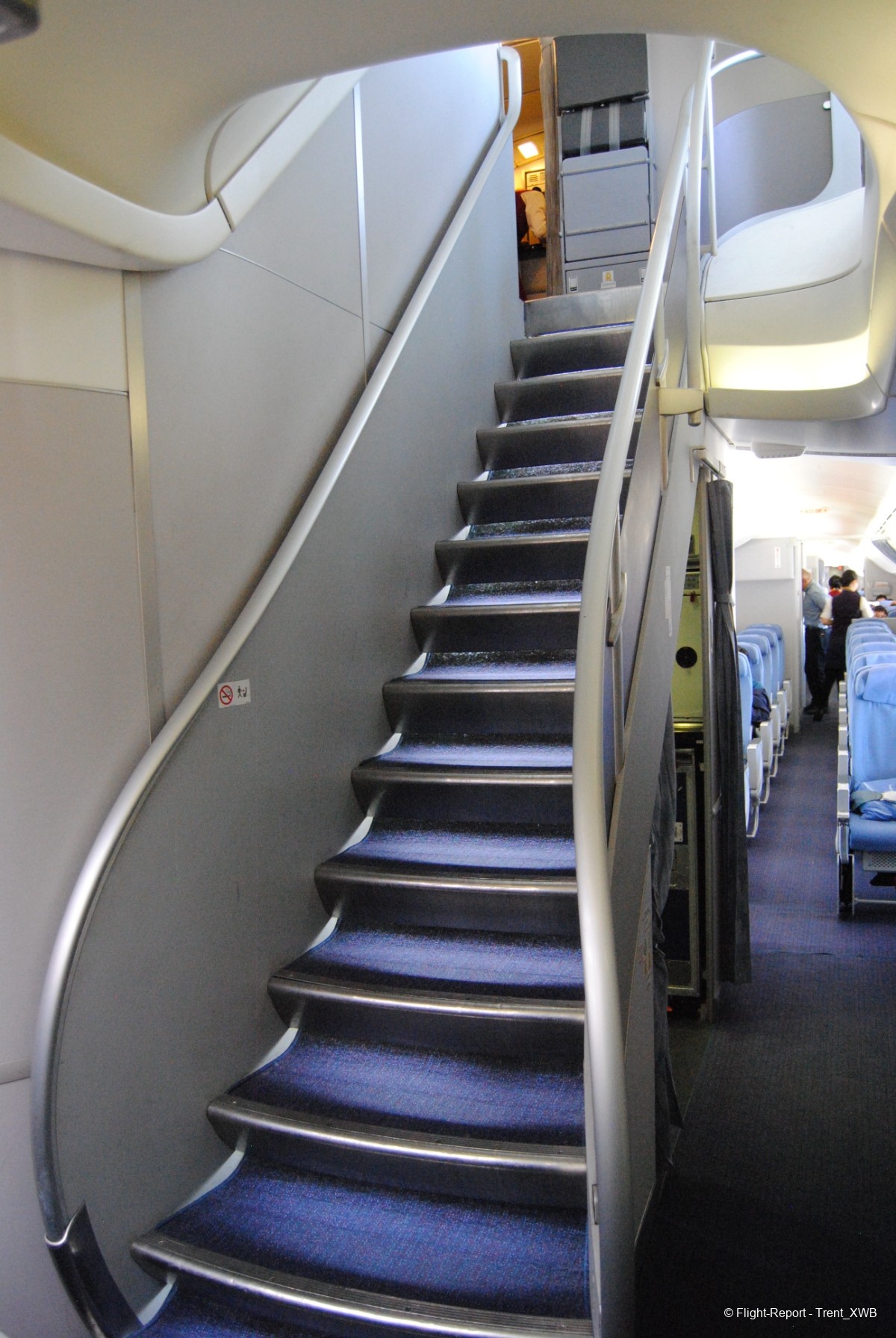
A brief look (with high hopes) at the stair to the upper deck…
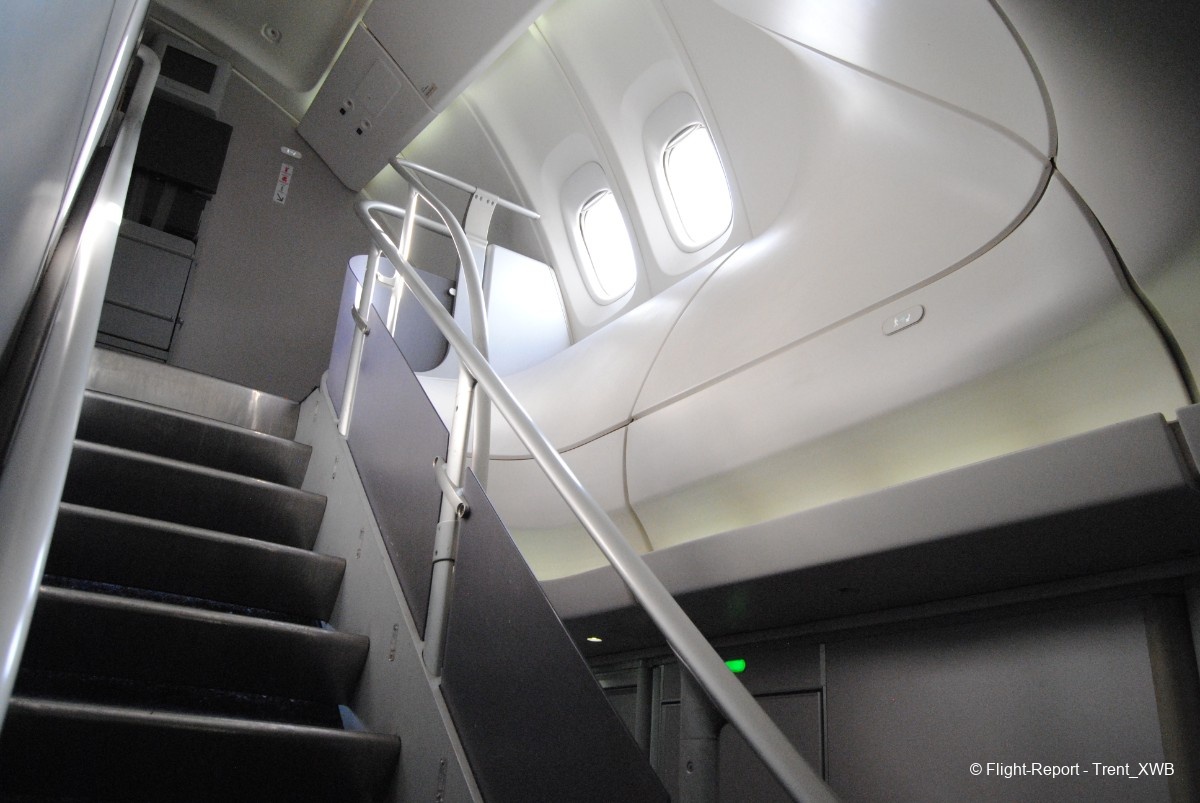
… and it's time to go to the central and rear sections of the aircraft behind 2L/R doors.
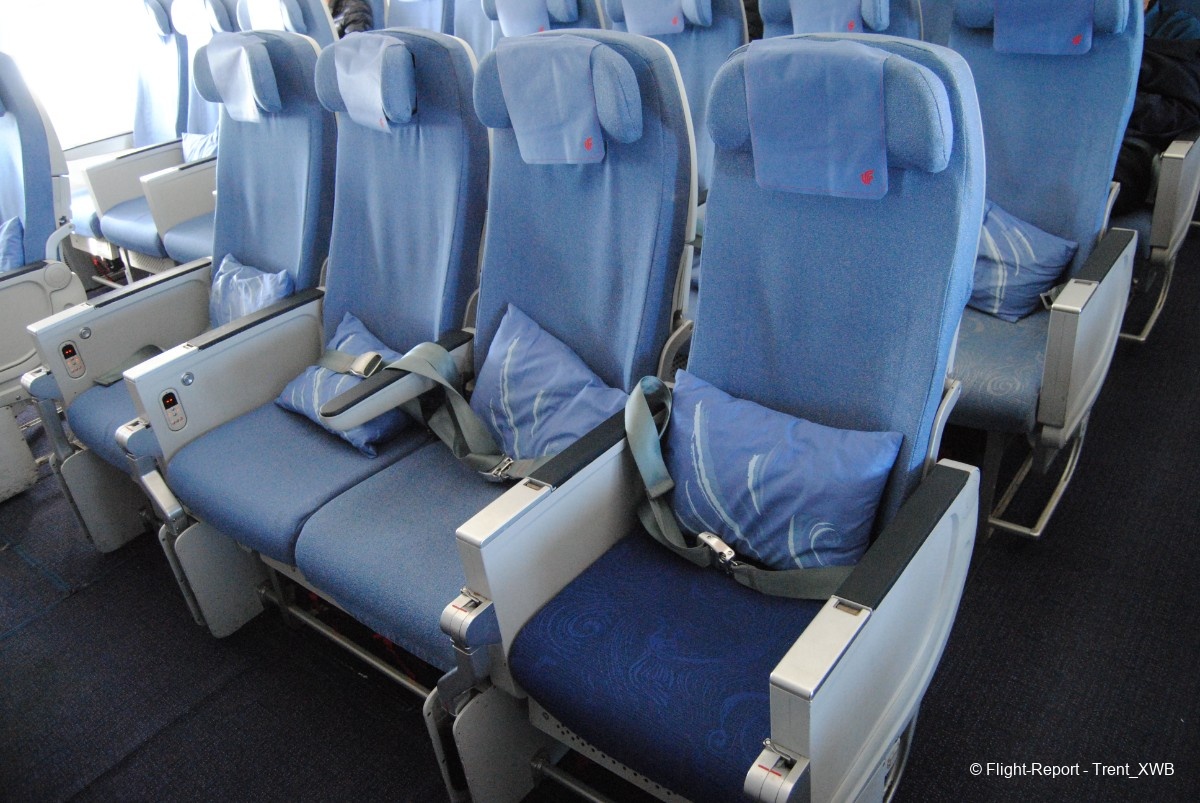
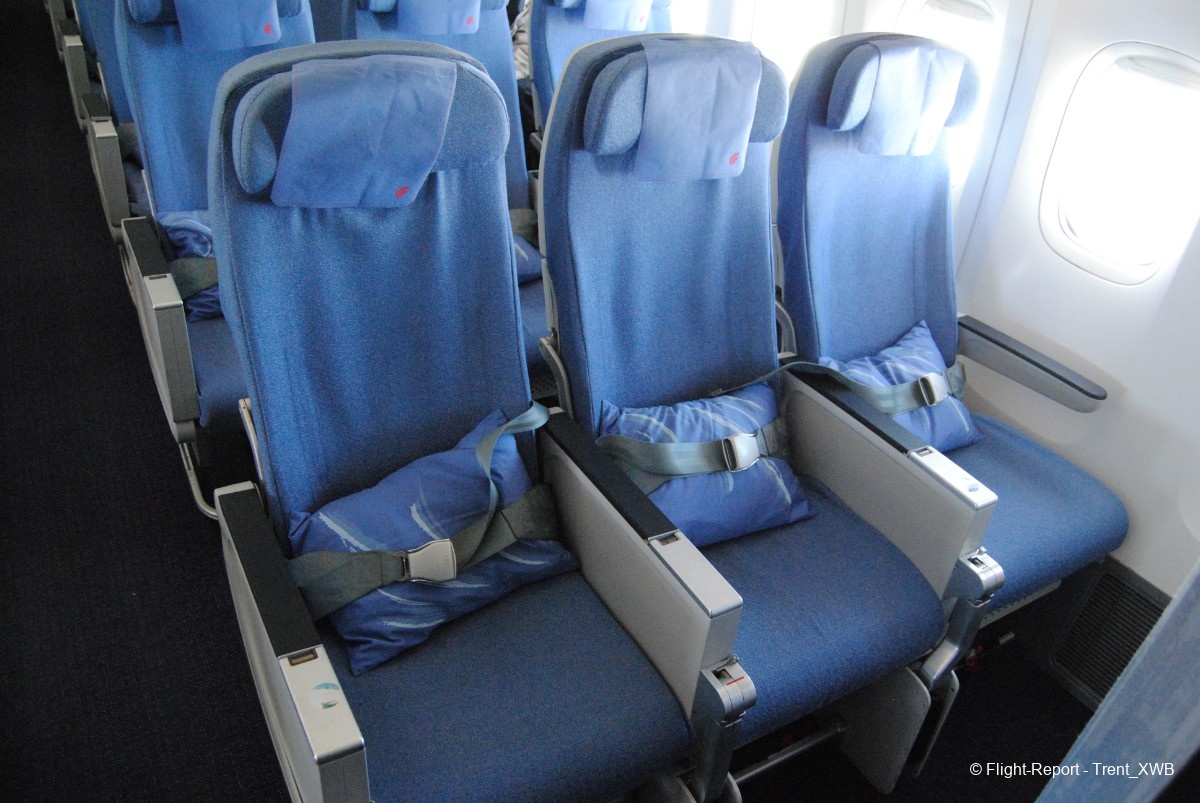
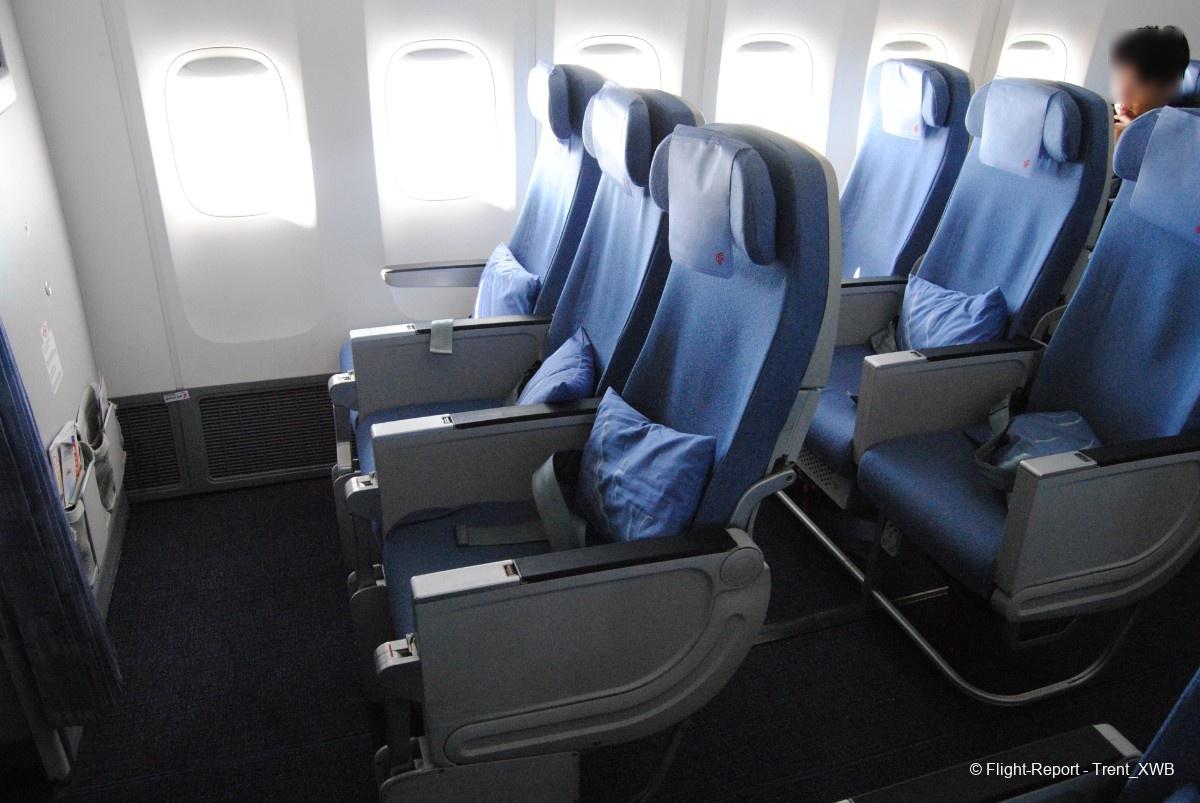
The Economy Plus Cabin
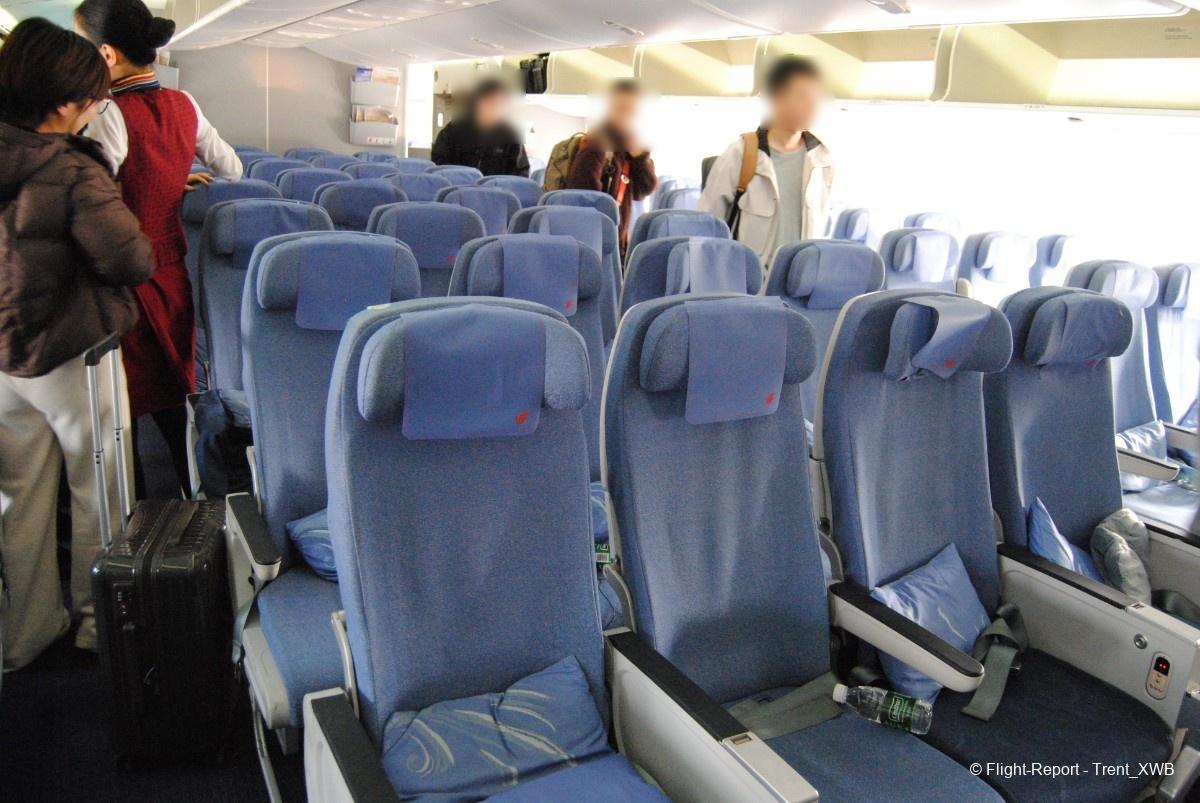
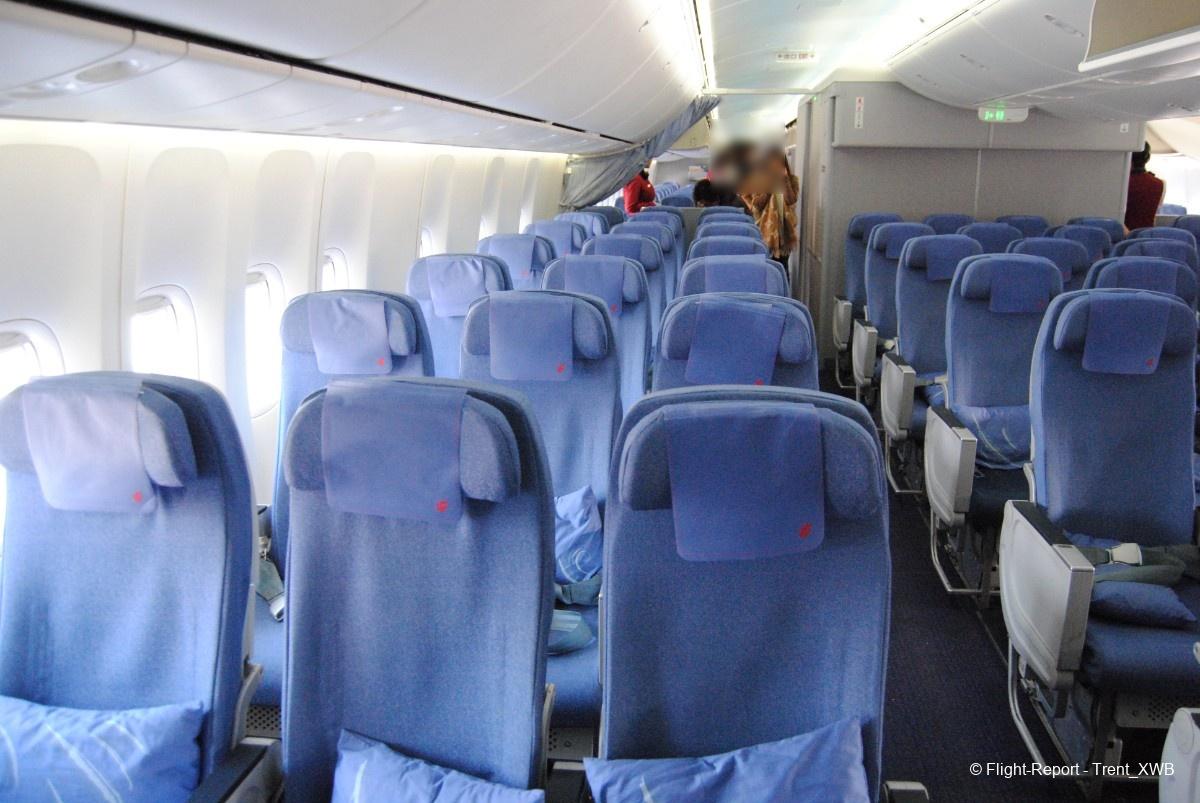
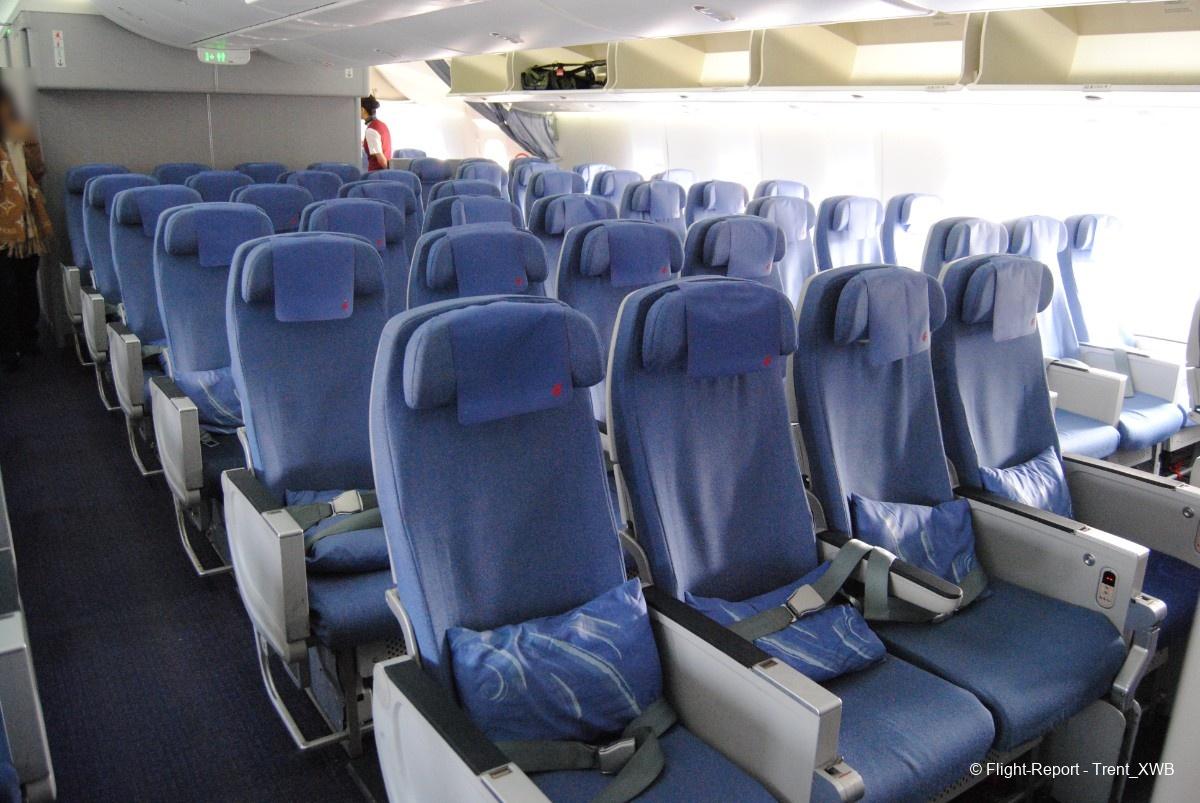
The economy plus cabin, consisting of 66 seats (the same as in regular economy, but with fixed armrests and increased row pitch), arranged in 6 rows (rows 31 to 37) with 3-4-3 layout, is located between 2L/R and 3L/R doors. It will be shown in details further. CA markets this cabin as "premium economy", but it's kind of cheating, because true premium economy cabin must have at least one seat less per row than economy cabin (resulting in significantly wider seats compared to Y).
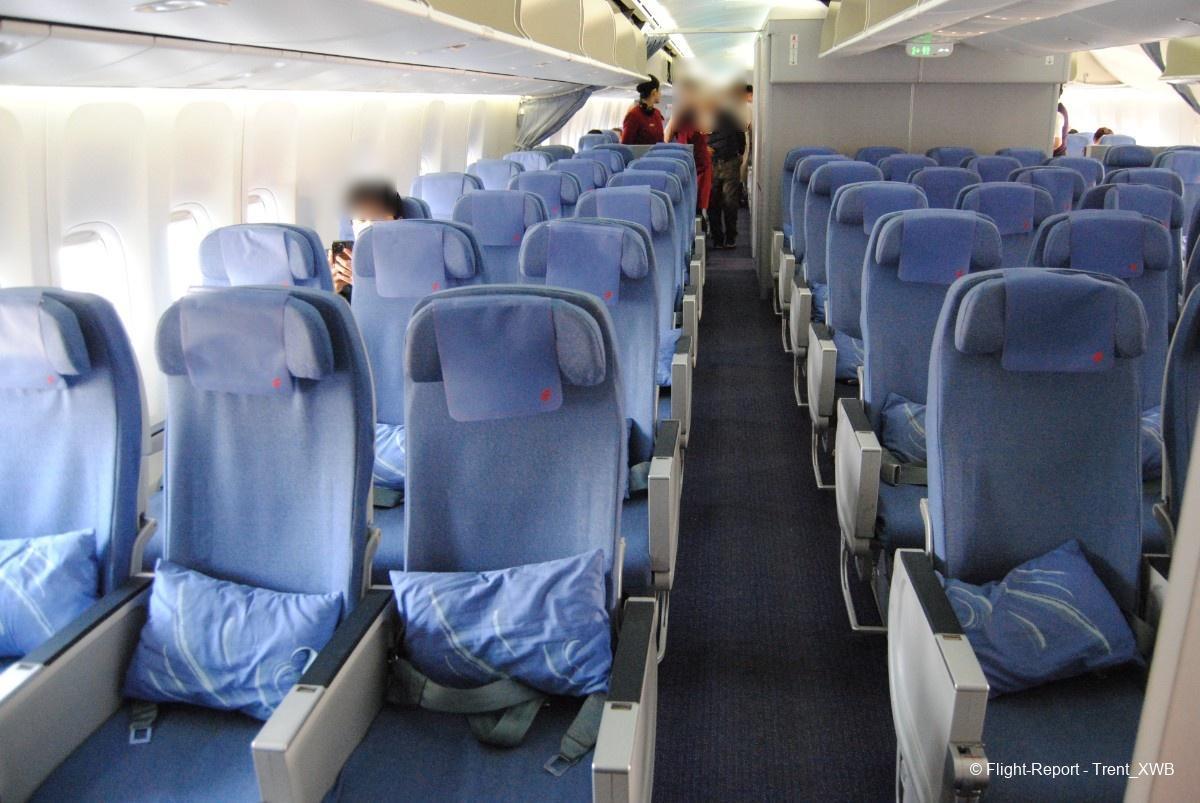
The Front Economy Cabin
The front economy cabin, consisting of 92 seats, arranged in 10 rows (rows 38 to 47) with 3-4-3 layout, is located between 3L/R and 4L/R doors. Rows 38 and 47 don't have central 4-seaters blocks.
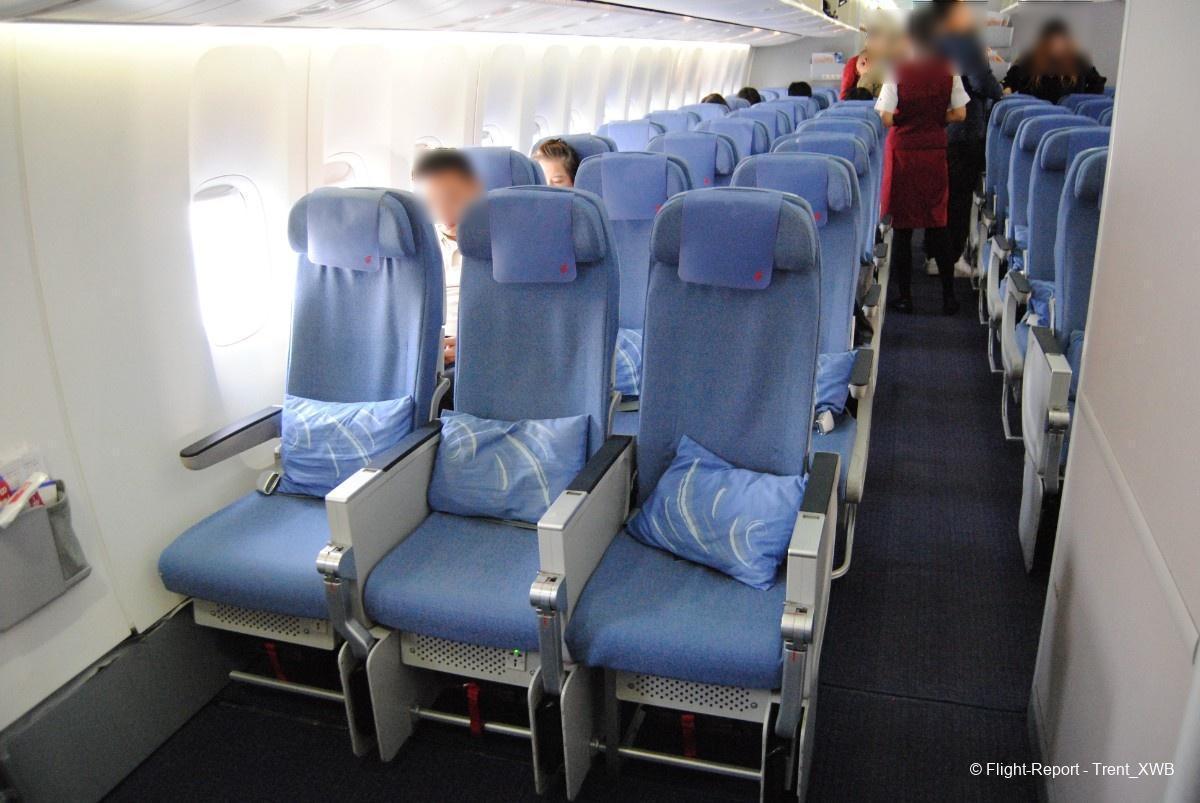
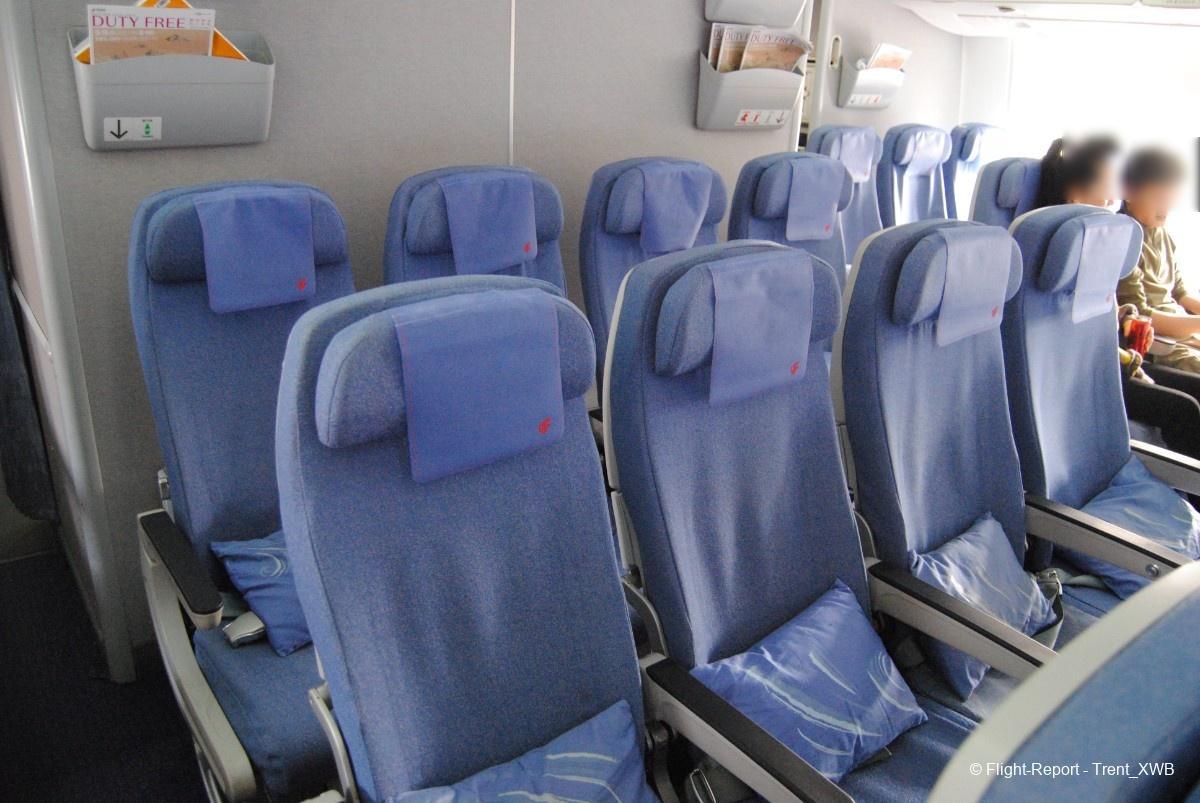
The Rear Economy Cabin
The large rear economy cabin, consisting of 141 seats, arranged in 15 rows (rows 48 to 64) with 3-4-3 layout, is located between 4L/R and 5L/R doors. Row 48 has only left 3-seater block, row 49 doesn't have central 4-seater block, rows 60 to 62 have lateral 2-seater blocks instead of 3-seaters (due to fuselage tapering), rows 63 and 64 only have central 4-seater blocks.
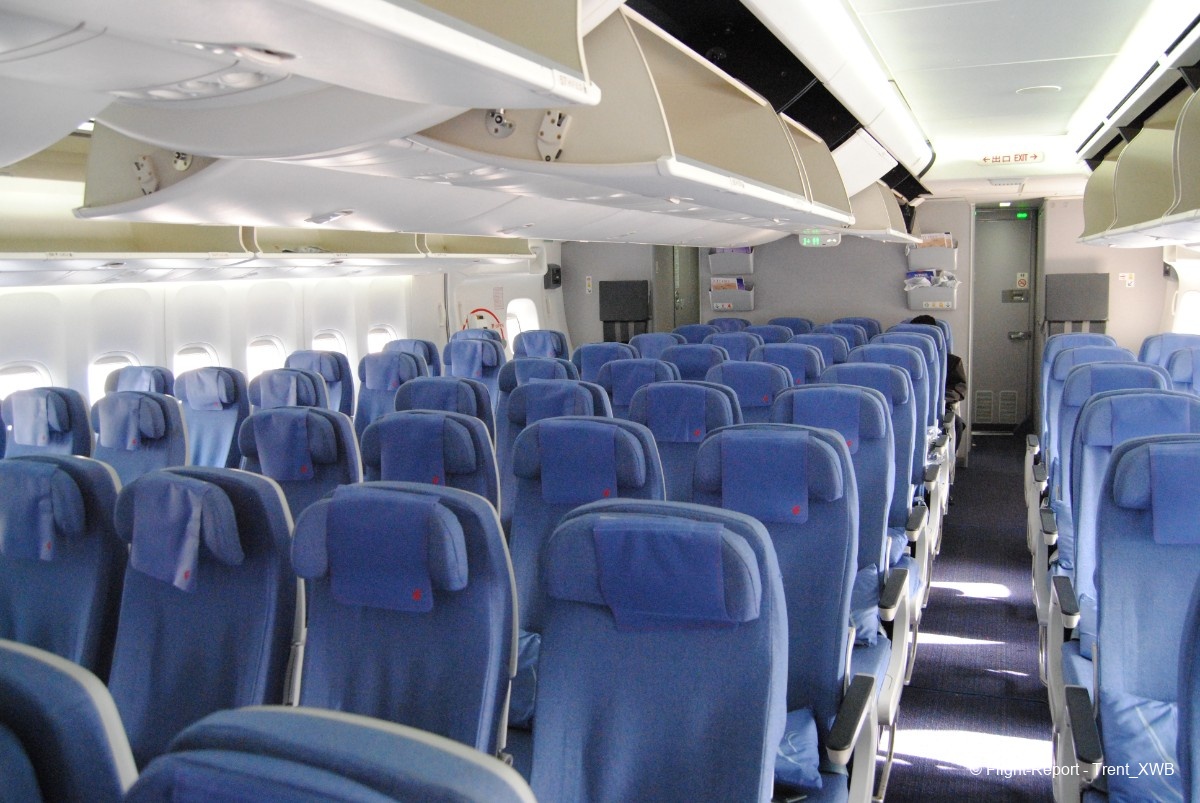
The Economy Seat
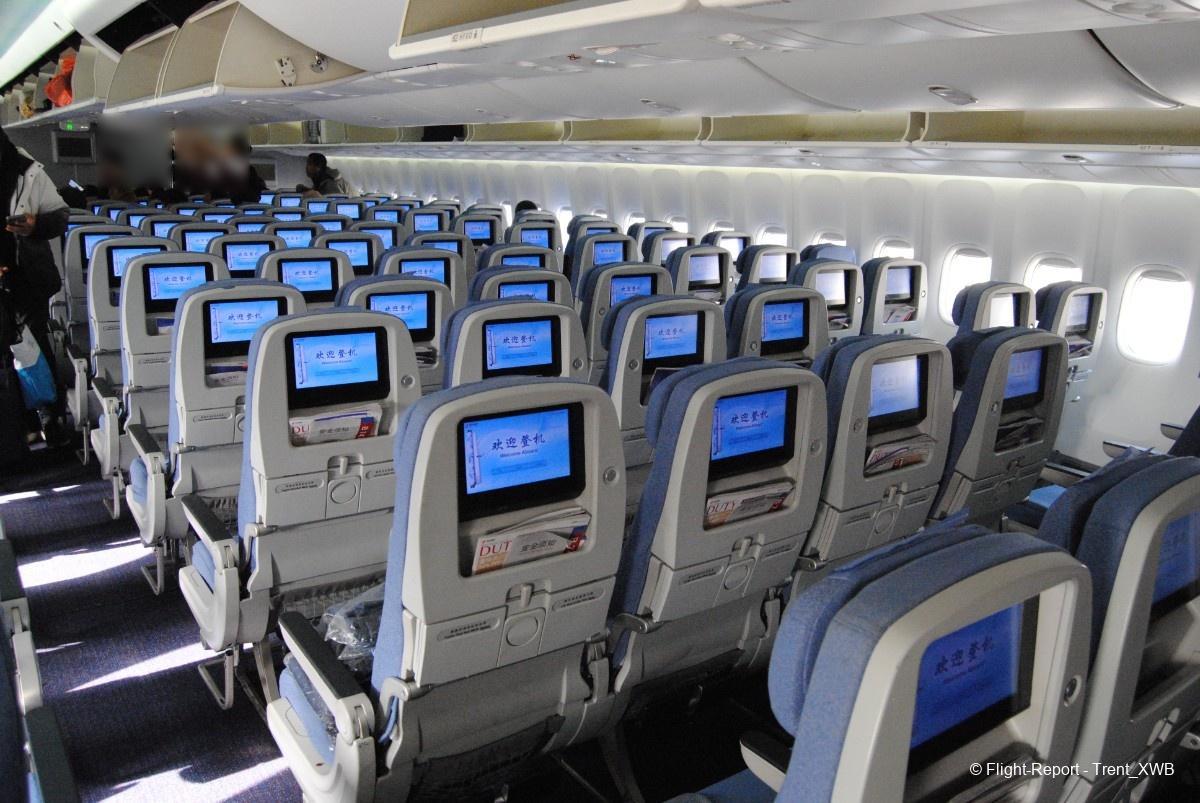
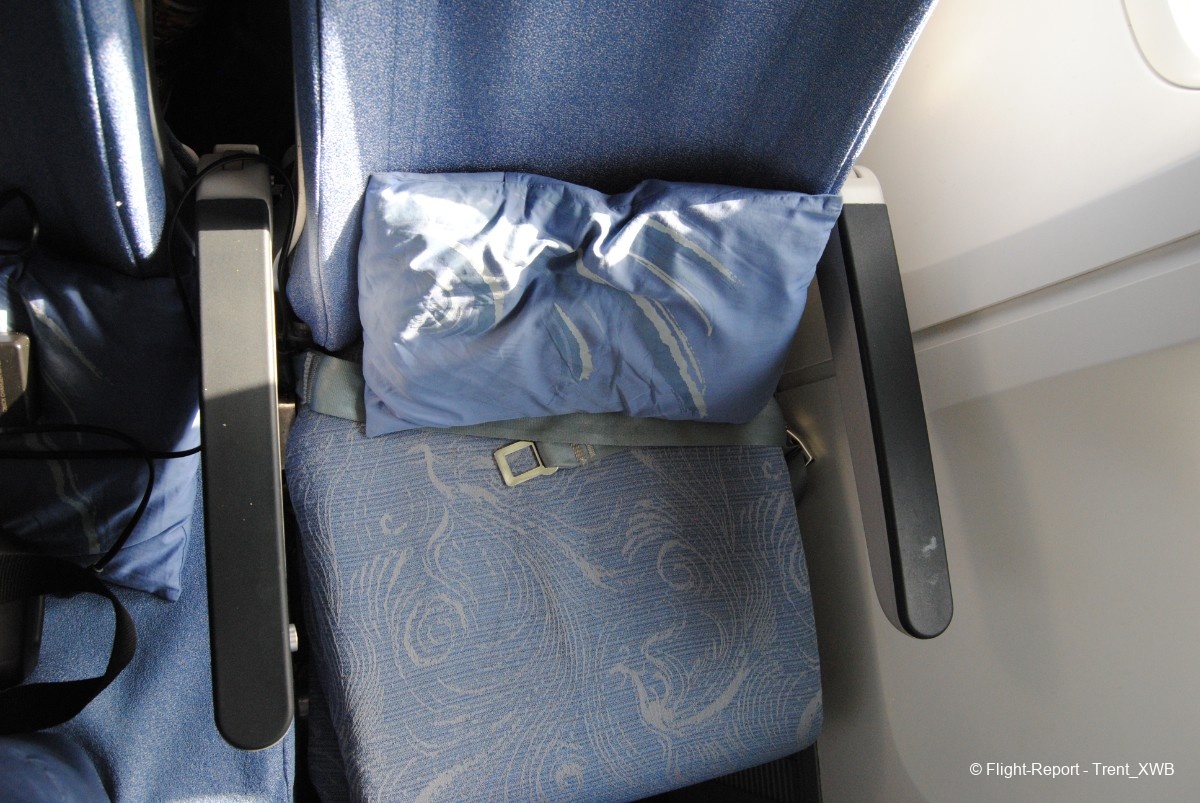
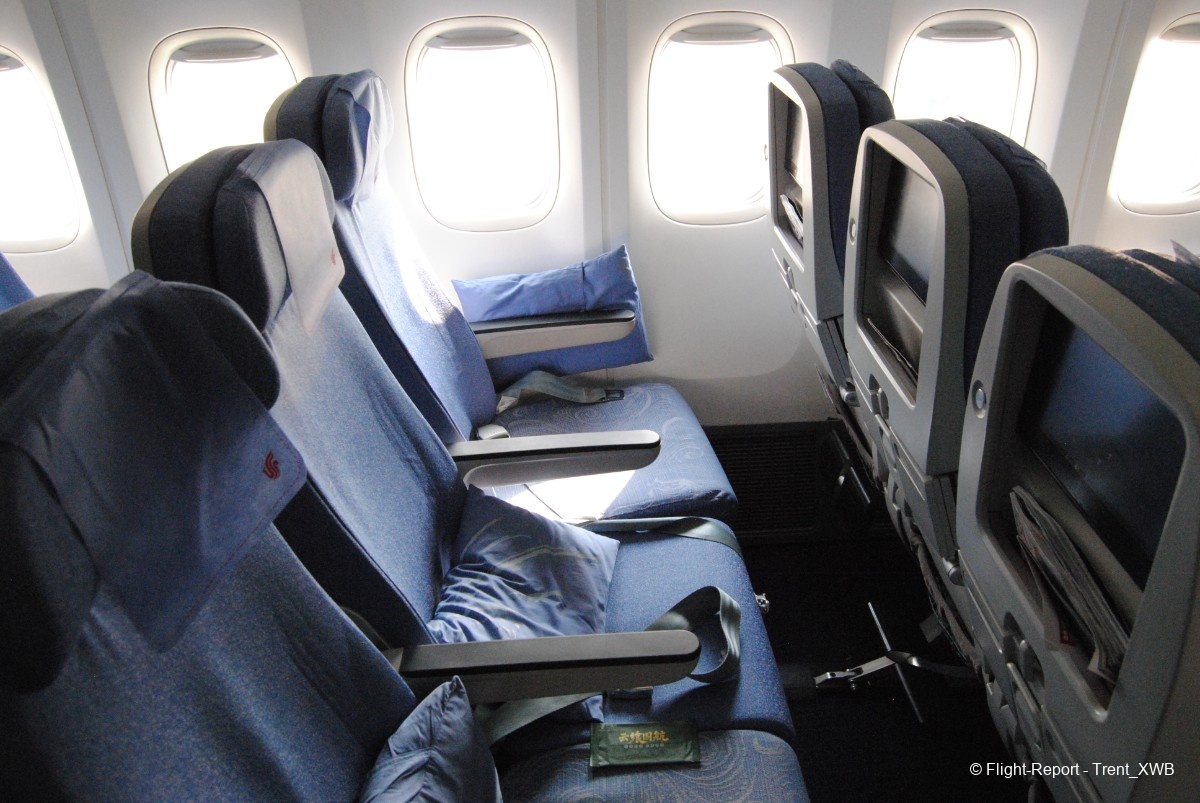
My seat is 50A, located in front of the rear economy cabin. The seat model is B/E Aerospace Star Plus - the same as in Lufthansa A346s (I flew a LH A346 8 years before from MEX to MUC). The only difference is the seatwidth: whereas in LH A346 it's 17.7", here in CA B748 it's 17.3". I measured the seatwidth on the return flight SHA-PEK, because this time the seat definitely wasn't in a good shape with the armrests literally dangling in the lateral direction, making one unable to make precise measurements. This seatwidth is on par with Korean Air B748 seatwidth and 0.2" more than Lufthansa B748 seatwidth. So, now it's proven that the seatwidth in any B748 is the same as in 3-3-3 Dreamliner.
One can ask, why CA B748s have the same economy seats as LH A346s? Well, there's quite an interesting story behind this. In 2011 Star Alliance decided to launch a special lineup of economy seats for the member airlines with Lufthansa, Austrian Airlines and Air China being the launch carriers (one can suspect that it was LH's idea!). It was announced back then that B/E Aerospace will be the seat manufacturer. In fact, the first model for this lineup was produced by Recaro, and it was CL3520 "Star Plus", which debuted on LH B748s, delivered from 2012 to 2015 (I have to say that this Recaro is the worst economy seat I've ever had on long-haul flights!). The model, produced by B/E Aerospace, debuted later - in 2014-2015, and was installed in LH A346s (which were being reconfigured at that time) and in CA B748s (delivered in 2014-2015). B/E Aerospace Star Plus is kind of "spin-off" from the well-known Collins Pinnacle (produced from 2010), and differs by the armrests and the back (which are similar to Recaro CL3520 "Star Plus") and, unfortunately, by the level of comfort. Whereas the standard Collins Pinnacle is definitely a comfortable seat for long-haul flying (in ex-LATAM B763 on GRU-MXP, AeroMexico B789 on MEX-AMS, LATAM B789 on AKL-SCL I always felt comfortable), B/E Aerospace Star Plus is hard and uncomfortable, as was proven on MEX-MUC flight on LH A346. Having seated in B/E Aerospace Star Plus of CA B748, I immediately felt the familiar discomfort of the hard seatback. Thankfully, it was just a short flight under 2 hours! I simply cannot imagine how the economy passengers survive in these seats on JFK and IAD (and also currently on shorter, but still long FRA) flights! Worth noting that OS somehow managed to slip out from this Lufthansa-inflicted "Star Plus" game and instead installed the standard Pinnacles into its B77Es and B763s. Kudos to OS!
BTW, this source, from where I got the name of this seat, reveals a very interesting story about the design of CA B748 cabins and the meaning of the presence of phoenix in CA aircrafts.
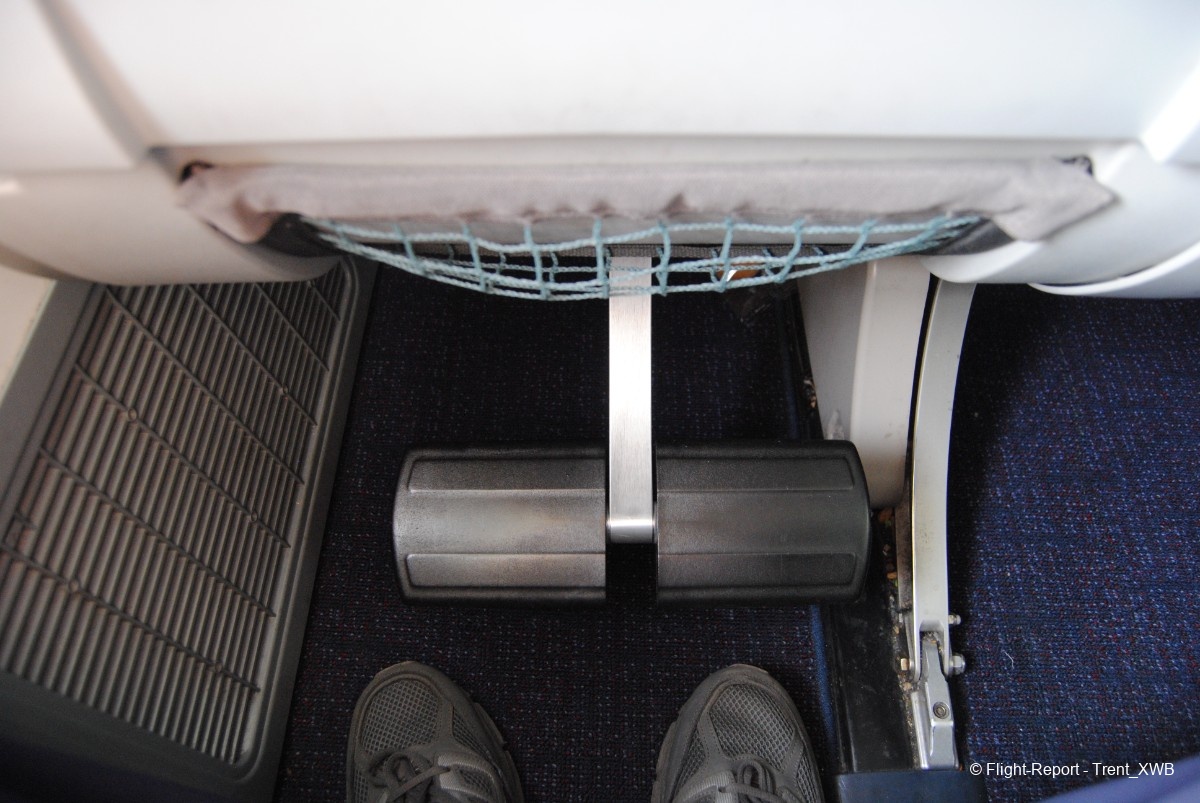
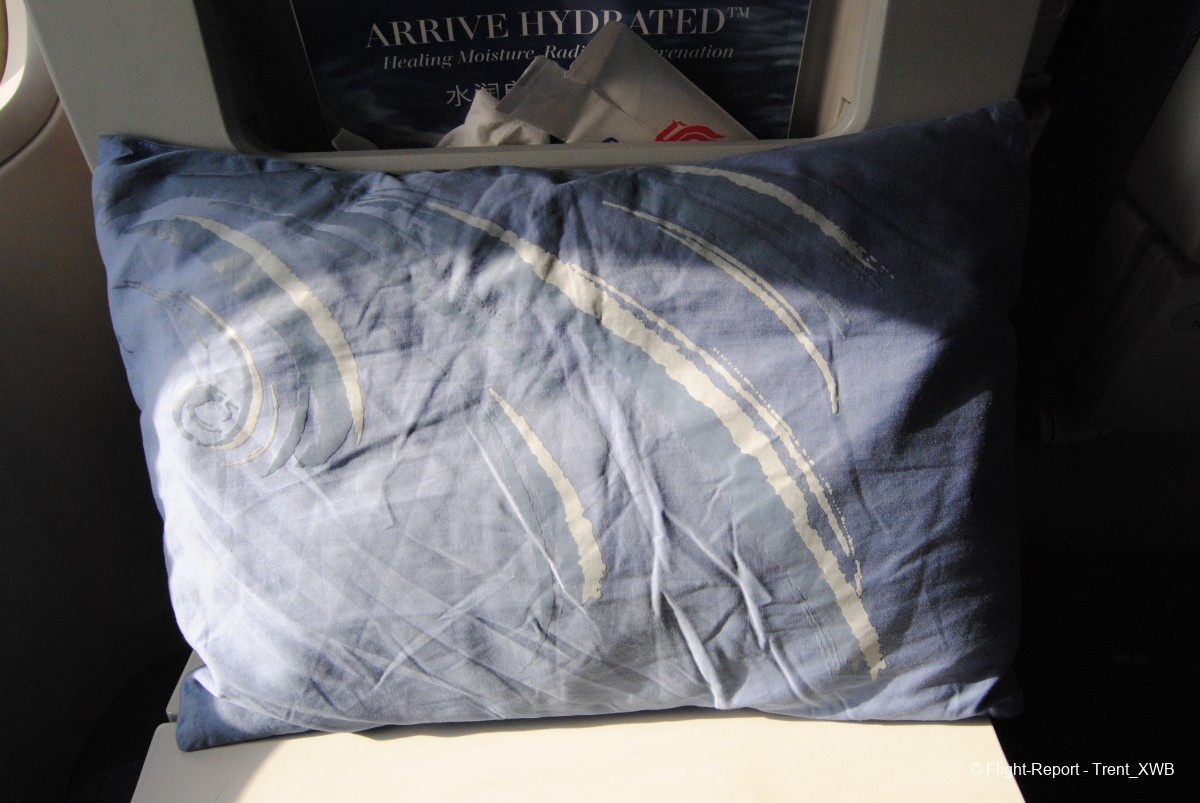
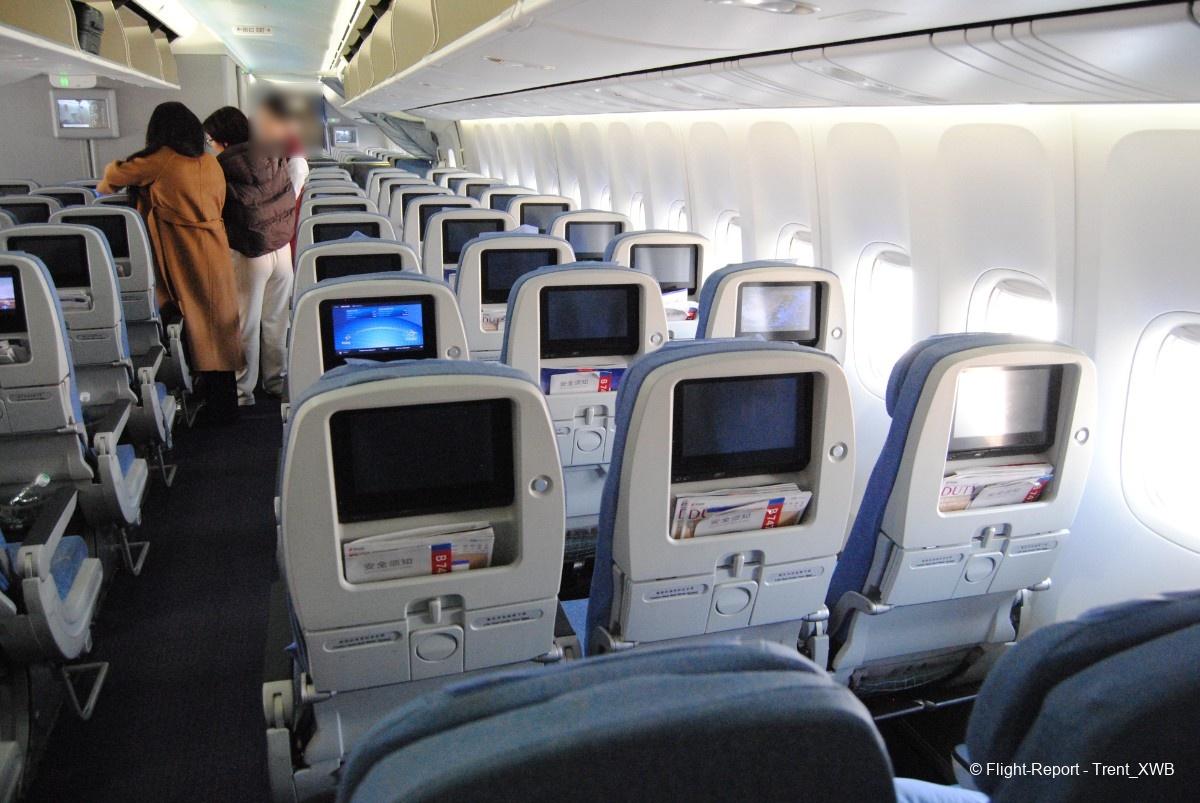
The seat has adjustable headrest, Panasonic eX3 IFE with USB port, upper hard pocket, coat hanger, bifold tray table with cup holder, lower soft pocket, footrest and underseat universal power socket. The window seats have IFE power box, but quite slim and not bothersome. Waiting on the seat was just pillow (blankets were available at request). The IFE screen is rather small and, in addition to the "tired" state of the seat, the IFE didn't want to turn on, so I asked a FA to reset it (later on it had to be reset again).
The row pitch is noticeably better than in LH B748, but (expectedly!) less than in KE B748.
Worth noting that due to the cabin load being far from full, I got an empty seat near me, which kind of reminded me MEX-MUC flight on LH A346, where I also got 2 similar seats at my disposal (but it didn't help me to feel comfortable).
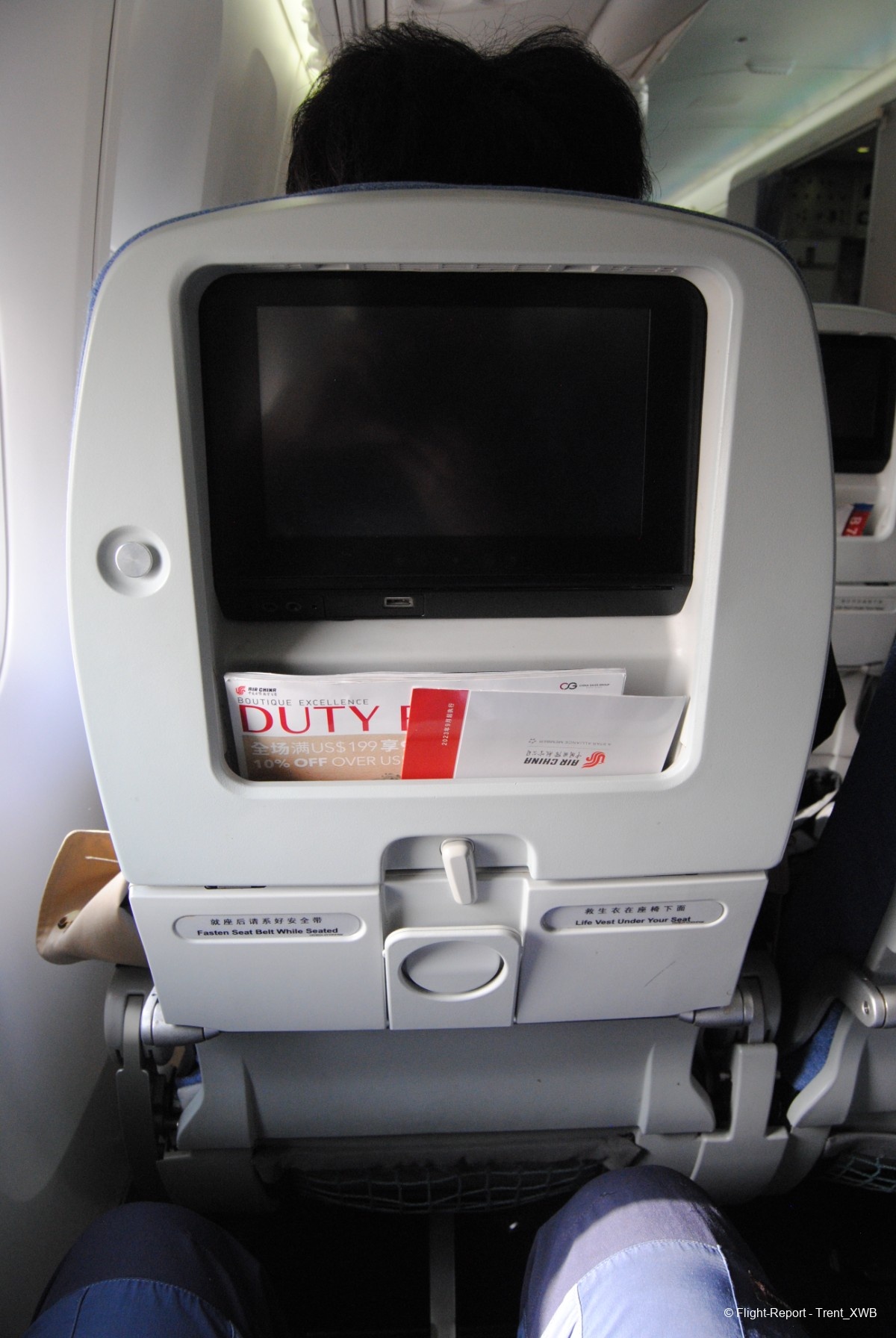
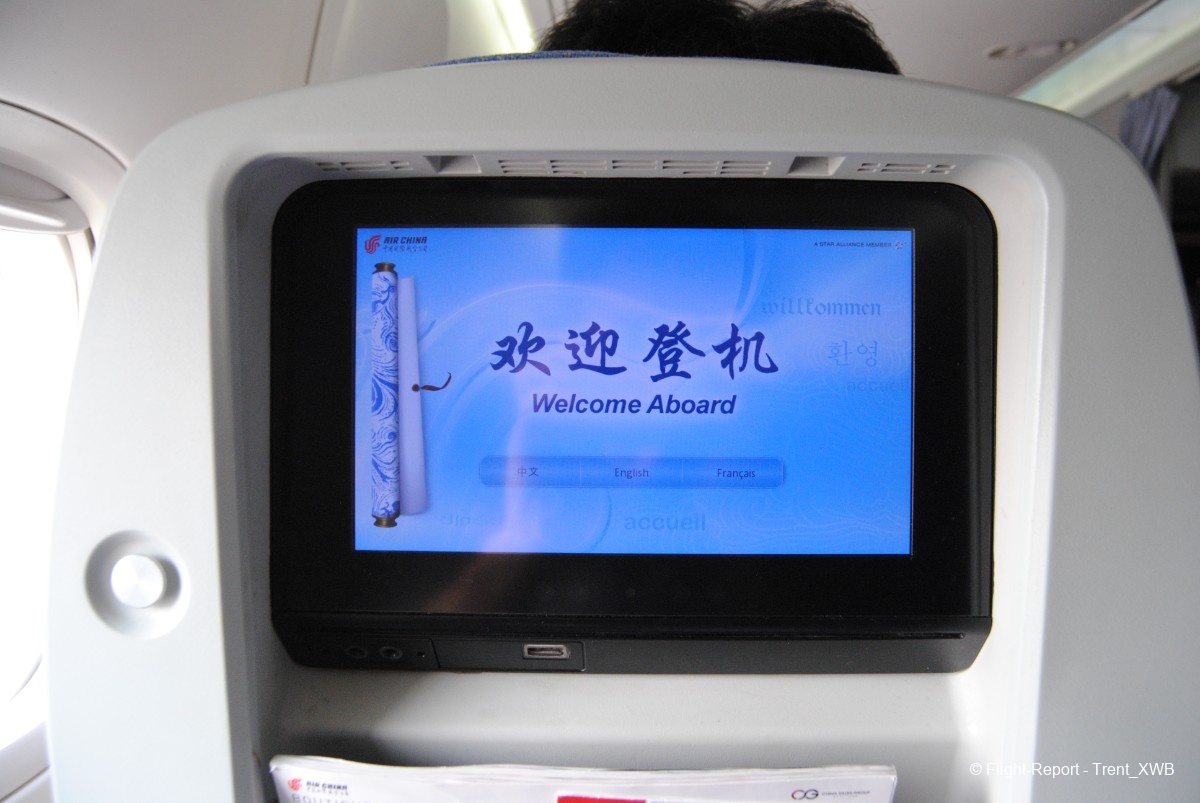
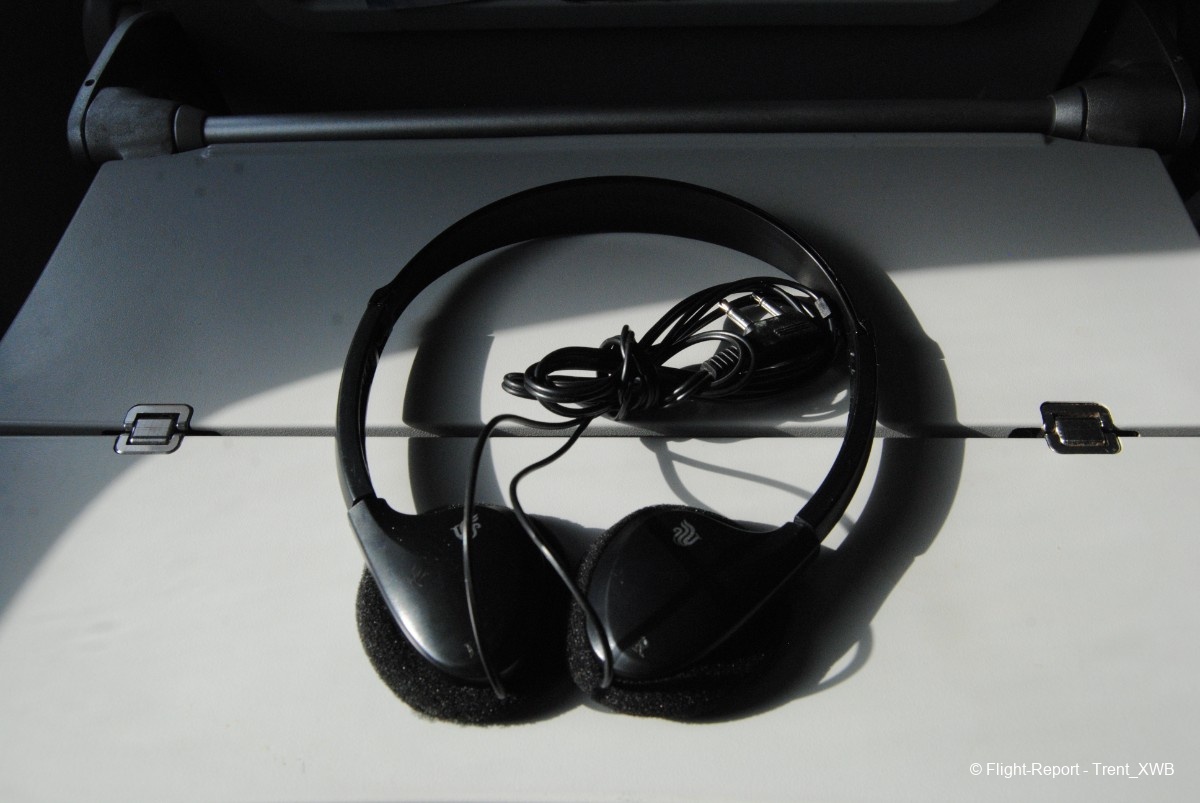
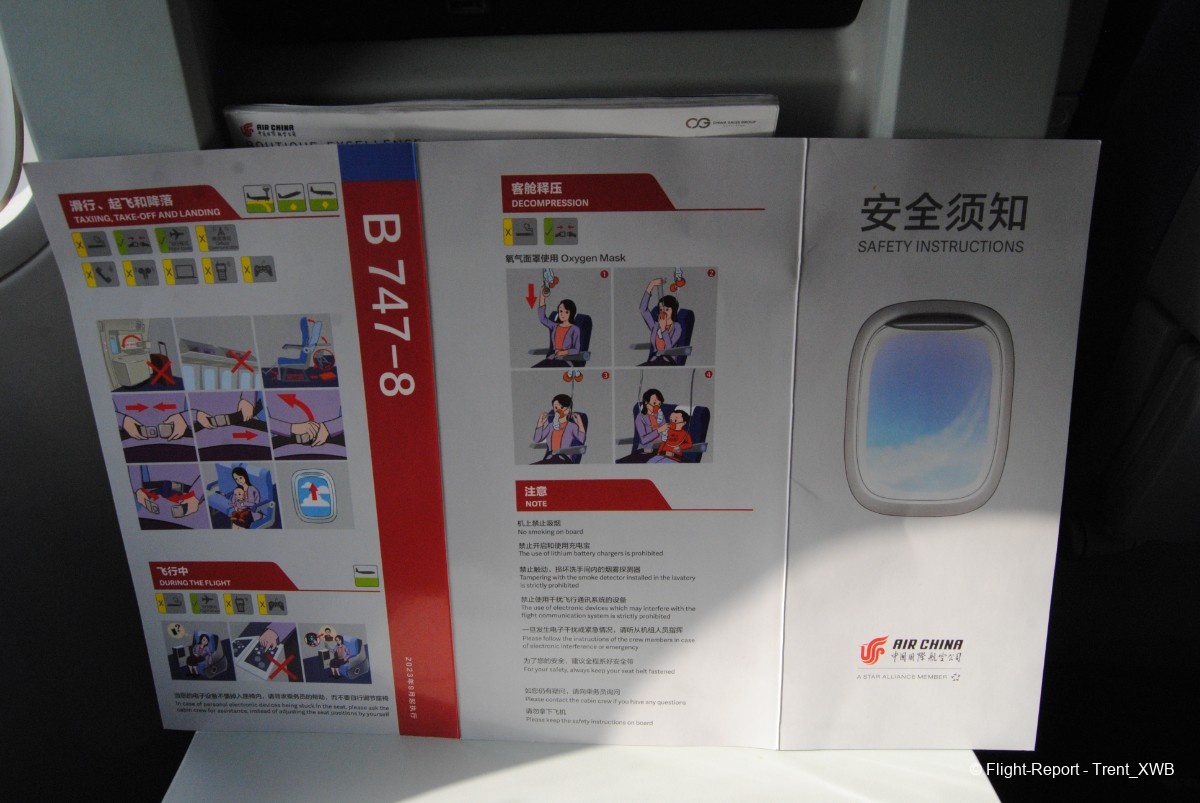
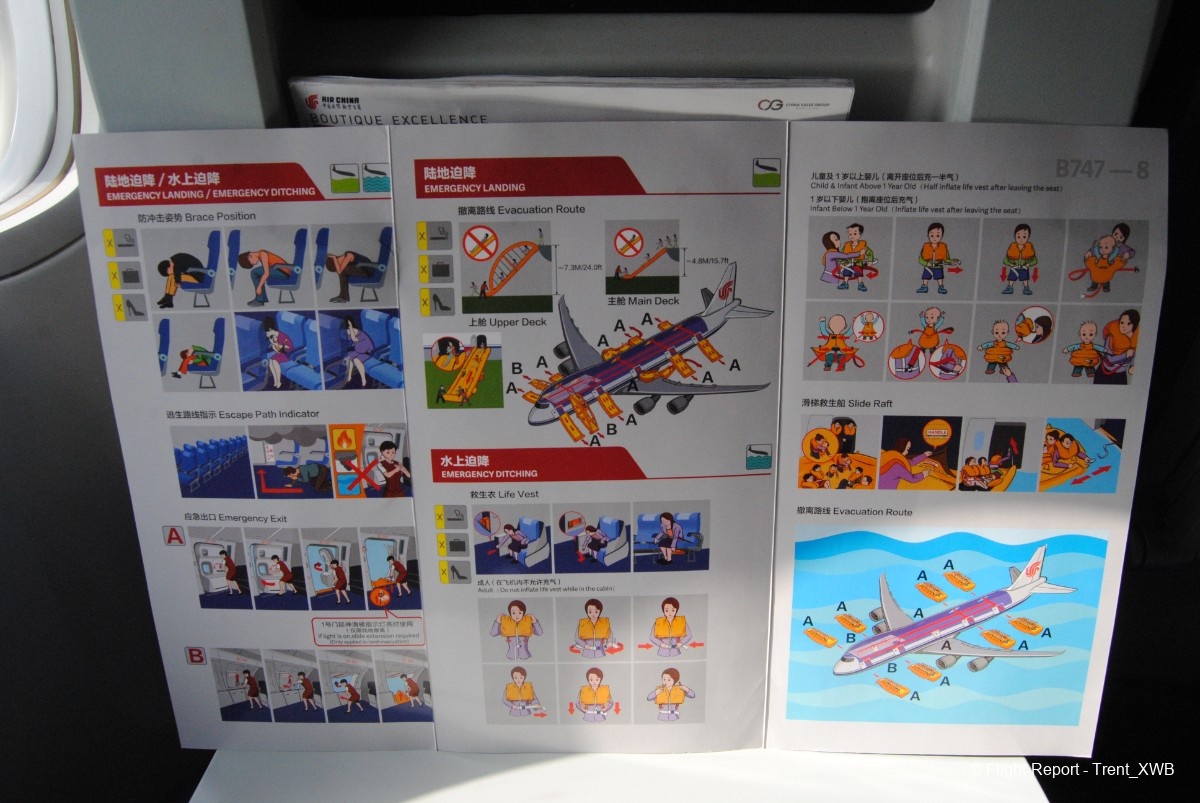
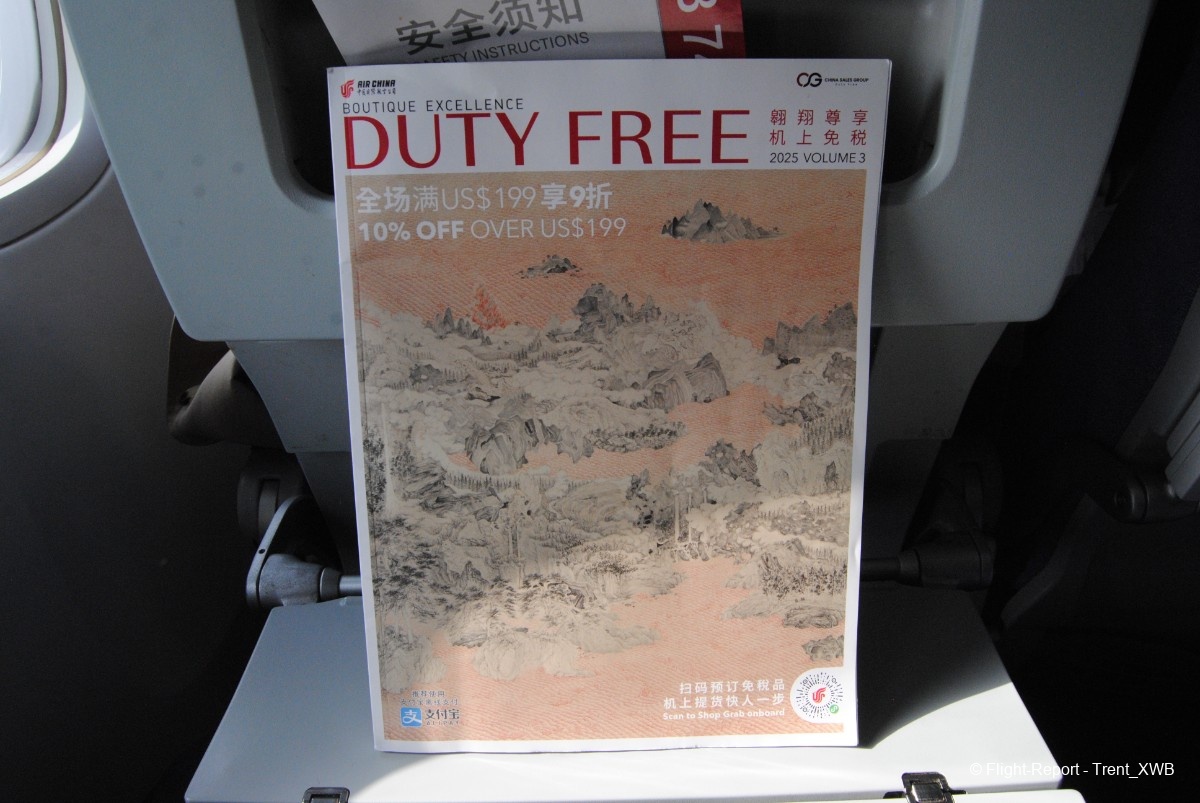
The headset, handed by crew, and the seat pocket content - safety card and duty-free magazine.
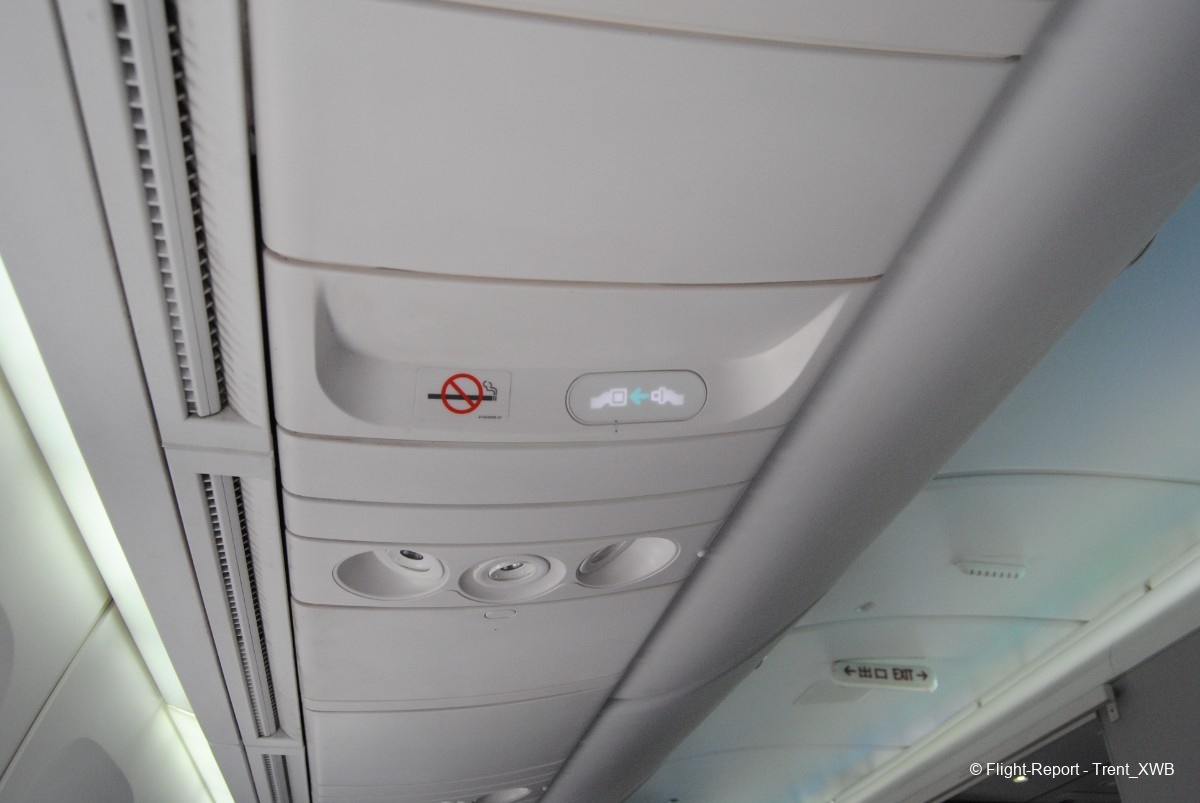
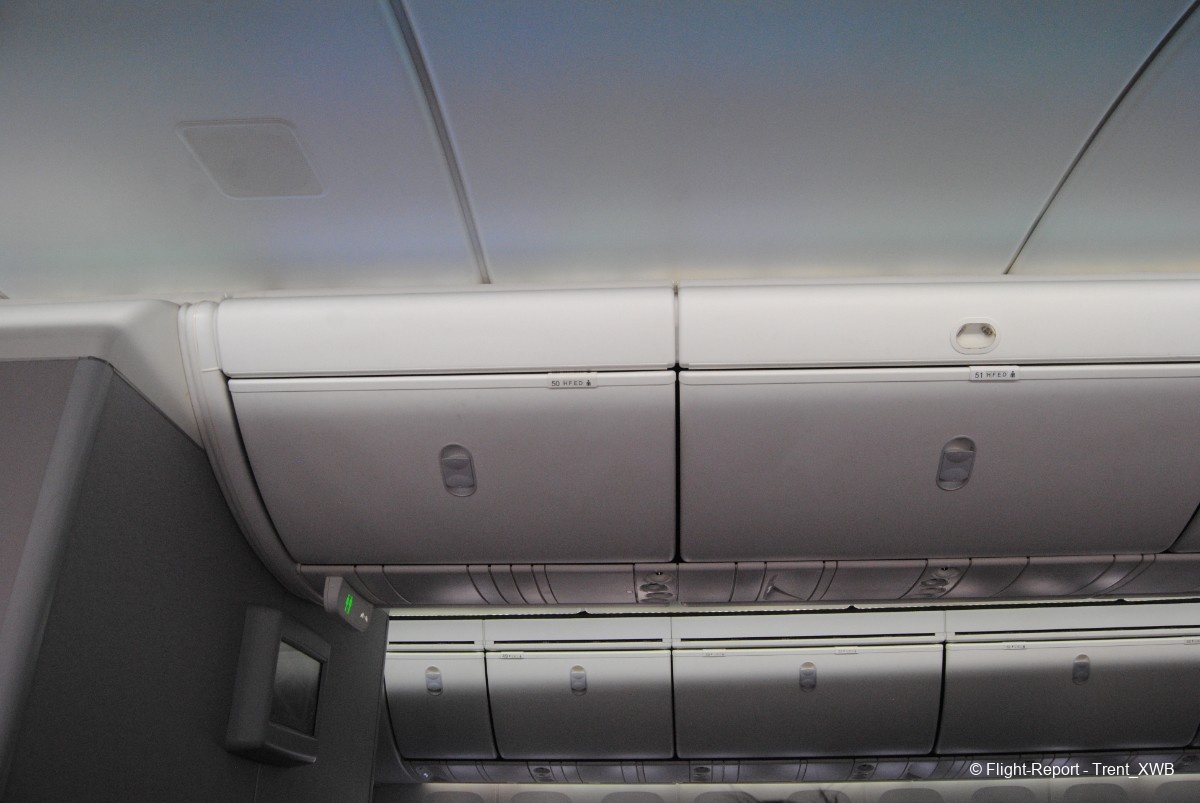
The overhead panel (expectedly without personal airvents) and 787-like cabin interior with pre-departure mood lighting.
The Flight
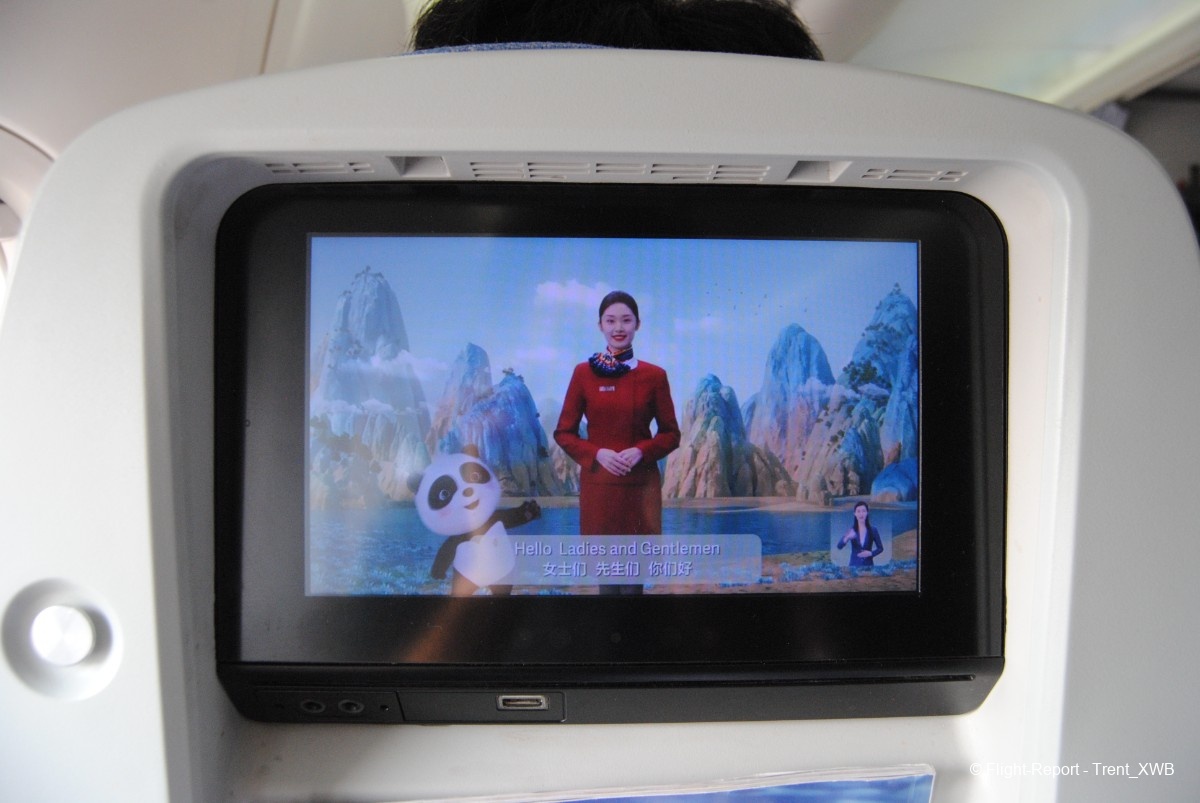
CA safety video is played (I found it to be nice and creative)…
… and pushback begins.
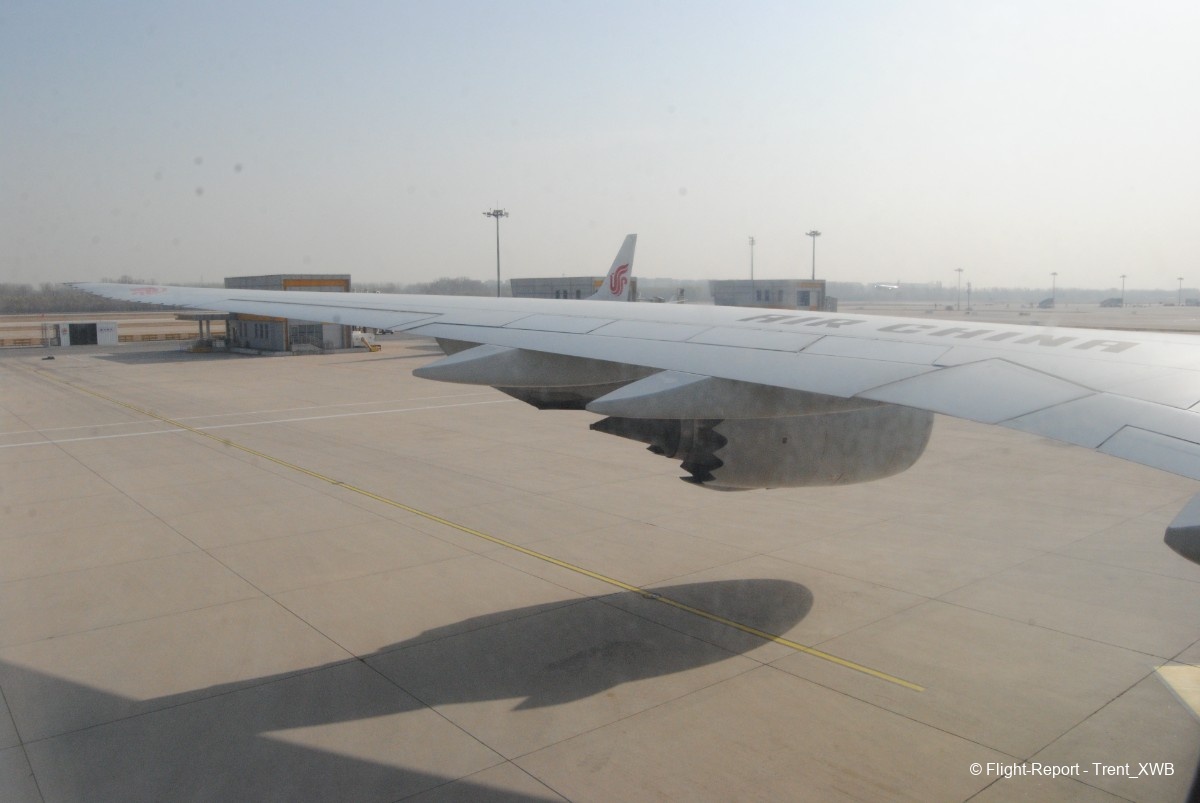
Flaps moving into takeoff position.
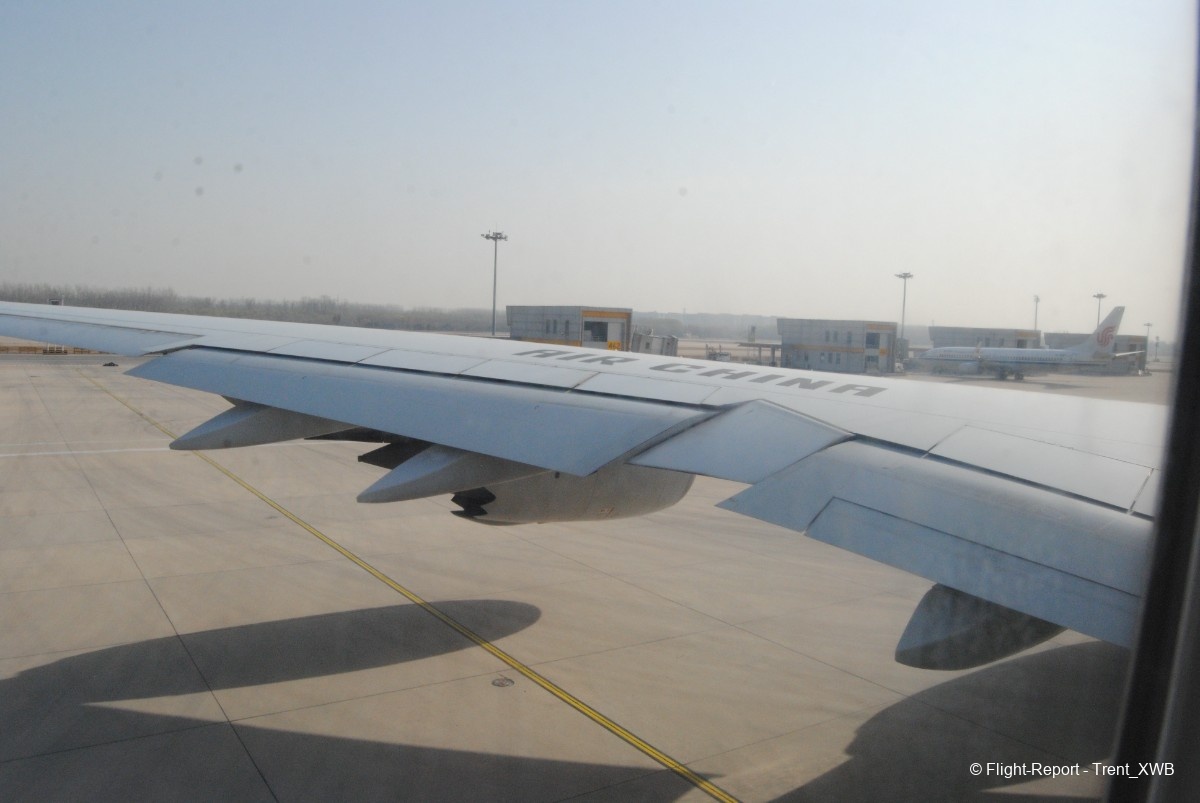
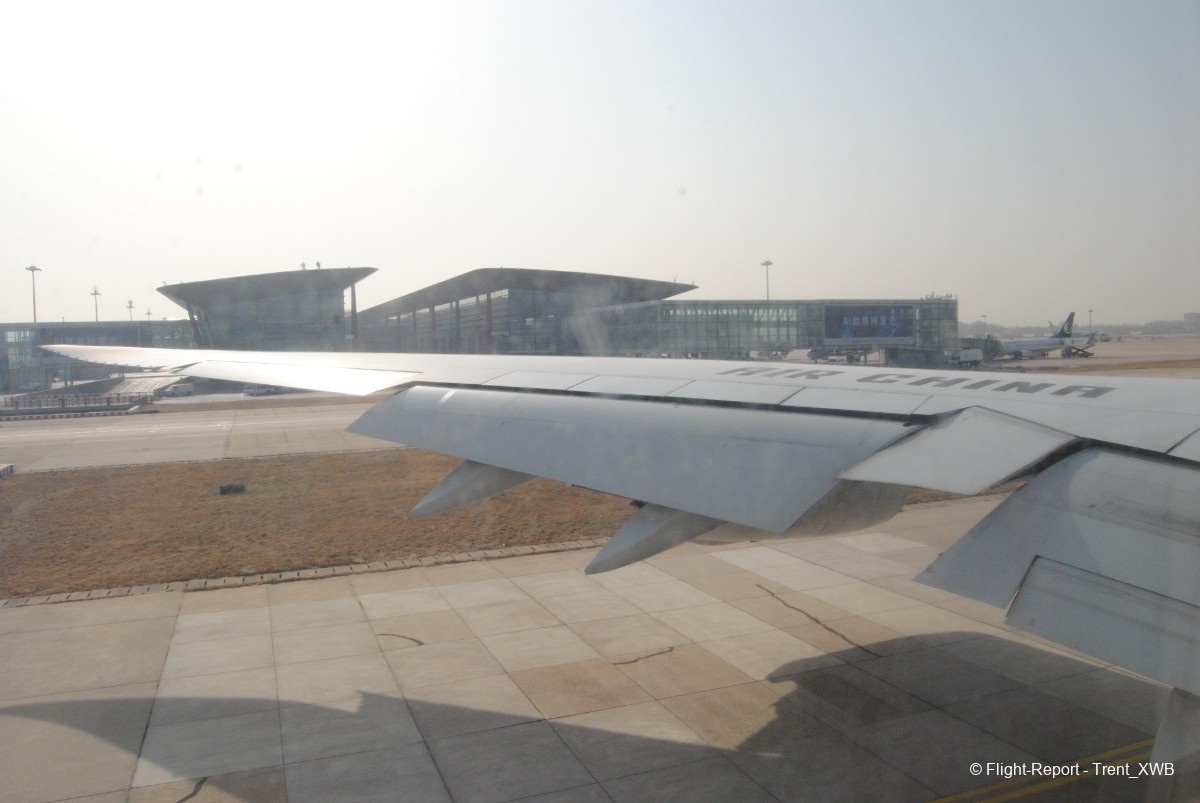
Taxiing past C-concourse of T3. When B748 wing is in takeoff or landing configuration, one can clearly see, how some B777 and B787 wings' features were implemented into the classic B747 wing.
Lining up to the runway.
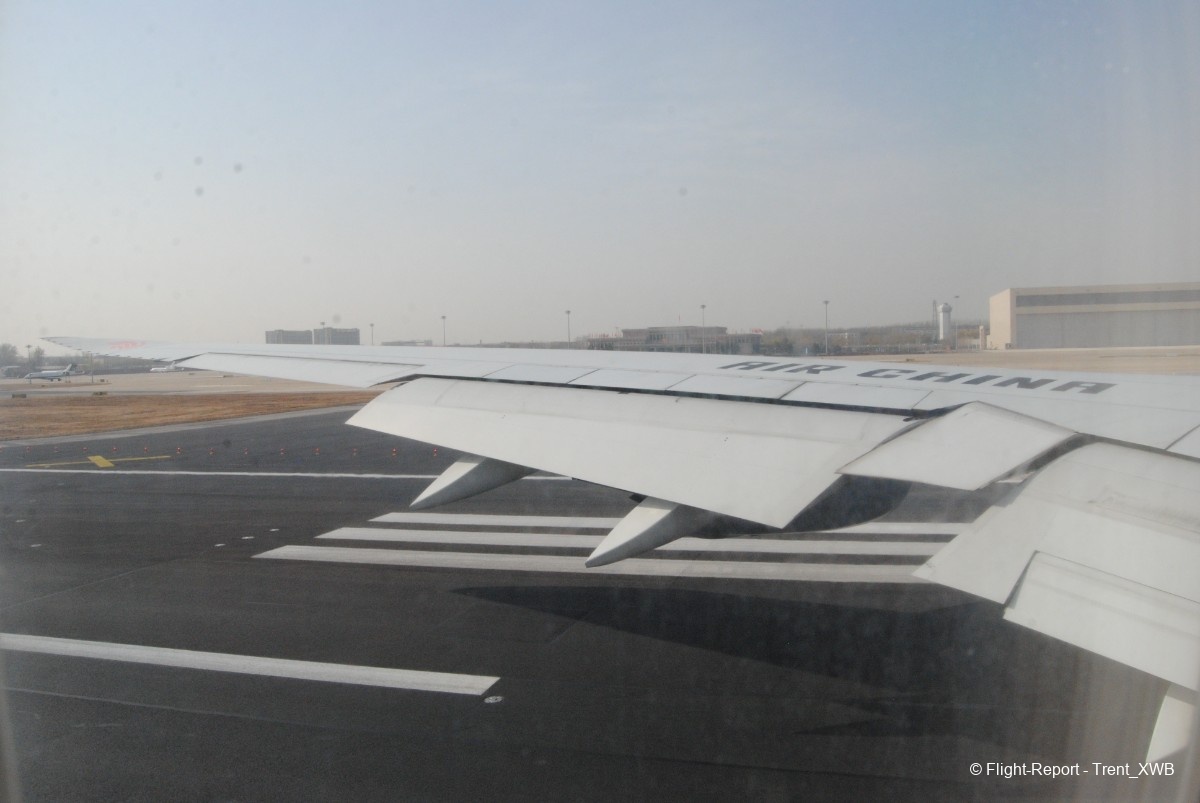
Takeoff with T2 and HU aircrafts in sight.
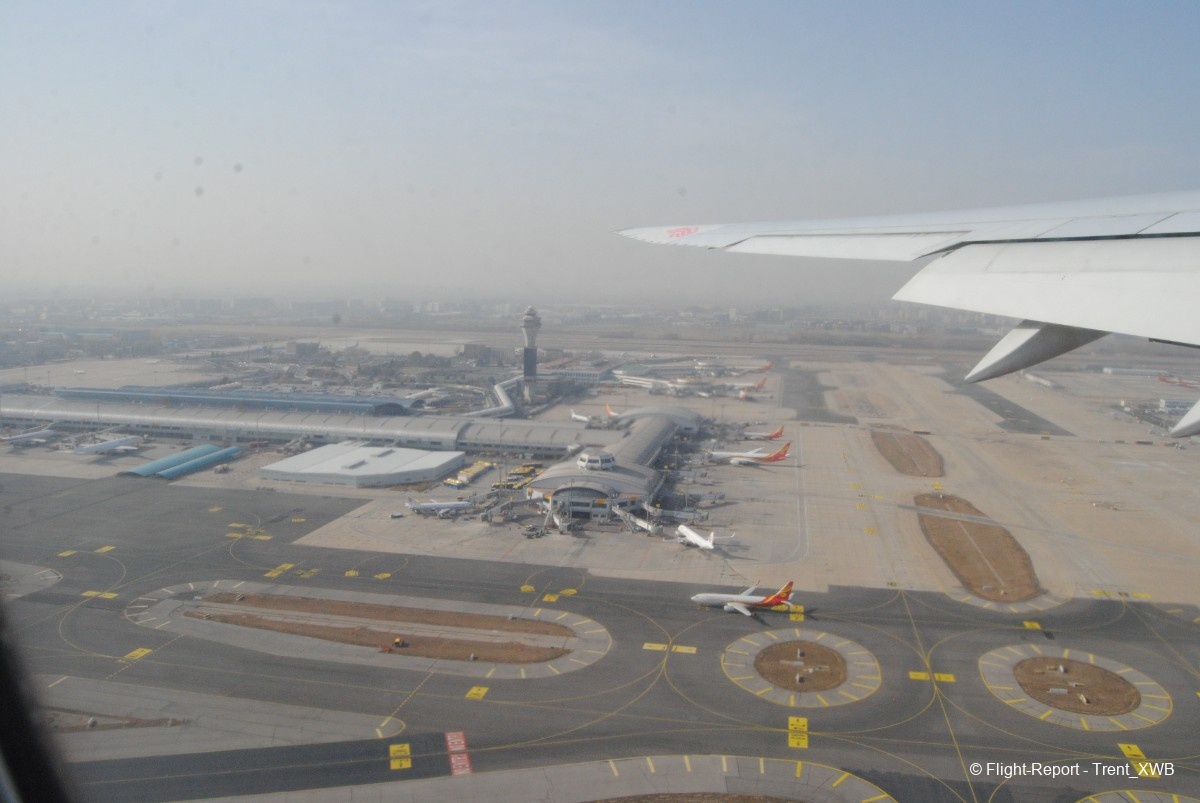
Climbing out above the thick smog covering Beijing and its suburbs (during my previous days in Beijing the air felt clear, so it was the right moment to escape the Chinese capital).
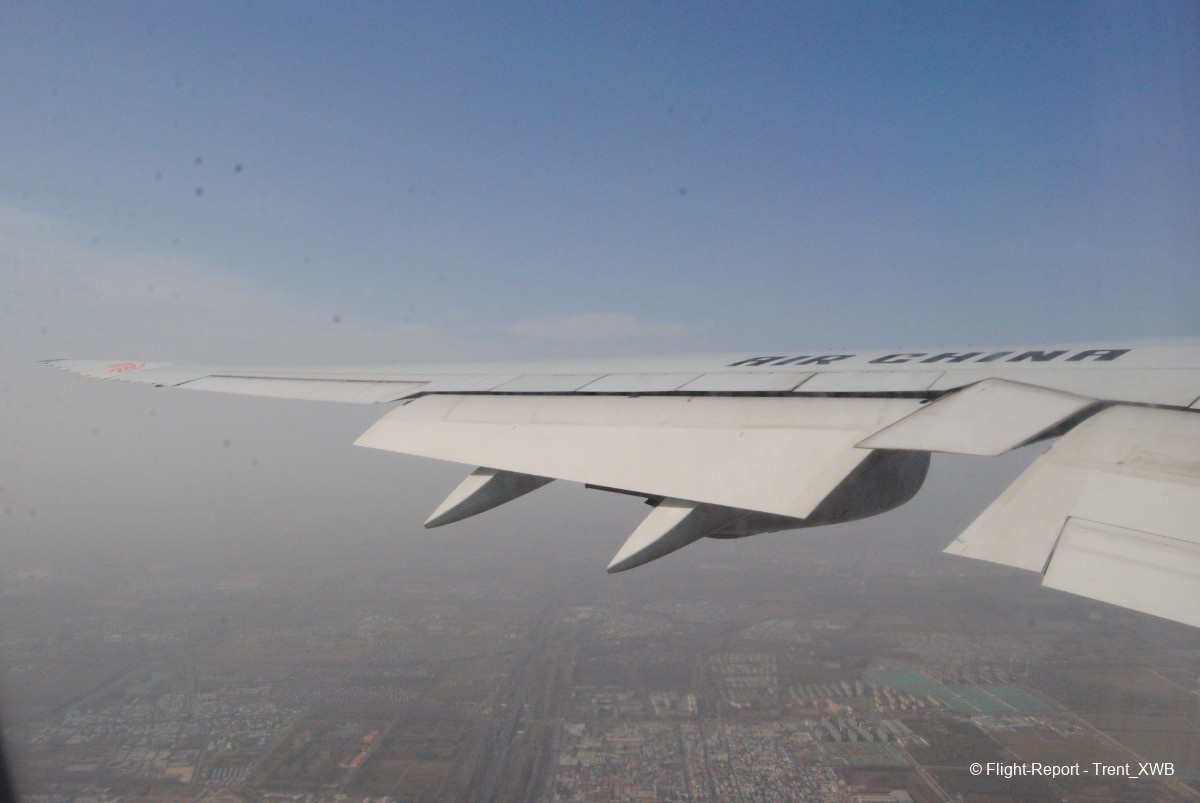
Flaps off, turning left above the sea of smog. One can clearly see how the famous B747 flaperons work.
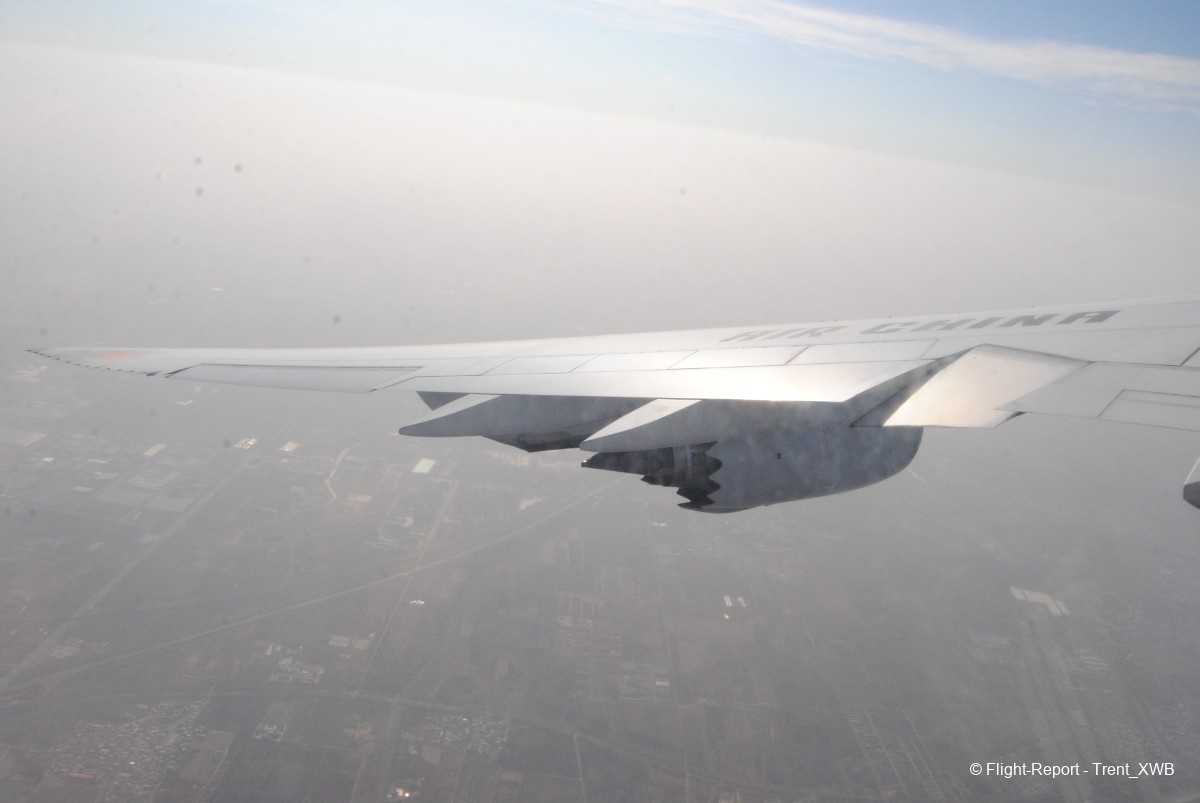
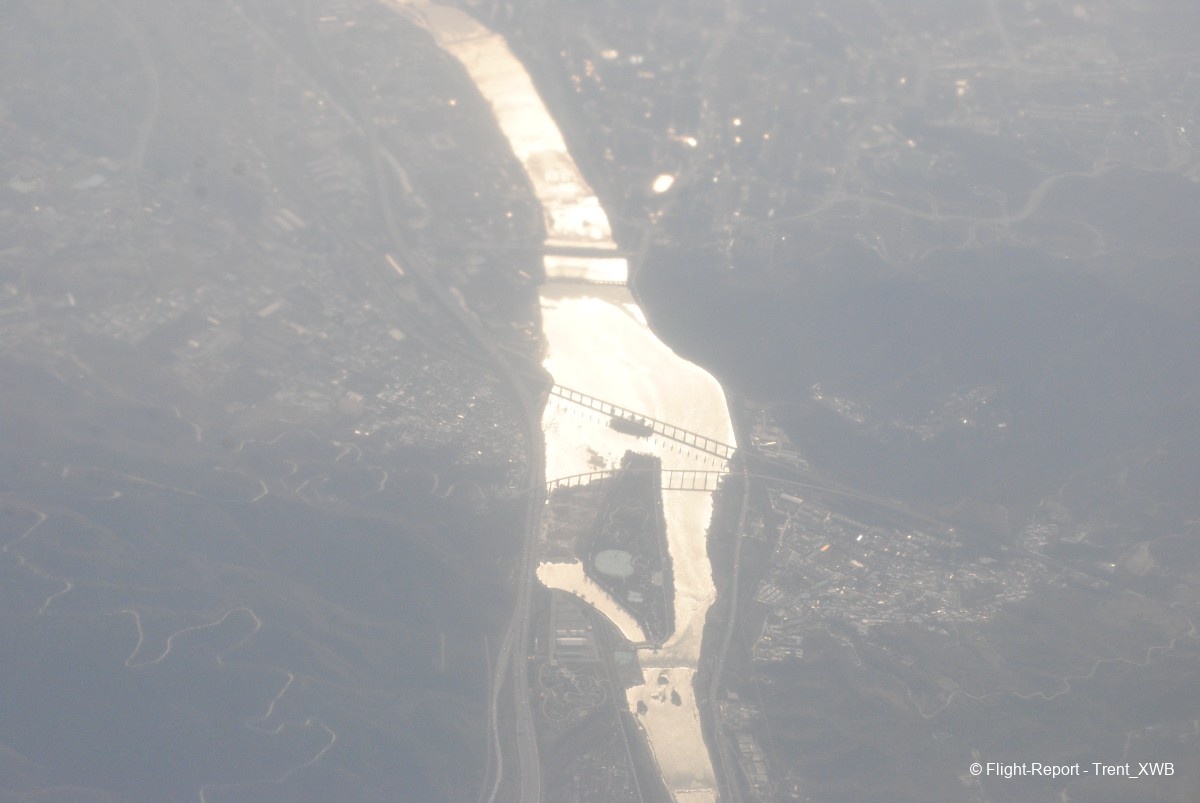
A river of gold with numerous bridges.
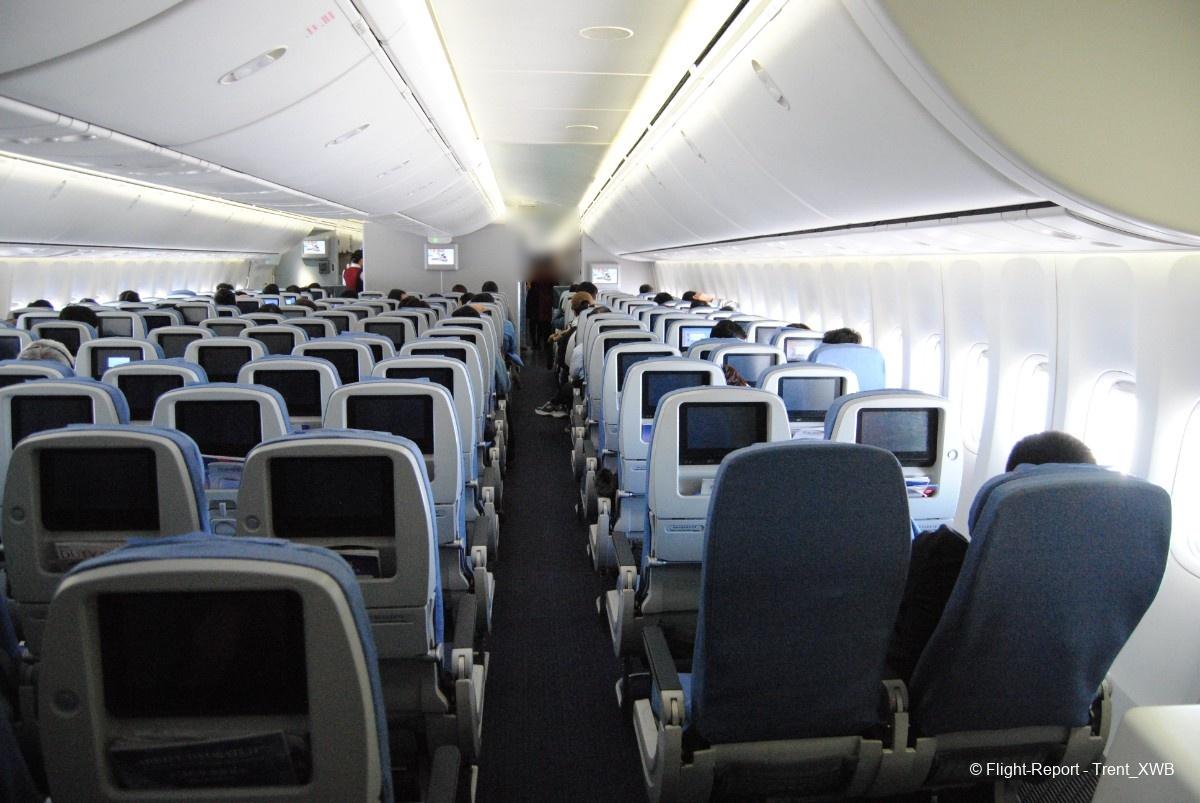
As we're reaching the cruising altitude, let's stretch the legs.
A couple of inflight views of the rear economy cabin. Notice the duo seat blocks in rows 60-62, aligned to the aisle. They have a huge gap between the B/K seats and the wall, which is good for lateral spaciousness and storage of the stuff, but very inconvenient for looking into the window.
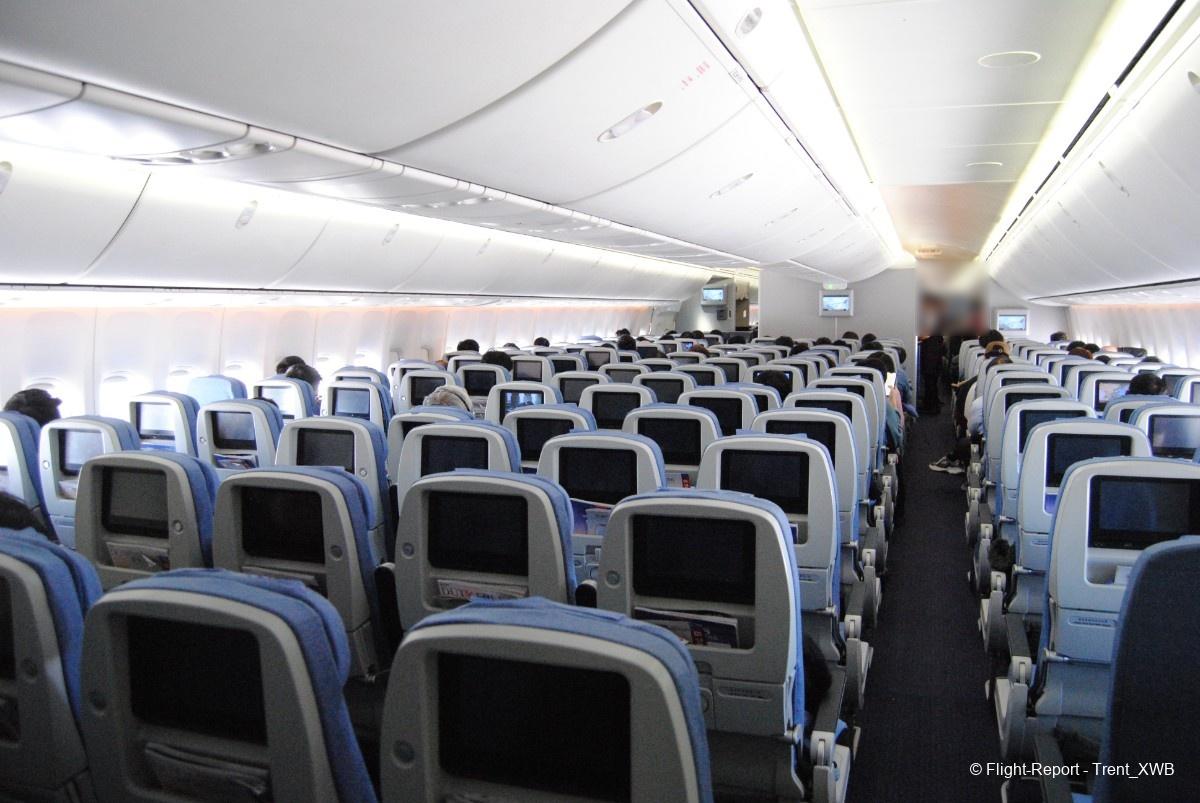
An inflight view of the front economy cabin.
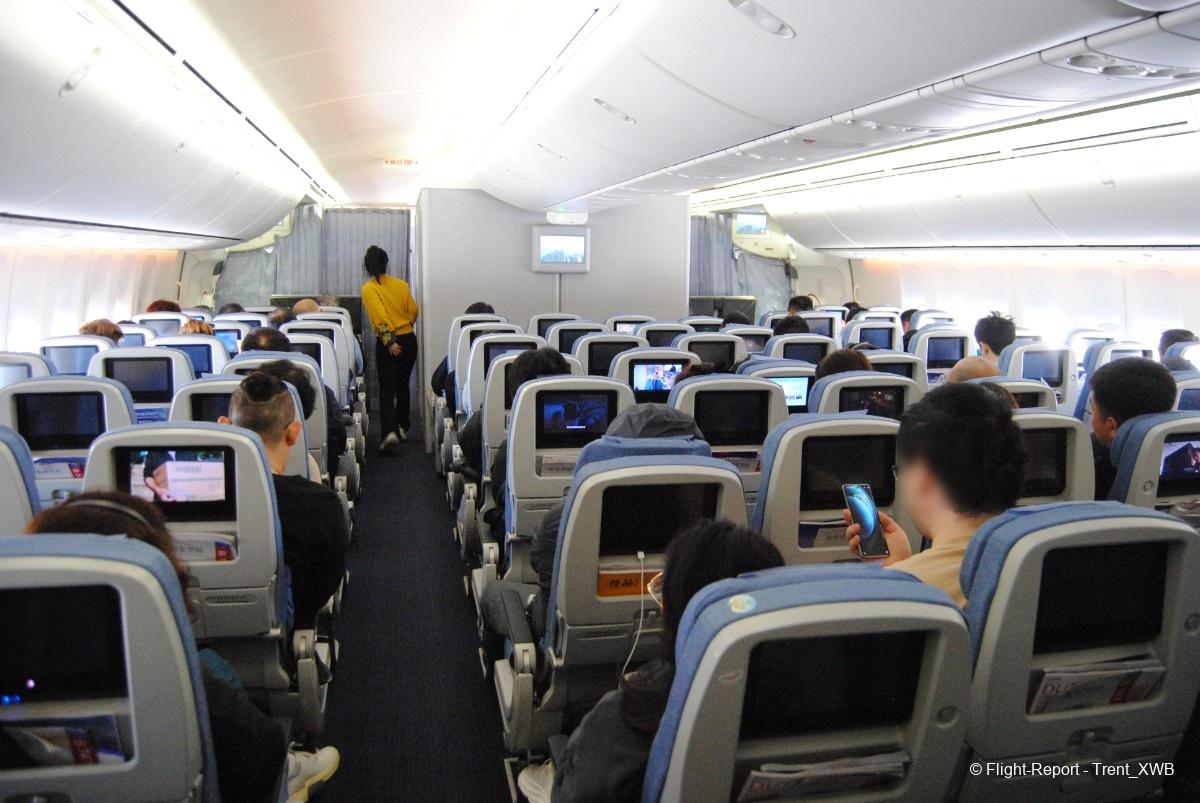
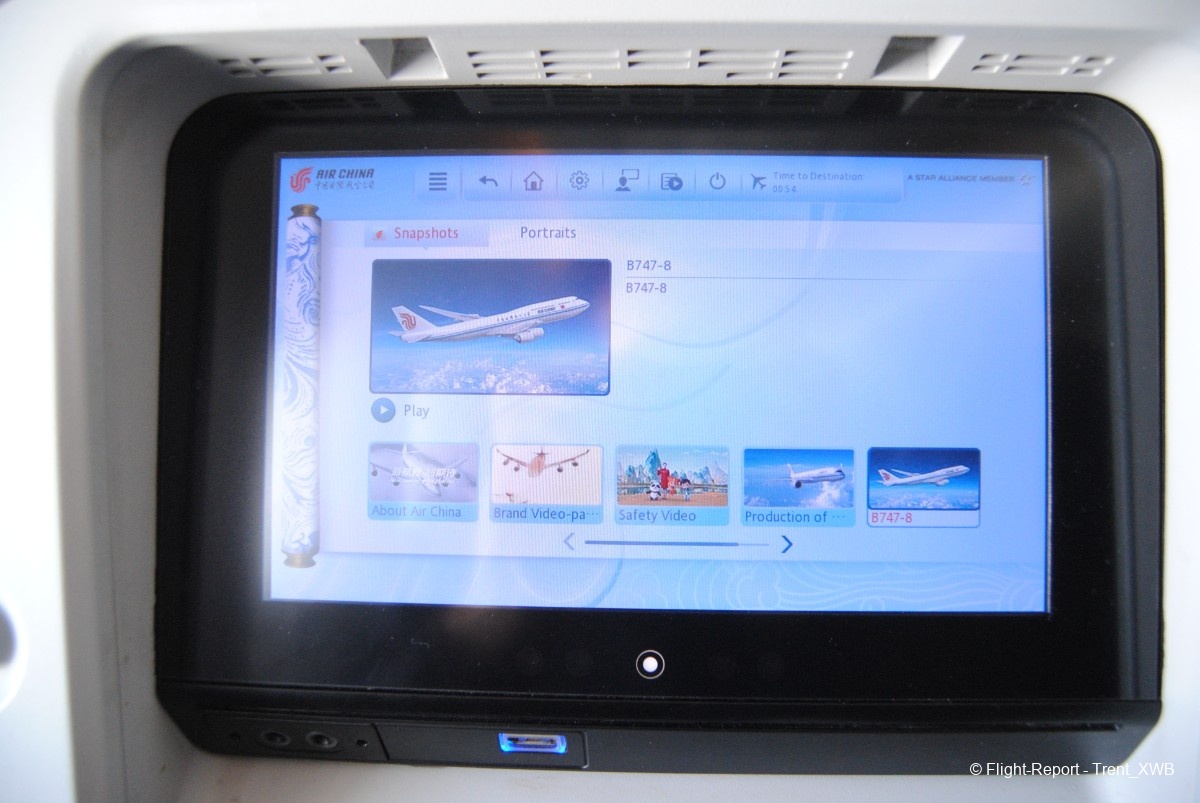
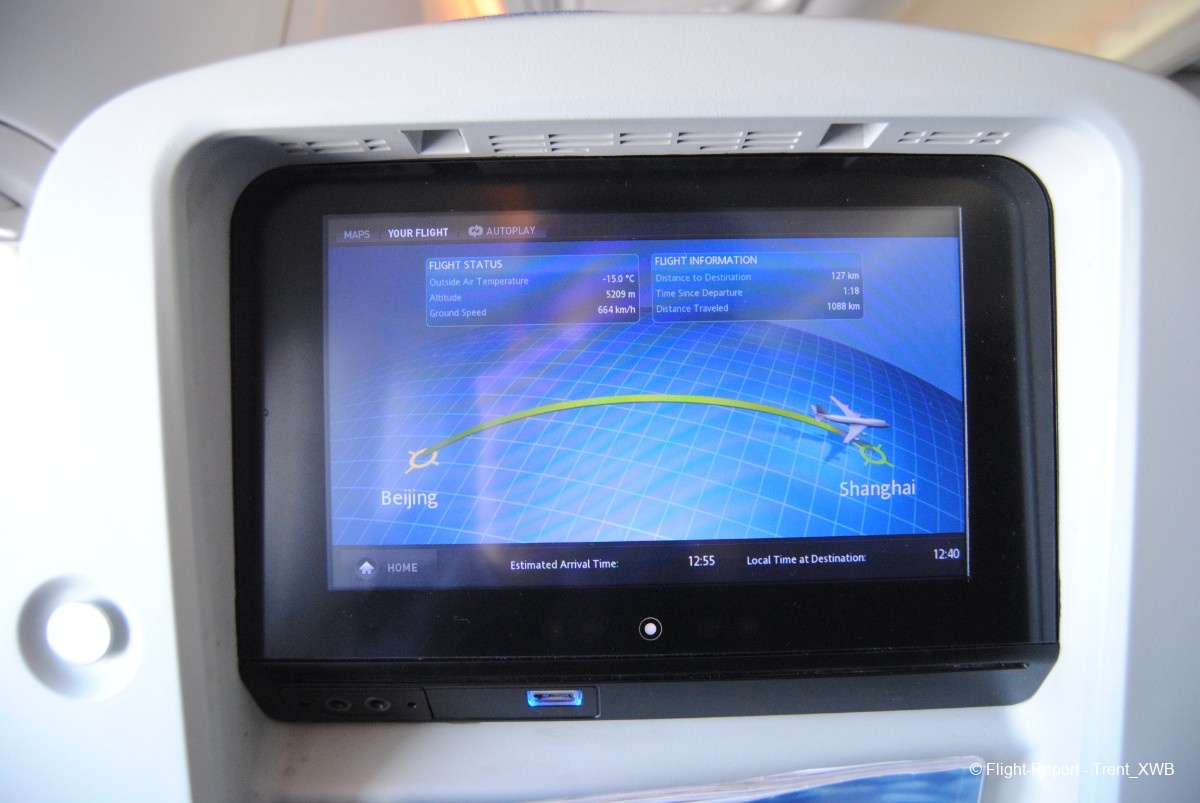
Let's explore the IFE. It turned to be rather weak content-wise, compared to the ones in KE B748 and LH B748. At least the seatmap is partially adjustable. One can see that having just reached the cruising FL, we've already covered 1/3 way to SHA.
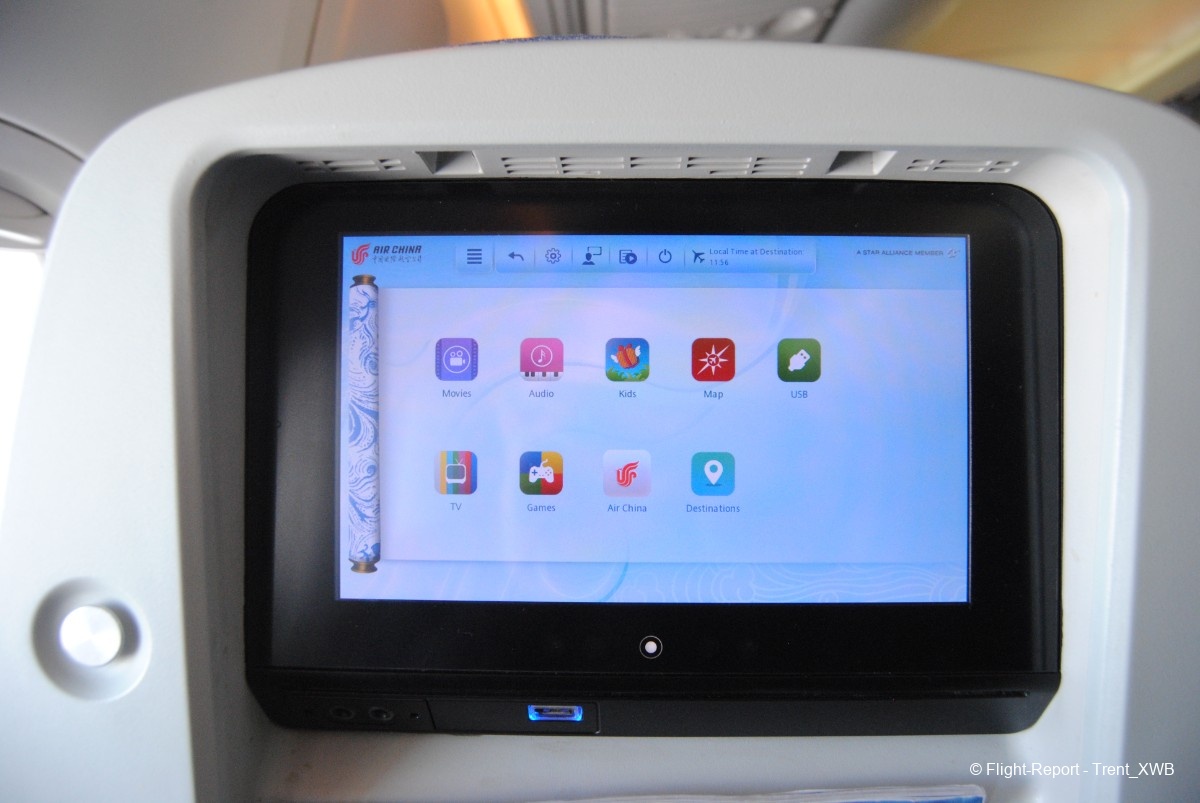
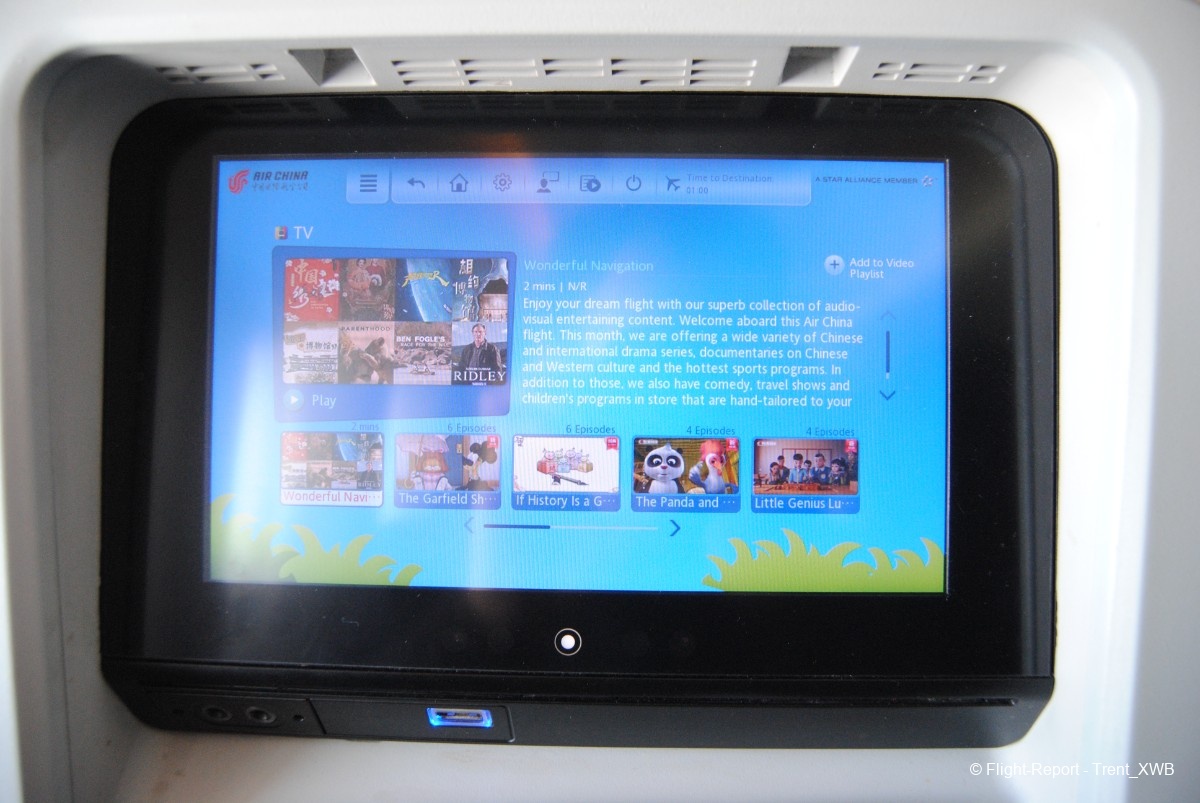
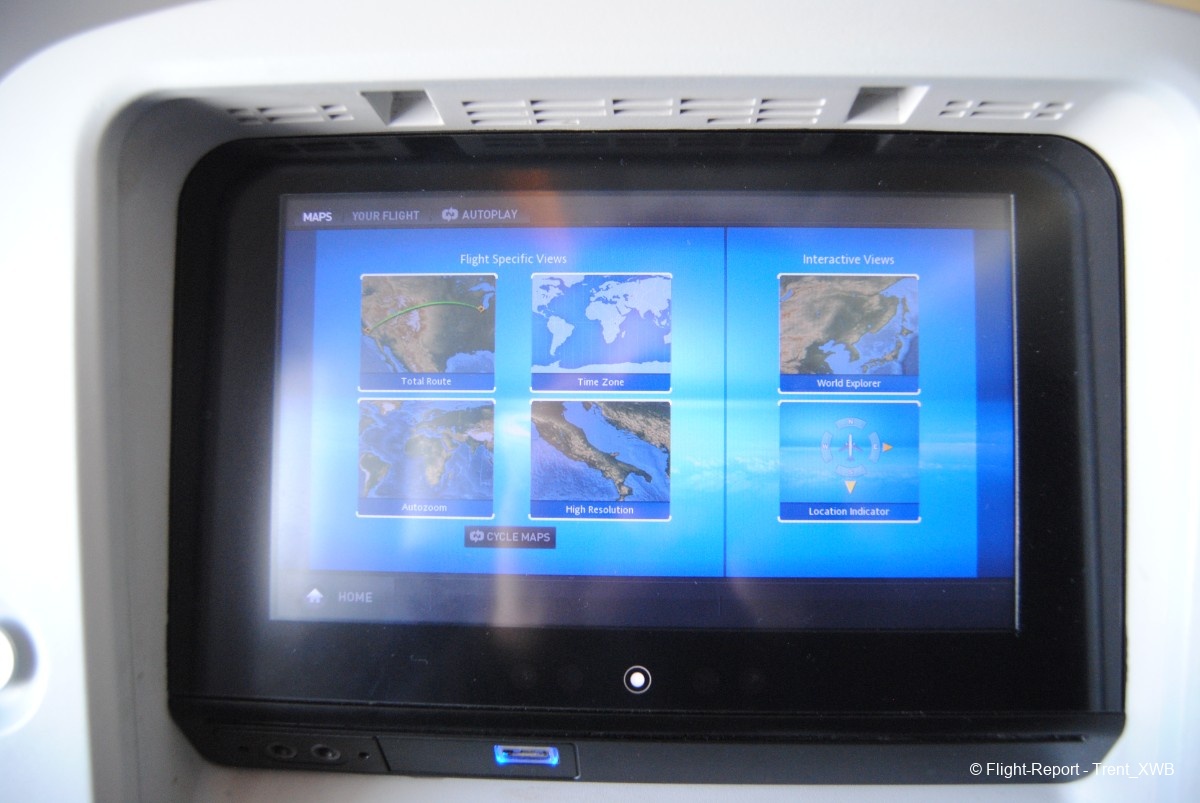
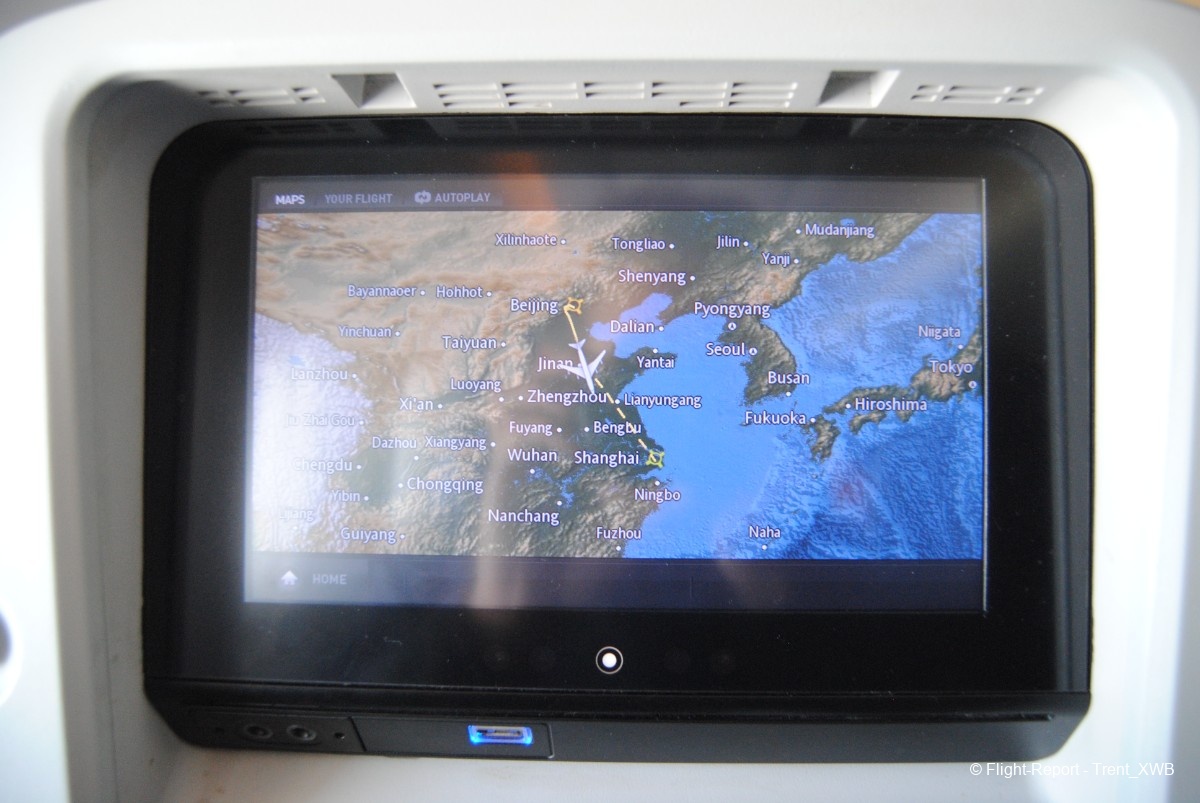
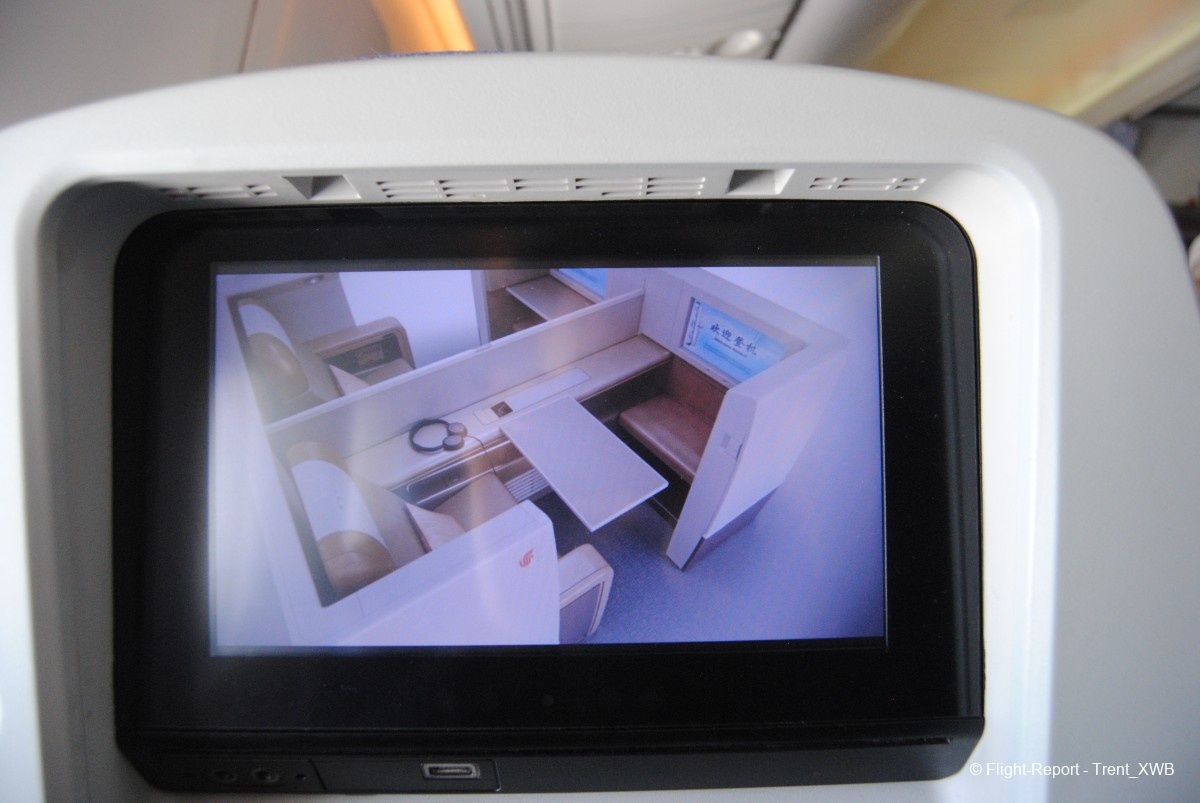
The most interesting part of IFE is the video about the star of the show - B748. Have you noticed something unusual about the upper deck on the 2nd photo in this gallery? If not, you'll see further.
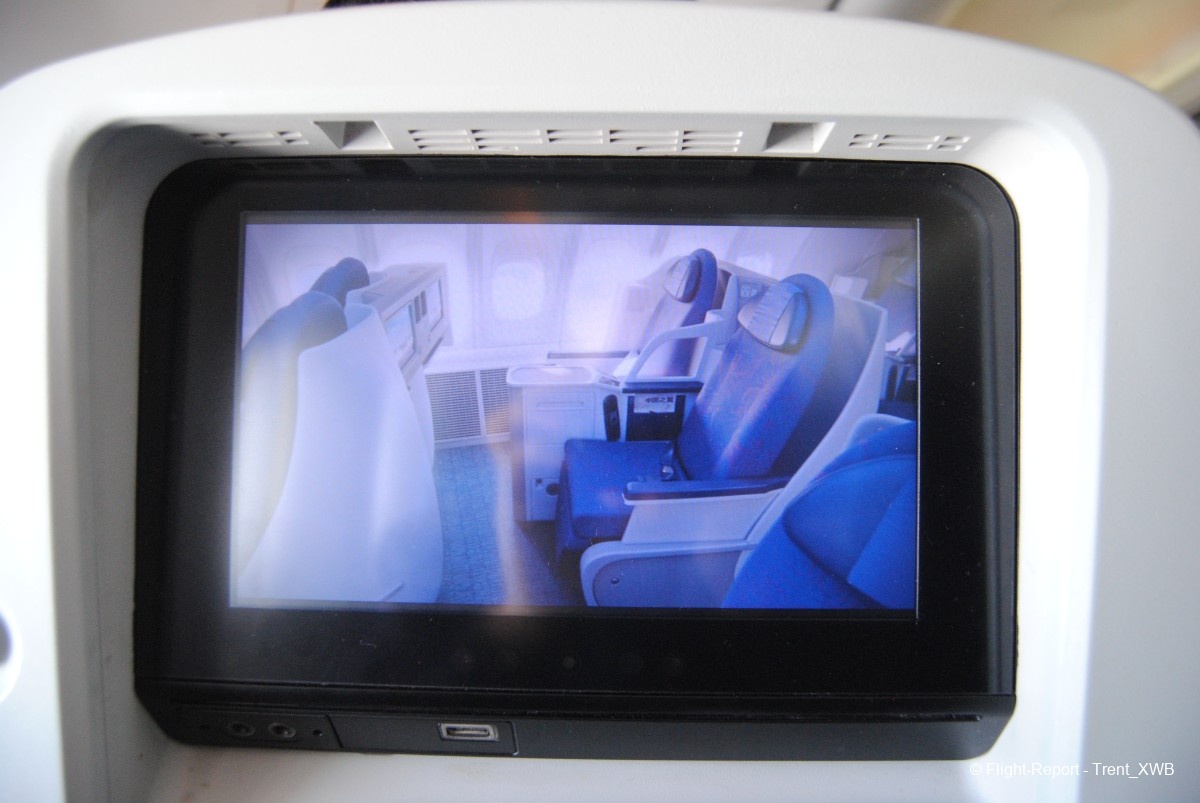
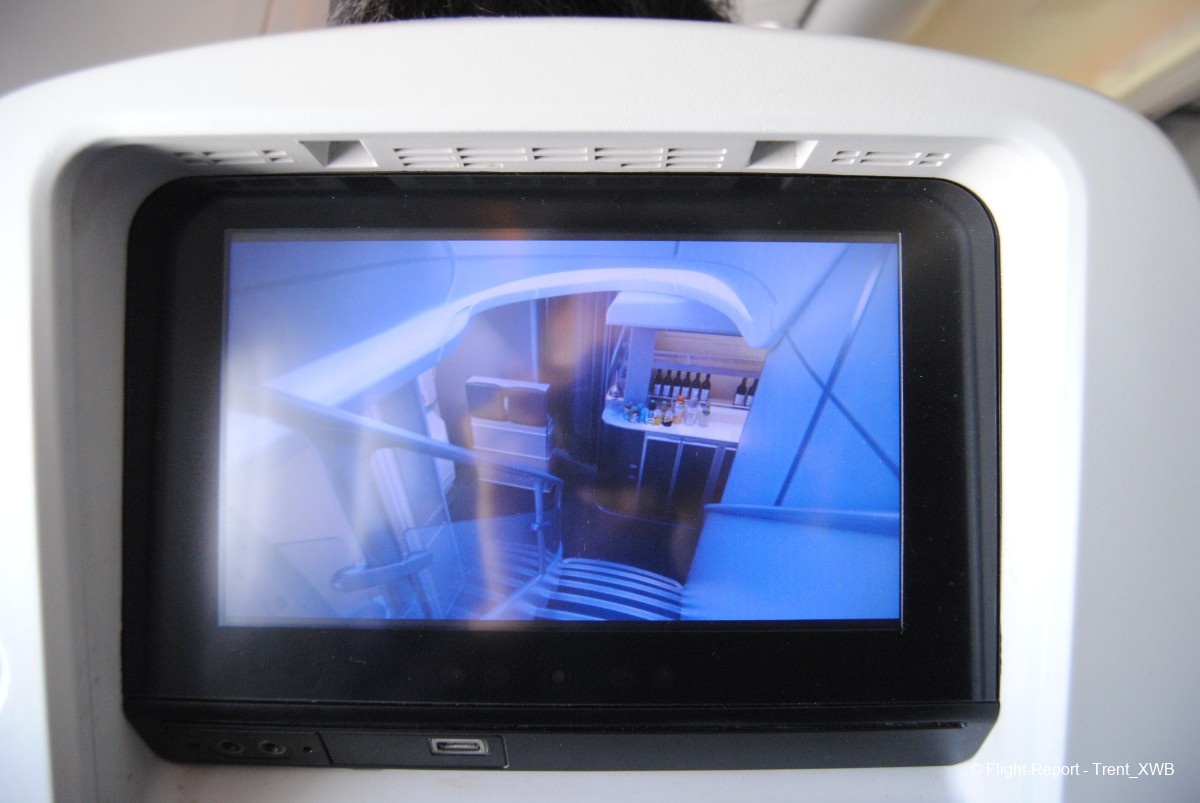
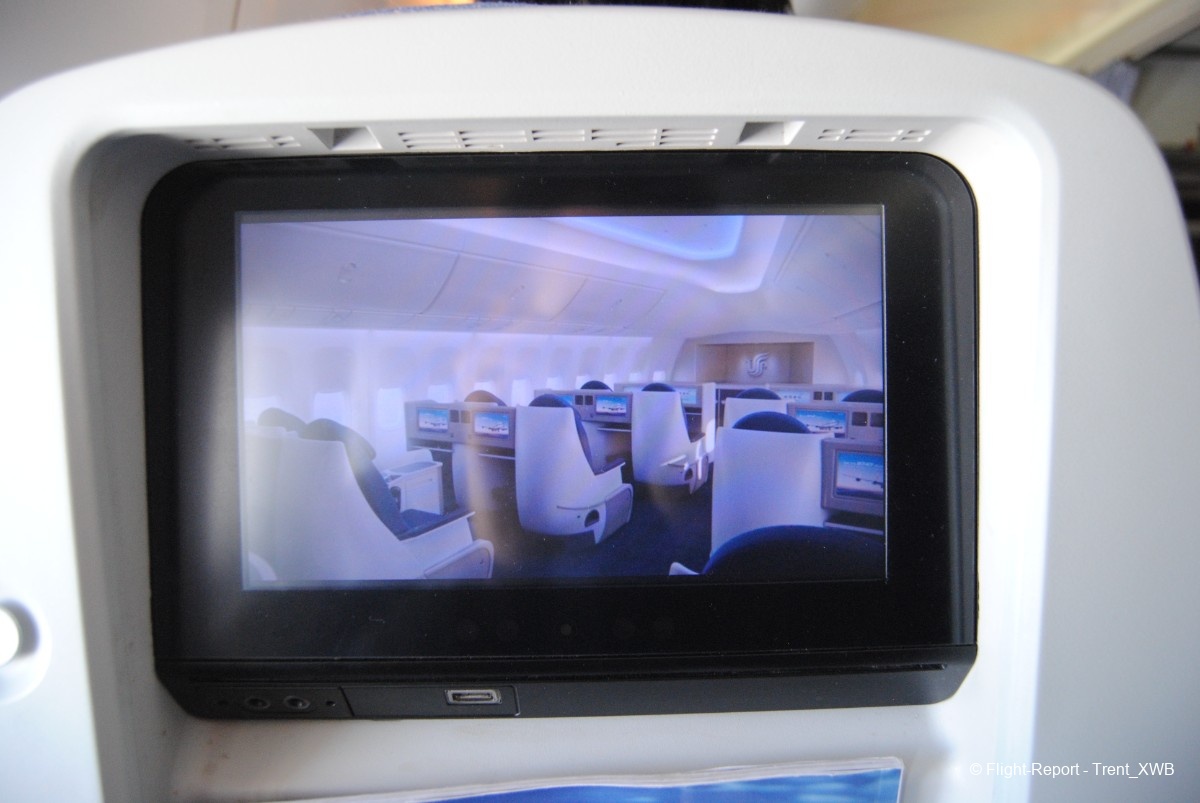
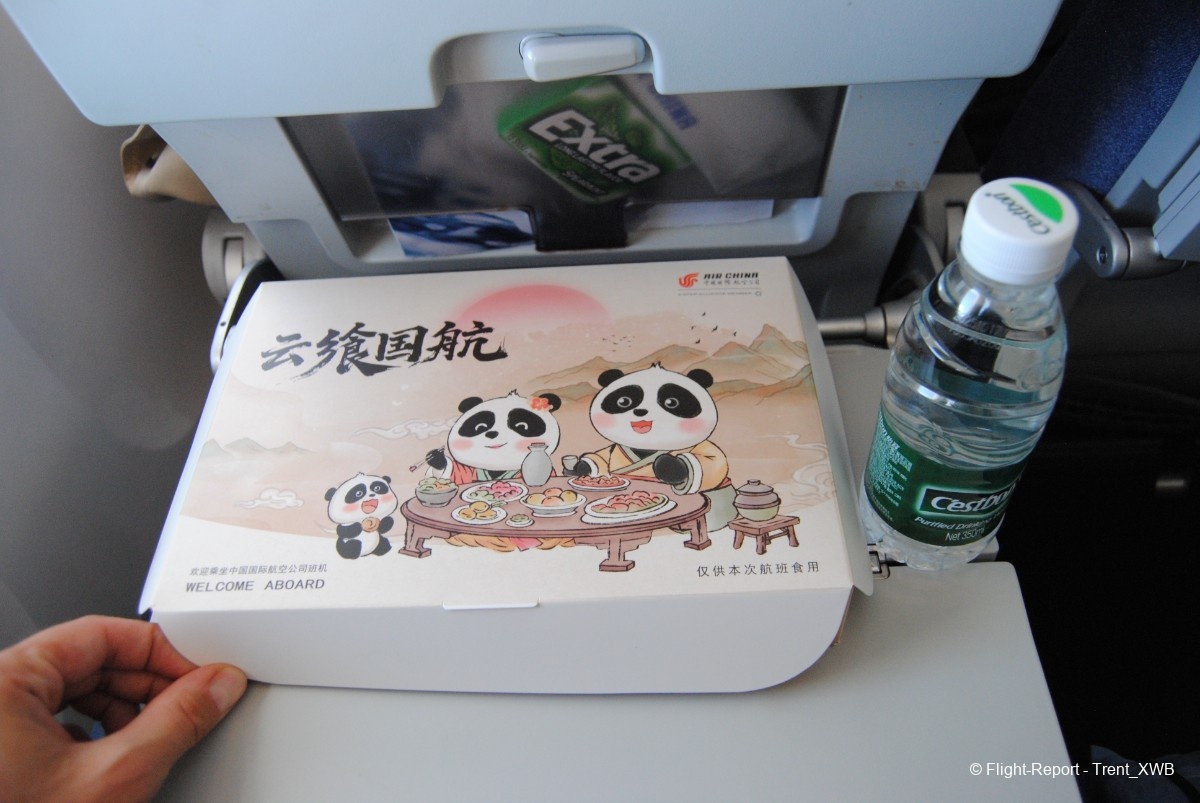
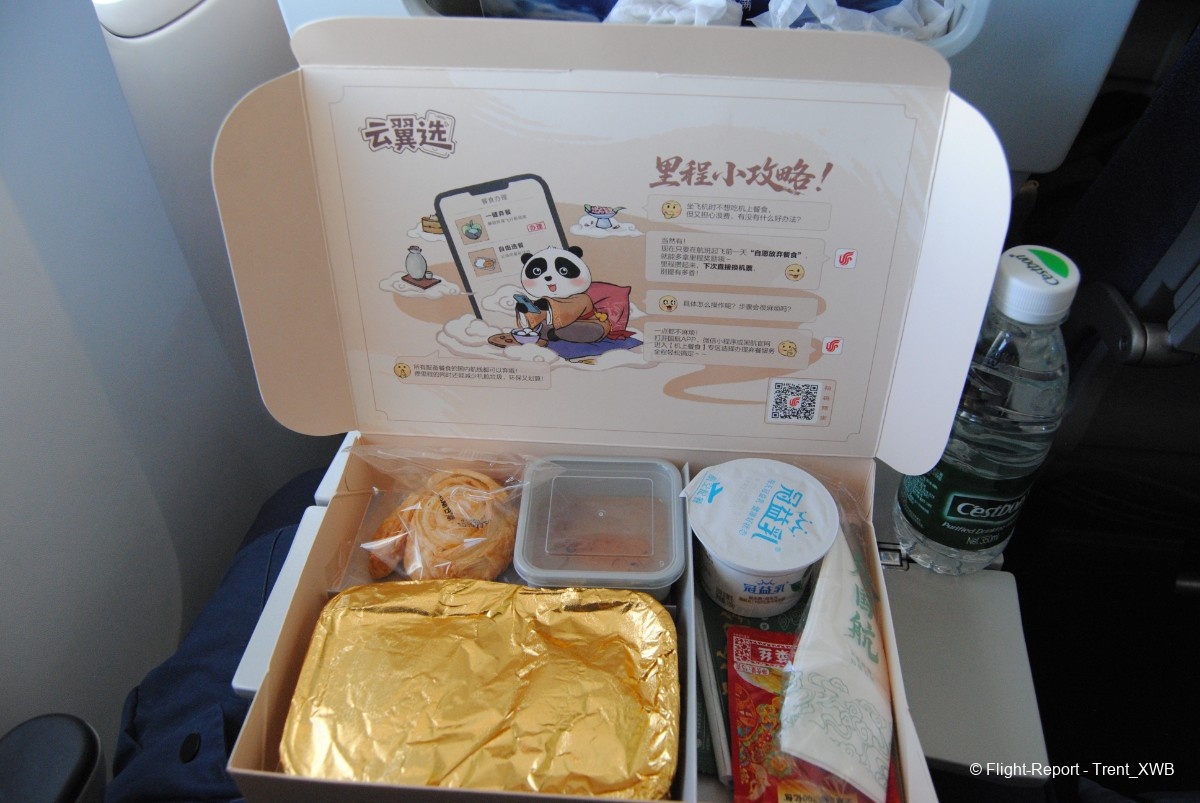
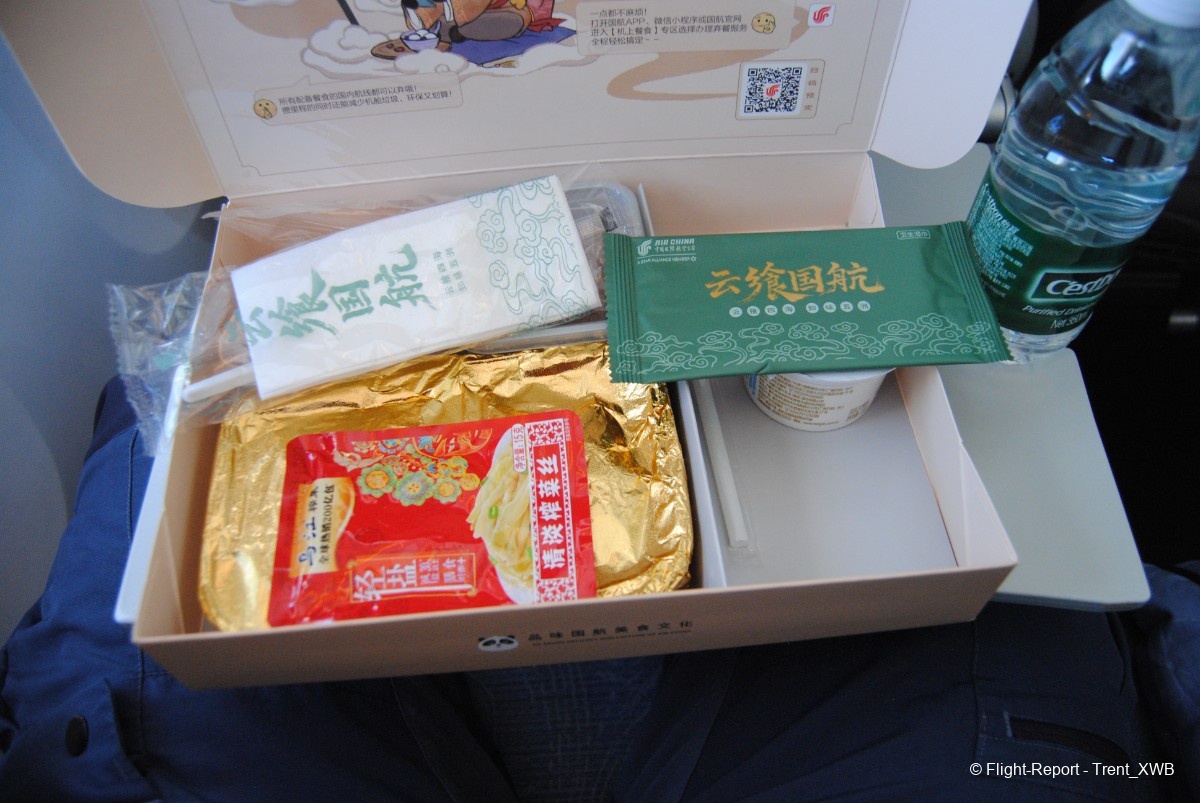
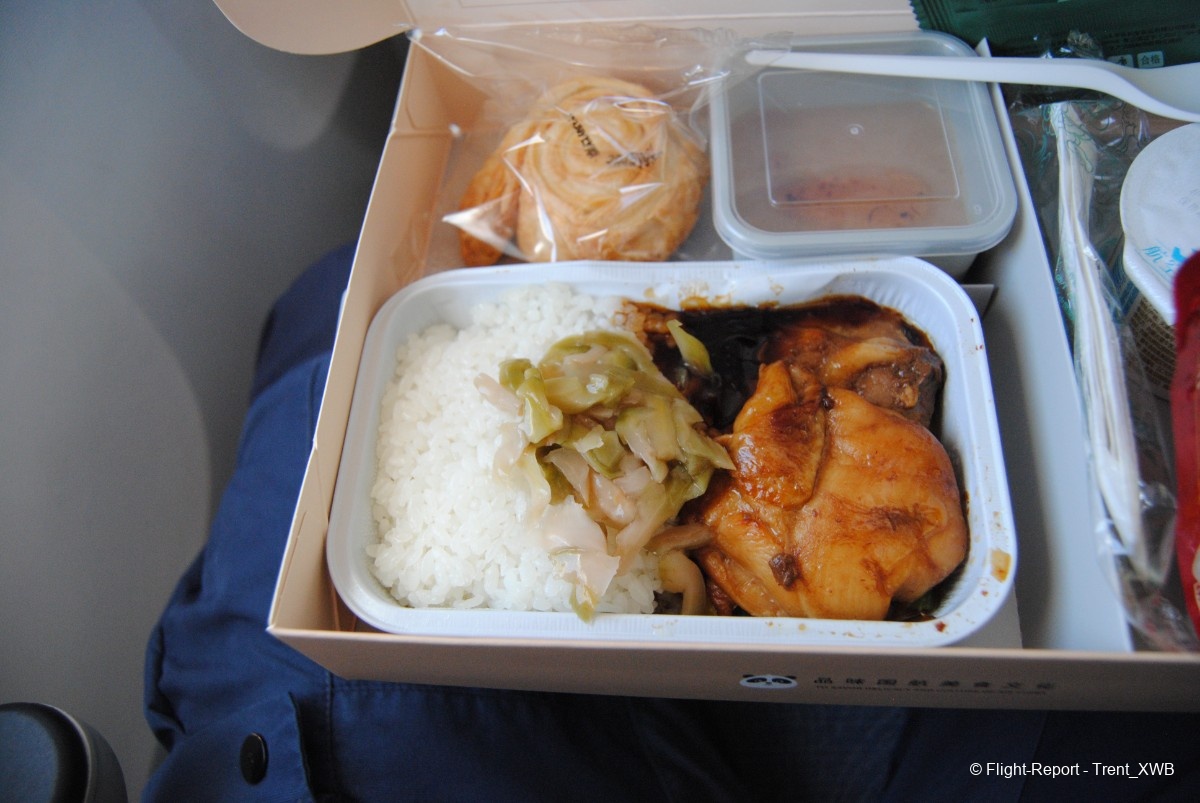
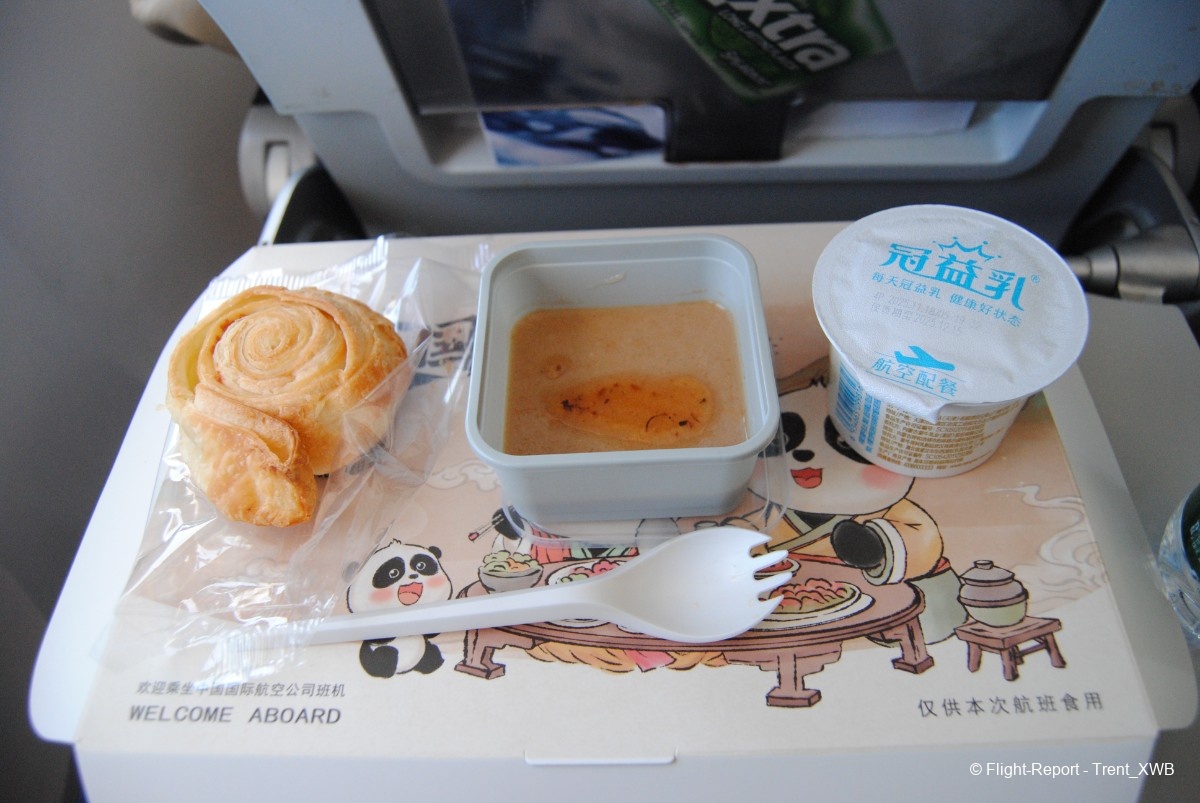
As we're halfway to SHA, the meal service is started. Just look at this - a beautifully presented hot meal on a short 1.5-hours flight! Wow! It's the same level of service as I experienced on OZ NRT-ICN flights! At the same time no drink service was provided, so a small bottle of water was all you can drink. So, I recommend to take your own bottle and fill it in the airport, given that Chinese airports always have water dispensers.
And I have to admit how nice and welcoming were the crew.
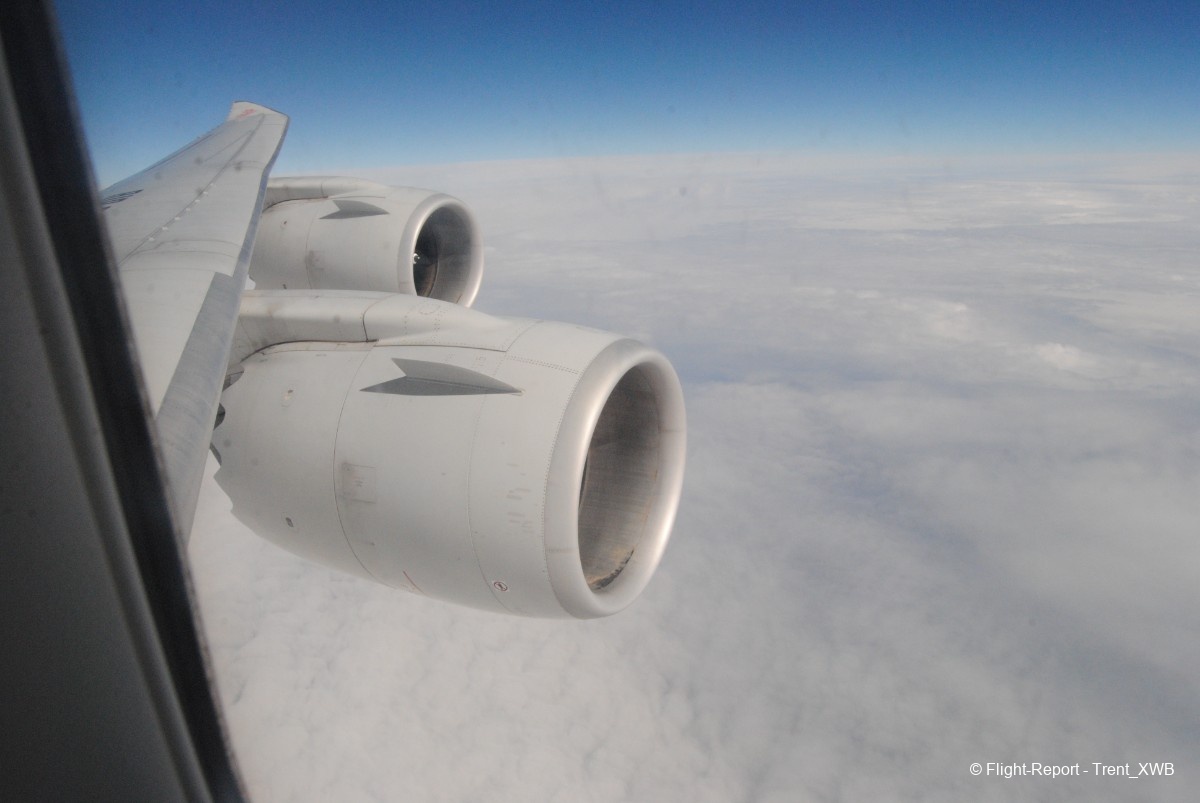
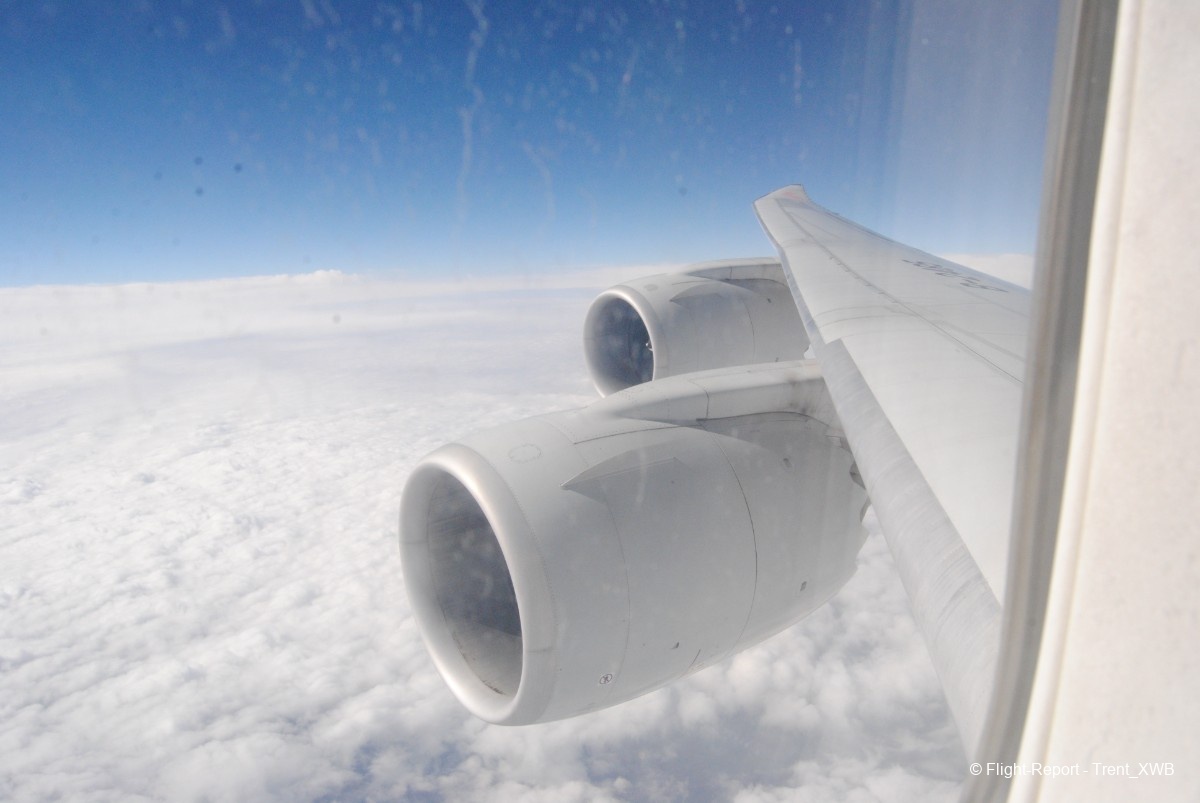
After the meal the crew allowed me to go to 2L/R doors for the nice engine views. The advantage of CA1557 flight in late November is that its timing aligns perfectly with the highest position of sun and the best possible light.
The stair to the upper deck from a nice angle (and yes, I asked the crew about visiting the upper deck after the flight; you'll see the result further).
Given that the economy+ cabin was almost empty, I made detailed photos of its seats. Could you guess why the seats have fixed armrest with armrest-mounted tray tables? Because of the large seat pitch, which makes inconvenient the use of the seatback tray tables! So, economy+ passengers de-facto have 2 tray tables (but due to the fixed armrests you cannot arrange "poor man's business class" if you have the 3- or 4-seater block at your disposal, whereas in regular economy you easily can). In this video by Jayden Wong you can see how it works (and also this video reveals that the meal service in the "economy plus" is the same as in the regular economy class).
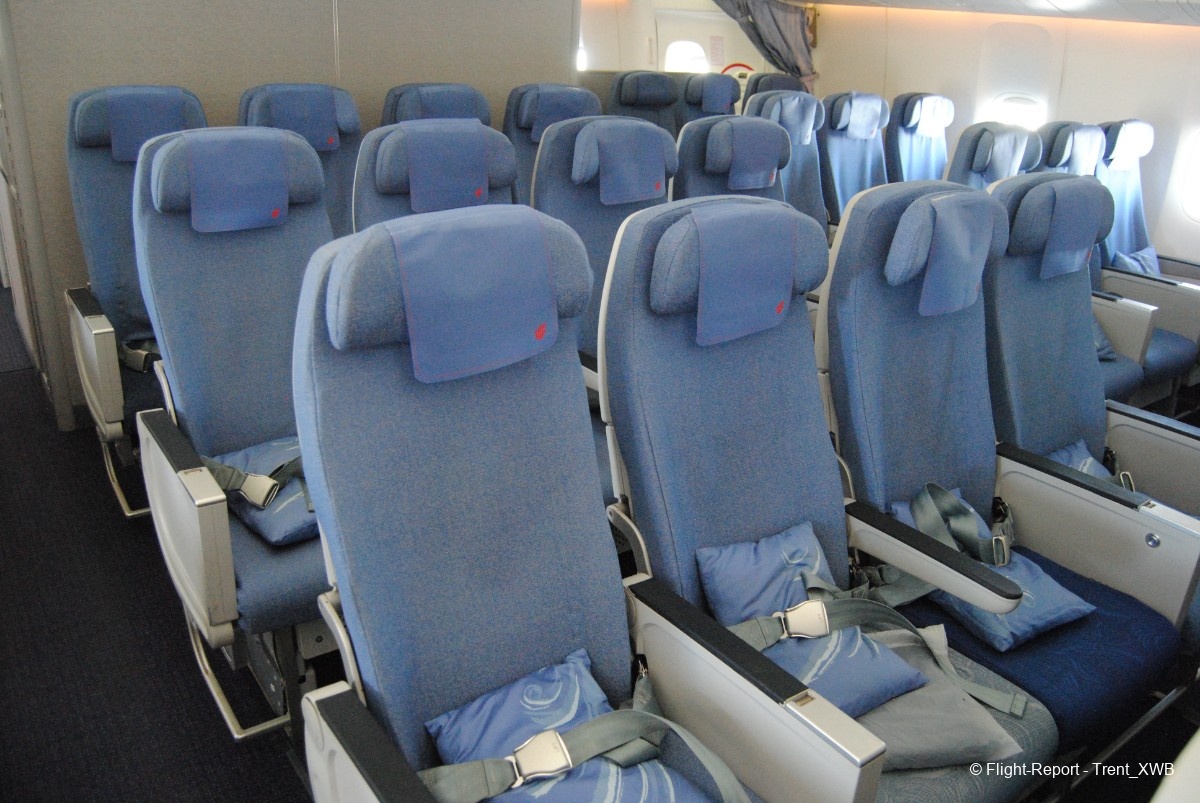
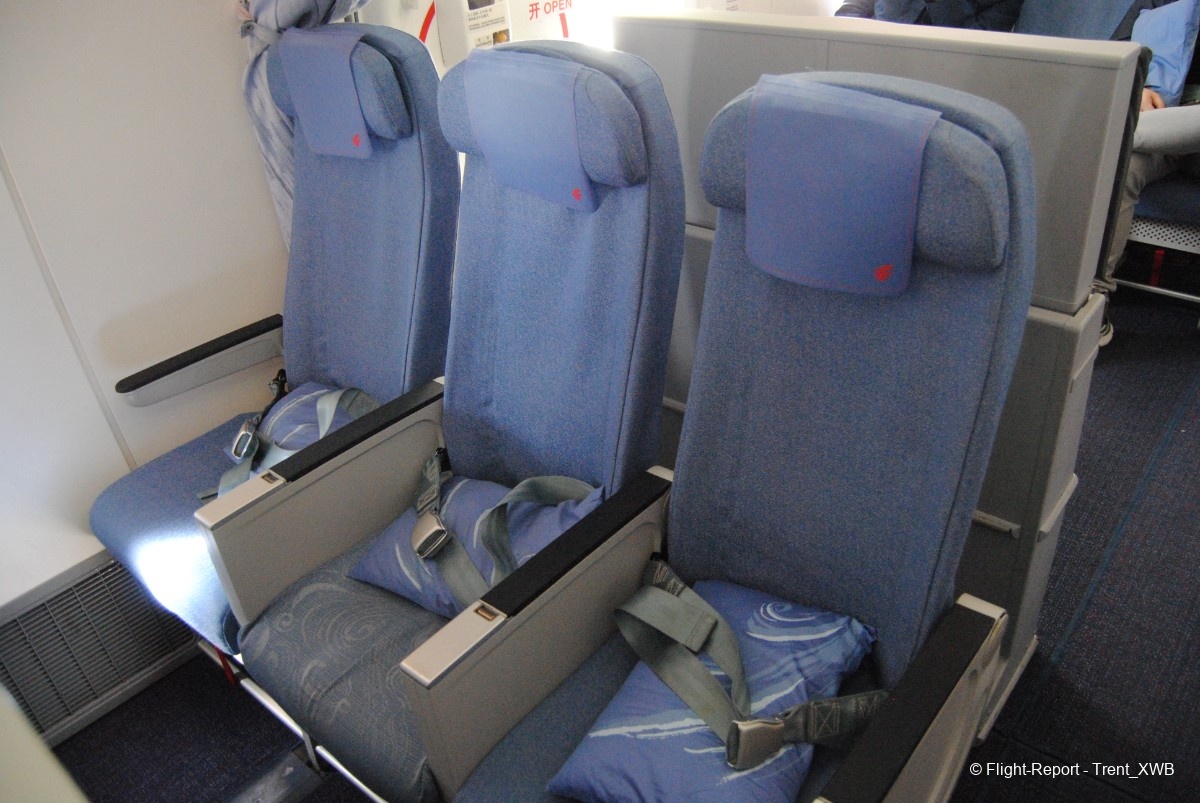
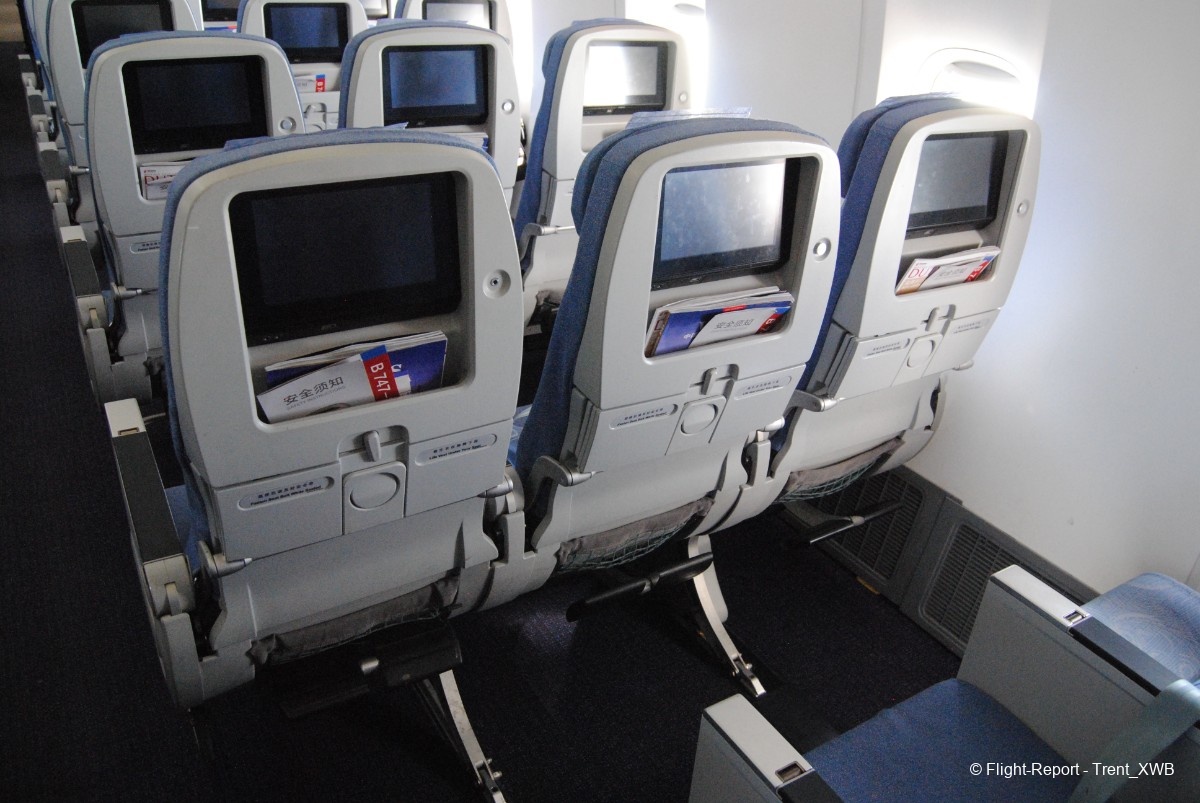
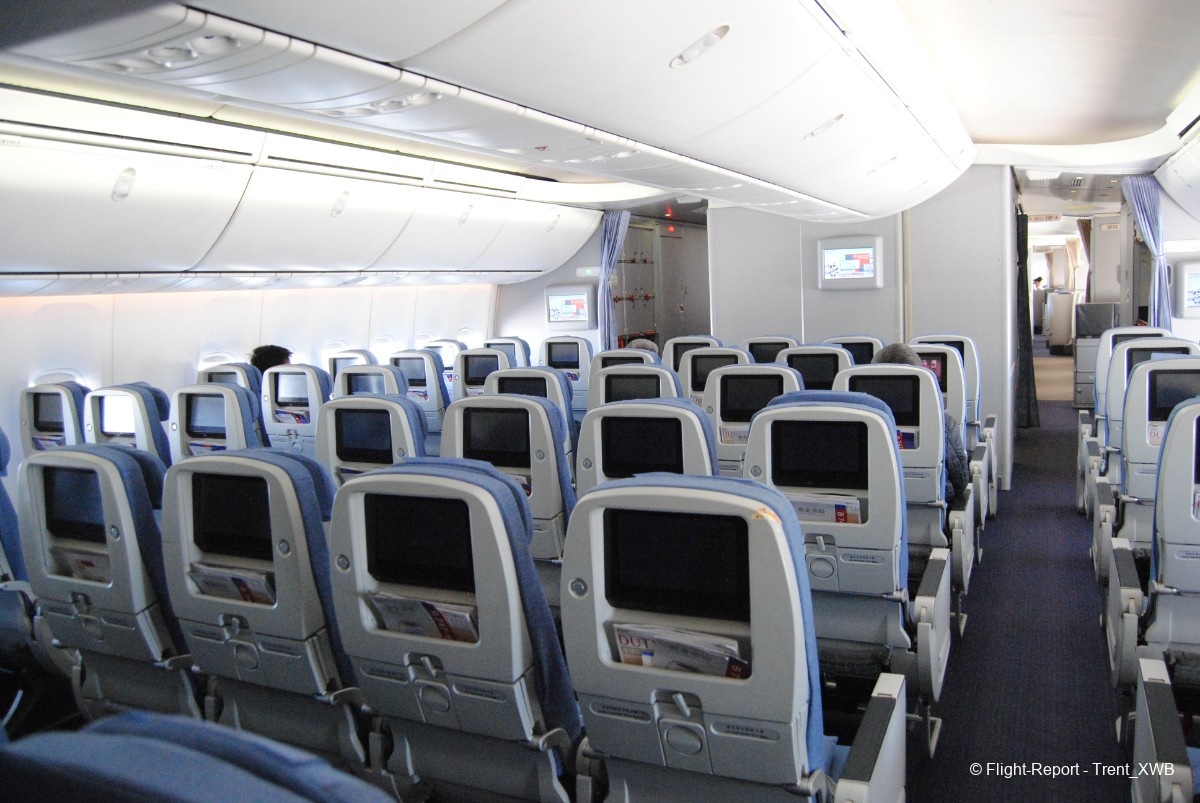
As we're slowly starting to descend, it's time to return to the seat and just enjoy the rest of the flight.
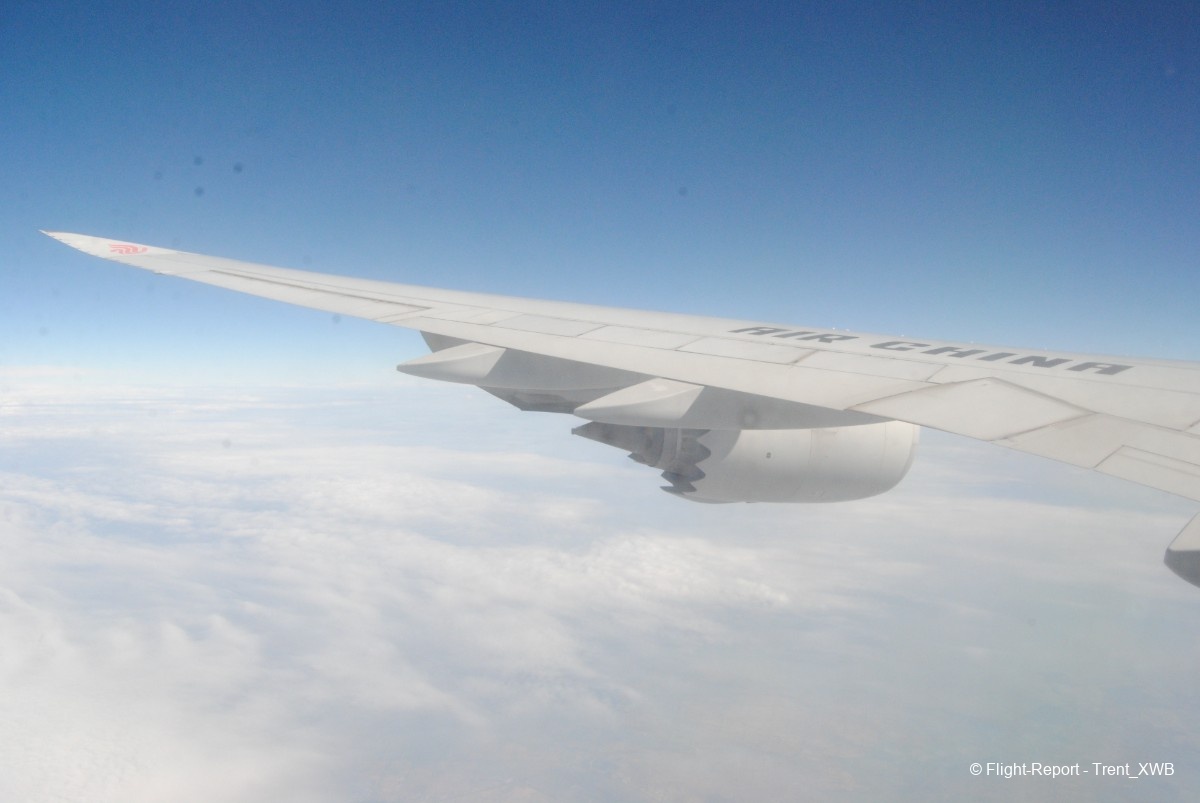
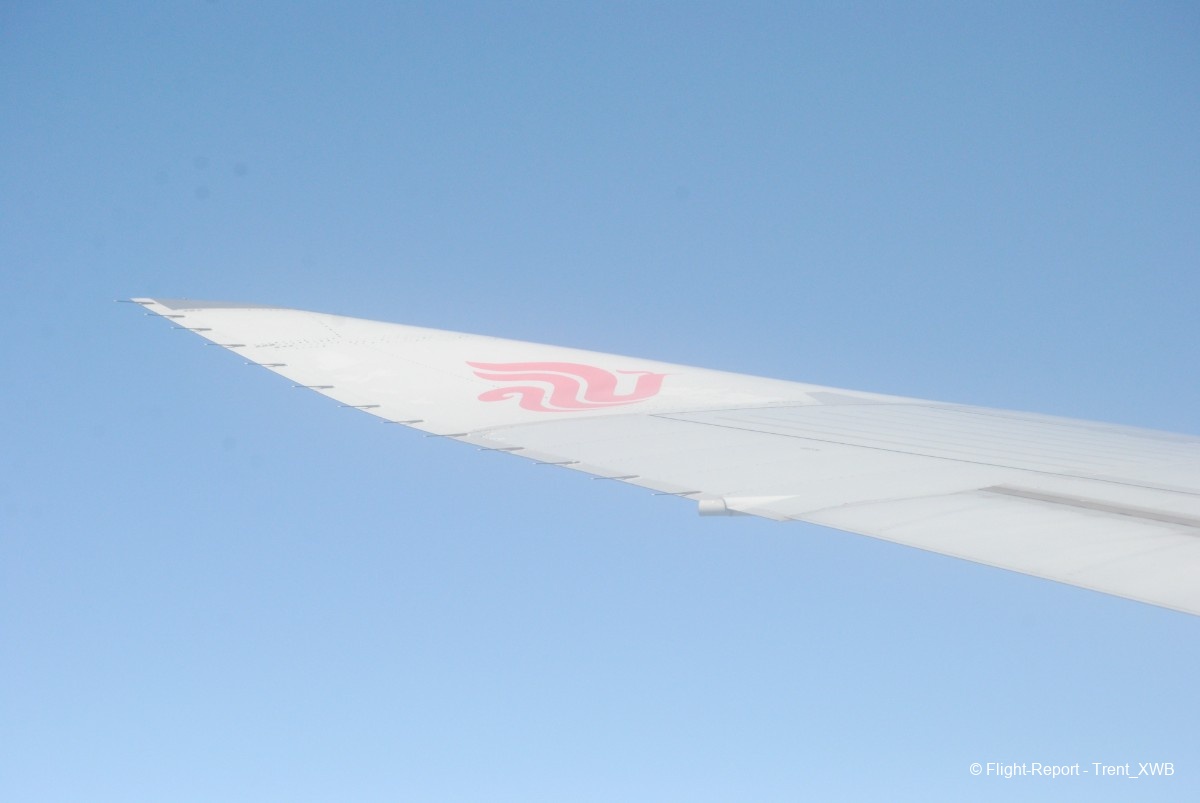
B748 wing and its wingtip with CA's phoenix logo.
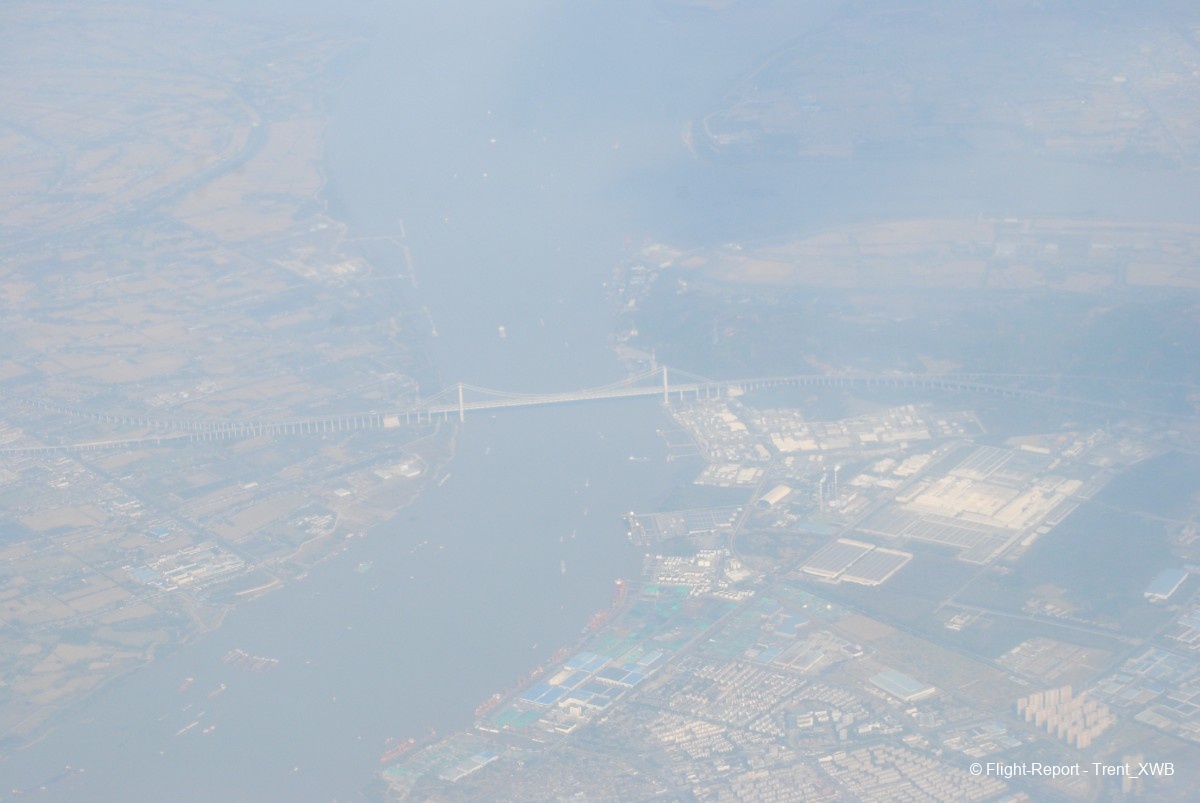
Overflying Yangtze river with some of its impressive bridges.
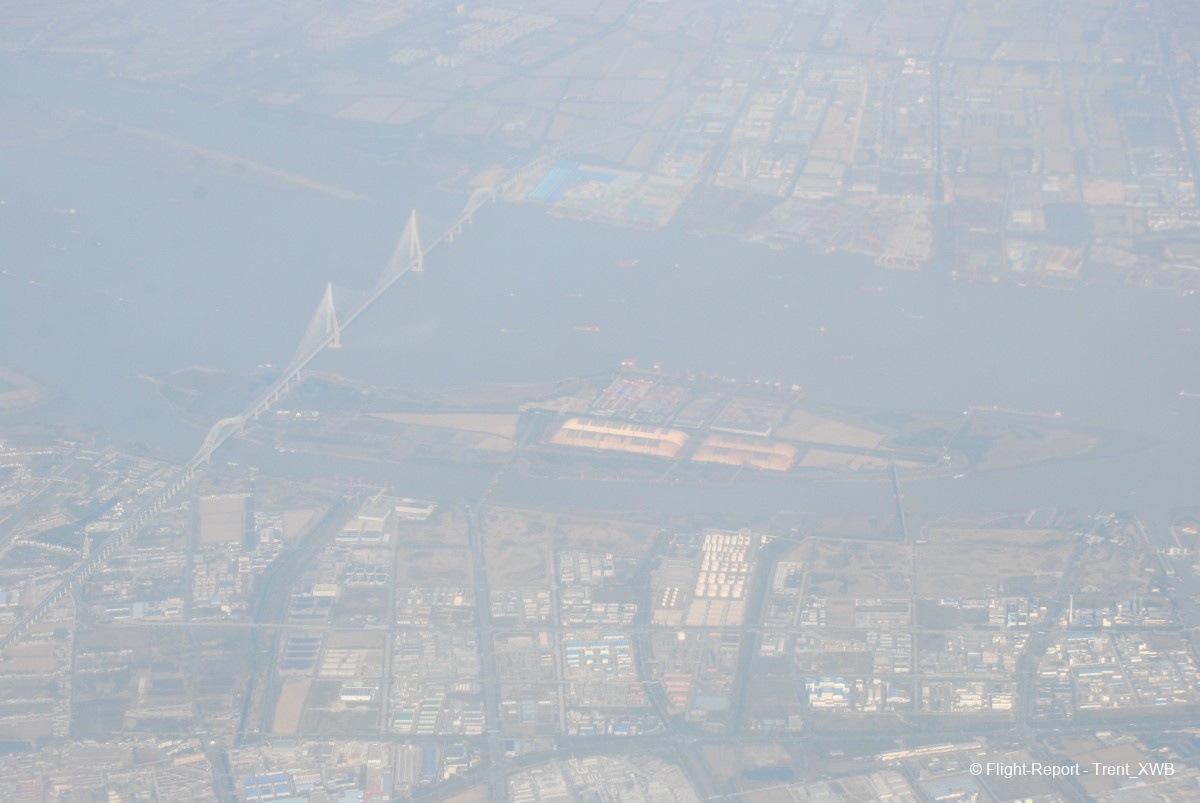
Getting closer and closer to Shanghai…
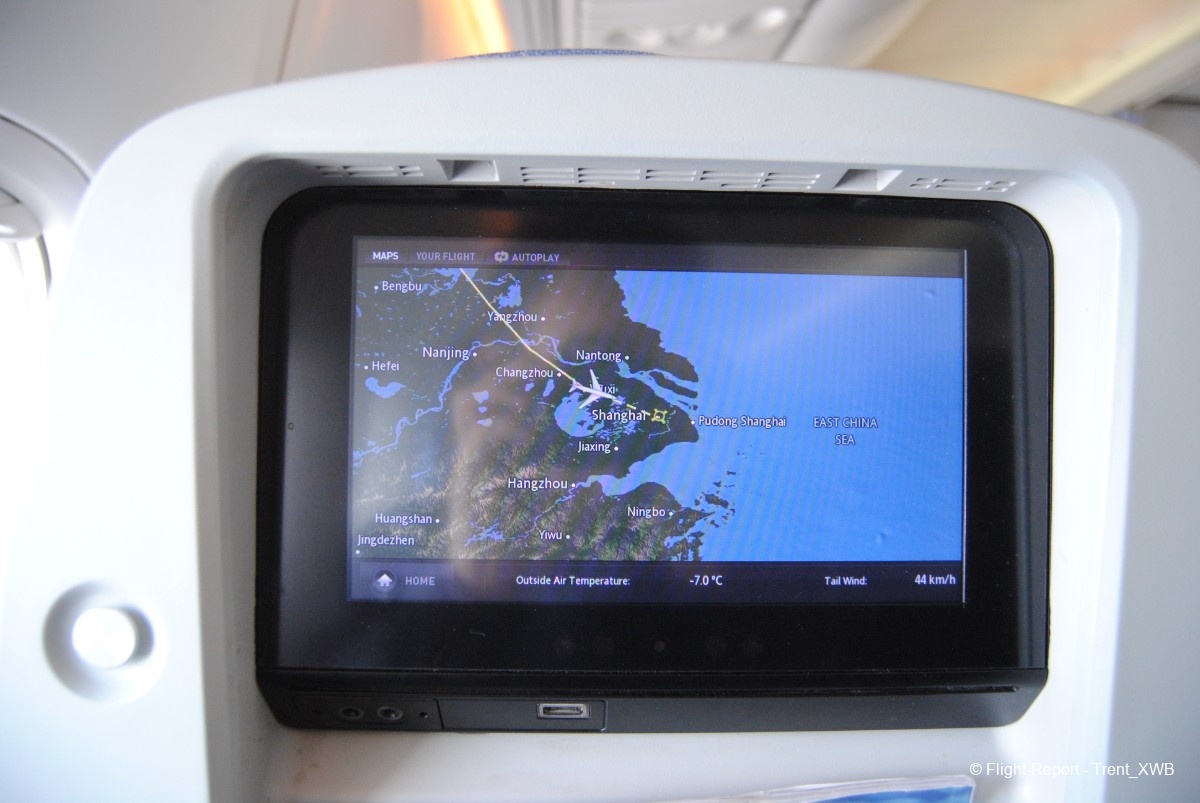
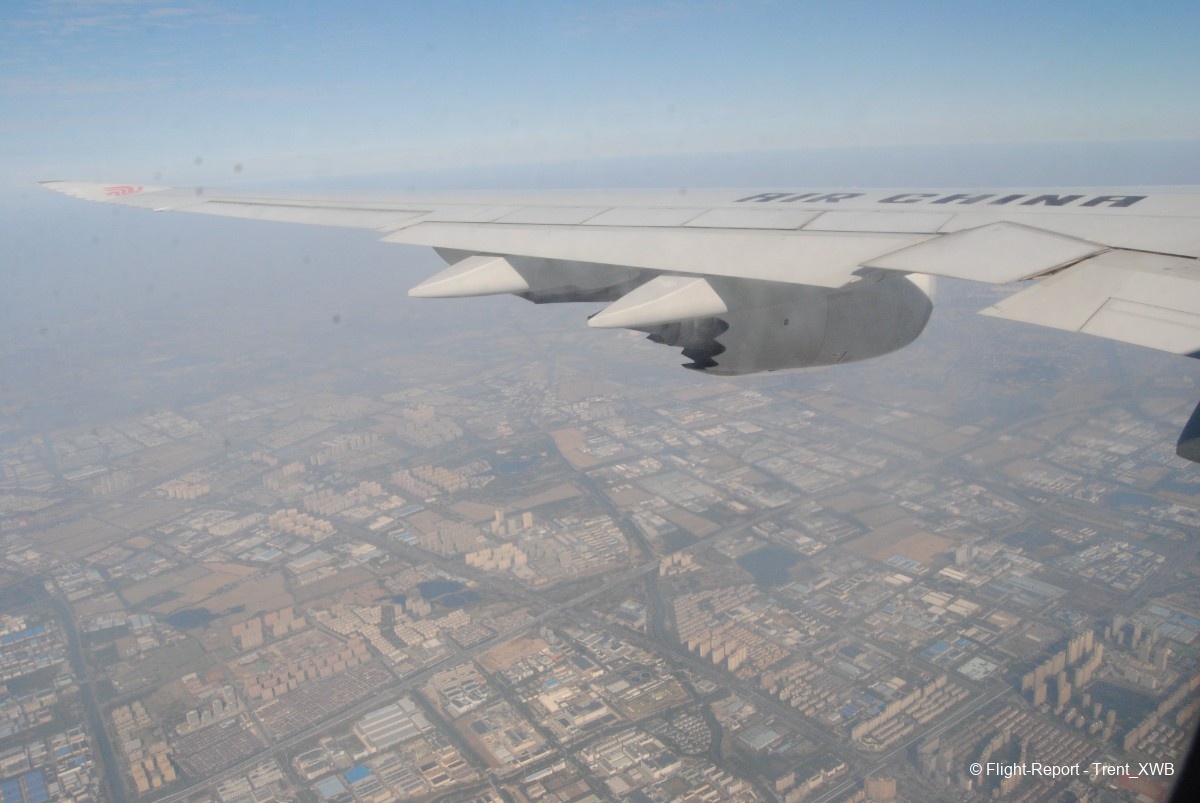
Impressive Shanghai metro area in sight as we're descending (with impressive flaperon oscillations).
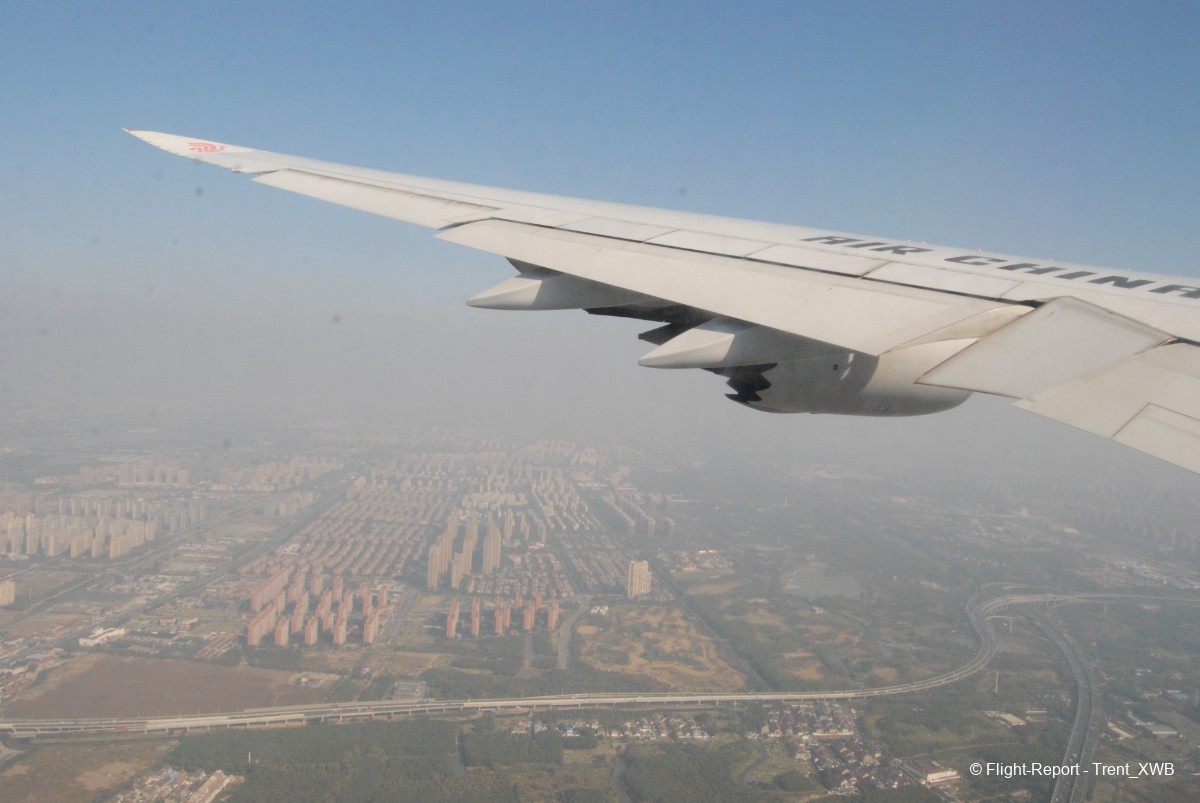
Flaps in pre-landing position…
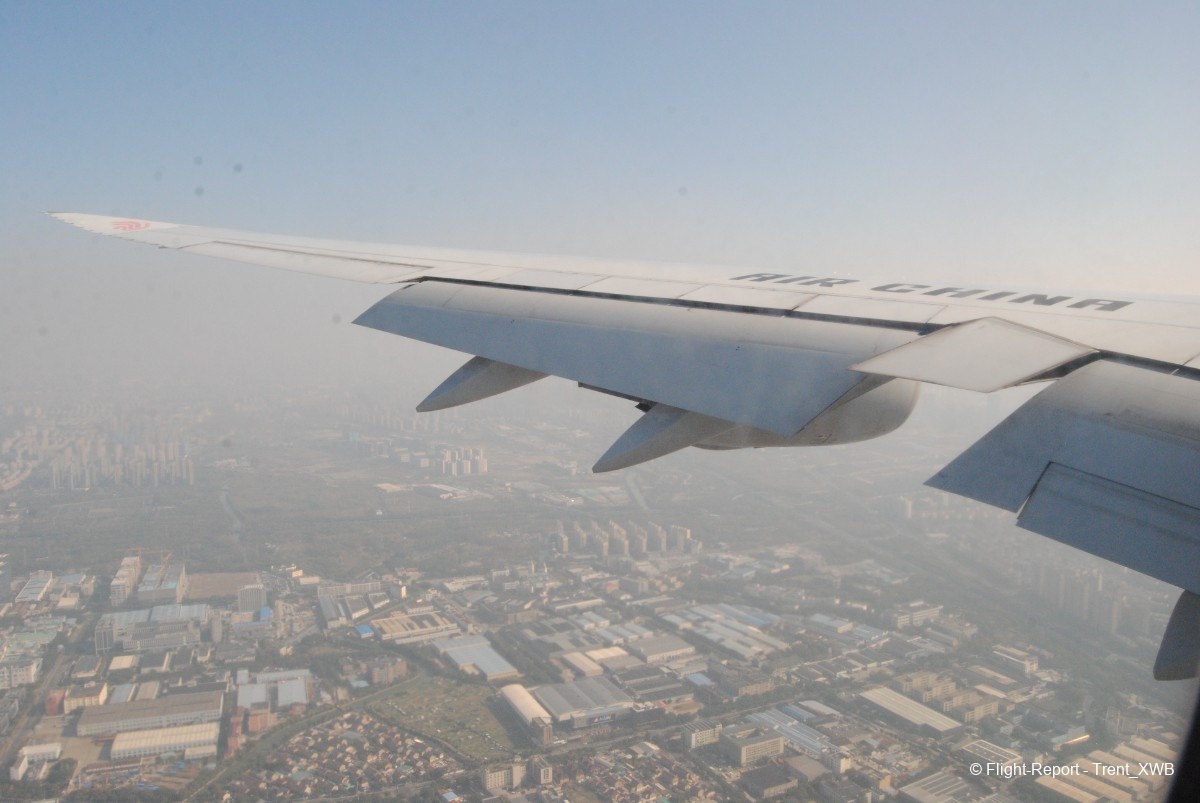
… and, finally, in landing position.
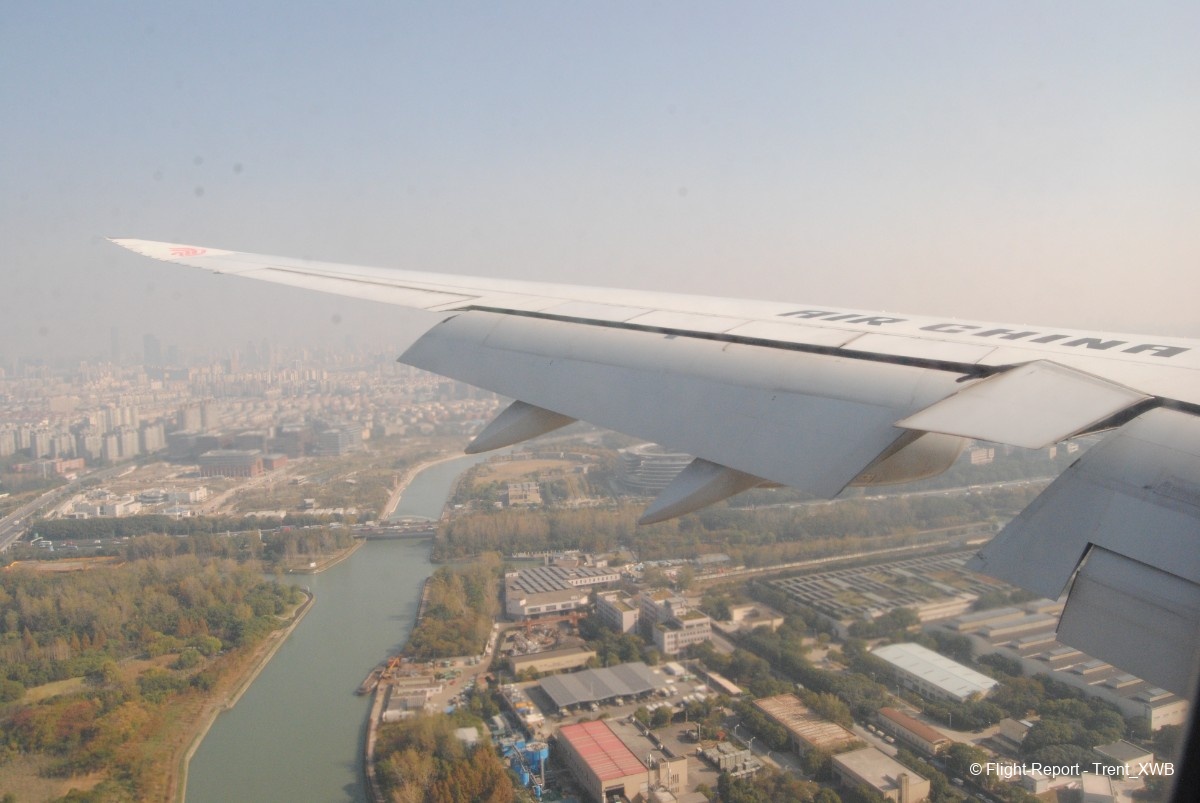
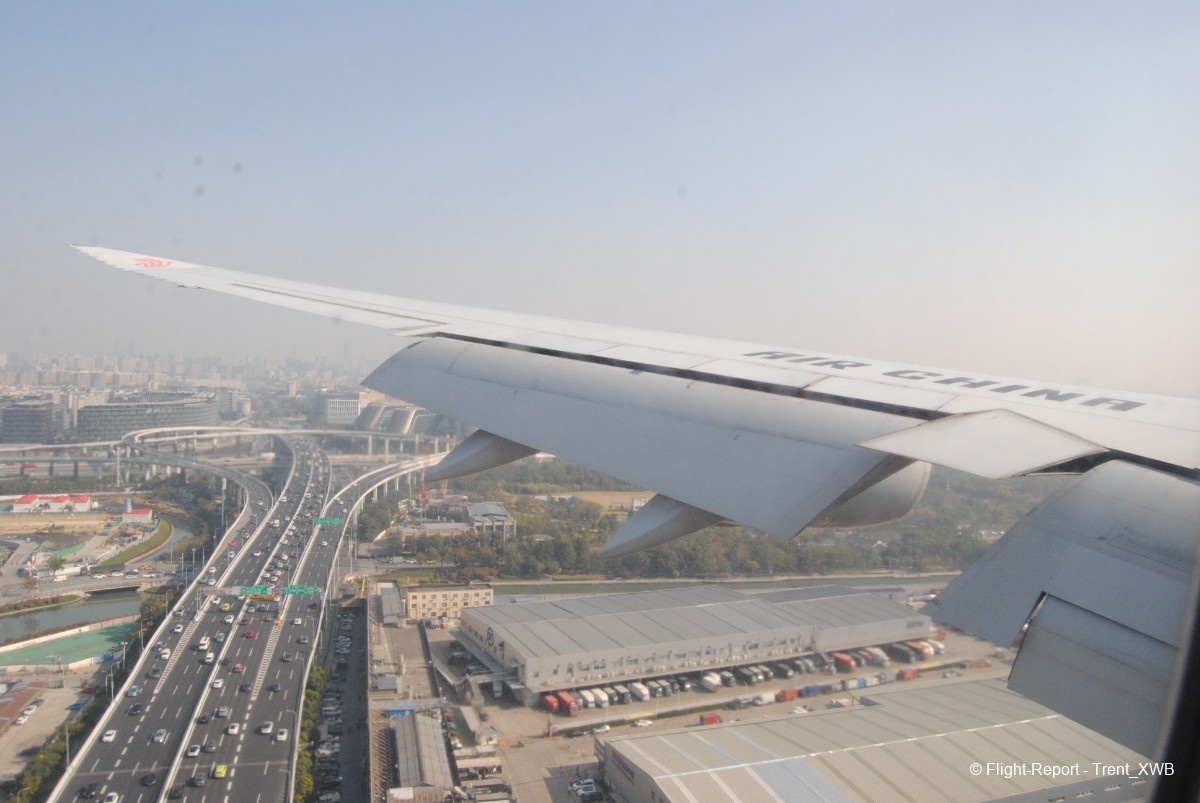
Touchdown in SHA with international T1 in sight.
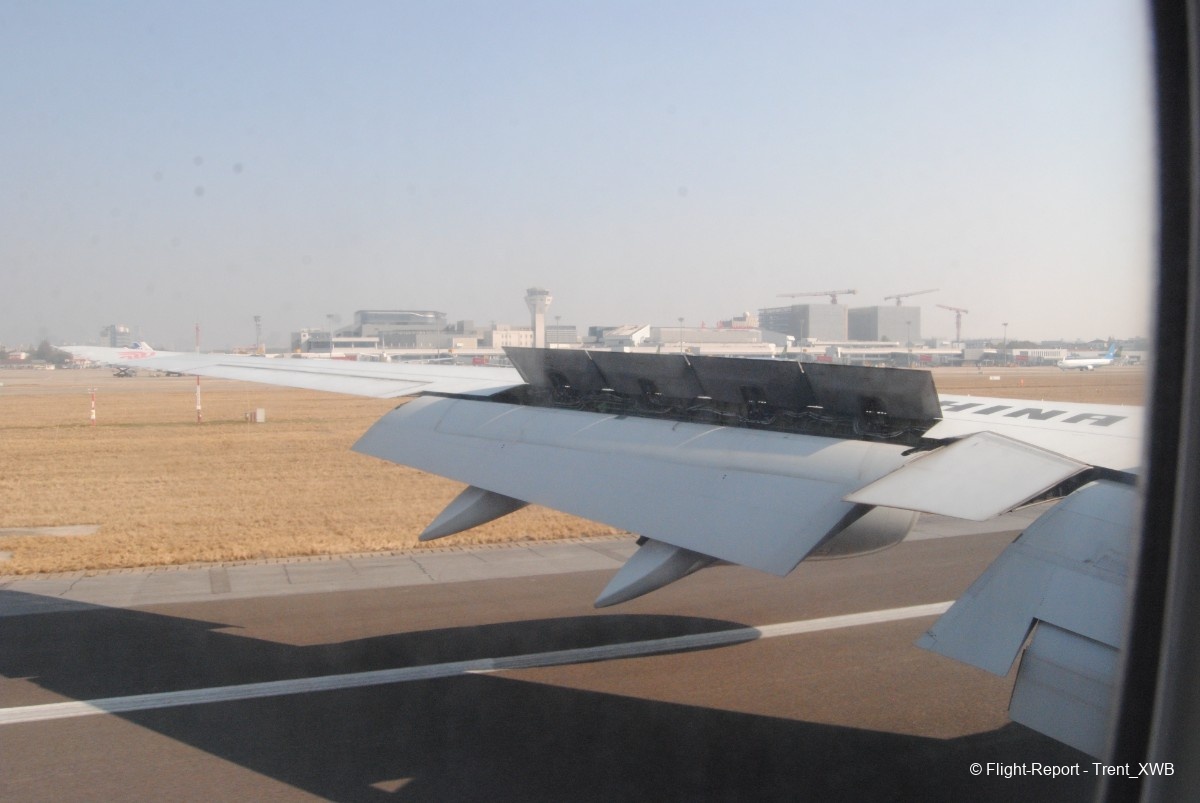
Flaps off, taxiing to the domestic T2.
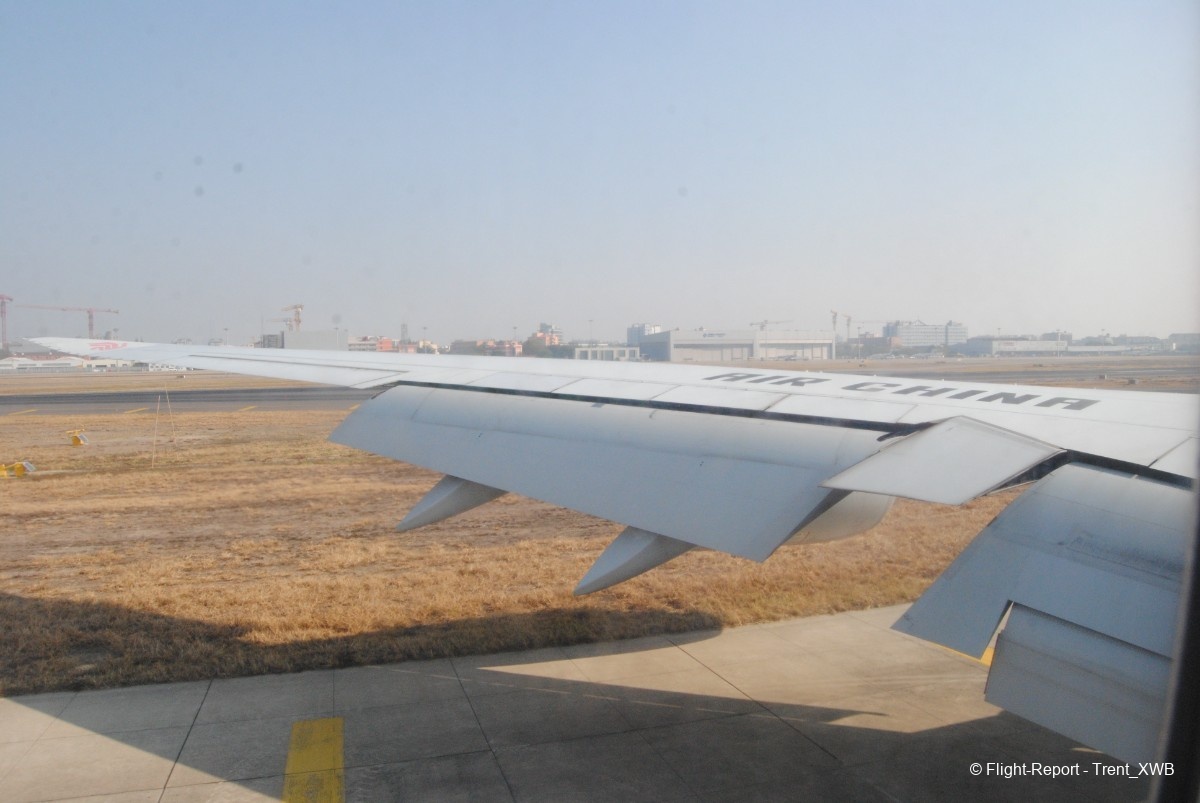
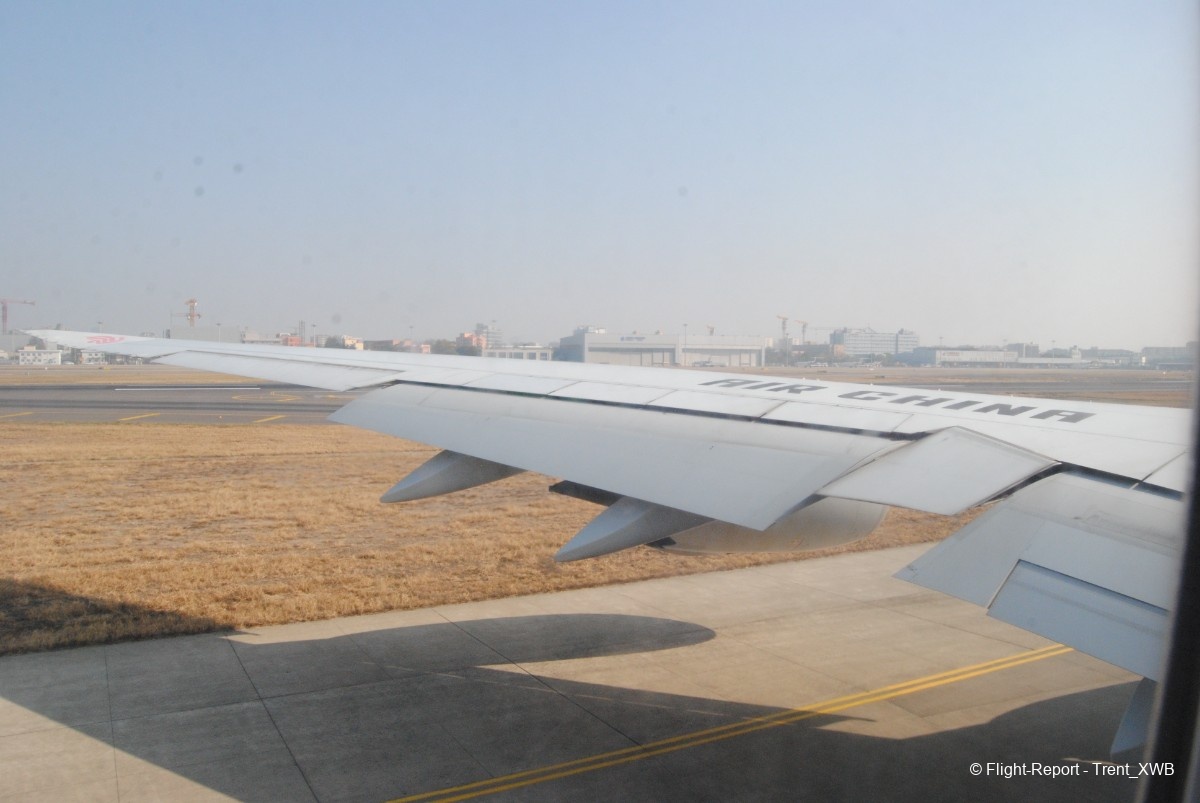
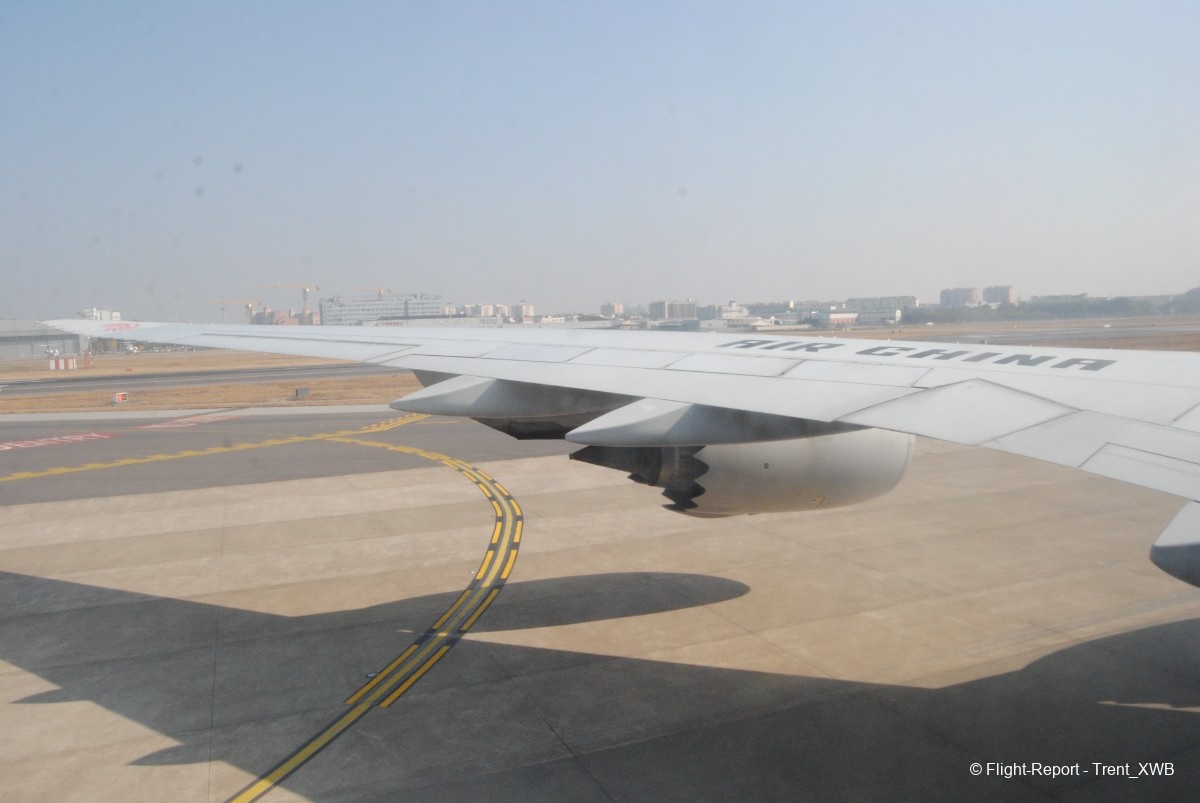
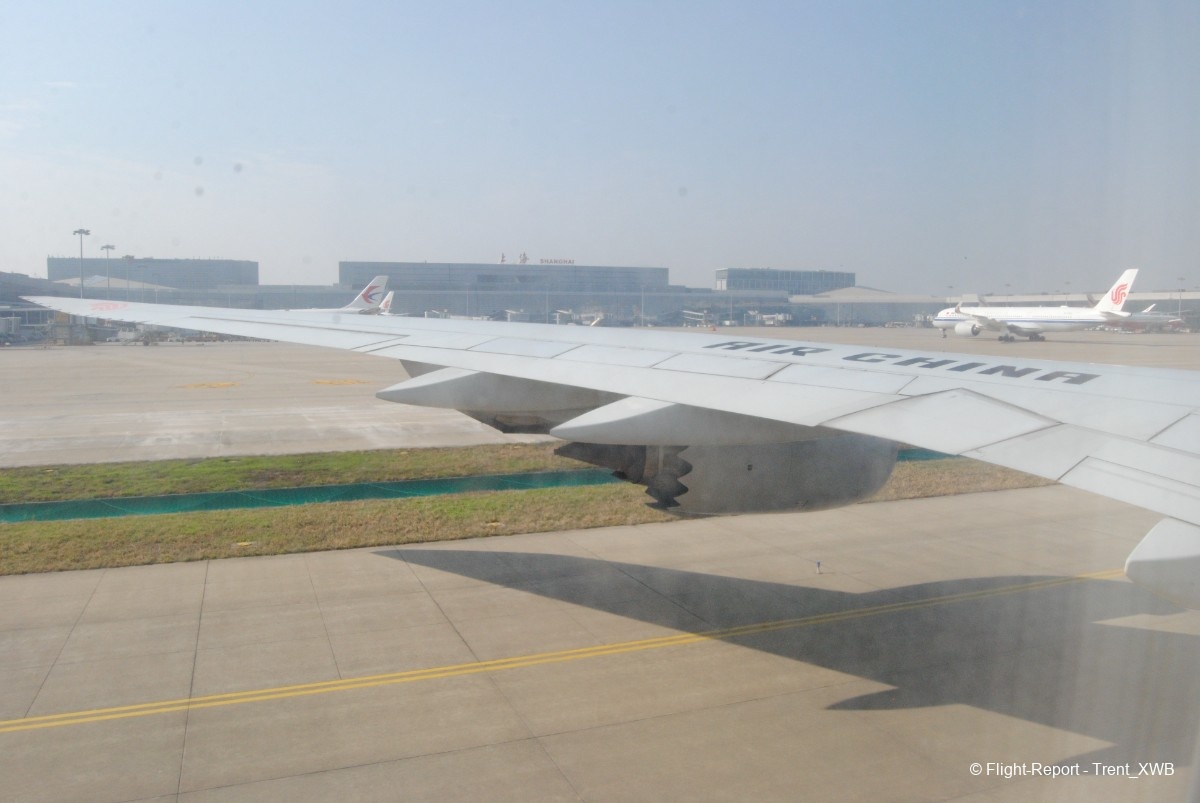
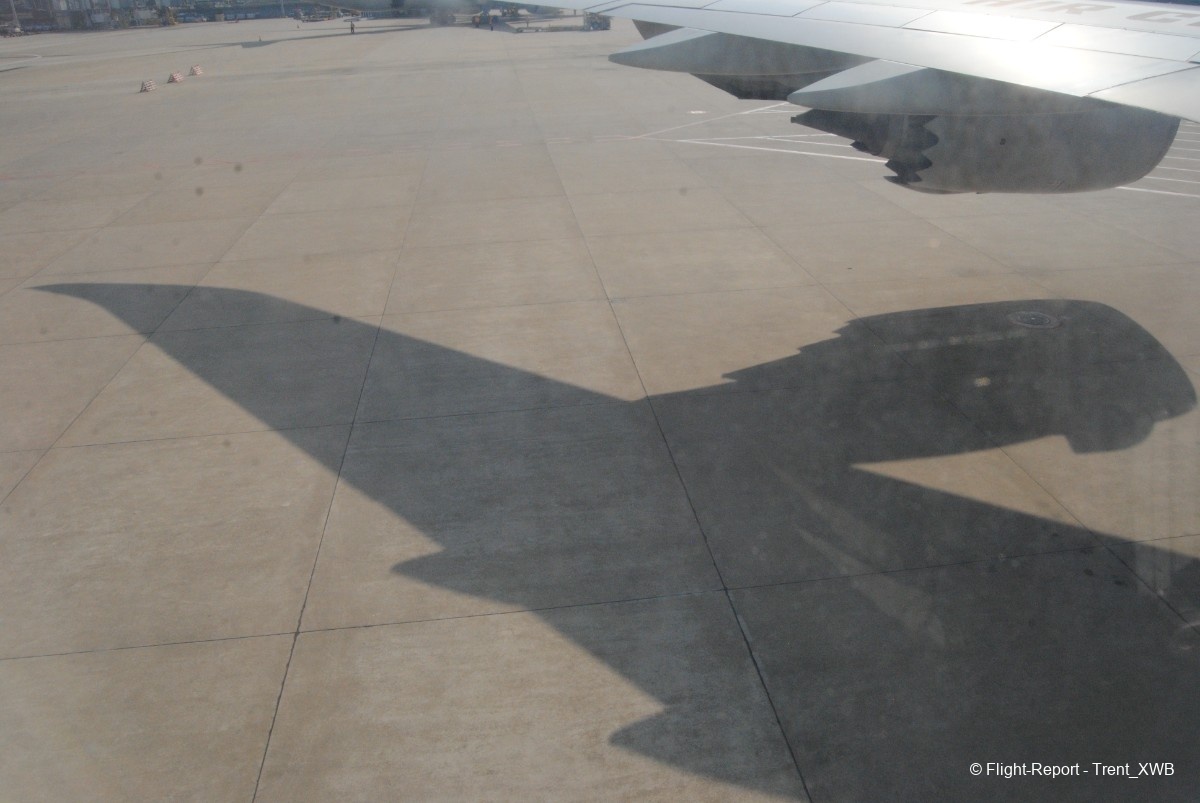
A shadow of the B748 wing and the outer portside engine as we've parked at gate 48 of T2. We arrived 40 minutes earlier than scheduled arrival time!
My seat 50A after the flight. Note that it has 2 well-aligned windows
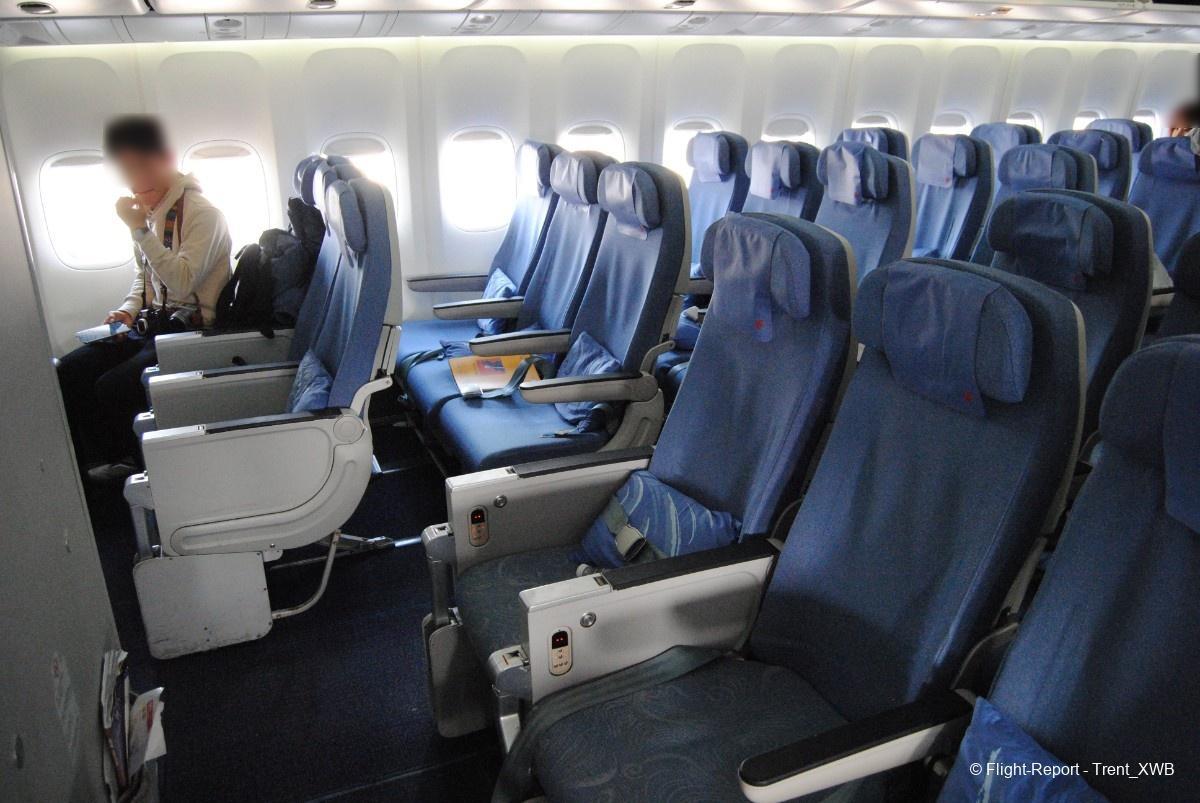
The Rear Economy Cabin After The Flight
A couple of views of the rear economy cabin upon disembarkment. Please note the guy from 49K - you'll see him further.
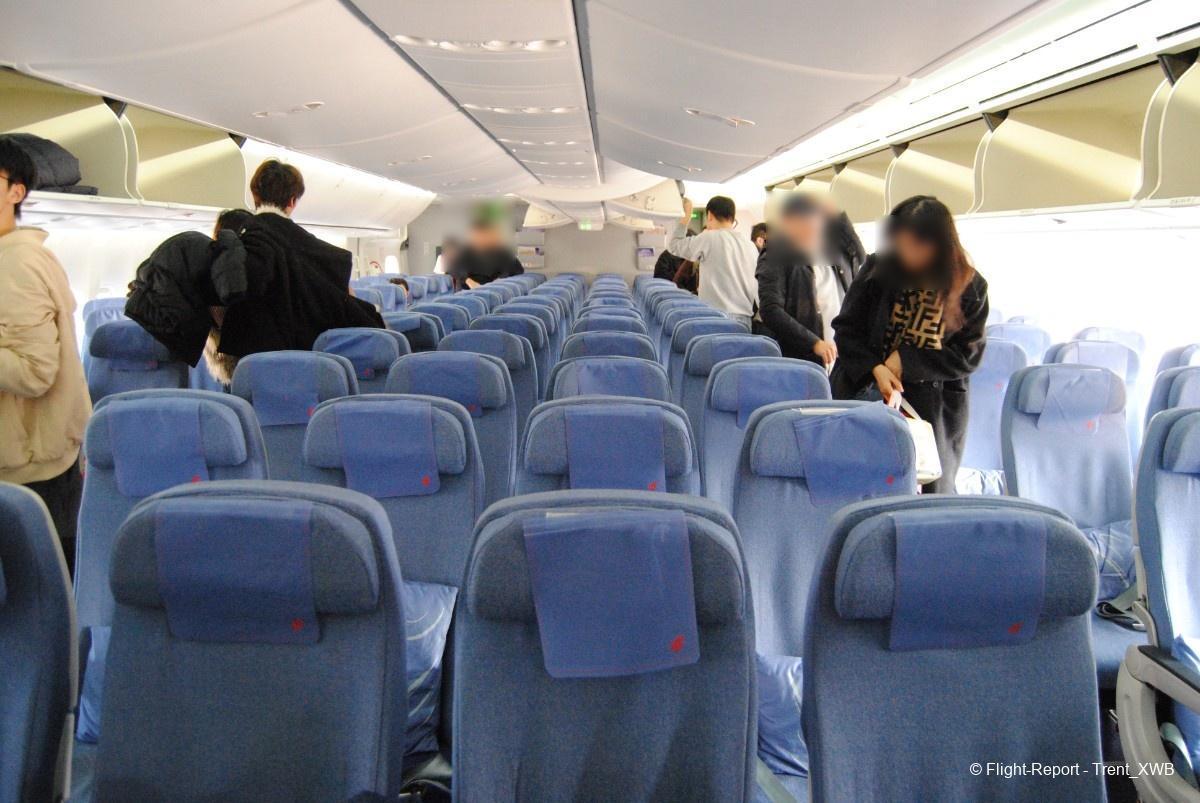
The Front Economy Cabin After The Flight
Couple of views of the front economy cabin upon disembarkment.
The Economy Plus Cabin After The Flight
And couple of views of the economy+ cabin upon disembarkment.
The Upper Deck Business Class Cabin After The Flight
And - YESSS! Welcome to the Jumbo's upper deck! CA crew were so nice and allowed all the avgeeks on this flight to visit the upper deck business cabin after the flight! Kudos and huge thanks to them!!!
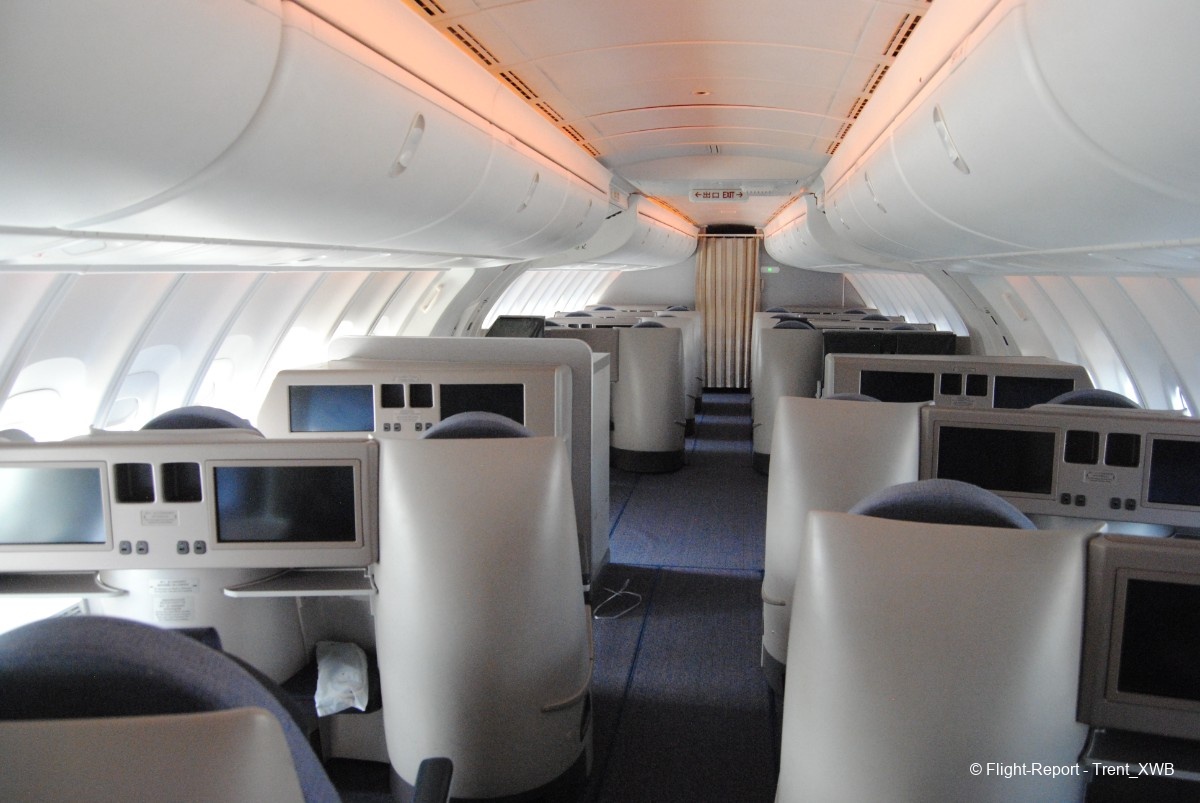
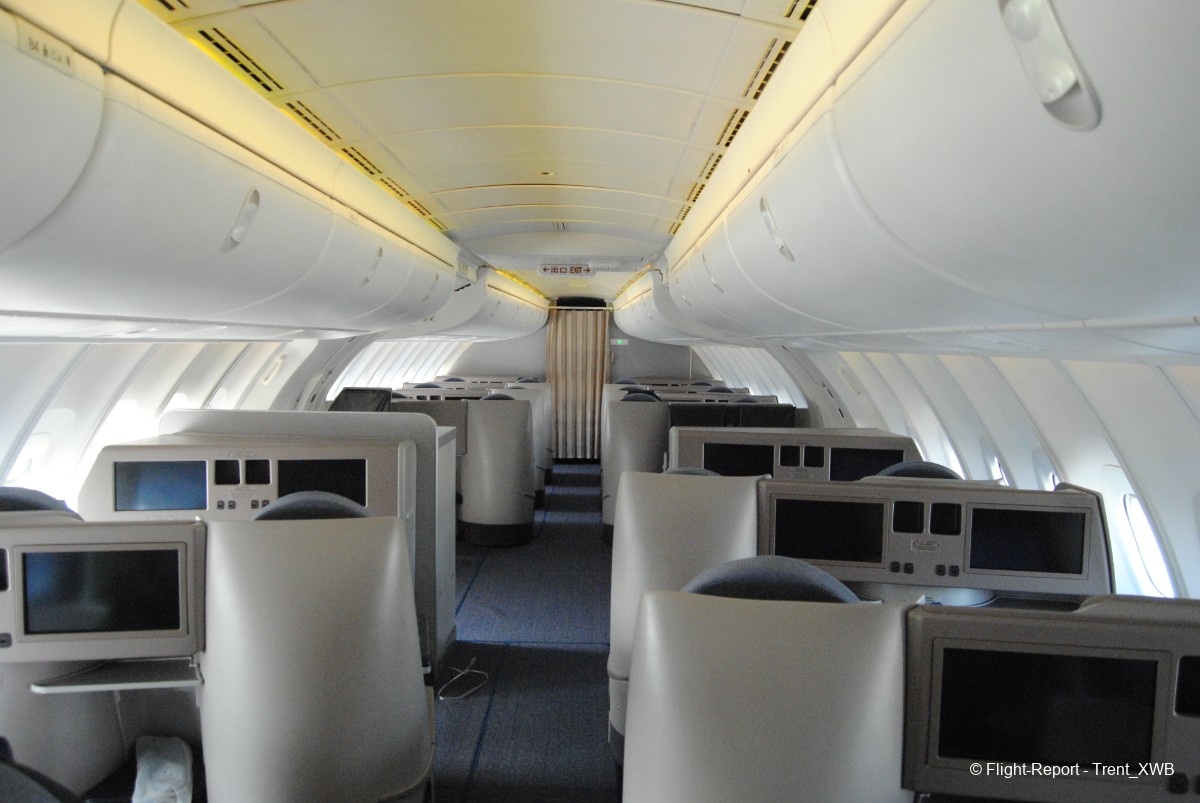
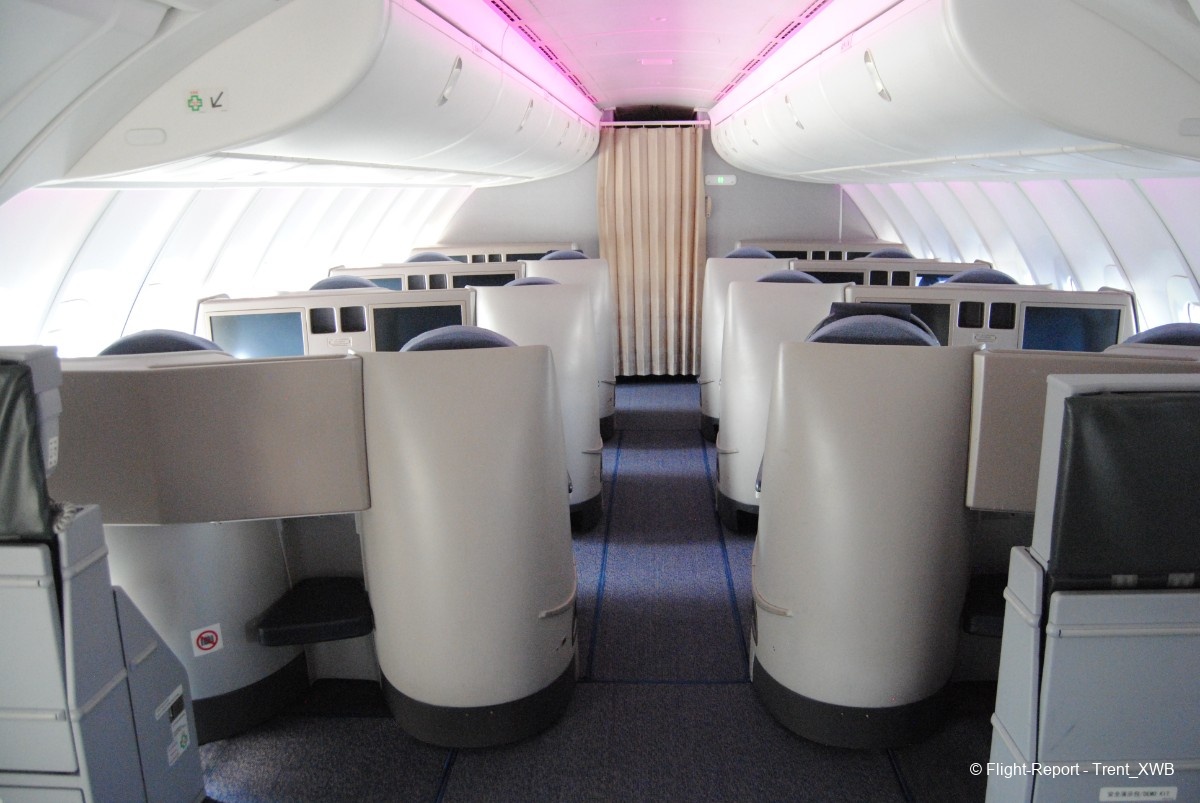
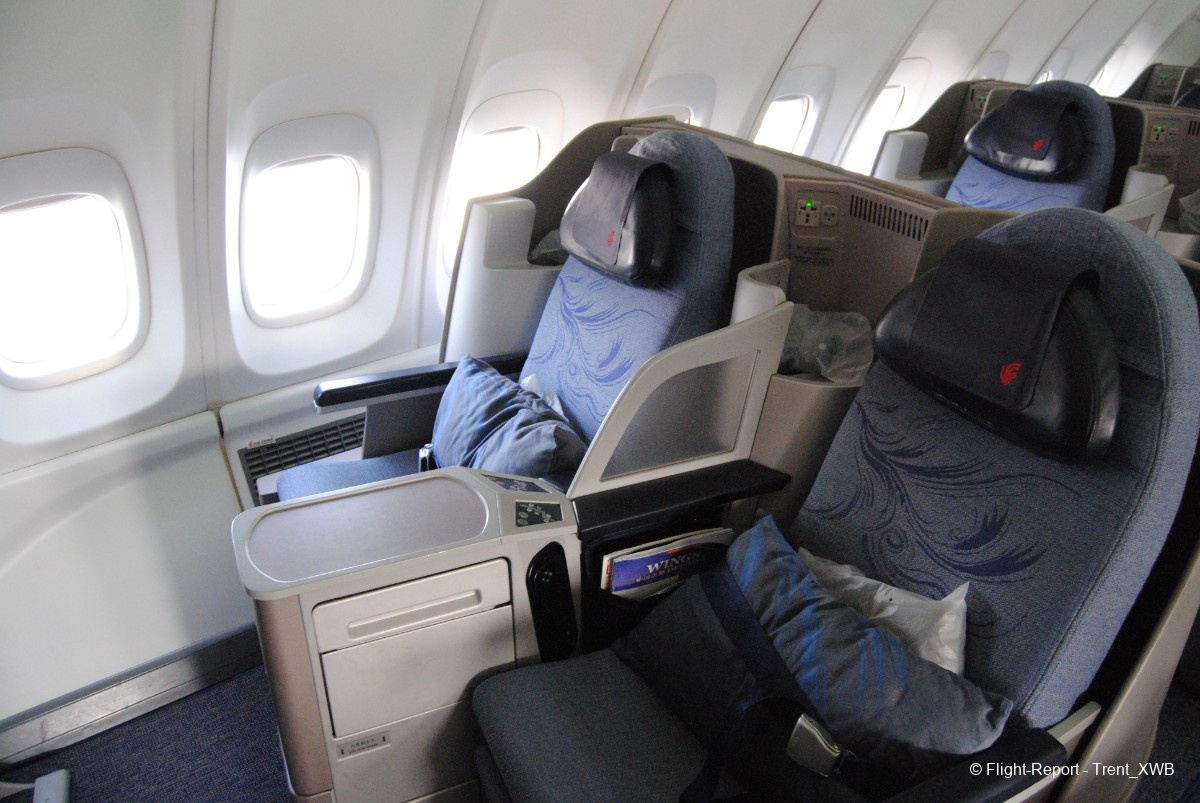
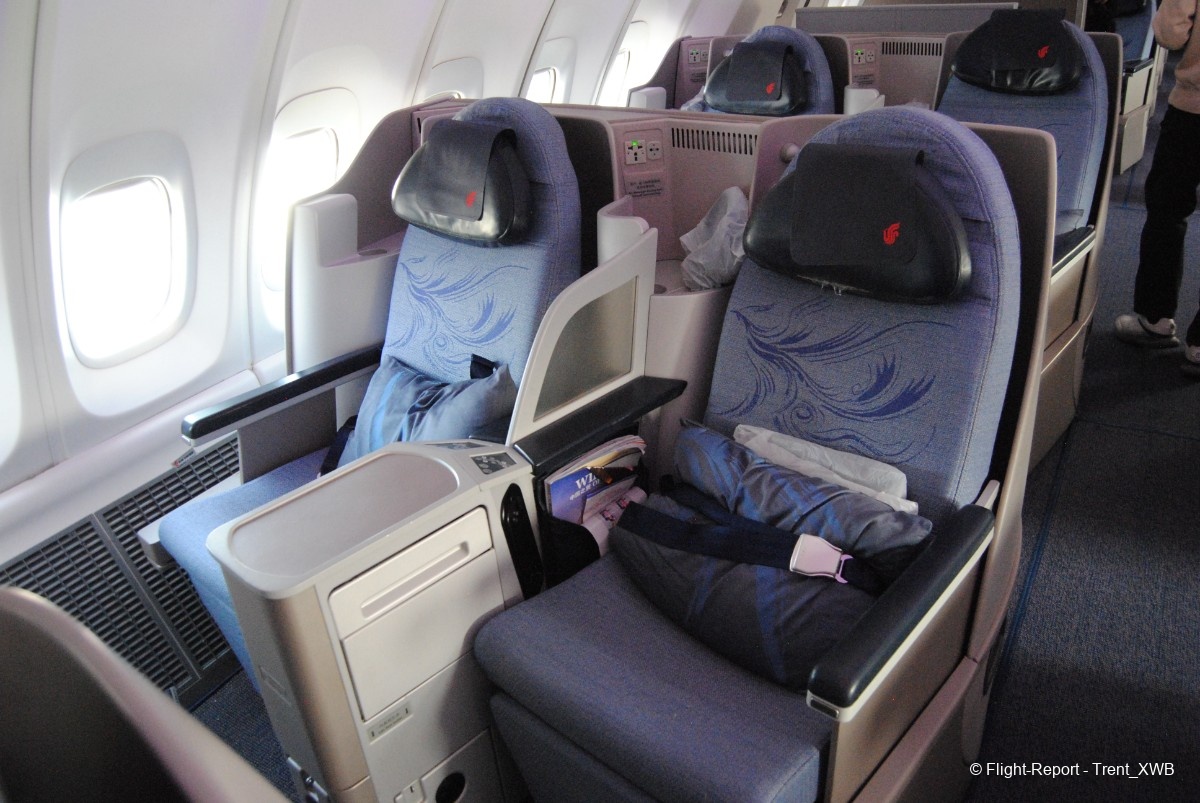
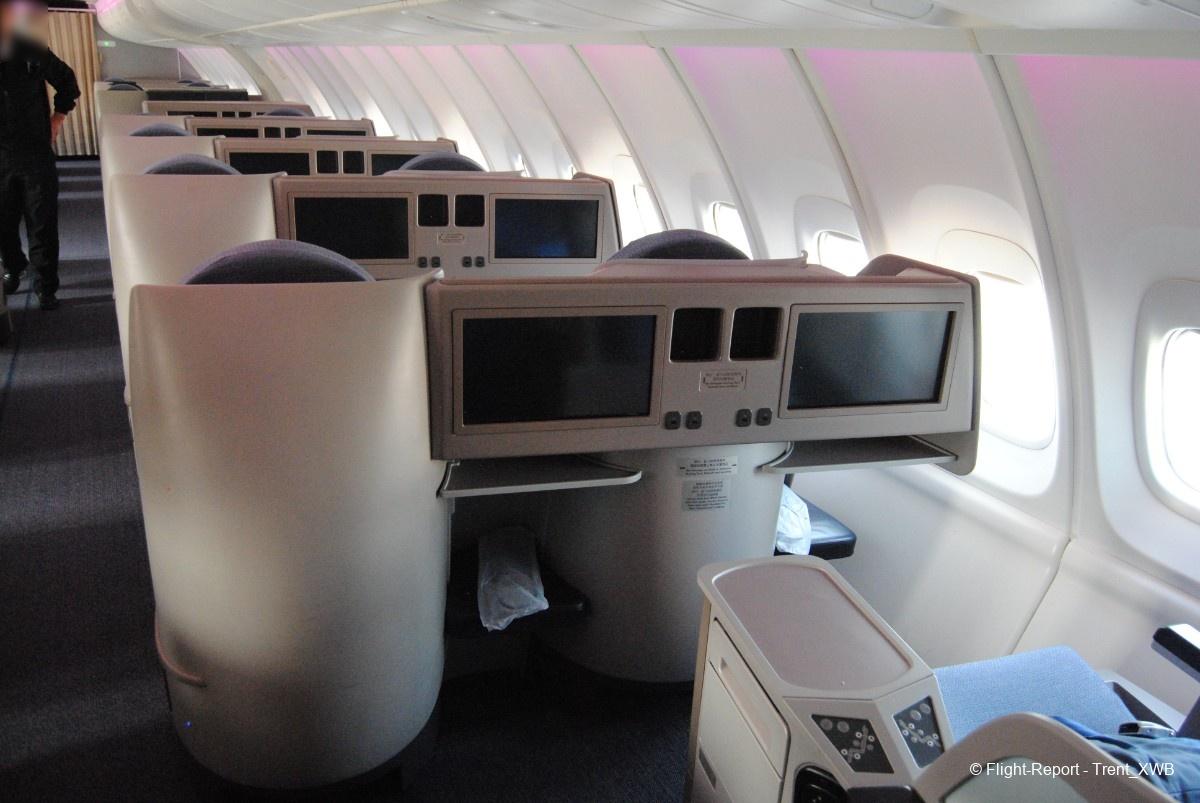
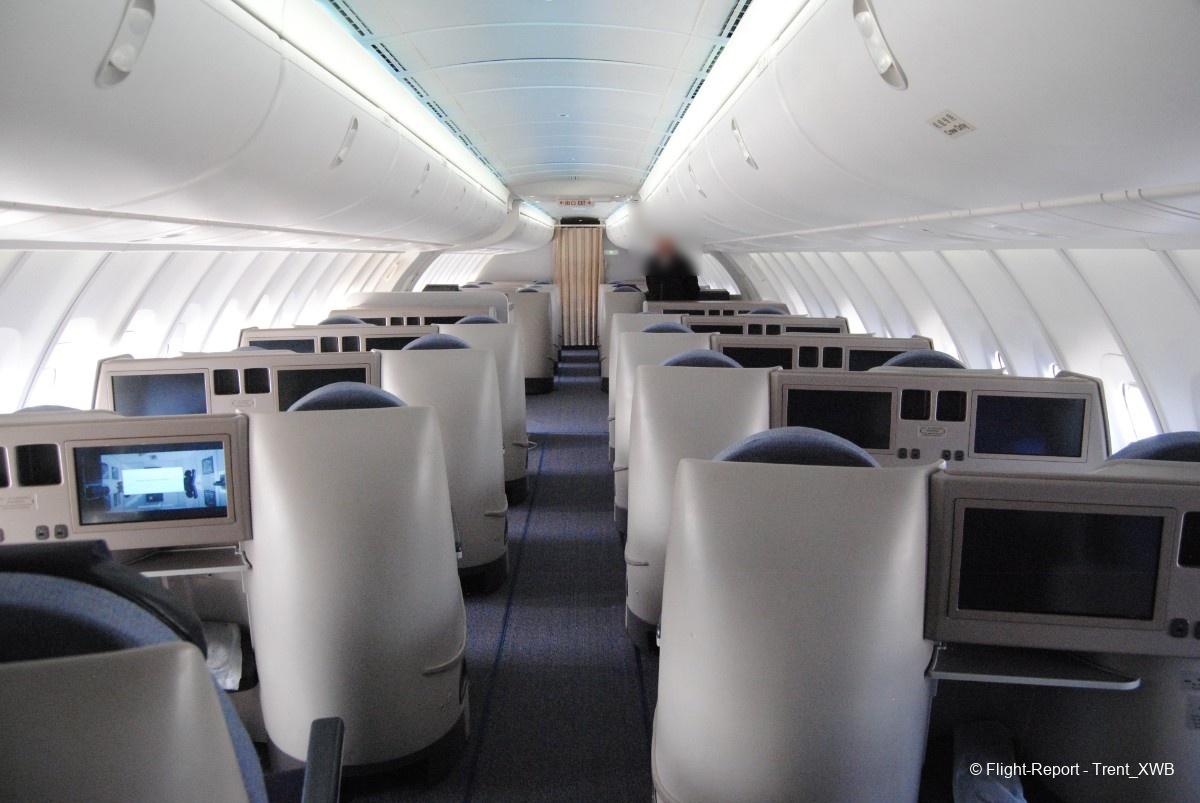
The upper deck business cabin consists of 30 Collins Parallel Diamond seats, arranged in 8 rows (rows 80-88) with 2-2 layout. Row 88 has only right 2-seater block.
General views of the upper deck from the rear. Notice that overhead bins are closed, making the "like inflight" vibe in the cabin, and multi-color moodlighting is turned on. This is the first time I'm visiting the upper deck in daylight time, which is the best for taking photos. The previous time, when I visited B748 upper deck after ICN-CDG flight, it was dark outside and the cabin light was low.
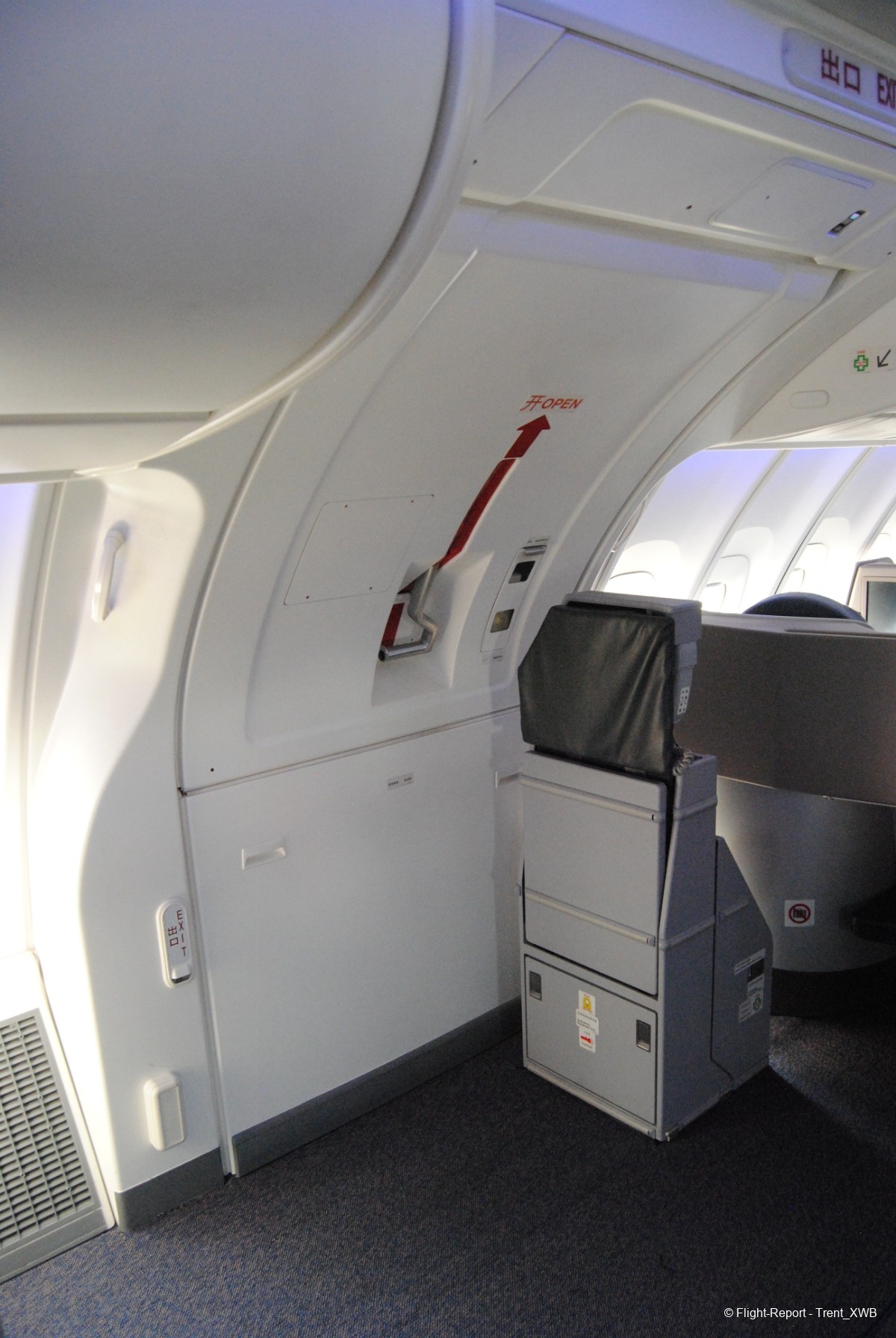
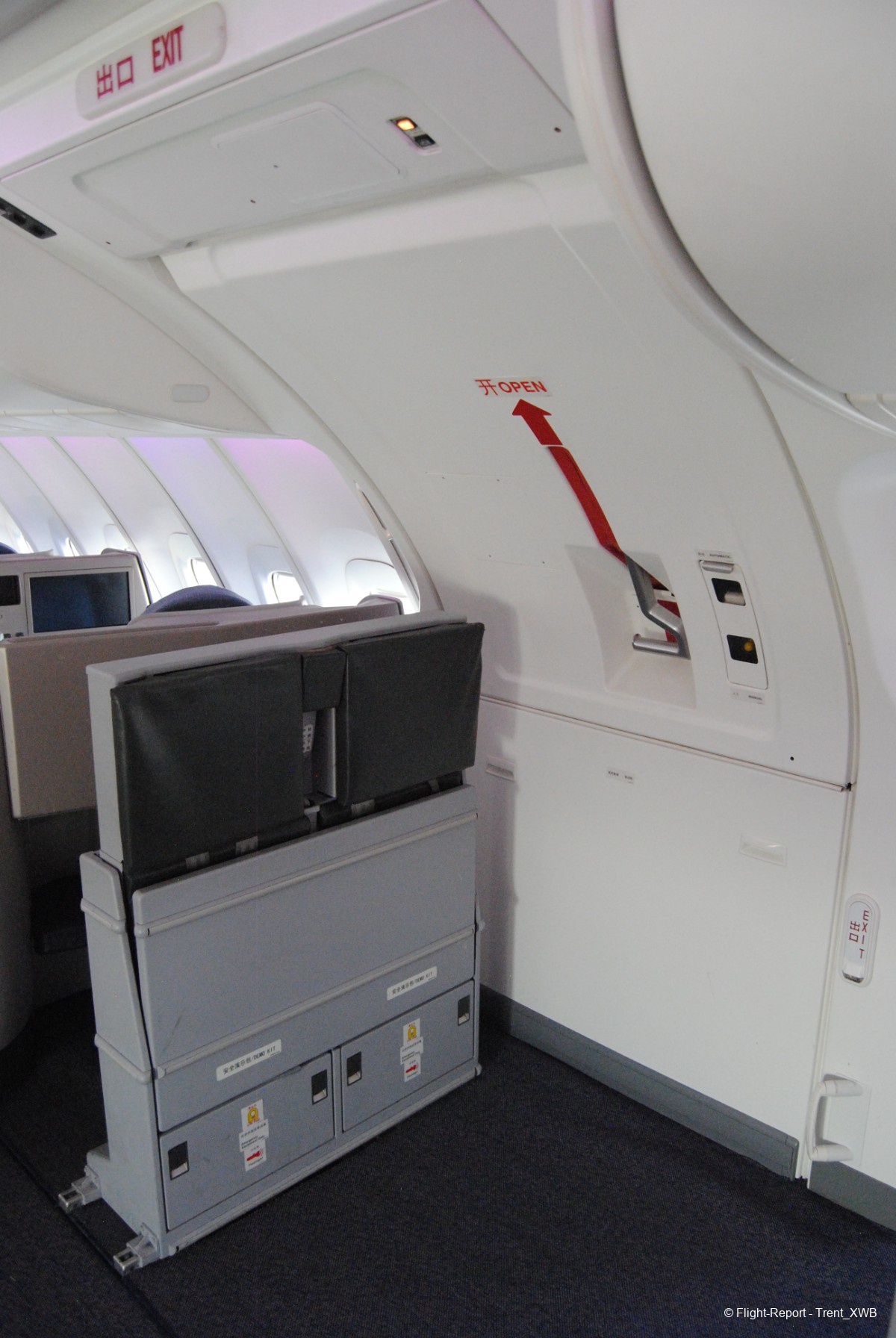
Exit doors of the upper deck.
Rows 80-82 from the rear.
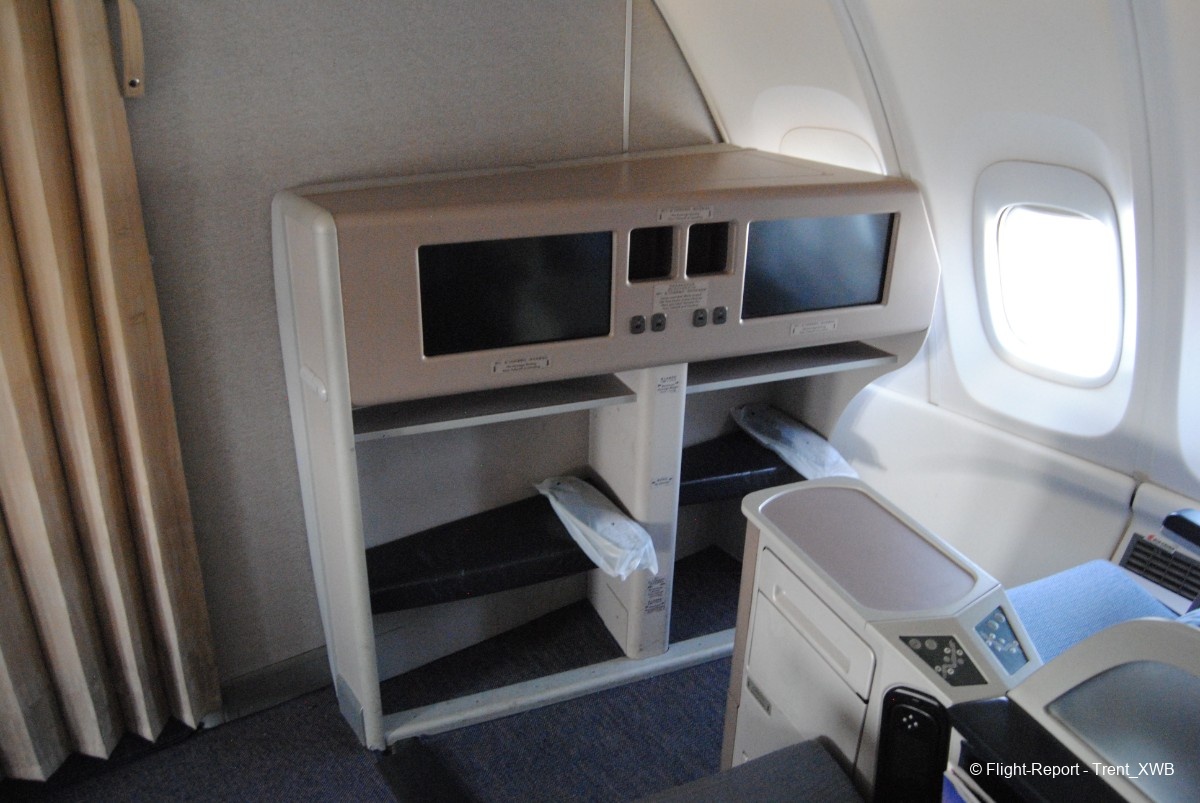
Rows 80-82 in details. Now one can see that CA's B748s not only have nonstandard layout of the main deck, but also nonstandard upper deck - without sidewall storages! And hence is the difference between CA's Collins Parallel Diamond and LH's Collins Diamond Parallel business seats - the former are significantly wider and more massive than the latter - to the extent, where removal of the sidewall storages is needed to allocate them on the upper deck! So, despite the obsolete seat model and layout, CA's business class definitely wins over LH's one in terms of spaciousness.
A general view of the upper deck from the front. Notice the another avgeek - the man from 49K seat!
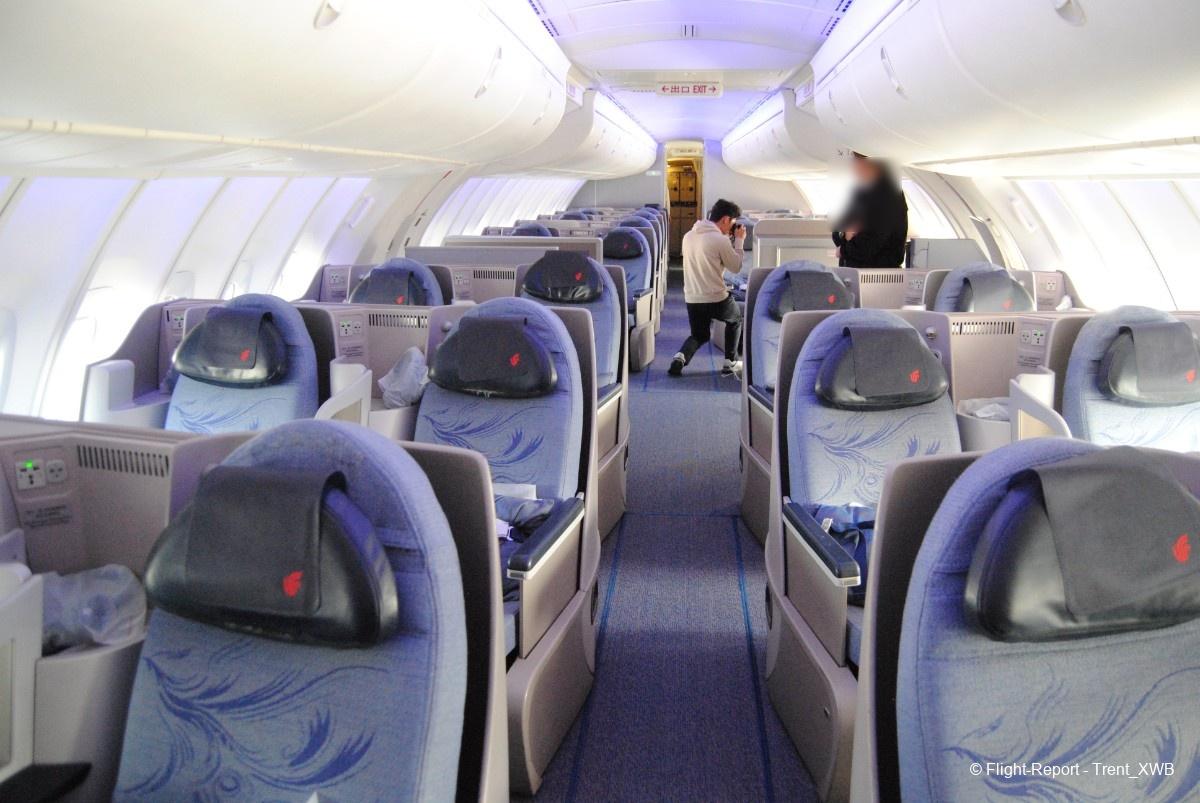
General views from the front with the nice variable moodlighting.
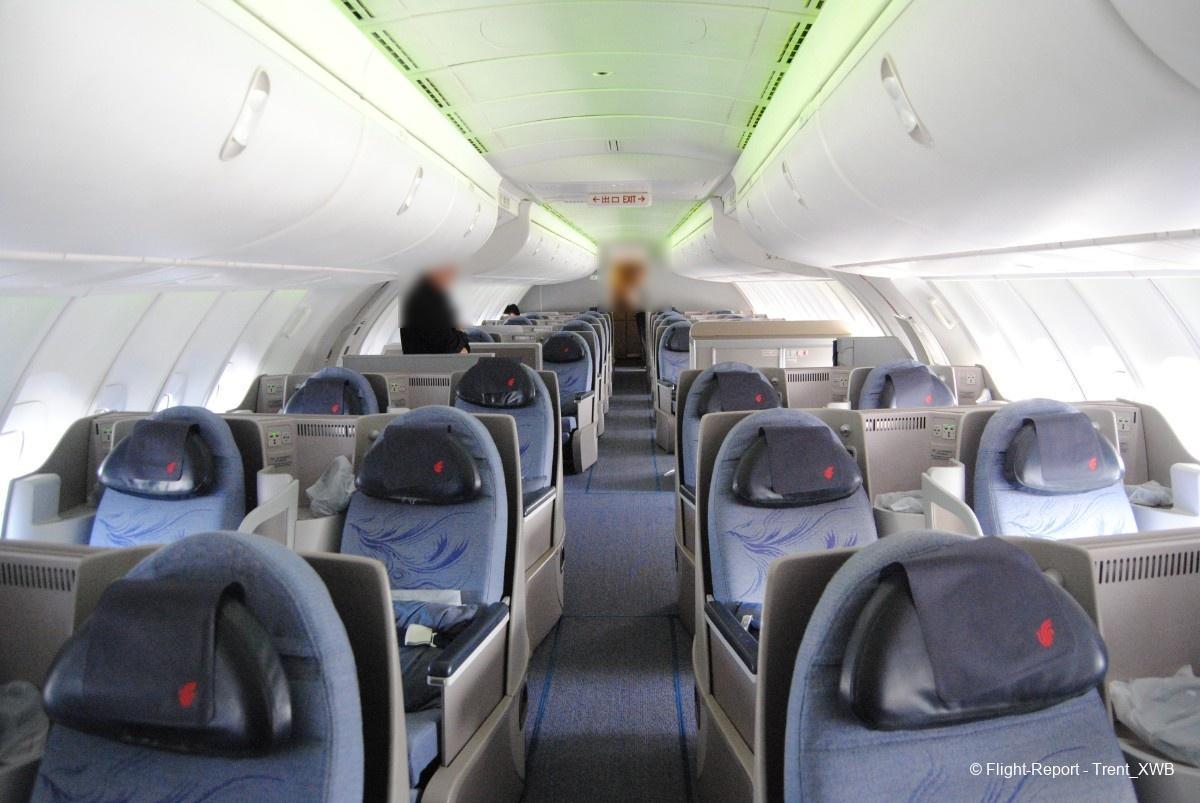
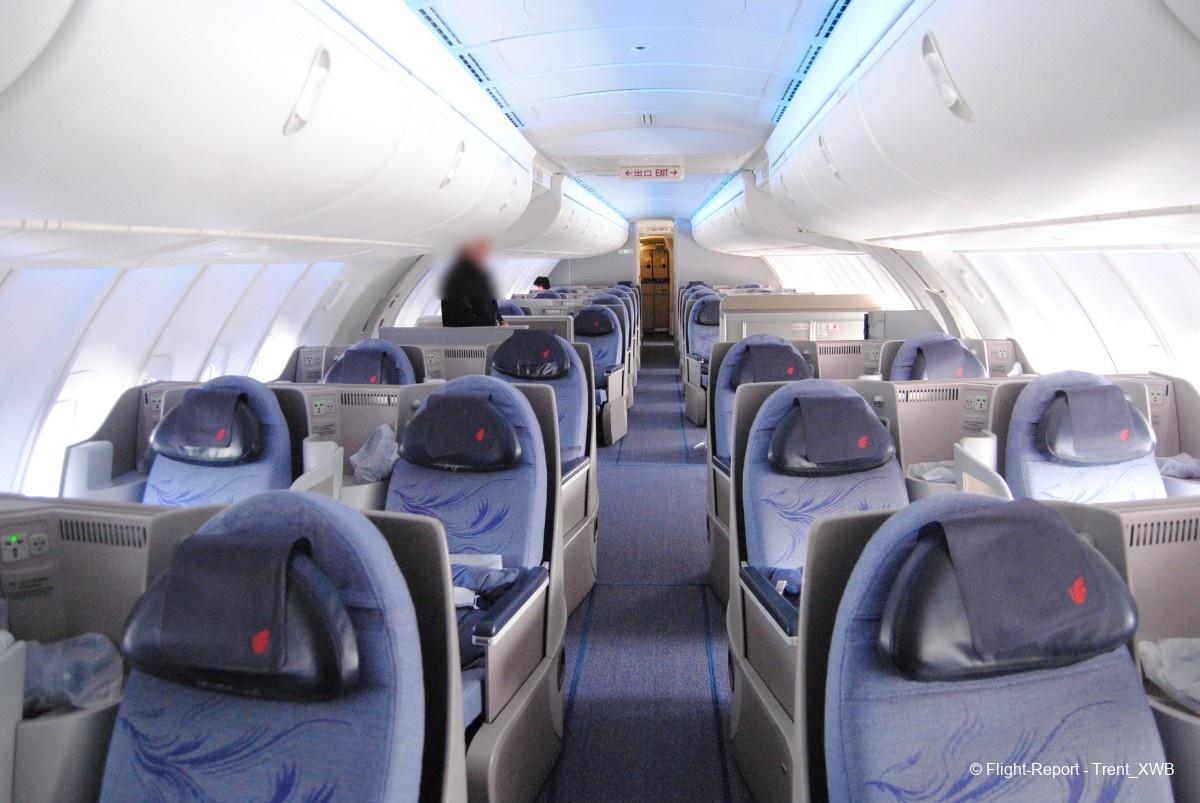
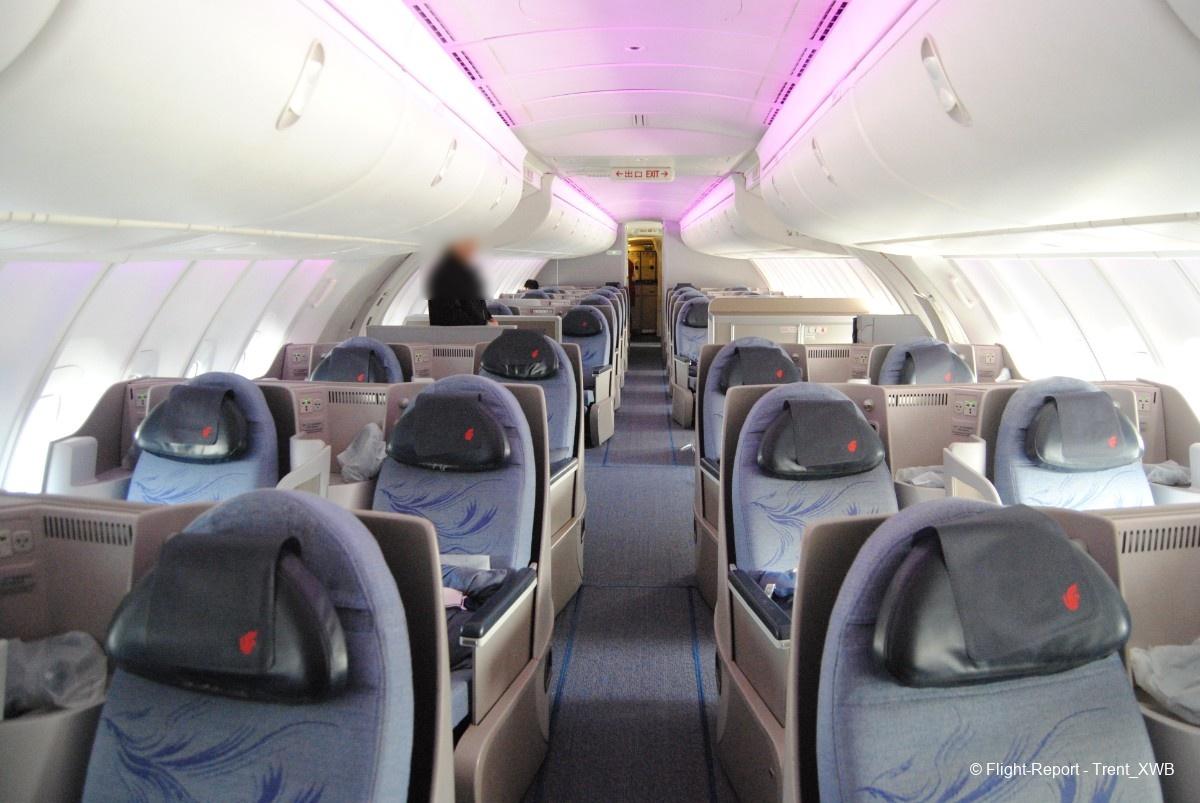
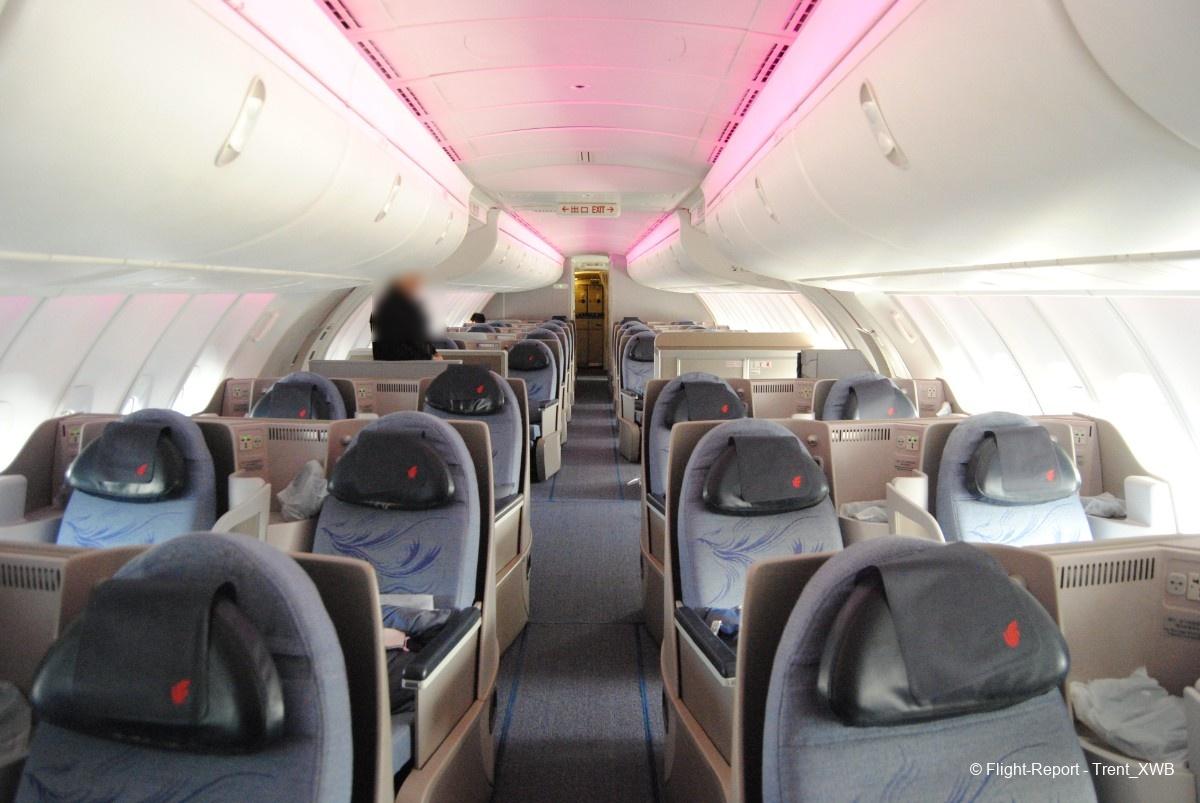
General view of rows 83-87 from the front. Note that the guy is taking photo of the engine view from 87L. This is the thing I forgot to make.
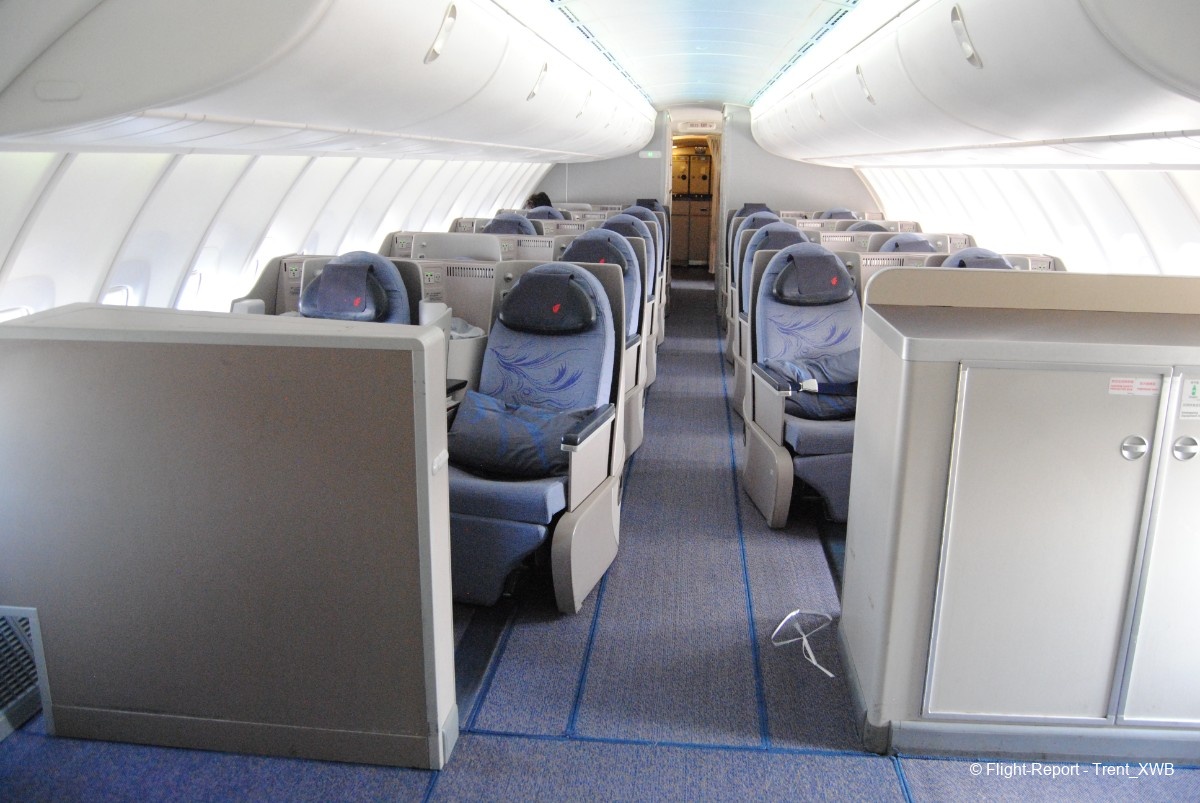
Rows 83-87 in details.
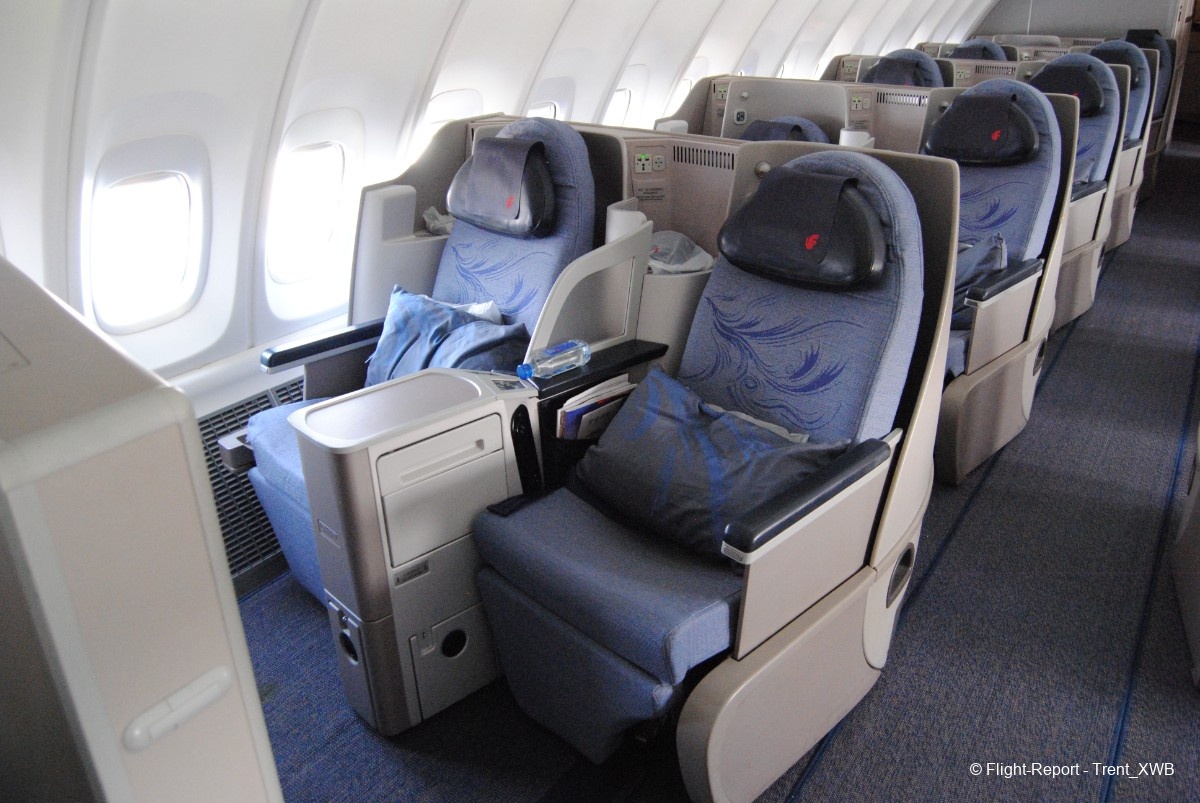
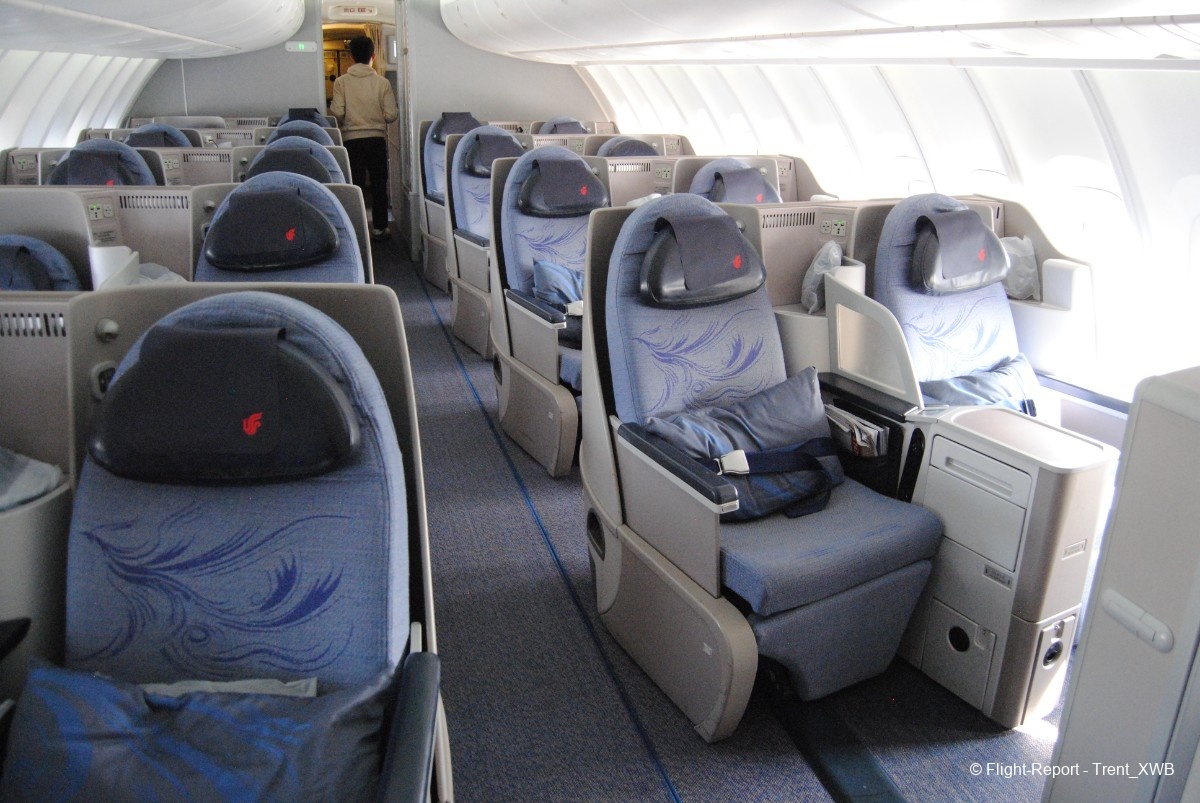
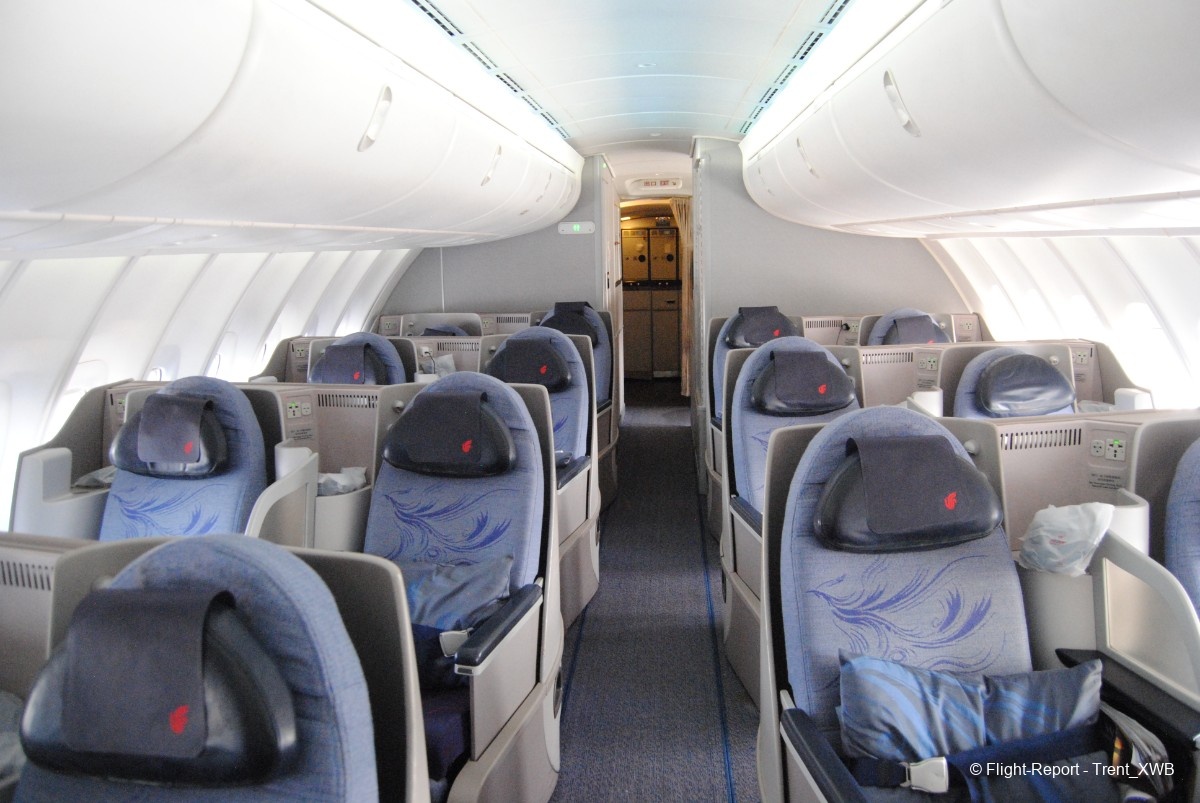
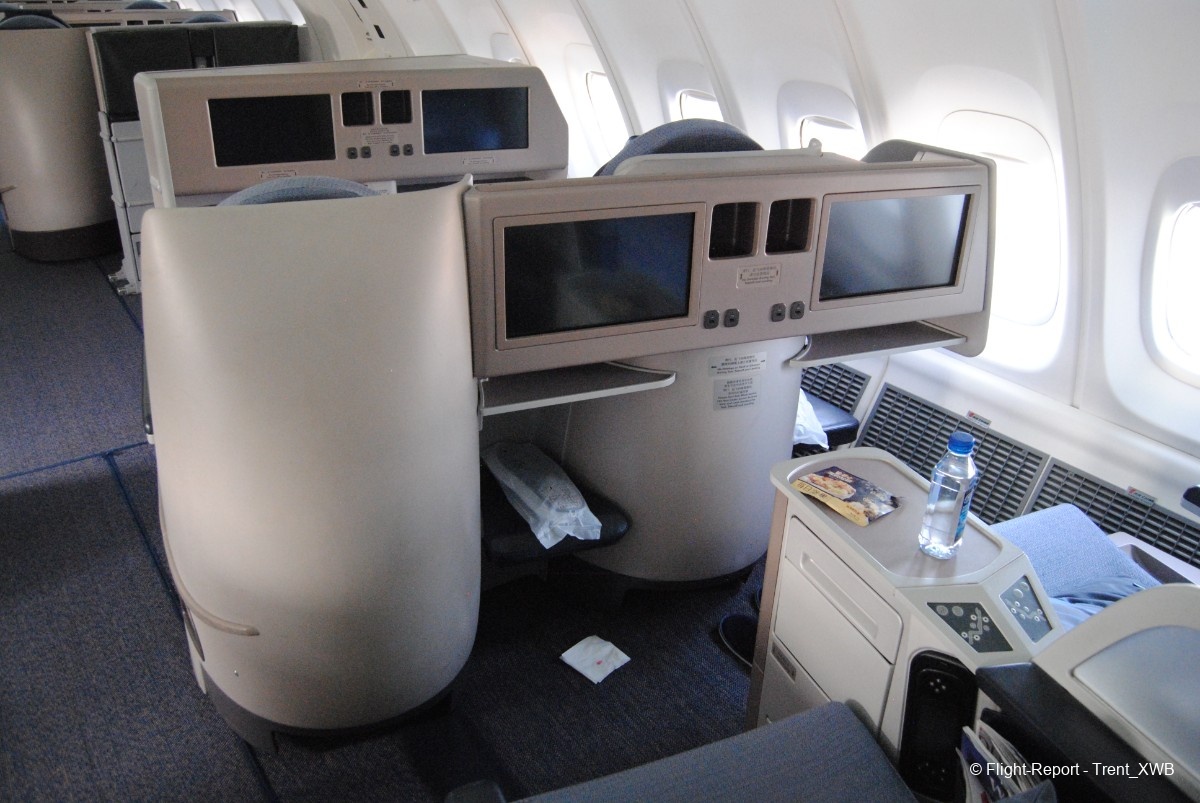
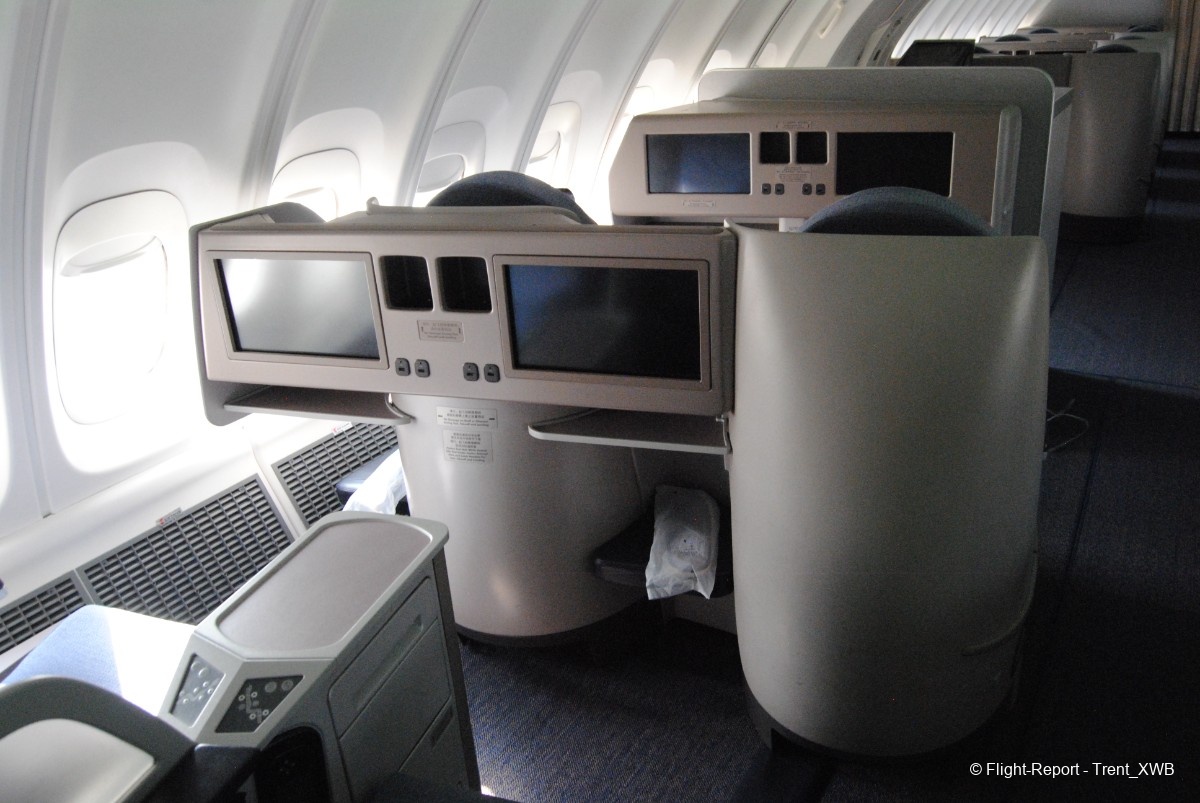
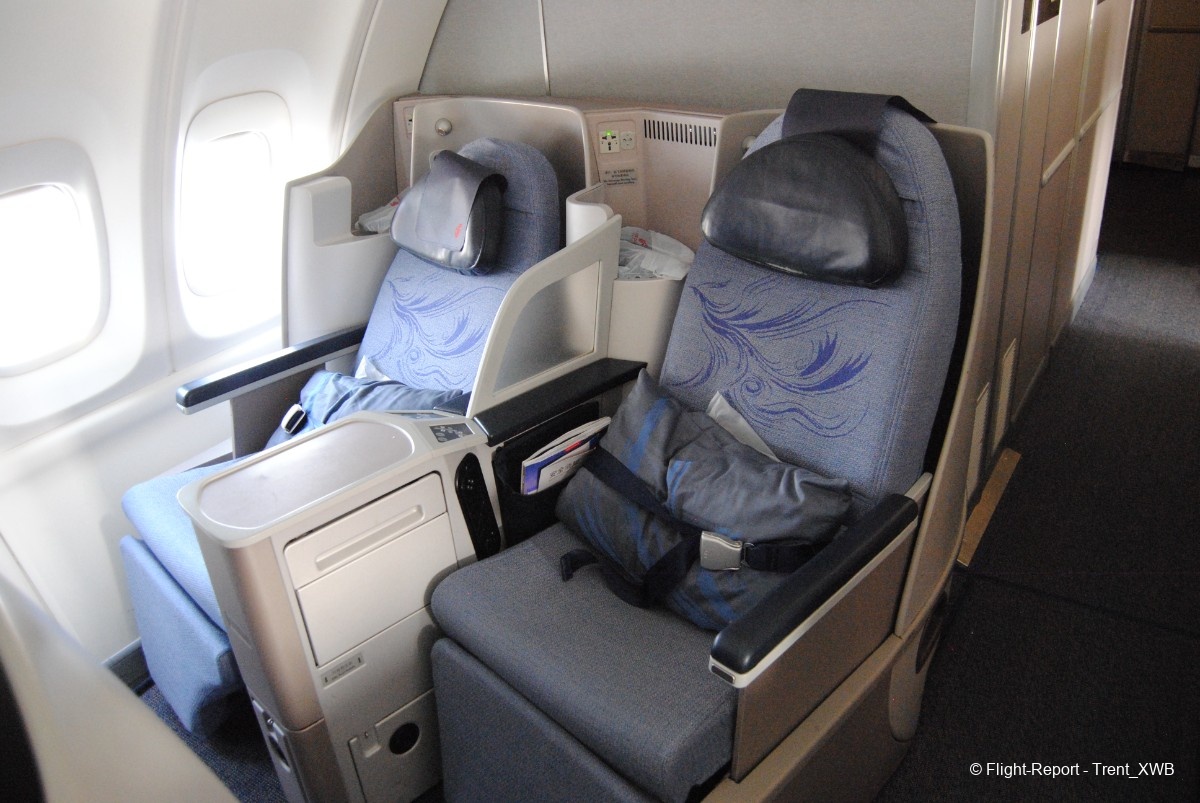
The last glance on the upper deck…
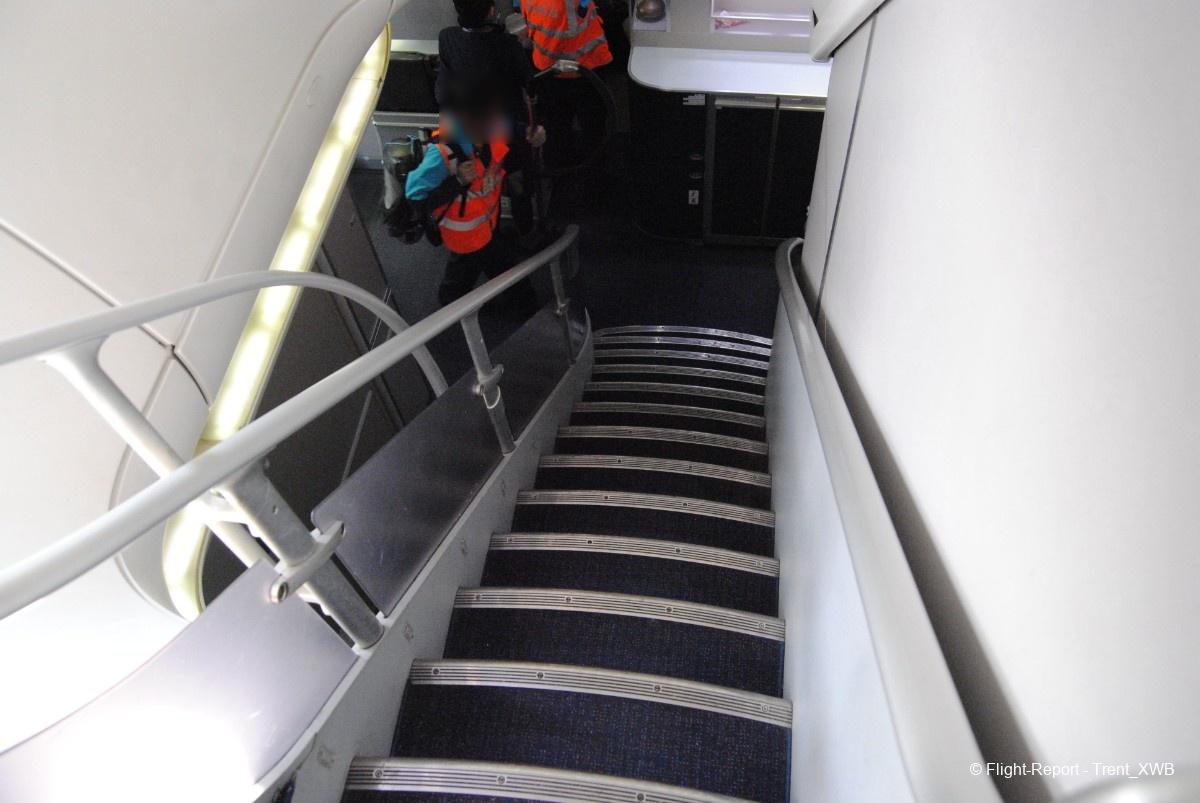
… and it's time to go downstairs. As one can see, the cleaning staff is already in the aircraft, so I have a little time.
The First Class Cabin After The Flight
Just a couple of photos of the first class cabin as I was rushing towards the nose. Thankfully, I had time to take unobstructed photos of this cabin during boarding…
The Second Business Class Main Deck Cabin After The Flight
And the last shot of the 2nd business main deck cabin before entering the nose.
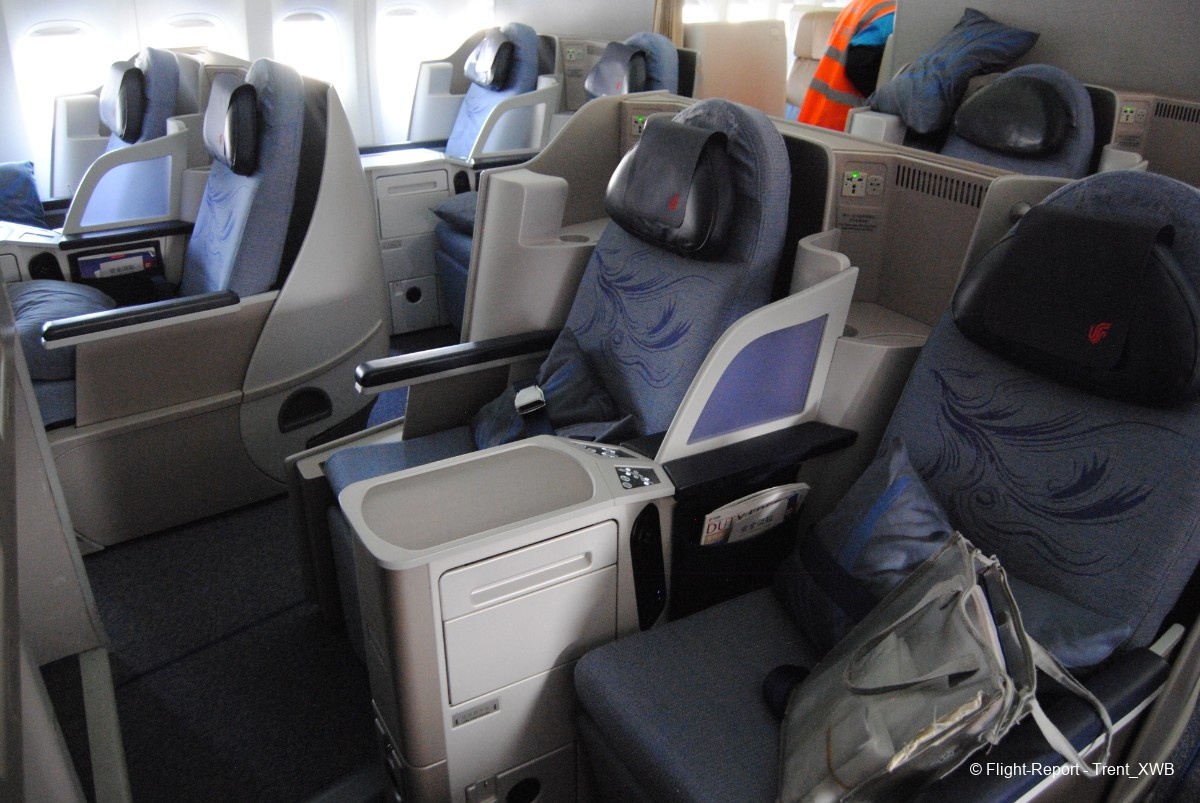
The Nose Business Class Cabin After The Flight
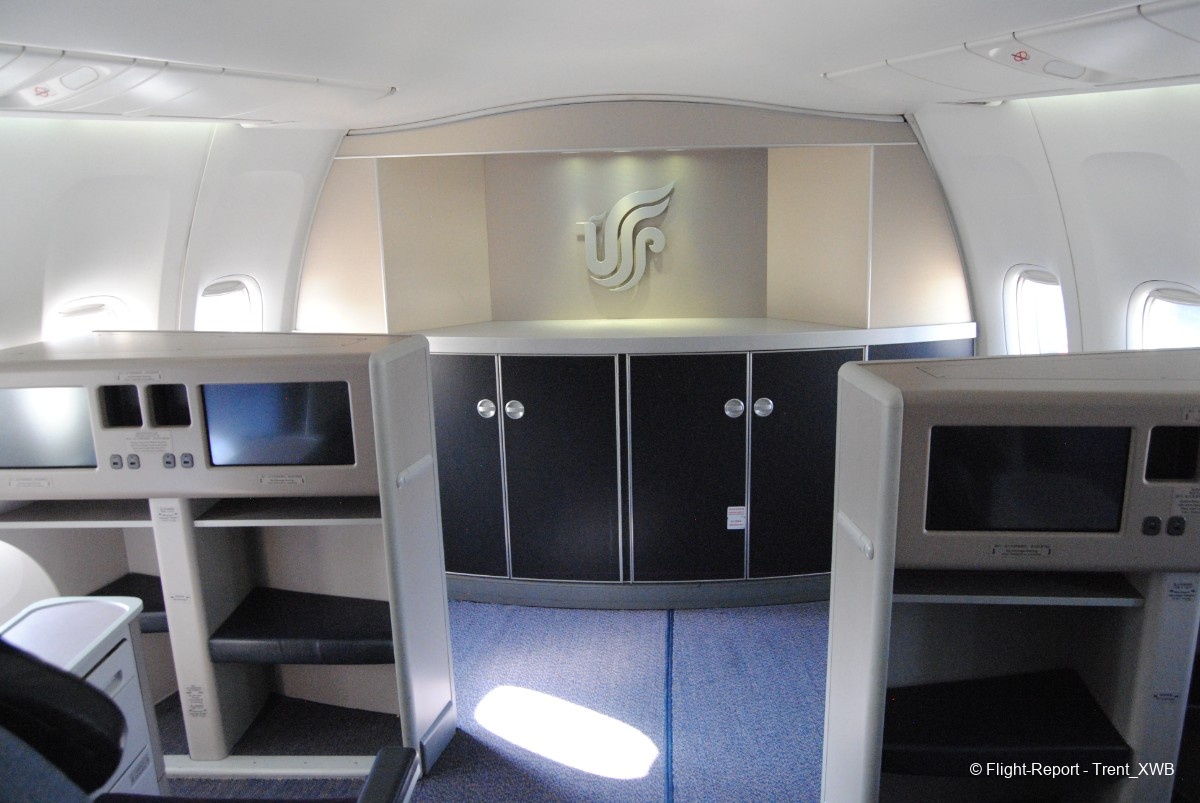
Thankfully, the nose business cabin was empty and the crew allowed me to visit it despite the time was already clocking out. Thus I managed to take detailed photos of this cabin as well.
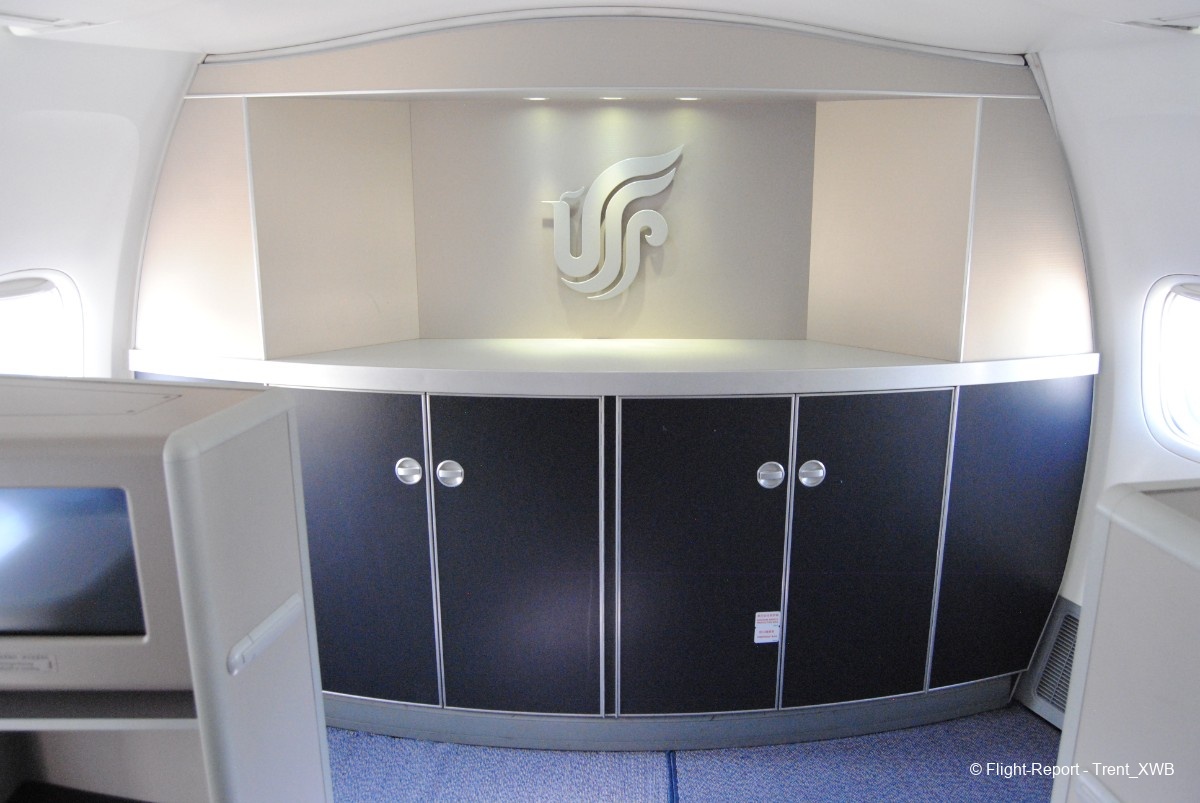
General views of the nose cabin from the rear and the closet with CA's phoenix logo.
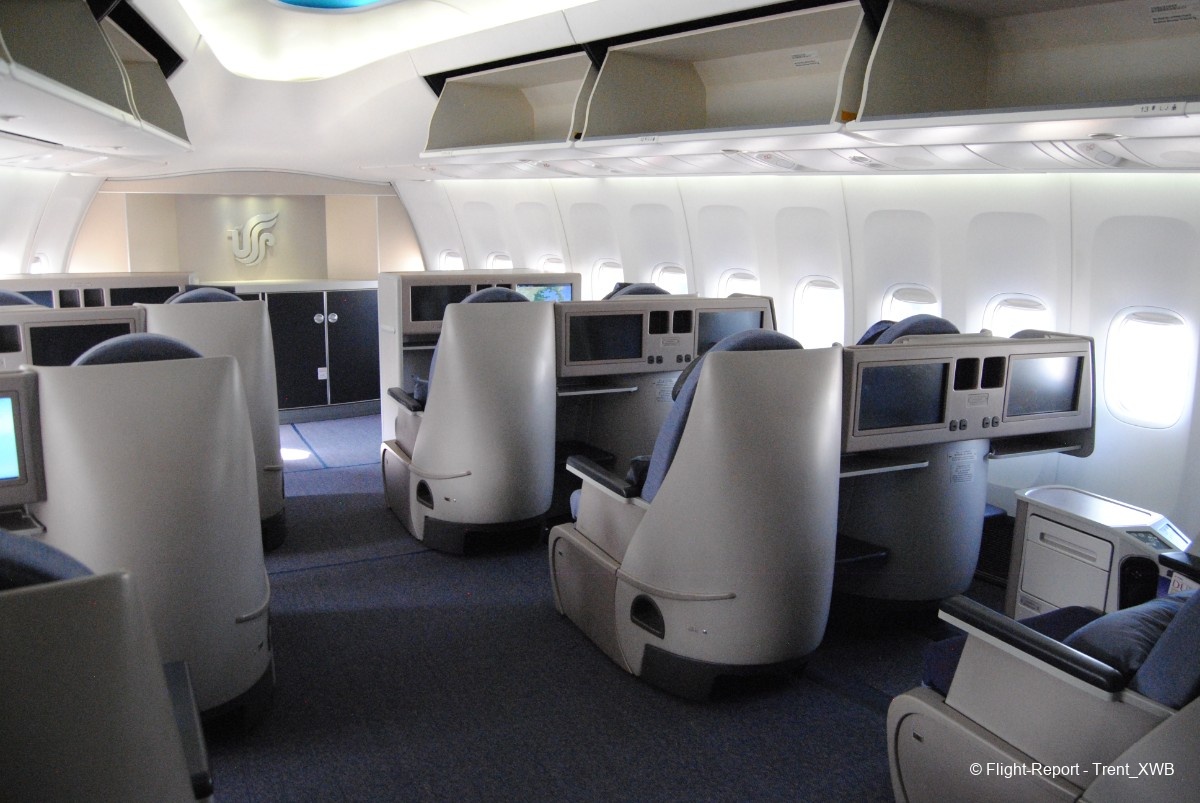
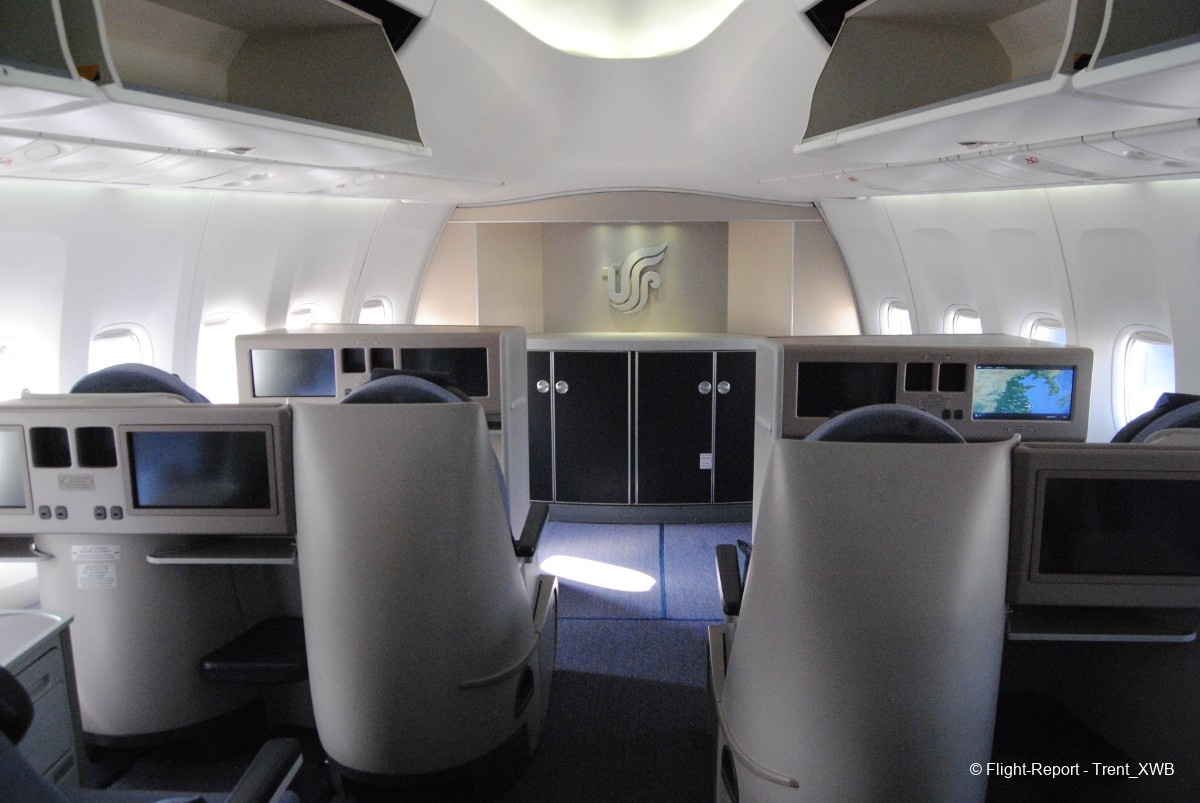
General views from the front.
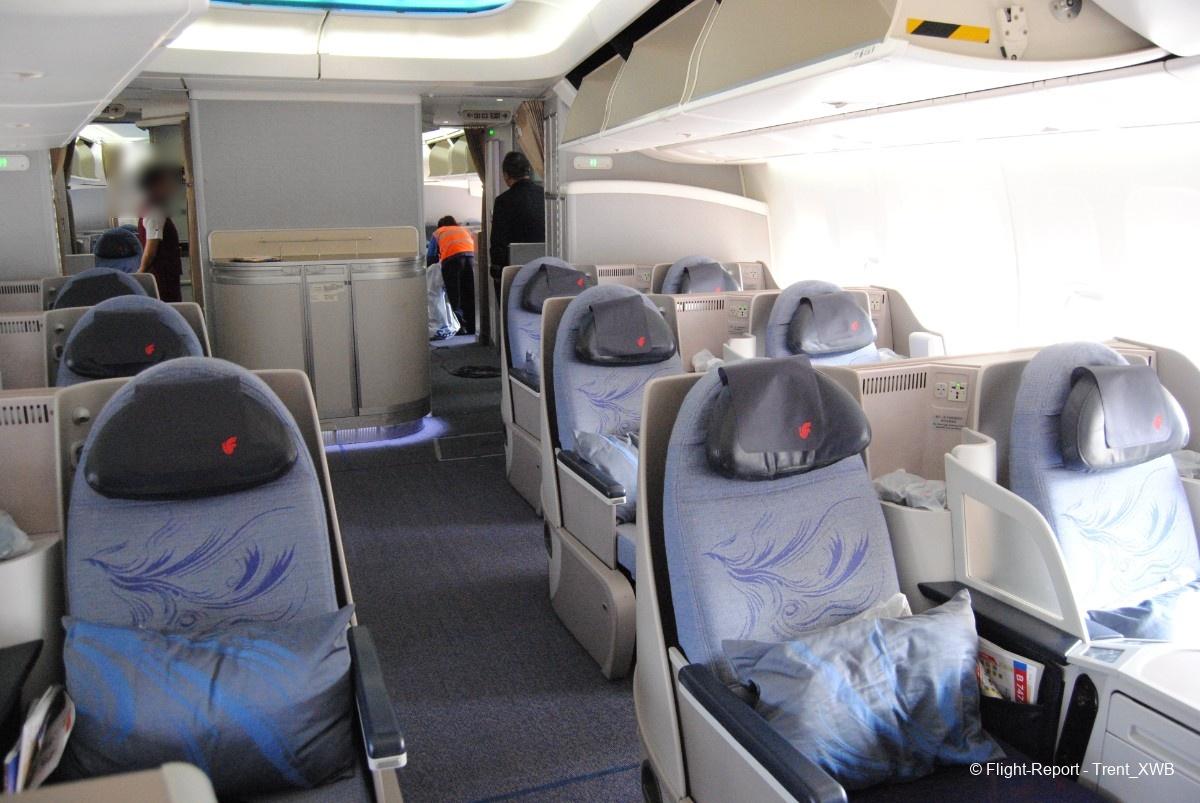
Rows 11-13 in details.
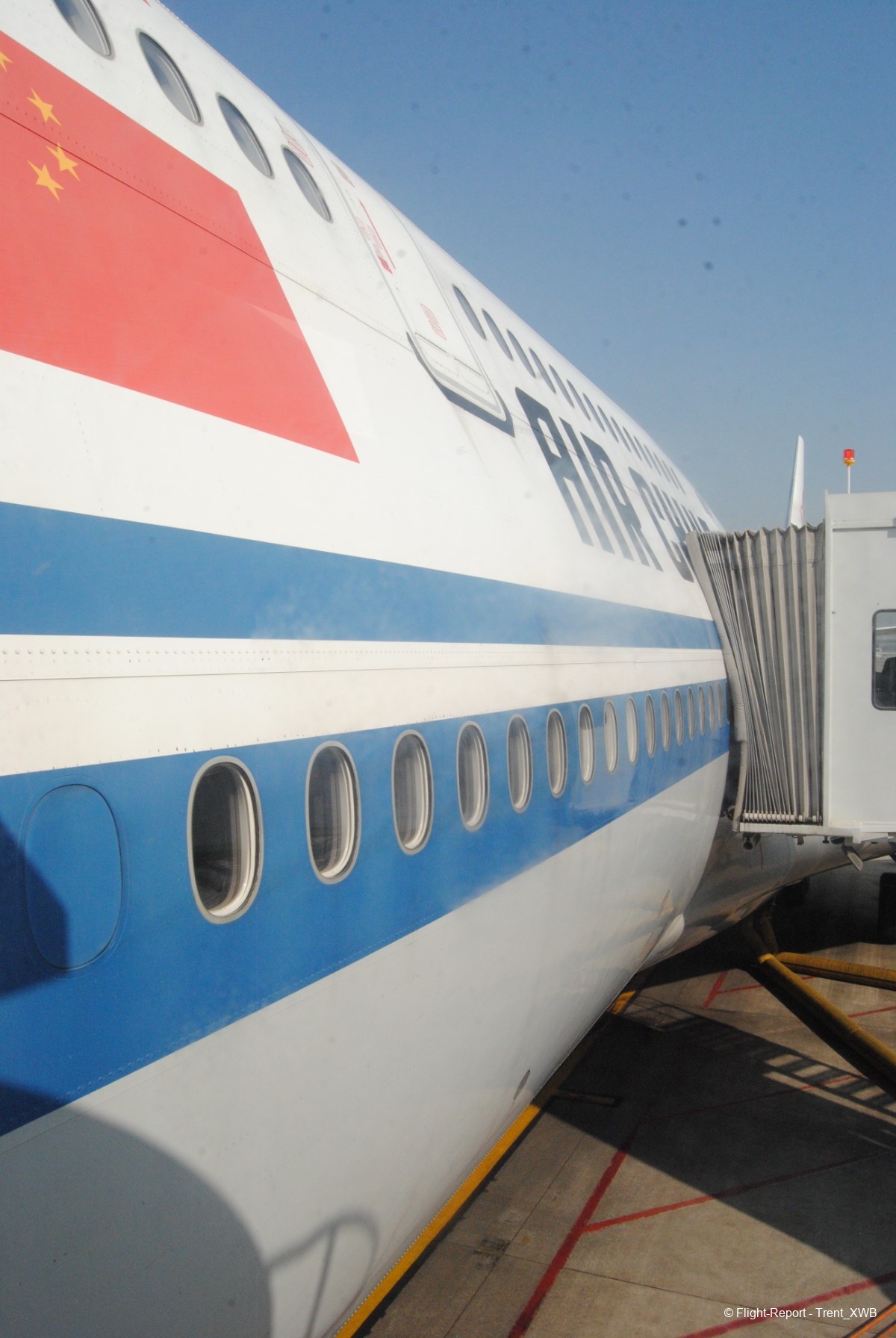
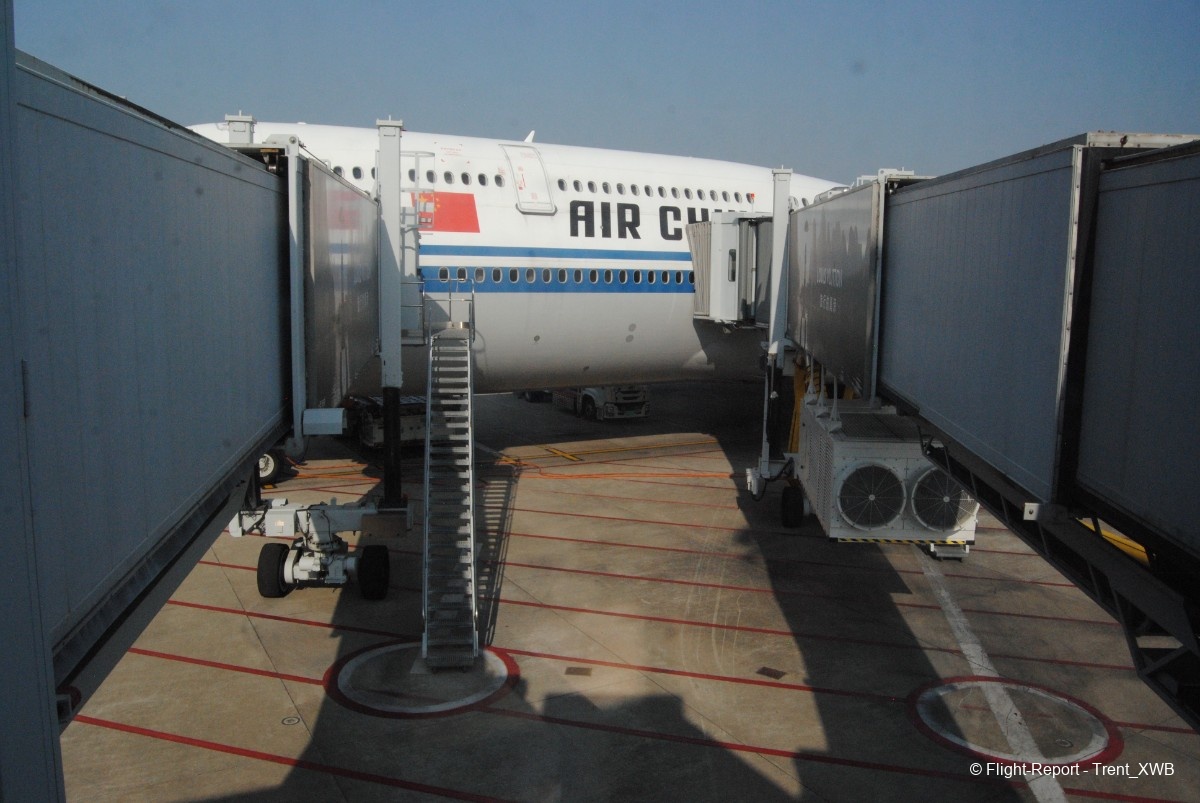
The Aircraft After The Flight
And now it's time to say a big "she-she" to the amazing CA crew and say goodbye to B-2485, leaving the aircraft via 1L door.
A couple of fuselage views from the jetbridge. And again, as in PEK, the sunny-side views are obstructed by the jetbridges.
And, finally, a couple of views of the beautiful Jumbo and its wing from the terminal.
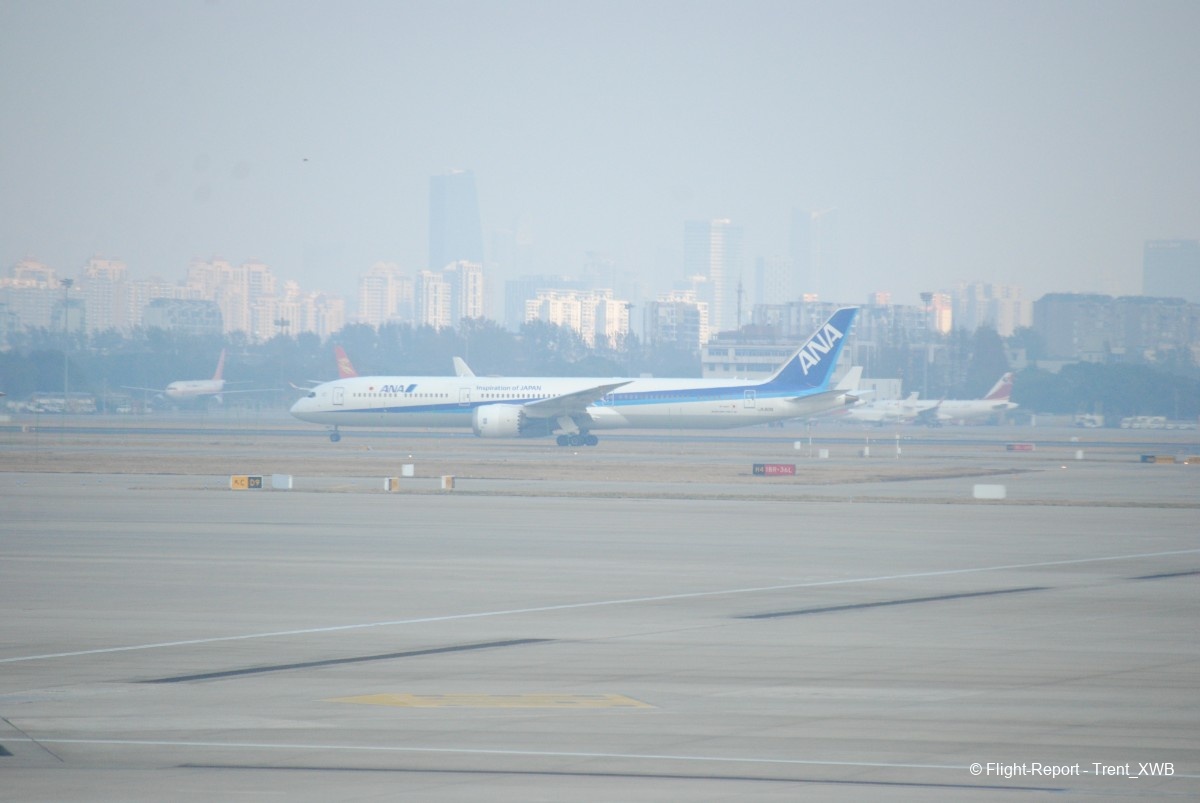
A Bit Of Planespotting From T2 SHA
An ANA RR-powered B78X (JA901A) in 3-class C38_W21_Y235 international layout is departing from T1 to HND (BTW, SHA is a direct analog of HND, except that Hongqiao is not located in the bay!). NH has just 3 international B78Xs (all of them are RR-powered), but also 7 (with more to come) domestic GE-powered B78Xs in high-density 2-class C28_Y401 domestic layout with quite bare-bones cabins (though, with modern IFE with large screens), replacing old domestic B773s, B77Es and B772s. NH's international flights are very expensive, but their domestic flights (for example, HND-ITM) is quite an affordable way to try a B78X (though, on my way to Japan a year ago I already flew a quite luxurious EY B78X, so I ignored NH's domestic ones).
Thank you for your attention and see you in the next FRs!
Hi, thanks for sharing your experience!
I have also booked a flight on CA's 747, CA1507 on February 20th on seat 47L for about 570 yuan including taxes. I want to ask if the situation with the airline's 747 and the equipment change issue has gotten better. Surfing through Air China's website, there seems to be no IAD flight arriving in the morning and one JFK flight arriving just an hour before CA1507's departure time, which makes me think the chances of a swap is very unlikely.
Also, I wonder if you have any information on the likelihood of a swap to the 744, as the website does just vaguely say '747'.
Hi! Thanks for the comment!
I'd say, based on tracking CA B748s and B744s (yes, CA since late December 2025 returned into service its both B744s), that situation has changed a lot since the moment I wrote this FR.
Currently B748s, when deployed on domestic flights, are more frequently assigned to SHA than to CAN, and CAN is getting B744s.
Do also have in mind that B-2482 and B-2485 (the hero of this FR) are currently grounded (probably for maintenance) and CA's active B748 fleet is again down to 3.
Worth noting that in 3 days (January 27) CA also starts to deploy B748s on FRA flights after long hiatus (since June 2024), which was hard to foresee in late 2025. B748 will operate CA931/932 frequencies 3 times per week (Tue, Fri, Sun).
20 February is Friday, so one B748 will be deployed on PEK-FRA CA931 flight, which departs at 13:40 (this schedule doesn't couple with CA1507/1508 rotation) and another one on PEK-IAD CA817 flight, which departs at 16:00 (couples well with CA1507/1508 rotation). At the same time one B748 will be out of PEK (having departed on Thursday 19 February evening) operating JFK rotation. One more B748 arrives from JFK on Friday 20 Feb at 06:50 (doesn't couple with CA1507). This schedule requires 4 B748s, so until your date B-2482 or B-2485 (or both) should return to service. So, if there'll be no a/c change, your flight will be operated by a B748, which later that day will fly to IAD.
Talking of types of Jumbos assigned to domestic flights, CA's app doesn't show whether its B748 or B744, so you have to use expertflyer.com. As of now, it shows that flight CA1507 on February 20 is announced to be operated by B748 (it's easy to tell looking at the seat map: for example, economy is from row 38 to 64, which is distinctive for B748).
You've got a bargain price for this flight, and hopefully a/c type will be kept as announced. The fact that your date is within the interval of the Chinese New Year celebrations, may also help, as the domestic air traffic will surge, thus justifying the use of the largest widebodies.
Also have in mind that CA1507 departs so early that you won't be able to use PEK airport express train, which leaves you with spending the night in the airport or taking a taxi.
Good luck!
Thanks for the research! I also did some digging but completely missed out on the FRA deployment and thought I'd be completely safe.
Looks like B-2482 and B-2485 had their last flights on the 13th and the 16th of January respectively. Surprised the maintenance schedule is overlapping so much. Hoping they can return and other aircraft stay in service by then. CA1507/1508 is supposed to see 747s on Fridays from February 6th, so we'll see if the fleet is ready by then.
Yeah I already made my mind up to take the last airport express train the day before, as the schedule only allowed me one day in Beijing with my arrival flight from GMP on KE2051. I'll probably store my luggage at T3 and get around the city before heading back that night. Pretty disappointing, as I wanted to visit the Great Wall of China.
Let's hope that B-2482/85 will return to service on time.
BTW, I see that you've already flown Lufthansa A346. Having flown their A346 a long ago (MEX-MUC in 2017), I've just realized that these A346s have exactly the same economy seat model as CA B748s. It's not Collins Pinnacle, it's Star Plus by B/E Aerospace (this company is in relations with Collins, thus some similarity with Pinnacle). This article is the only source that sheds the light on this model (and also on the process of designing CA B748s interiors) : https://www.aircraftinteriorsinternational.com/features/air-china-b747-8i-2.html
Talking about your schedule, it seems like you have time to visit Badaling part of The Wall. Yes, it's the most popular part, but by far the most easily accessible, as there are high-speed trains from Qinghe station. But if you decide to spend the day in the city, there are a lots to see.
Yeah didn't notice that! Looks like it's the same seats but with different IFE screens. I think I didn't notice it until now because they have different sets of IFE screens. All this time I thought the same seat products would have the same screens, but I guess not.
Thanks for the info! I just decided to wander around the city and see all the essentials before heading back. I'd love to come back and do a pretty thorough tour of the Wall though!
Yeah about this, I noticed a few days ago on the Air China app that my flight was switched to a 777. Ha, at least the change wasn't last minute.
Judging by the schedules, the flight on the 13th still has a 747 scheduled, albeit on the 8:30 departure as CA1501 instead of on the 7:30 departure as CA1507. And the flight on the 27th has the 747 scheduled to run on the CA1507 flight as normal. As domestic flights on the 20th don't seem to have any special 747 flights, I am guessing that my flight on the 20th was sandwiched awkwardly between one 747 returning and another heading to maintenance. Very unlucky, but I guess I still have a lot of chances to fly them, as opposed to the -400 which was my original plan but couldn't draw out a good routing. I still am hoping that another flight on the 20th switches to the 747 before my flight.
As for my original flight, I ended up spending another 125CNY to switch to the 8:30AM departure, to fly on the A350 because the 777 just doesn't interest me as much as the A350. it isn't all that bad, but it sure does take the sting out of this whole trip.
Anyways, thanks again for helping out with the comments.
Hi!
It's sad that CA has played random on your flight. Just another illustration of the fact that nothing outside of JFK and IAD flights (and now temporary FRA flights) is guaranteed about 748s. Probably the reason is that maintenance of B-2482 and B-2485 is taking longer than expected (I guess, especially of B-2485, which is more "tired").
But there's some good news: CA decided to withdraw 748s from FRA flights from the end of April (initially B748 was announced on CA931/932 until the end of summer schedule), and this will definitely have a positive impact on B748 availability on CAN and SHA flight. So you may consider visiting China once again.
Speaking of CA's B77Ws and A359, CA assigns to SHA flights 3-class 77Ws (B-20XX reg) with first class suites and business class seats similar to the ones in B748s, and with very spacious and comfortable 3-3-3 economy (this is by far the best long-haul economy of CA widebody fleets). These 77Ws are definitely in the highest part of the spectrum of world's 77W layout variety. At the same time CA 359s are quite dull with generic (albeit modern) layout and very subpar Recaro CL3710 economy (though, it's not an issue for a short ride to SHA).
But if you haven't flown an A359 yet, it's a good opportunity to check the box given that the circumstances has turned this way.
Good luck!