


Starting from 2026, my flight reports will become rather non-chronological in nature. There were so many flights (a whopping 45 of them!) that I took in 2025, plus some more exciting ones to start off 2026 — like United and Ethiopian 787-9s on the fifth-freedom BKK–HKG sector, and a Thai Airways A350 in Star Alliance livery in Business Class!
As such, I’ll mostly be sifting through my recent memorable flights when it comes to publishing them here, and will put them up in a largely random sequence. To start, here’s an Etihad A350-1000 report from September 2025 — my first time flying the stretched -1000 variant — that goes to show just how magnificent Etihad’s branding game is.
Next up, in February 2026, will be two exotic flights from November 2025: Saudia’s new fifth-freedom 787-10 route from Singapore to Denpasar, and Malaysia Airlines’ new A330-900neo from Denpasar. Both of these are also among the best-branded airlines in the world as far as I’m concerned, with a top-notch typographical experience to match, and new cabin products to boot.
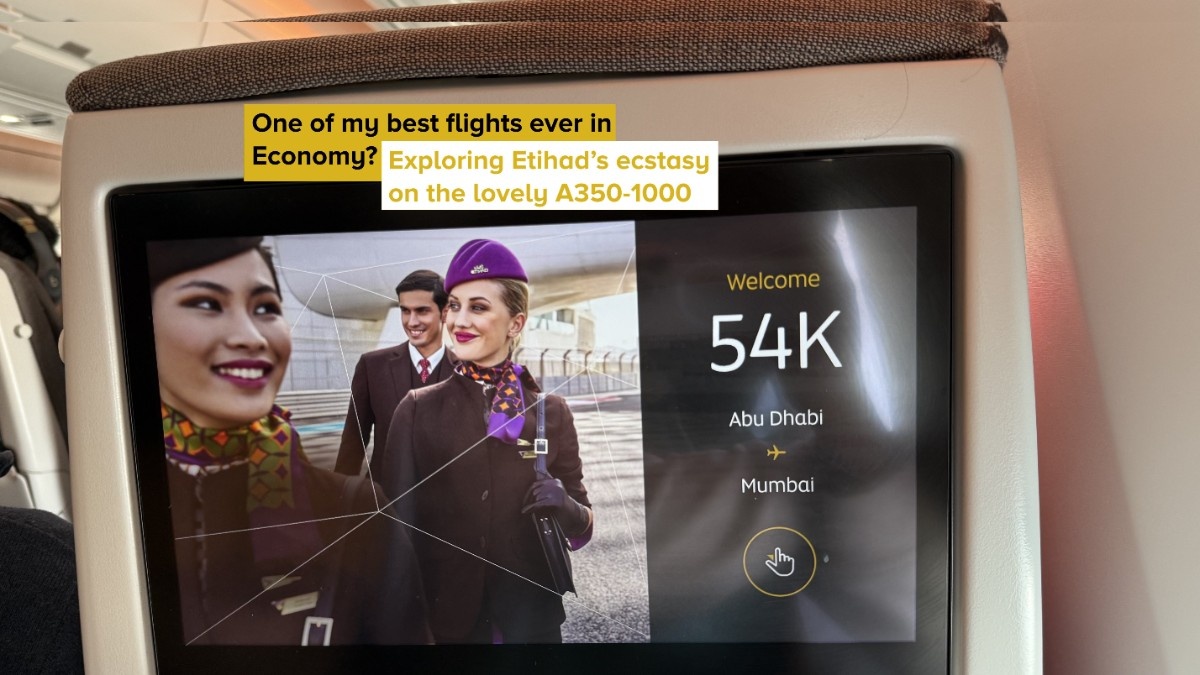
Introduction: Arabian adventures on the A350-1000
For the longest time, I’ve held Etihad Airways in extremely high regard. Recovering from all its struggles and failed investments — among them Jet Airways, once India’s best airline, which crashed into bankruptcy — the UAE’s national carrier has reinvented itself spectacularly with lots of new aircraft and routes. 2025 was by all means a very exciting year indeed for EY, with new destinations as far afield as Atlanta and Taipei, and brand-new A321LRs (with a pair of First Class suites up front) flying to cool new Asian cities like Hanoi, Medan and Phnom Penh. Not to mention, the A380 and its fabled Residence now flies to Singapore and Toronto, and will soon serve Tokyo Narita from June 2026.
All this without the sure-footed complacency of Emirates or the hubris of Qatar Airways. Yes, the A320/1ceos — with no seatback IFE — and older 777-300ER fleet leave a lot to be desired, but then again so do QR’s awful, ancient A330s. With a rapidly expanding fleet of some 120 passenger aircraft — roughly half of Qatar’s 240+ or EK’s 260+ — what Etihad has achieved under the able leadership of Antonoaldo Neves, amid all its prior financial woes, is nothing short of remarkable. As more A350-1000s and A321LRs roll into the fleet, plus A330-900neos from 2027, I’m excited to see what’s next for the airline. (Oh, did I say that it’s now the only Gulf airline with a physical inflight magazine?!)
At this point I think EY is by far the best-designed airline in the Middle East, overtaking even Gulf Air — which in a 2023 report I called one of the world’s best-branded airlines — in terms of fonts and typography. Heck, there are very few airlines in the world as competently branded as Etihad, with Cathay Pacific (as I’ve said numerous times) also being among the very best out there. Both EY and CX are right at the top of the typographic consistency rankings, as far as I’m concerned. This comes amid stiff competition from chiefly US, European and Middle Eastern airlines — plus some other brilliant ones like LATAM and Malaysia Airlines — with Gulf rivals including a revamped Saudia and a highly promising Riyadh Air, waiting to unleash itself upon the world.
All fine and dandy, but how do I actually fly Etihad?
With my first semester at IIM Bangalore, one of India’s best business schools, drawing to a close in September 2025, I planned a six-day holiday trip. The first half was in Abu Dhabi — a place that had always tickled my fancy — and the second in Delhi, where I hadn’t visited for a decade. The primary goal was to fly Etihad — and also the A350-1000 — for the first time. I’ve made no secret of the fact that I absolutely adore flying on the A350, and have made it my most-flown widebody plane by some distance. However, up until this point I hadn’t flown the longer -1000 variant, hard as it is to find on intra-Southeast Asian routes.
Then I noticed that Etihad flew the A350-1000 to Delhi on selected days in September, and also flew it to Mumbai every so often. And so I booked EY216 from Abu Dhabi to Delhi on Tuesday, 9 September — only to discover (after reaching Abu Dhabi) that it had been swapped to the older 777-300ER! (Specifically A6-ETS, the airline’s final 777-300ER — and the only one with First Class.) Naturally, I was bummed, if not for the fact that the A350-1000 would be flying EY204 to Mumbai instead! So I cancelled EY216 and booked EY204, and, had I not noticed this swap, the whole point of flying Etihad would have been defeated. (Both EY204 to BOM and EY216 to DEL are operated by a mix of A350-1000s, 777-300ERs and the odd 787-9 or 787-10, depending on the day of the week.) Afterwards I’d stay at the Niranta transit hotel at BOM before boarding an early-morning Air India A321neo flight, AI2930, to DEL.
There was also the small angle of flying Air India’s A350 on the Delhi–Bengaluru route in Economy. I’d already flown Air India’s A350 in February 2024 on the 90-minute Bengaluru–Mumbai hop in Premium Economy, shortly after it entered service. For a few months until October 2025, the AI2664 afternoon service on the DEL–BLR sector was operated by the A350 up to three days a week, so I wanted to fly it in good ol’ Economy instead.
As for getting from BLR to Abu Dhabi, I chose the new Indian low-cost carrier Akasa Air, which has a codeshare partnership with Etihad and operates an all-737 MAX fleet. As I see it, Akasa is the spiritual successor to the erstwhile Jet Airways — down to the management, the 737 fleet and the Etihad partnership — so the Jet service DNA of old was reflected in Akasa’s bright orange-and-purple branding as well. I’m not going to review the other flights (AI A321neo, Akasa 737) in the series, except perhaps the Air India A350 on the DEL–BLR route — that too not in the near future.
With all the logistics sorted, all that was left was to tour the famous Louvre Abu Dhabi on the morning of Tuesday, 9 September, before boarding the afternoon flight to Mumbai.
Flight routing
- 1QP578 | Bengaluru to Abu Dhabi | 6 September 2025 | 737 MAX 8-200 | VT-YBB
- 2EY204 | Abu Dhabi to Mumbai | 9 September 2025 | A350-1000 | A6-XWF
- 3AI2930 | Mumbai to Delhi | 10 September 2025 | A321neo | VT-TVA
- 4AI2664 | Delhi to Bengaluru | 11 September 2025 | A350-900 | VT-JRA
An hour — only an hour — at the Louvre Abu Dhabi
Tuesday, 9 September, morning. My three days in Abu Dhabi were drawing to a close. I’d foolishly not accounted for the fact that the Louvre Abu Dhabi — located on Saadiyat Island, the city’s cultural district — is closed on Mondays, as I’d originally planned to go there on Monday. This meant that I’d had to squeeze in a visit to the Louvre on Tuesday morning itself, shortly before my flight. (Monday didn’t go to waste, though: between the Manarat al Saadiyat art gallery — also on Saadiyat Island — and the opulent The Galleria mall on Al Maryah Island, I had a whale of a time.)
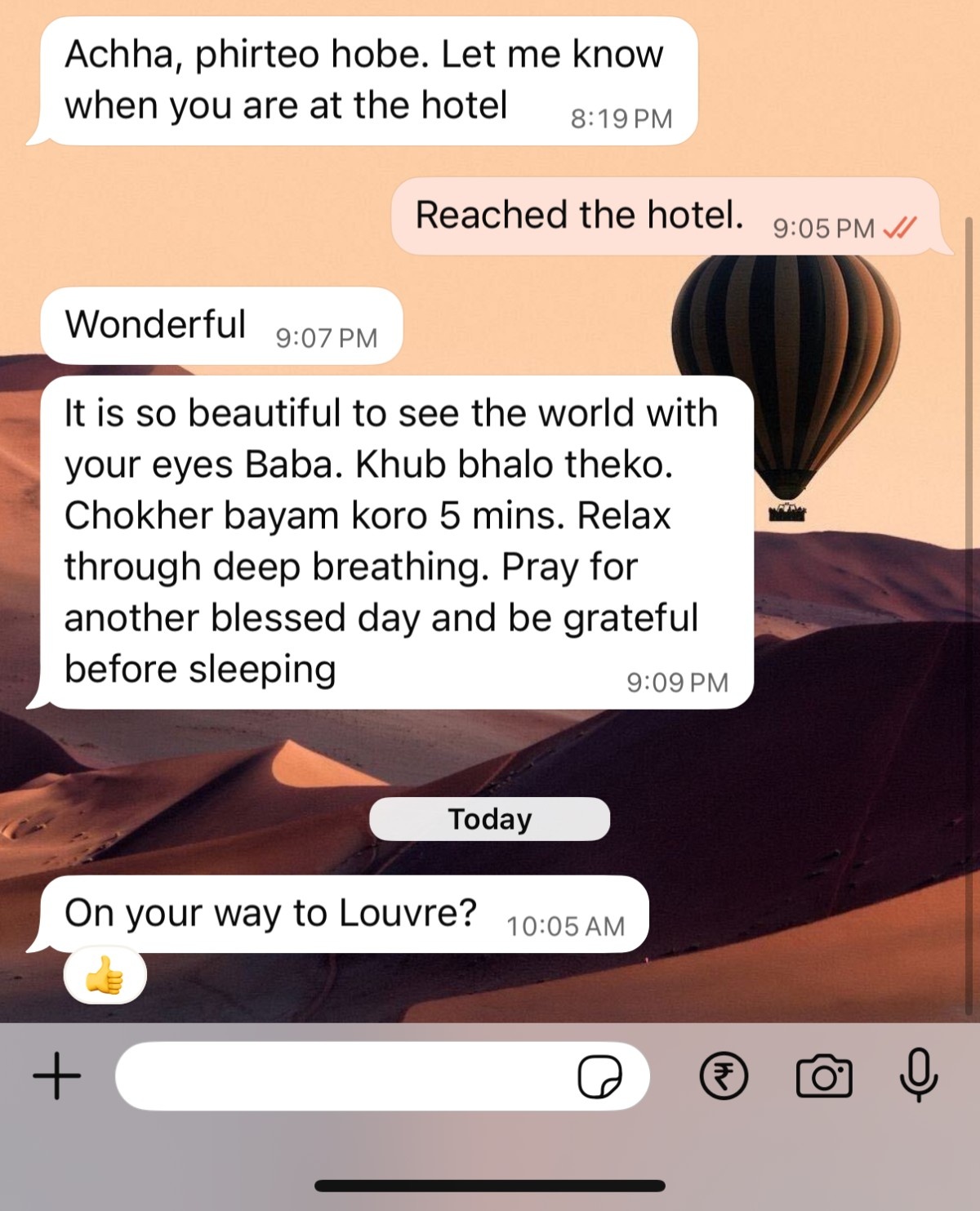
As always, my mom asked me for my whereabouts, half a day after sending me a note of appreciation for seeing the world through my eyes — eyes that she then asked to relax and destress!
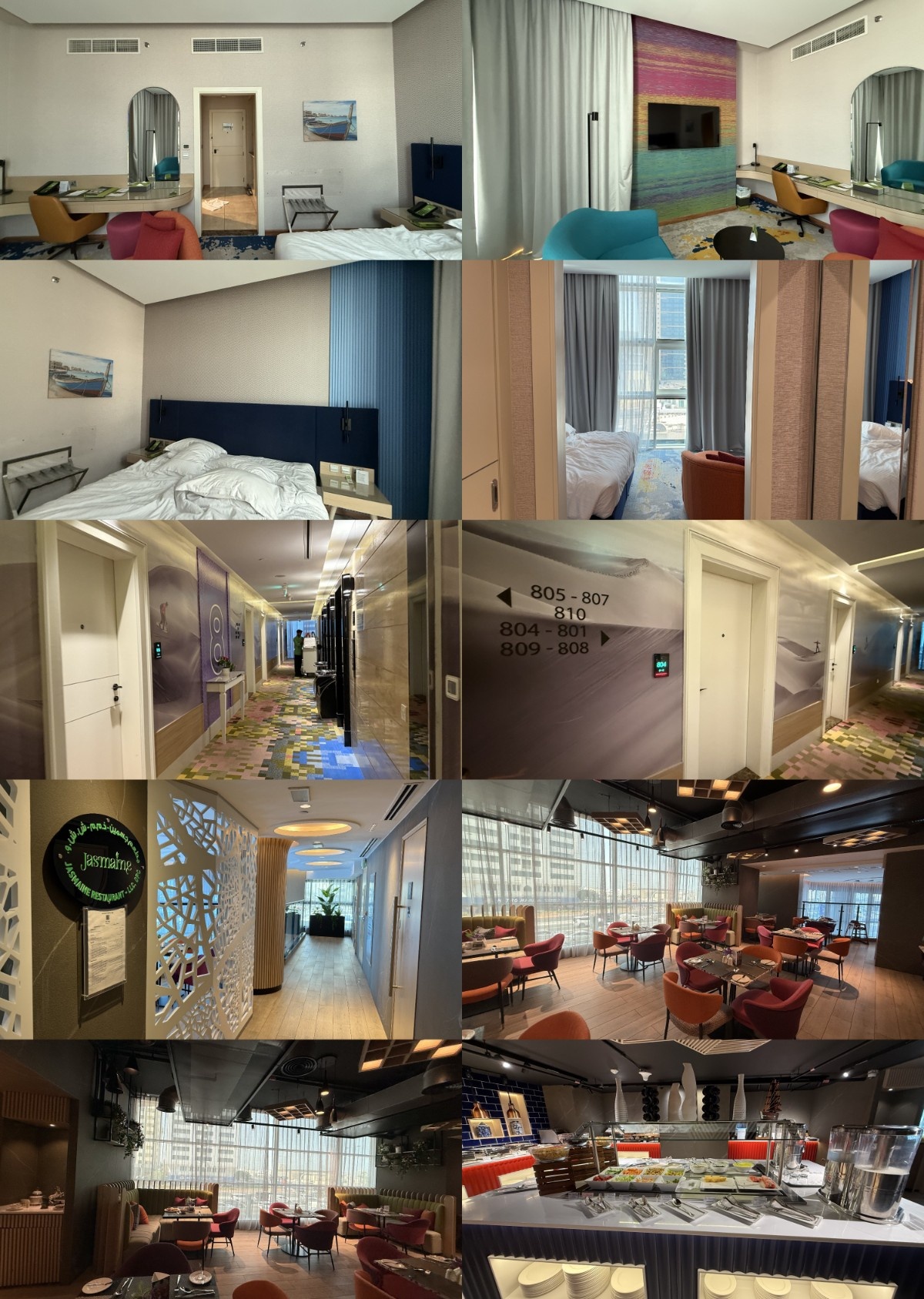
I checked out of my new, pretty and spacious hotel: the La Quinta by Wyndham next to Al Wahda Mall, one of the city’s oldest and most well-known shopping centres. It’s not often that I stay at a chain hotel, but in this case the décor, location and price all worked out for me.
After leaving my luggage at the reception, I set out for the Louvre Abu Dhabi. Mind you, this is a crazy expensive city (by Indian standards), which is reinforced by the fact that my Uber ride was a luxurious Lexus!
Before long we’d crossed Abu Dhabi Mall, which actually isn’t the largest in the city. That honour goes to the endlessly undulating Yas Mall, which I’d visited on Sunday evening — right after the Sheikh Zayed Grand Mosque — and spend hours happily roaming in.
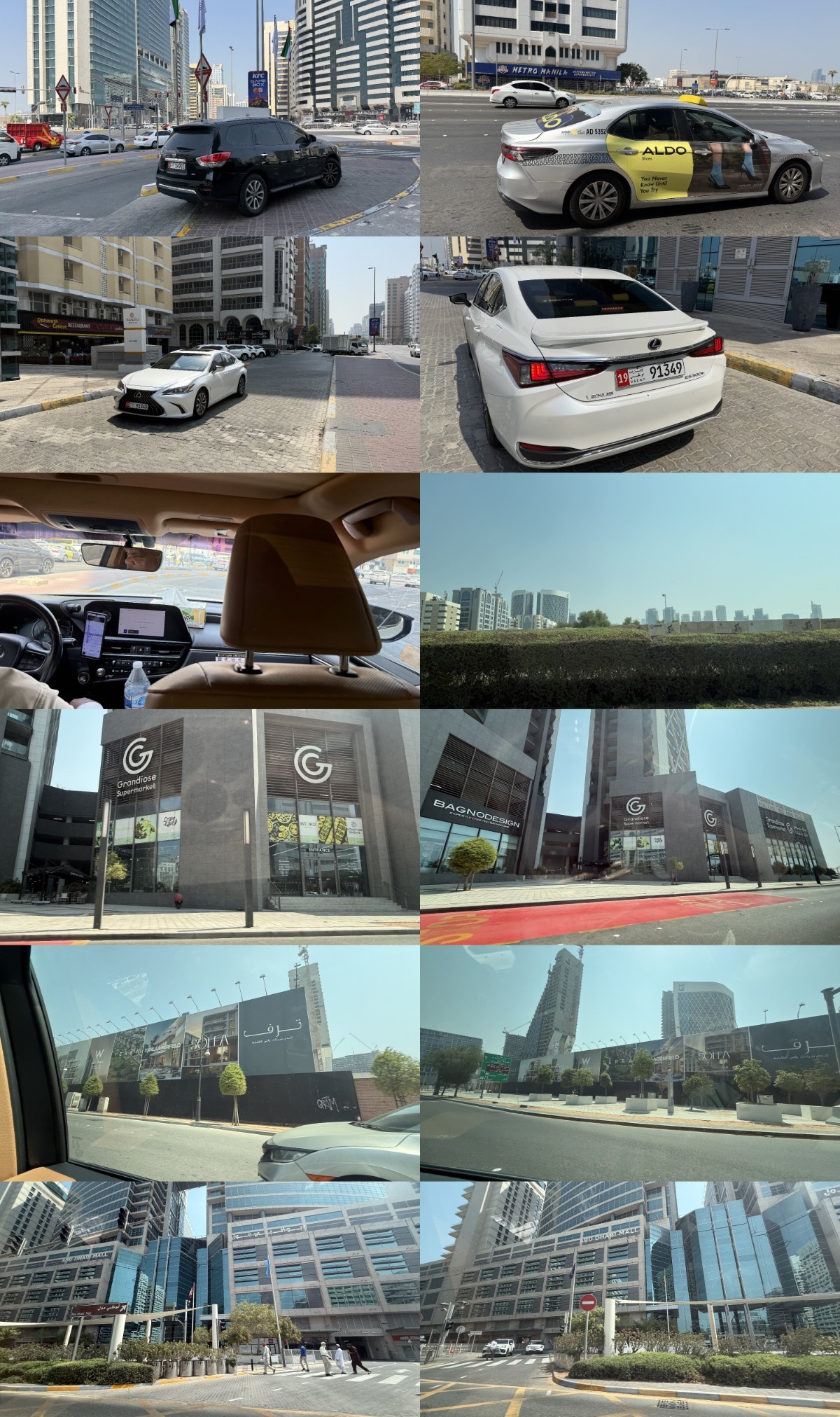
At length we came to the bridge connecting the city with Saadiyat Island. The views were incredible, and the tell-tale dome of the Louvre Abu Dhabi appeared within half an hour of my starting from the hotel.
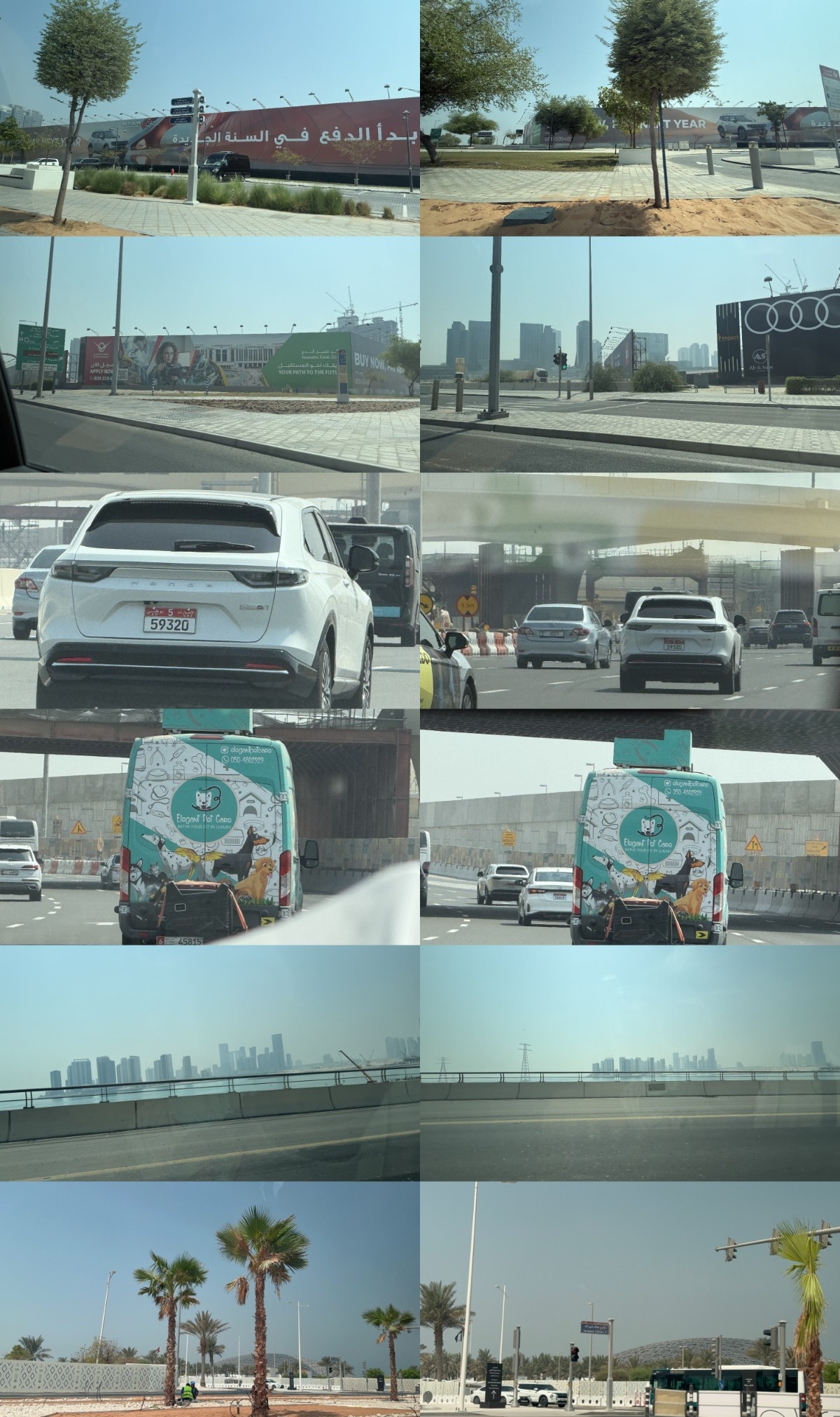
All the way ahead, zipping to Zayed
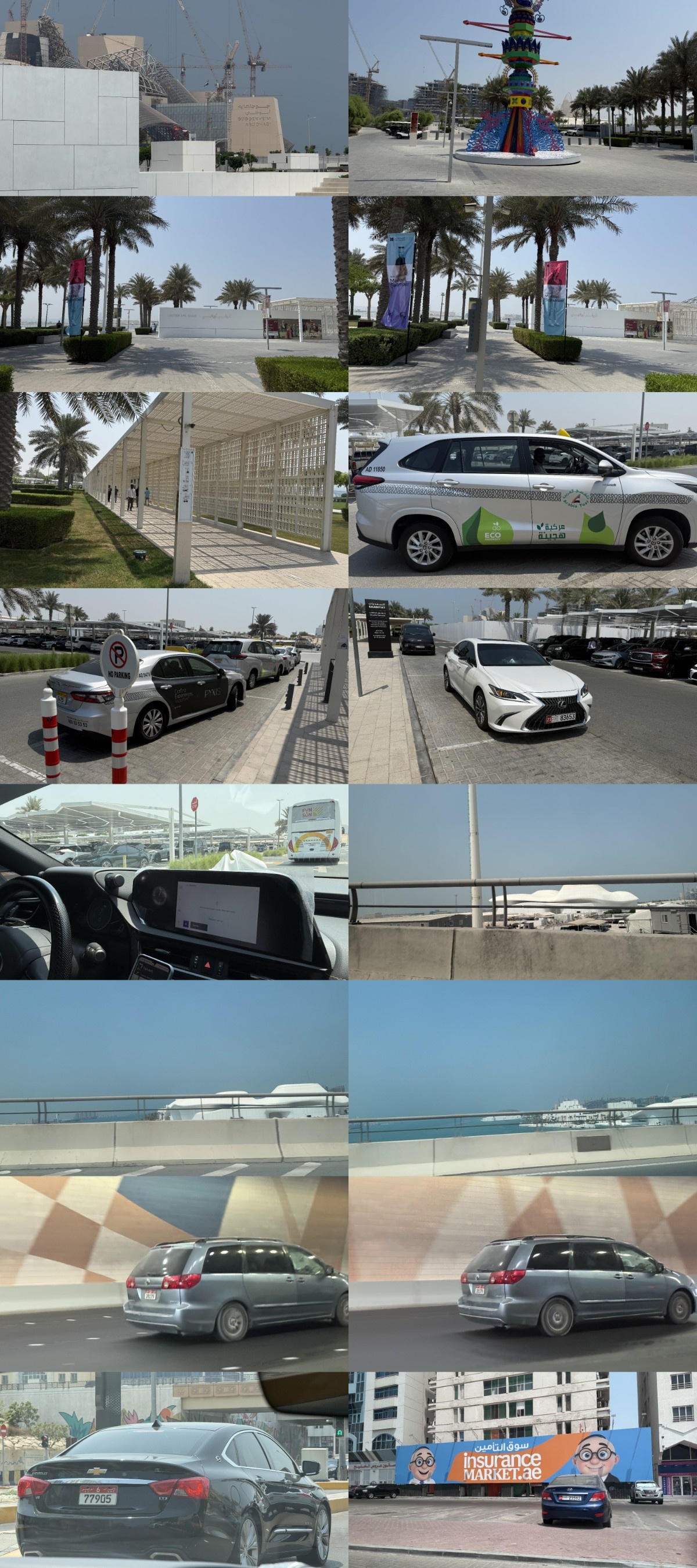
With the Louvre box ticked, I couldn’t help but notice the under-construction Guggenheim Abu Dhabi, which is nearing completion and is now slated to open some time in 2026 after several delays. Its architect, the legendary Frank Gehry, died on 5 December 2025 at age 96 — just days after two more museums on Saadiyat Island, the Zayed National Museum and the Natural History Museum, opened their doors on 2 December (the UAE’s National Day)!
Another Uber, another Lexus, and I was off and away: first to the La Quinta to pick up my luggage, and then all the way to Zayed International Airport and its brand-new Terminal A, which opened only in November 2023. This is certainly an emirate and a city that takes great pride in its architecture, and it shows…
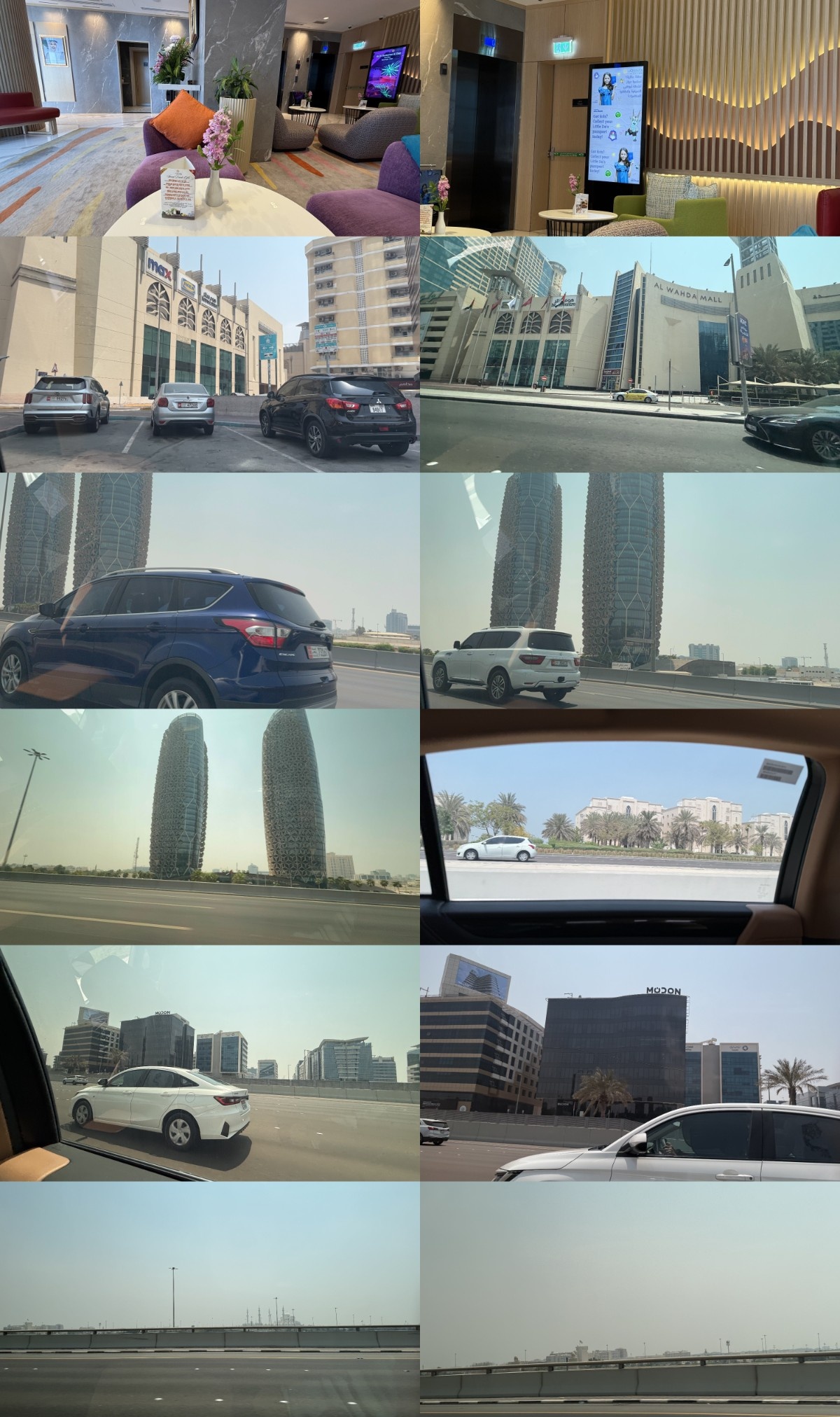
After one last look at the lobby of the hotel with its splashes of colour, I got my luggage from a bellman and set out for the airport, some 30 km east of the city that can be reached in as many minutes. But it also costs as much: an Uber or a taxi charges around AED 80 (US$22) for the one-way trip, sometimes more.
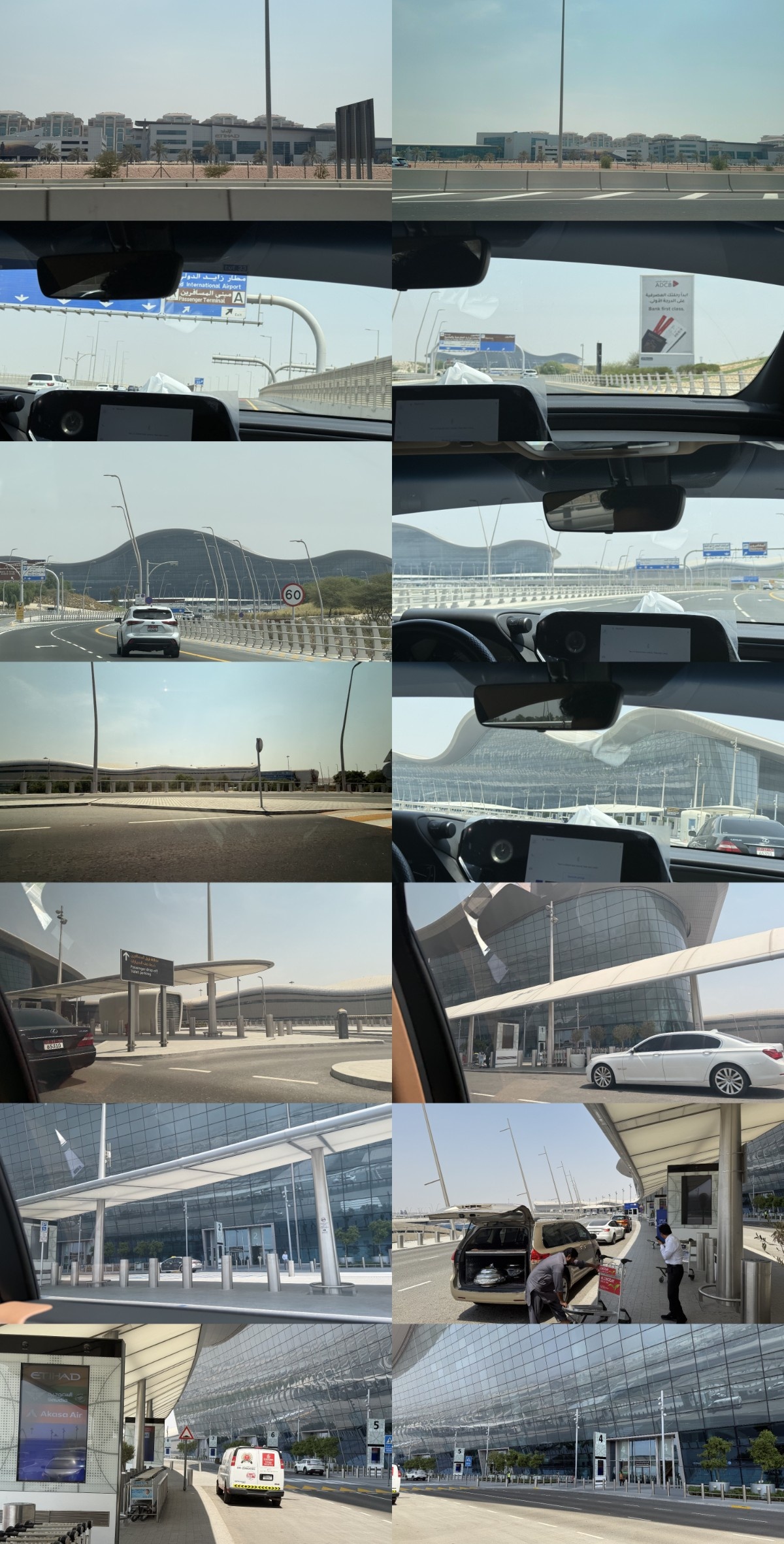
After a few minutes of wide, empty roads, I passed by the Etihad Aviation Training academy. That meant it wouldn’t be long before I encountered the sprawling terminal itself — and in a jiffy we were inside the driveway. Like Dubai T3, Abu Dhabi has one of those weird designs where the car pulls up to a median in the centre of the road, and you have to cross it yourself to enter the terminal building.
Among the airlines whose logos were visible on the displays was Akasa Air, the Indian budget carrier I’d flown into AUH three days before, as part of a partnership with Etihad. That the online booking did not allow me to select my seats or meals at all was an entirely different matter!
AUH Terminal A: Small yet sprawling; gold and gorgeous
I’d heard a lot of good things about Zayed International Airport — as AUH was renamed in early 2024 — and its Terminal A, which opened in November 2023 to much acclaim. The previous AUH terminal was a dump, to put it politely, and the new one (originally called the Midfield Terminal) did a fabulous yet compact redesign.
Naturally, I was overblown at how neat, spacious and elegant the entire design was — and yet this wasn’t a massive terminal à la HKG or BKK that stretched on endlessly. And it didn’t need to, either, given that most non-Etihad carriers here are from countries with heavy local traffic, like other Gulf countries and South Asian countries like India. You can’t expect the likes of United or Singapore Airlines to fly here!
Checking in my bag using the automated machine was effortless, mirroring all my experiences with this terminal so far. Then I was through immigration, and voilà!
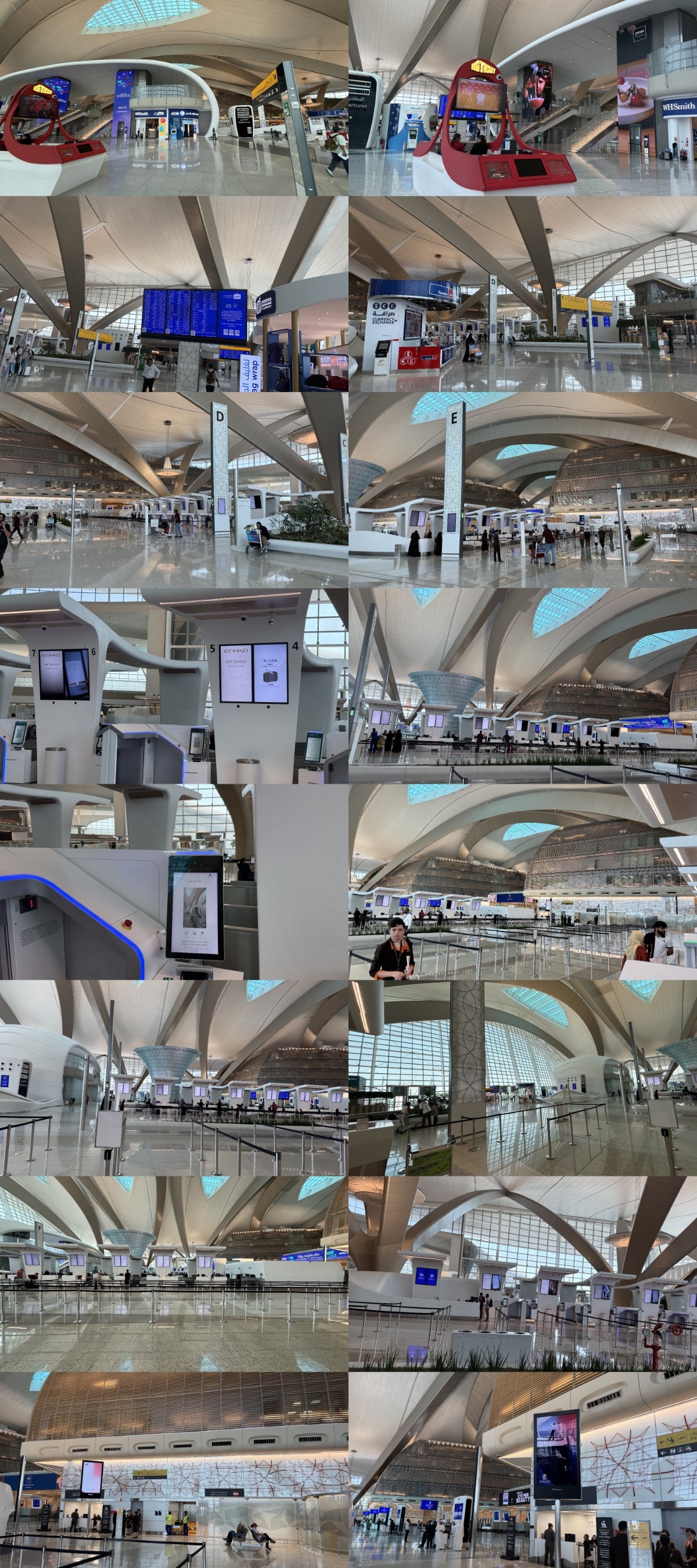
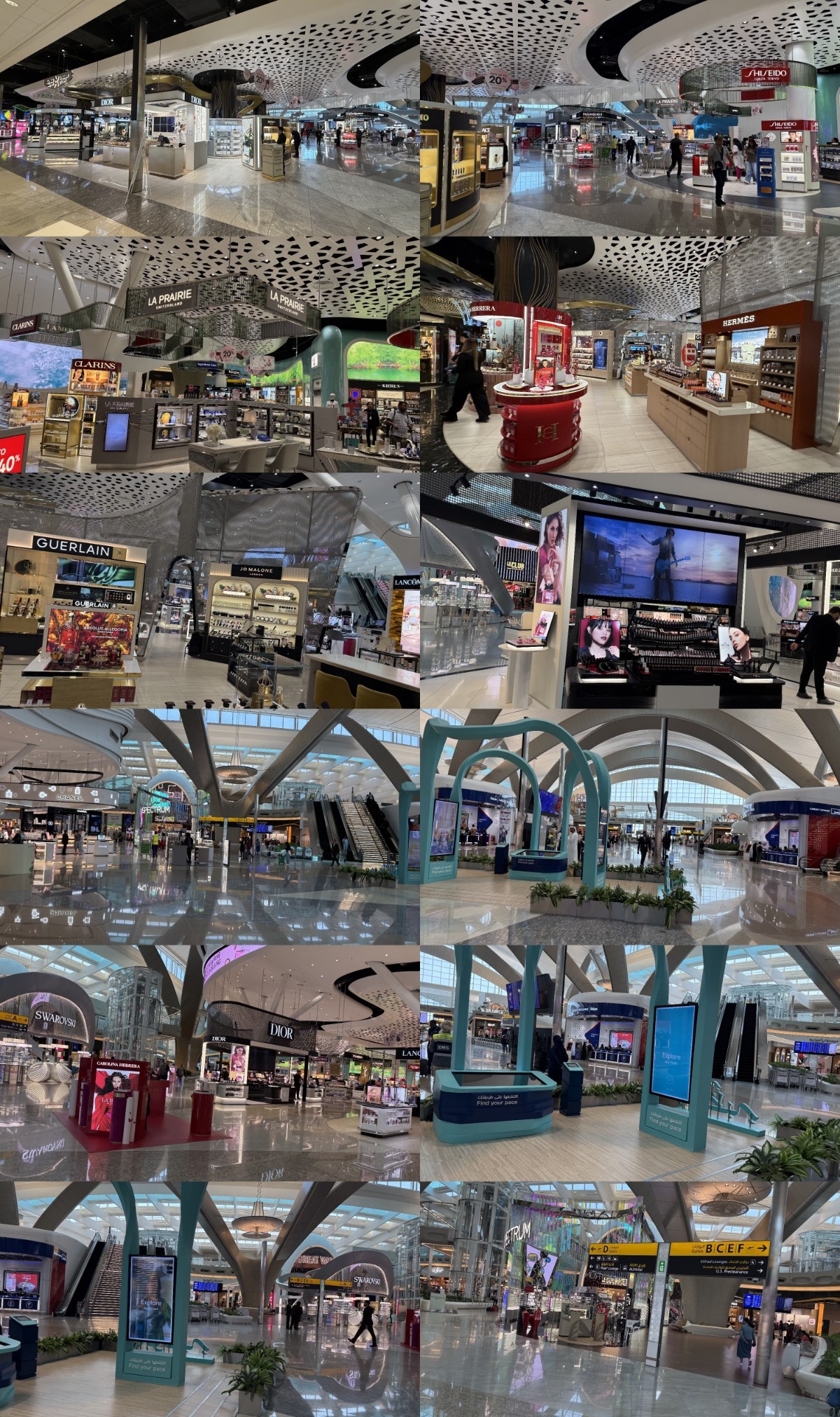
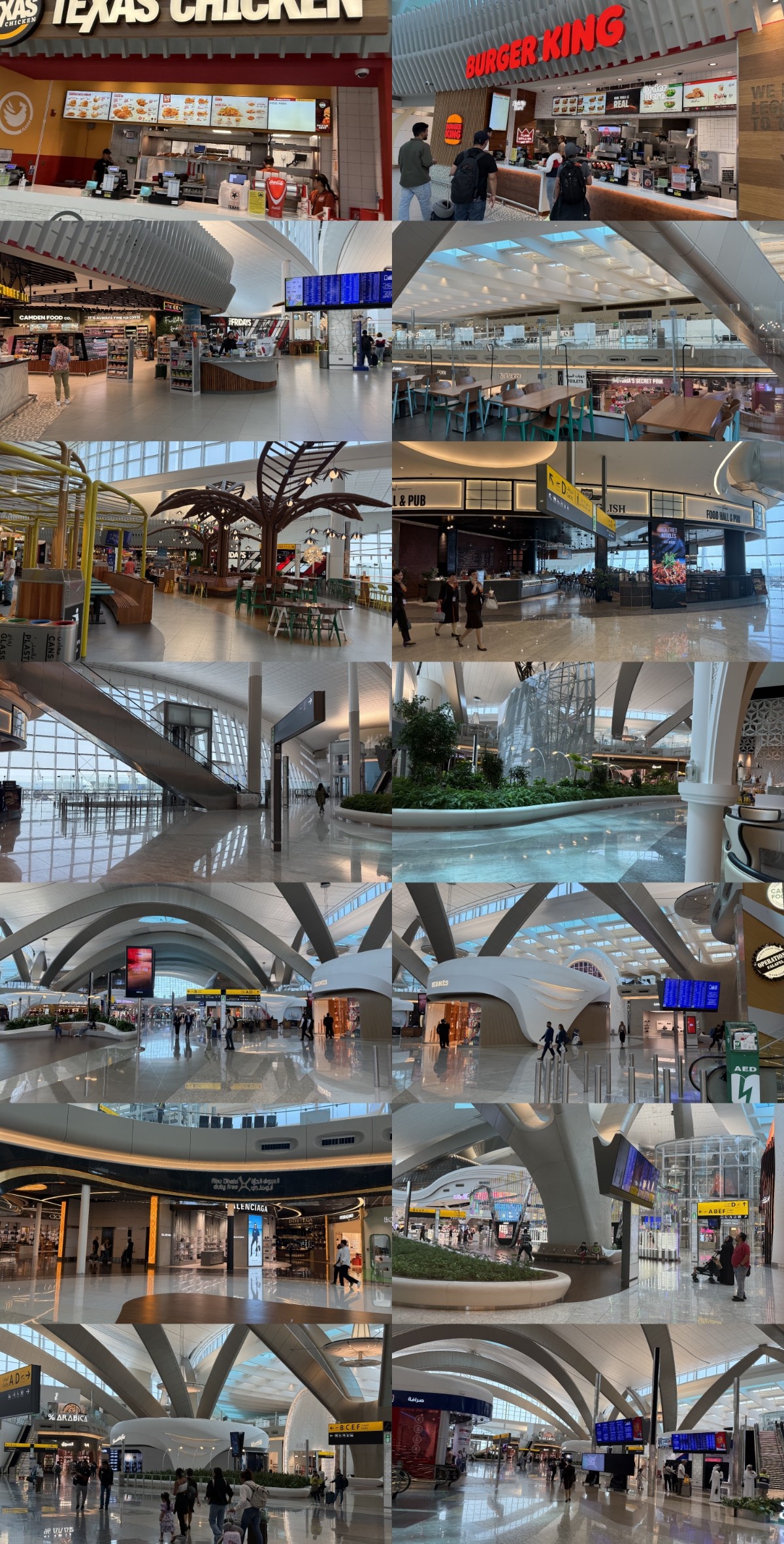
I was now hit by a huge duty-free with the standard trappings: cosmetics, perfumes, alcohol, the works. This then opened out into the main atrium of the terminal, which then branched into four starfish-like wings. It felt small, in a good way — no endless walking unlike, say, Istanbul — with all gates easily accessible, all while maintaining its undulating design and arching pillars.
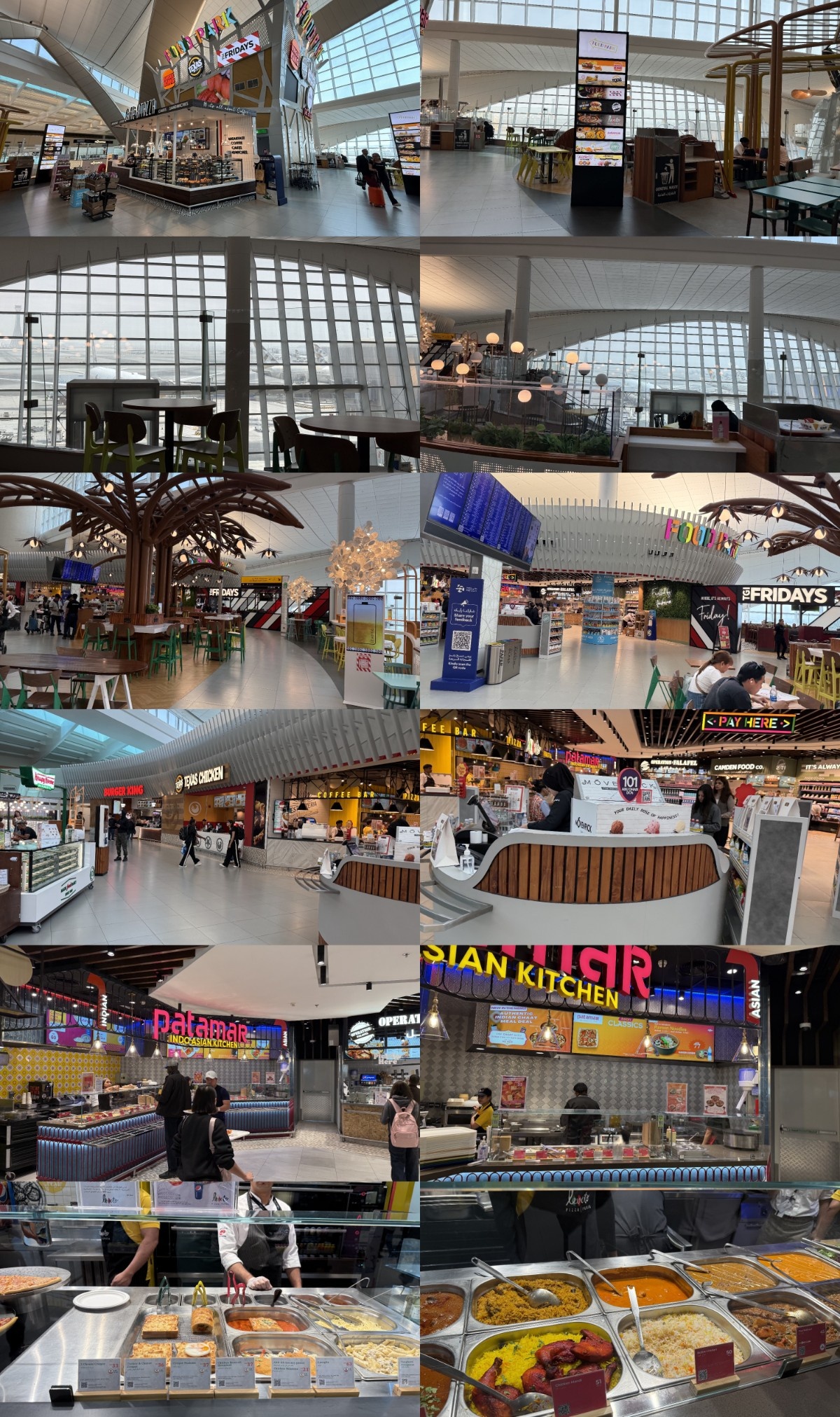
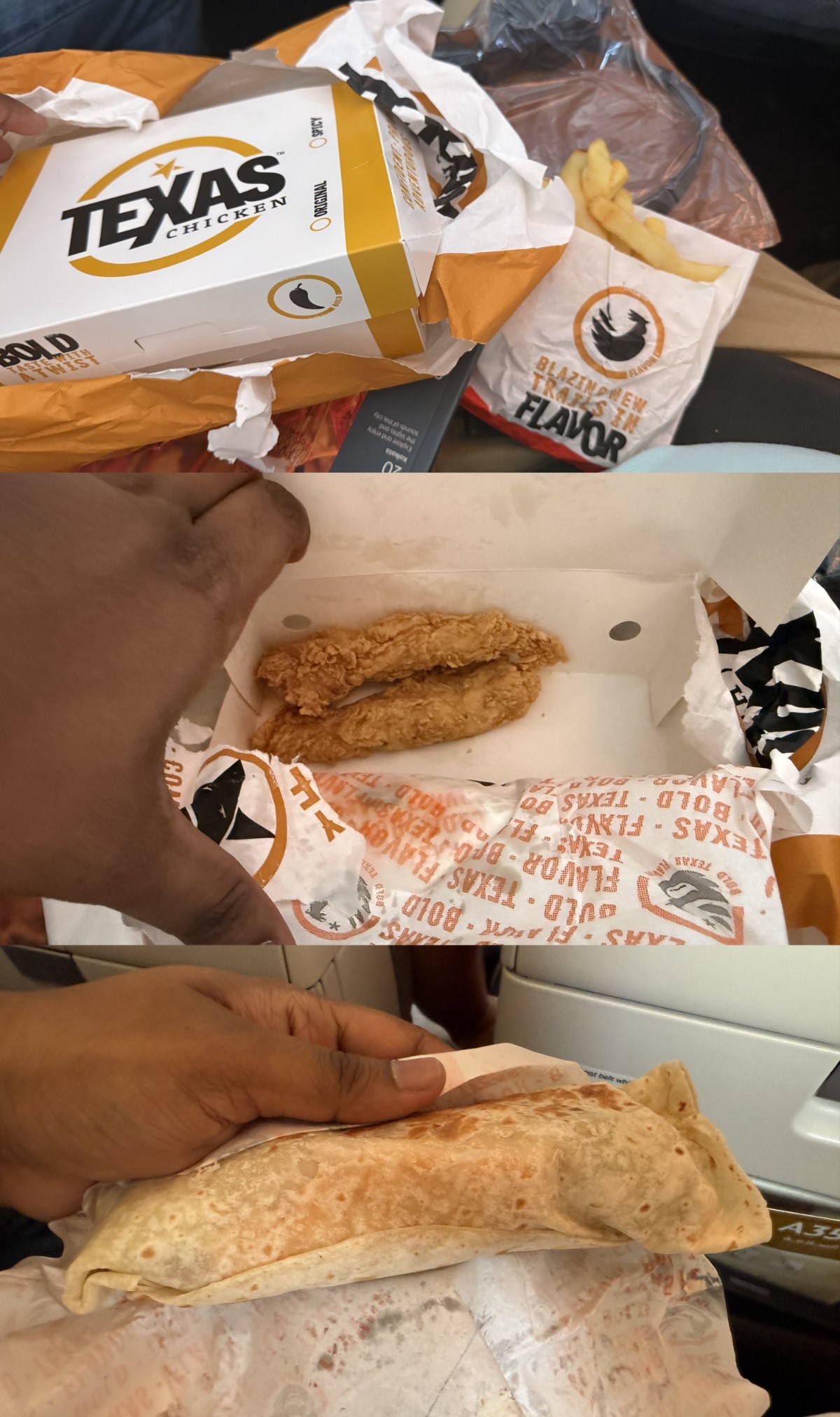
I went upstairs to the Food Park food court, and, with time short on hand, settled for the most appetising-looking fast-food option: Texas Chicken. I’d have loved to eat Indian at Patamar Asian Kitchen, but it would take too long to prepare and I’d risk missing my flight. With a hastily ordered Mexicana chicken wrap in hand, I sprinted to my gate.
I’d have loved to stroll around in this place for longer, but now was not the time! Besides, there wasn’t much by way of sculptures and cultural attractions like, say, HKG has…
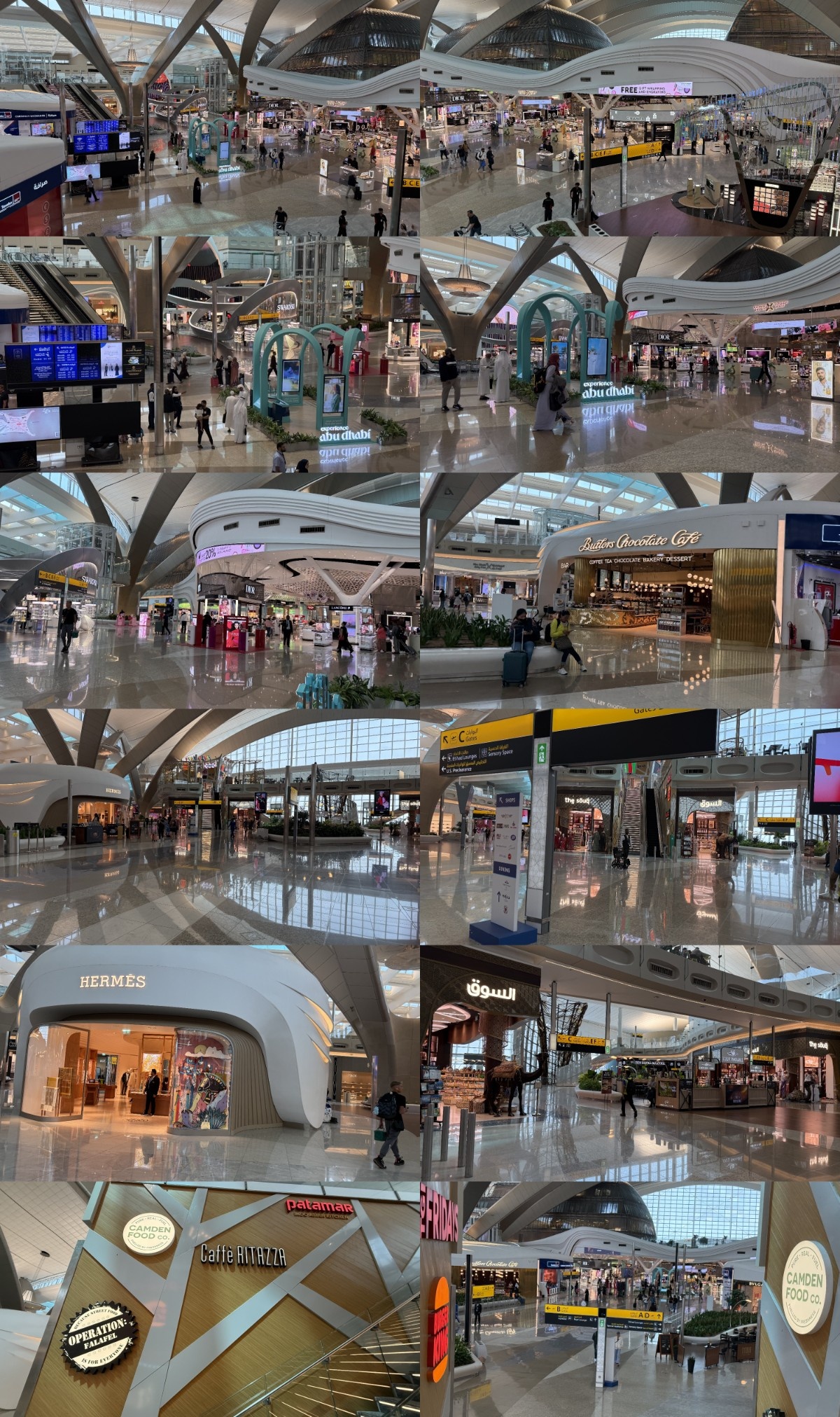
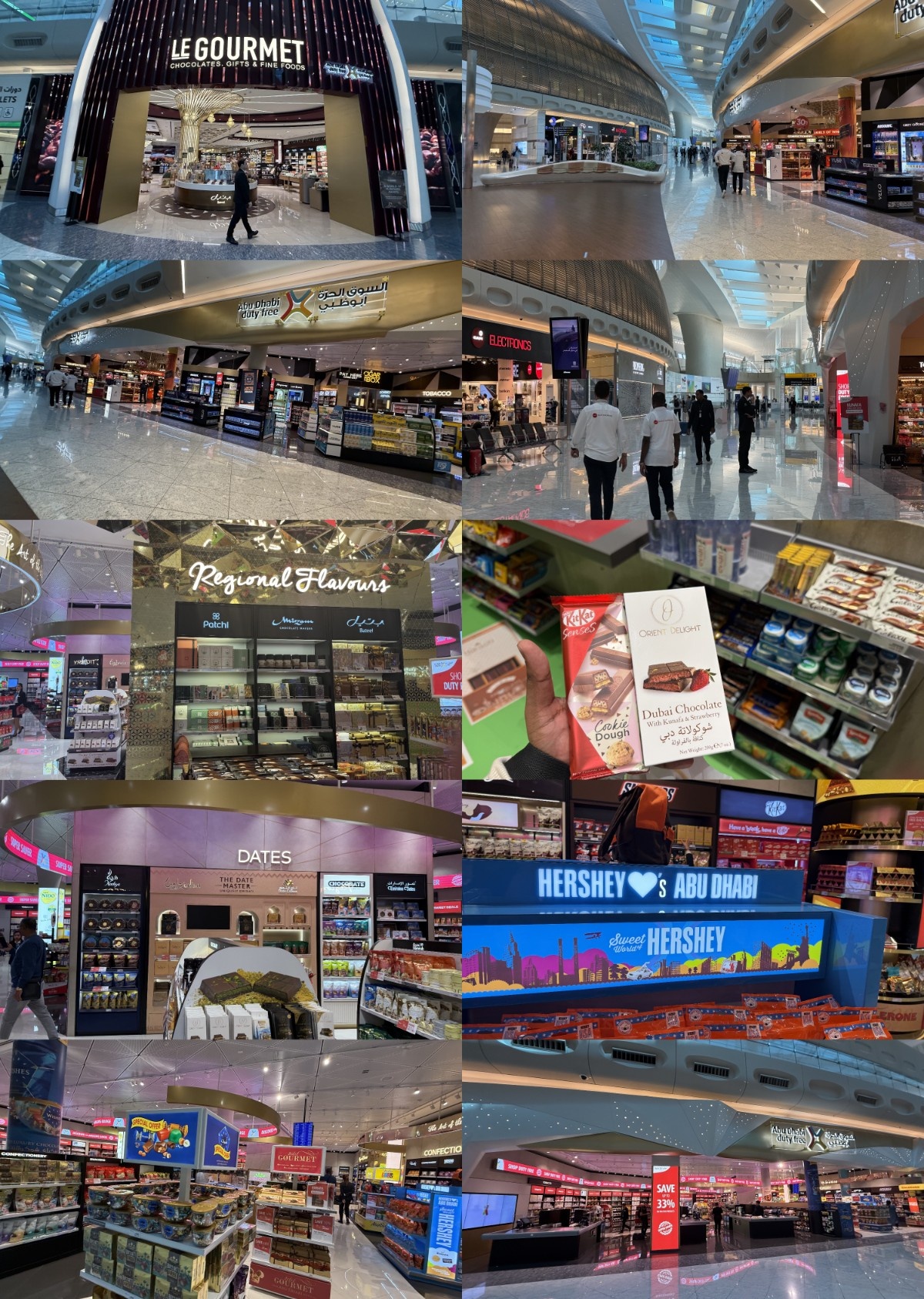
I barely had time to stop and look at the Abu Dhabi Duty Free stores along the way, including this one with chocolates, dates and all manner of other sweet treats. I wouldn’t leave without buying a chocolate bar or two — and I needed to have that four-coloured Abu Dhabi Duty Free bag — so settled for a cookie-dough KitKat and a Dubai chocolate.
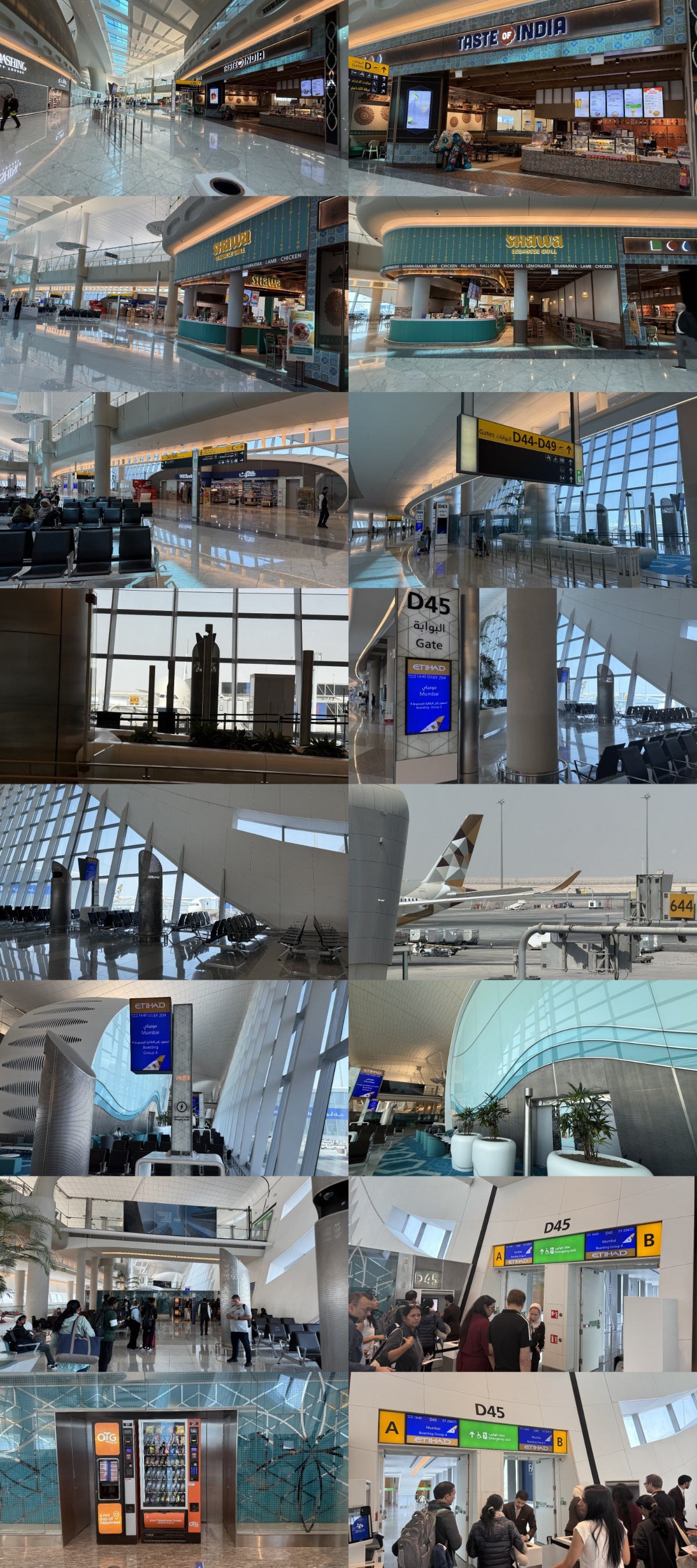
I would have strolled or eaten even more at the places I passed by, such as Taste of India and Shawa Lebanese Grill, but there was neither money nor time! At length I reached D45, where — as ever so often — passengers were already queueing up to board.
And there I saw her: A6-XWF, the first A350-1000 I would have the pleasure and privilege of flying. As elegant and ‘sExY’ an aircraft as ever was one — and a worthy successor to the long-legged, four-engined A340-500 and super-stretched A340-600, retired a decade ago. I was never a fan of Etihad’s old livery with massive ETIHAD titles in the centre, and the Abu Dhabi coat of arms on the tail — but even then I will admit that the A340 was a very elegant (if fuel-guzzling) beast indeed, even in that livery, and will sorely be missed.
The only problem is that the registration isn’t very creative: the XW series (from the designation A350 XWB) was also used by British Airways as the G-XWB series for its own A350-1000s. And EY did the same with the A6-LR registration series: first for some ex-Air India 777-200LRs a decade ago that were later scrapped, and most recently reusing them for the A321LRs. I think that’s a very boring way to register aircraft — much as Etihad is a genuinely exciting airline otherwise…
Most A350-1000s in service belong to Oneworld airlines — Qatar Airways (the first and largest operator), Cathay Pacific, British Airways and most recently Japan Arlines. Also, Qantas’ Project Sunrise A350-1000ULRs are expected to start flying in 2027. Etihad will soon be the largest operator among the rest, tying Virgin Atlantic at 12.
Etihad originally had only five of these, with this one, A6-XWF, being the last — A6-XWD does not exist — but more started to enter the fleet from 2025. Even the first five A350-1000s were parked from 2019/20 and did not enter service until the end of March 2022, facing delay after delay due to the pandemic. Delhi and Mumbai were among its first routes, and are still served by it.
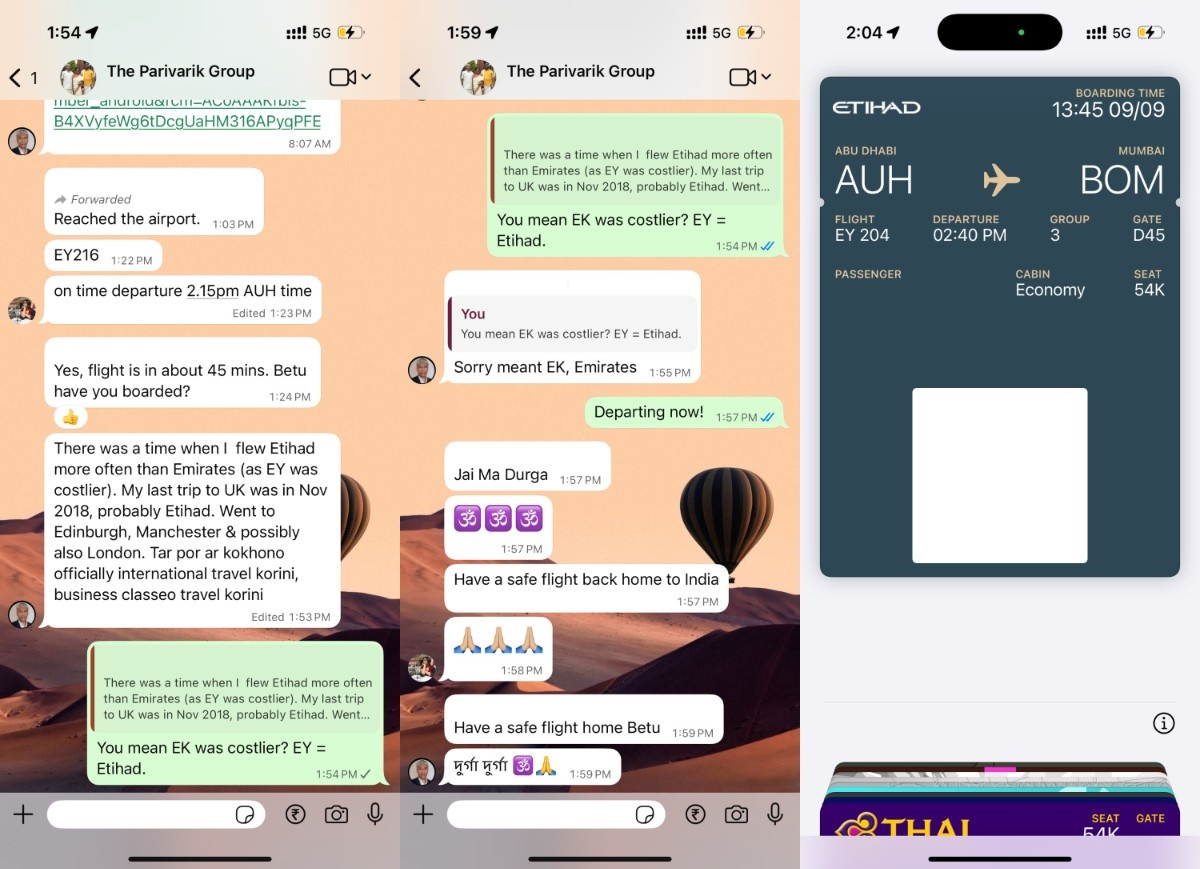
Meanwhile, on WhatsApp, Dad reminisced about all the Emirates and Etihad flying to the UK he used to do until 2017: not 2018 as stated below. It used to be that I was in awe of him jetting off to London and Edinburgh every few months when I was a kid — and now I’m the one doing all the flying!
With the time exactly 2:04, I was now ready to board the flight of that number… one that I wasn’t originally supposed to.
I’d also like to add here that I have a small history with registrations ending with F being my first aircraft flown of a particular model. In June 2022, I flew the A350-900 and 777-300ER for the first time — on Thai Airways and Emirates respectively — and their corresponding registrations were HS-THF and A6-EPF. And now I’d fly the A350-1000 for the first time on A6-XWF!
Meanwhile other aircraft have registrations beginning with A6-A** for Airbus and A6-B** for Boeings — just like Qatar Airways. So the A380s use A6-AP* (just like Qatar’s A380s use A7-AP*), and the A321s (non-LRs) have A6-AE* — while the A330-300s in the past had A6-AF*. The 787 Dreamliners, which are now the backbone of the widebody fleet, are split between A6-BL*/BN* for the 787-9s and A6-BM* for the 787-10s.
Then there are those aircraft whose registrations stem from the brand name of the aircraft itself — namely A6-XW* for the Airbus A350-1000 XWB, and A6-LR* for the A321LR (formerly also the 777-200LR) — which is similar to British Airways.
Finally, the Etihad Cargo fleet uses the completely different A6-DD* series for the 777 freighters — I don’t know where that came from — and, previously, the A6-DC* series for the now-retired A330 freighters.
I couldn’t contain my excitement as I saw the words Airbus A350-1000 below the cockpit windows. Never mind the ‘boring’, predictable XW registration series, this airline is as premium as they come, and reflects it beautifully through its typography.
But the onboard experience can still vary significantly. I was surrounded on all sides by 787s, but one did not feature Etihad’s desert-gold livery — being instead operated by the Spanish SkyTeam carrier Air Europa on its behalf. What did I care: the A350-1000 was EY’s latest and greatest, and it was so worth it not having to fly the aging 777-300ER to Delhi instead!
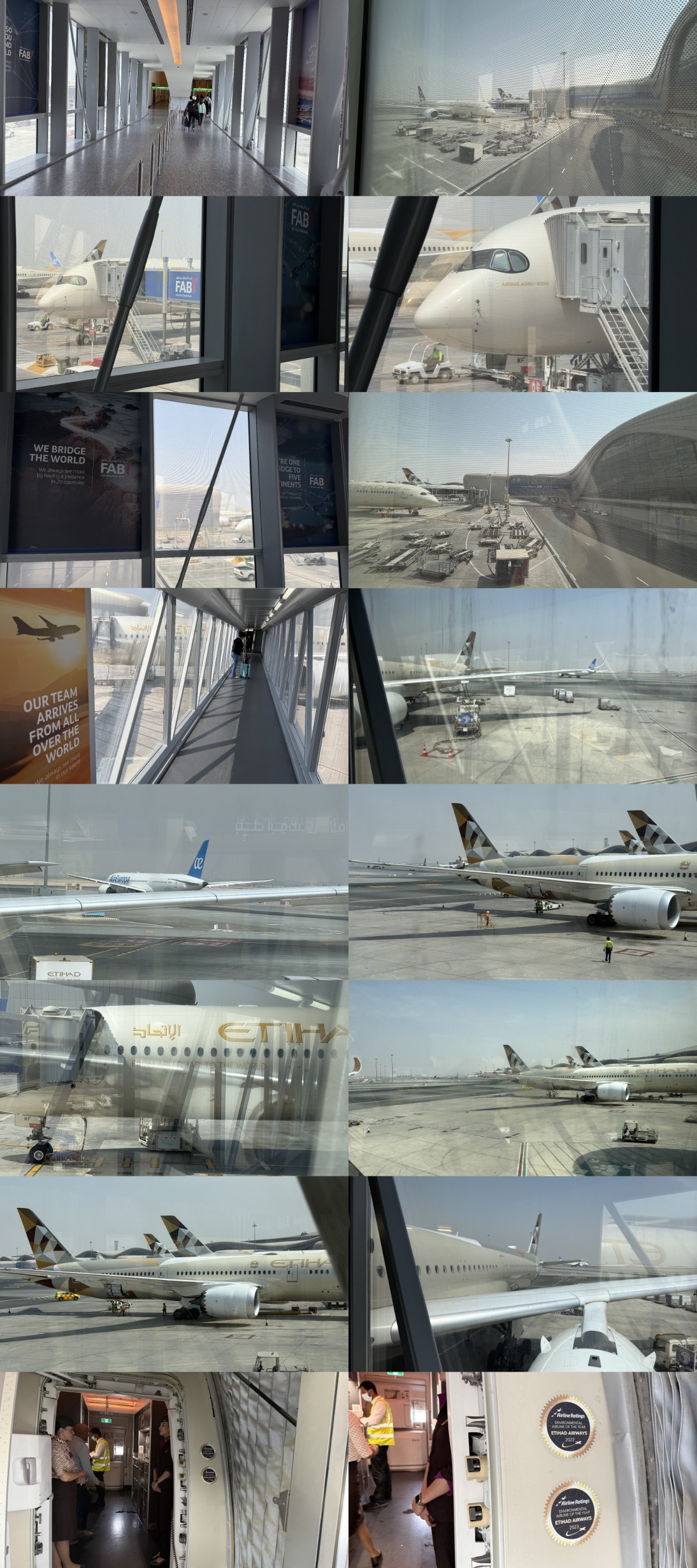
The flight: Boarding and departure
Flight: Etihad Airways EY204/ETD204
Date: Tuesday, 9 September 2025
Route: Abu Dhabi–Zayed (OMAA/AUH) to Mumbai Chhatrapati Shivaji Maharaj (VABB/BOM)
Aircraft: A6-XWF, Airbus A350-1000
Age: 5 years 4 months at the time (built: 23 April 2020, delivered: 25 May 2020; entered service 1 June 2022)
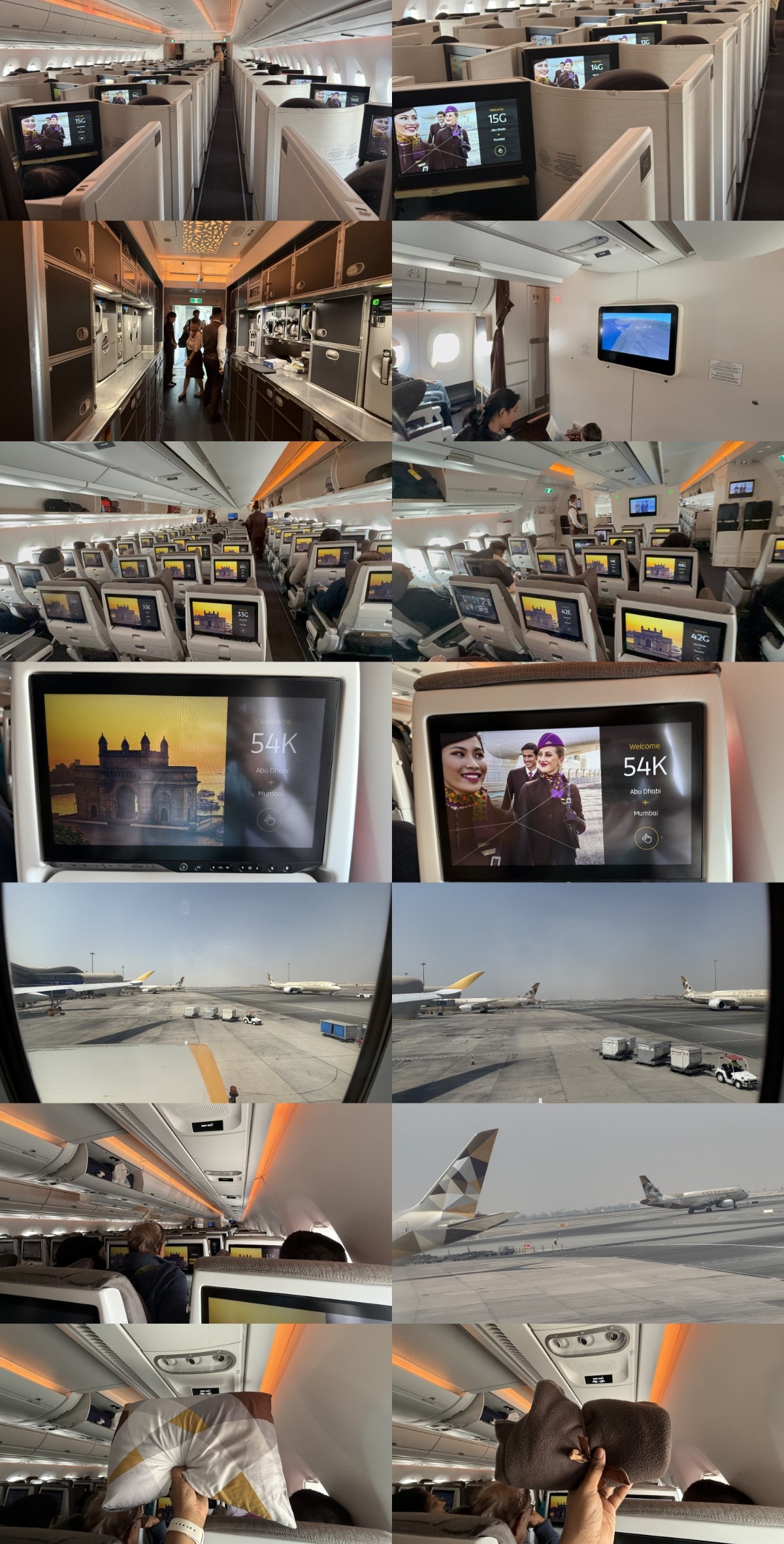
Seat: 54K (starboard side, window)
Boarding: 2:50pm Gulf Standard Time, UTC +4 (4:20pm Indian Standard Time, UTC +5:30)
Departure: 3:06pm GST (4:36pm IST)
Arrival: 7:16pm IST (5:46pm GST)
Duration: 2 hours 40 minutes
Notes:
• First flight on Etihad and on the A350-1000. While the A350-900 remains my most-flown widebody aircraft by a huge margin, I was yet to fly the -1000 variant until this Etihad flight. Interestingly, the registration ended with F, the same letter as my first A350-900 flown (HS-THF) and first 777-300ER (A6-EPF) — both in June 2022.
Also, since Etihad does not have any fifth-freedom flights — unlike Emirates, Gulf Air and Qatar Airways, the latter two of which I’ve flown on such routes in Southeast Asia — it was imperative that I fly to Abu Dhabi in order to fly Etihad. (In other words, you can’t fly Etihad without flying to or from Abu Dhabi.)
• Fourth Gulf airline flown, after the three mentioned above: EK, GF and QR. Two months later, in November 2025, I’d fly Saudia’s new fifth-freedom route from Singapore to Denpasar — on a 787-10 (registered HZ-AR33) with a sticker for The Red Sea.
This has the exact same timings as its SkyTeam partner KLM’s SIN–DPS service, as I flew — very memorably indeed (the plane was painted in the SkyTeam livery!) — in June 2023. I plan to publish a review of that Saudia flight in early 2026, soon after this one.
Inside the golden hues of this symbol of a desert land…
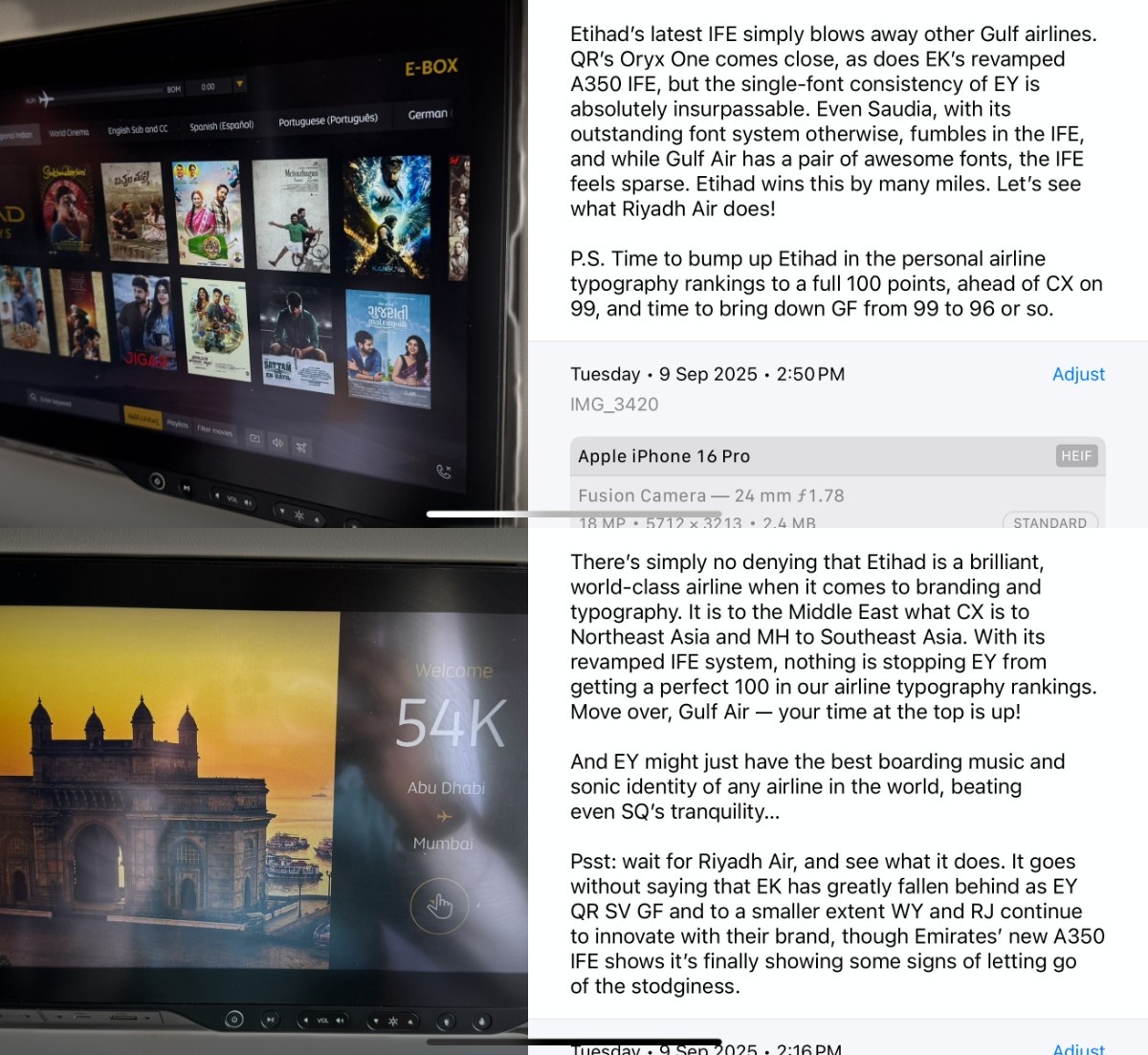
Gold is very much Etihad’s brand colour through and through. While the finishes of the Business Class seats — the popular Super Diamond by Collins Aerospace — were naturally beige-hued, EY is one of the few airlines which can actually claim that colour as its own. The tessellated pattern on the ceiling made for pretty viewing, too, as I headed to the back of the bus — there was no Premium Economy — where Mumbai’s iconic Gateway of India was bathed in an equally gorgeously golden sunset on the screens at the seats.
I’m no stranger to seat 54K, being one of my favourite places to be on a widebody — at the window behind the wing on the right. At my seat was a pillow, which like Etihad’s plane tails is also painted in the Facets of Abu Dhabi pattern, and a brown blanket, which was not. Everything else seemed gold or an associated colour — be it the orange mood lighting, the metallic-golden winglet or even the very tarmac on which we stood…
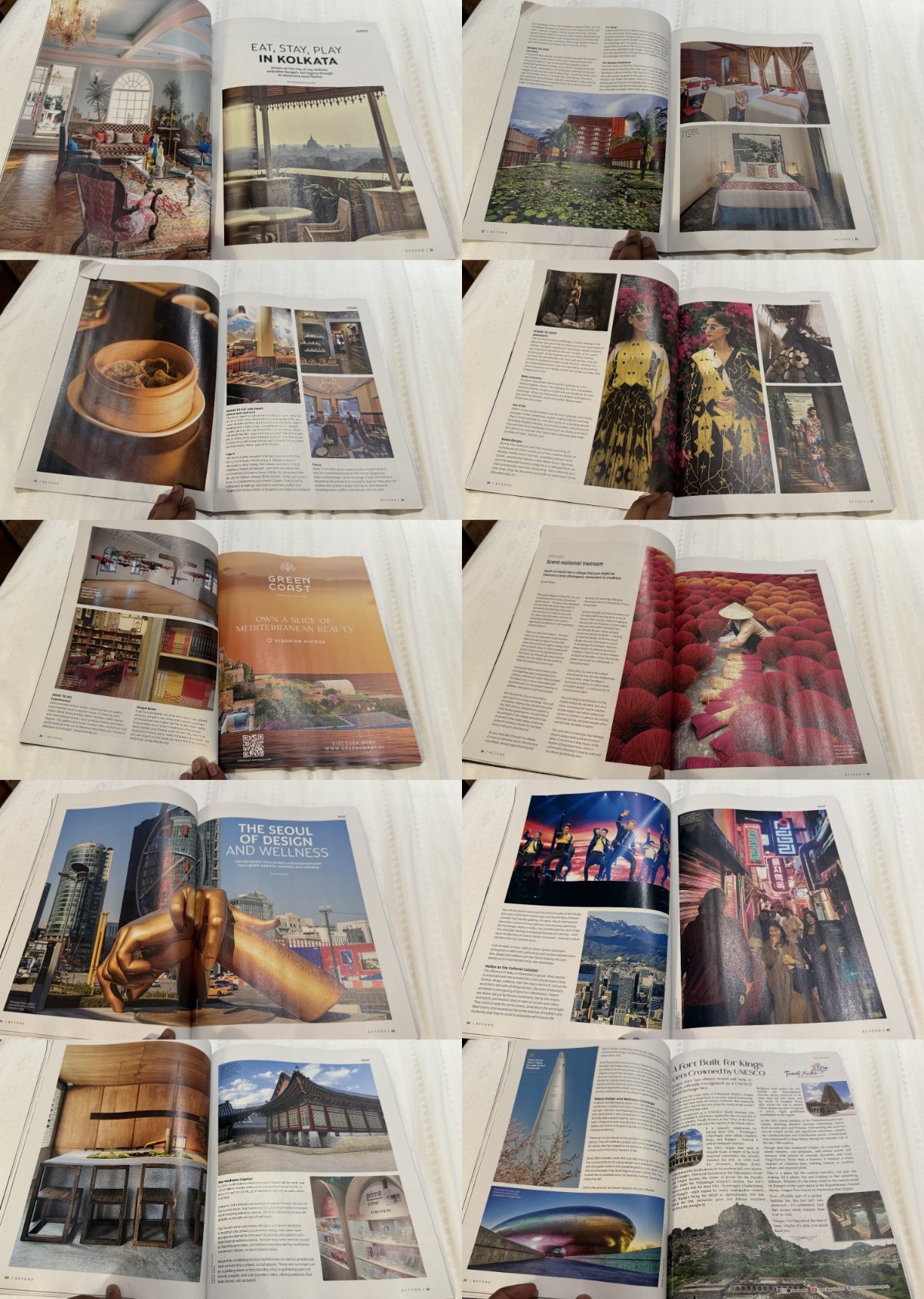
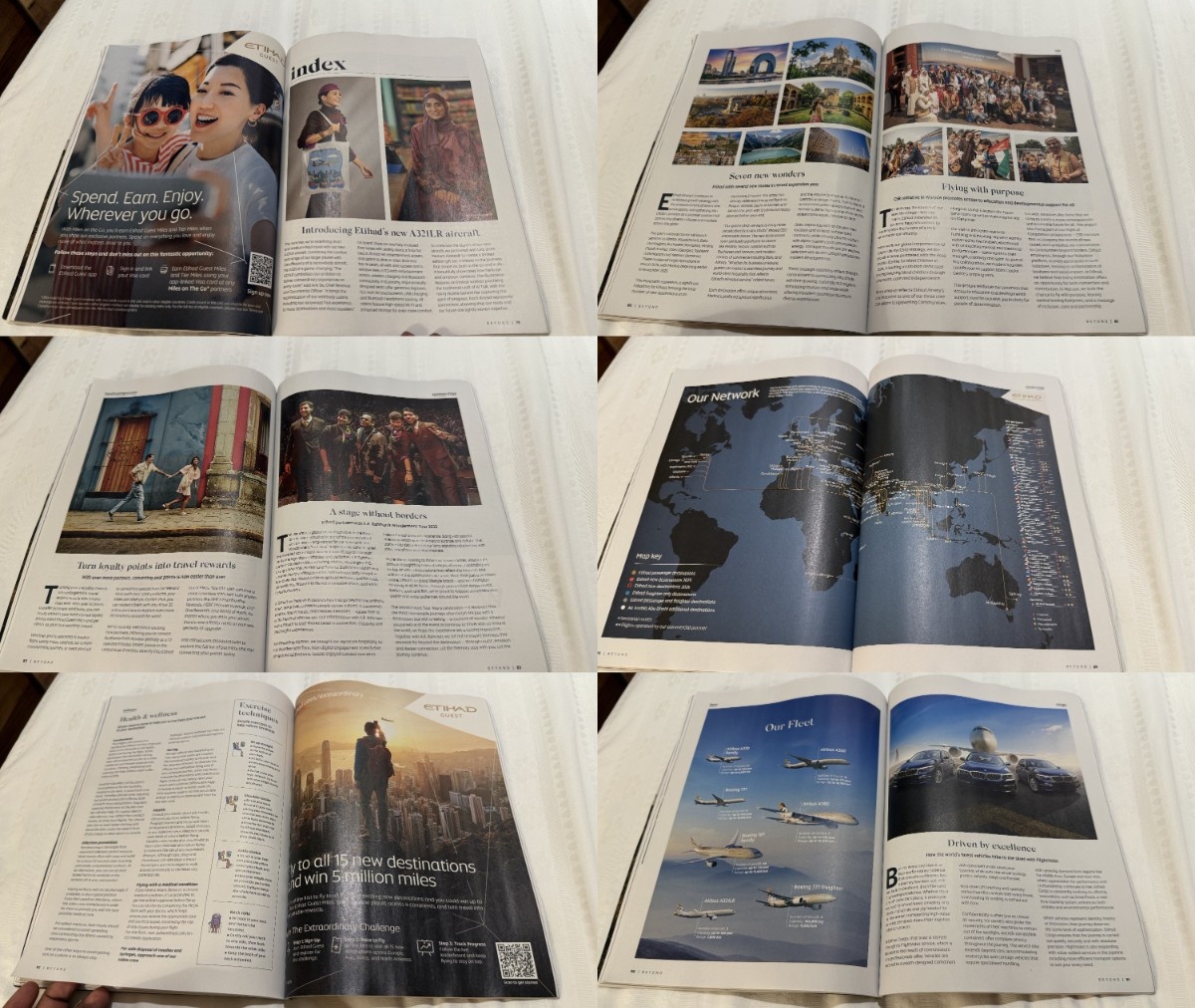
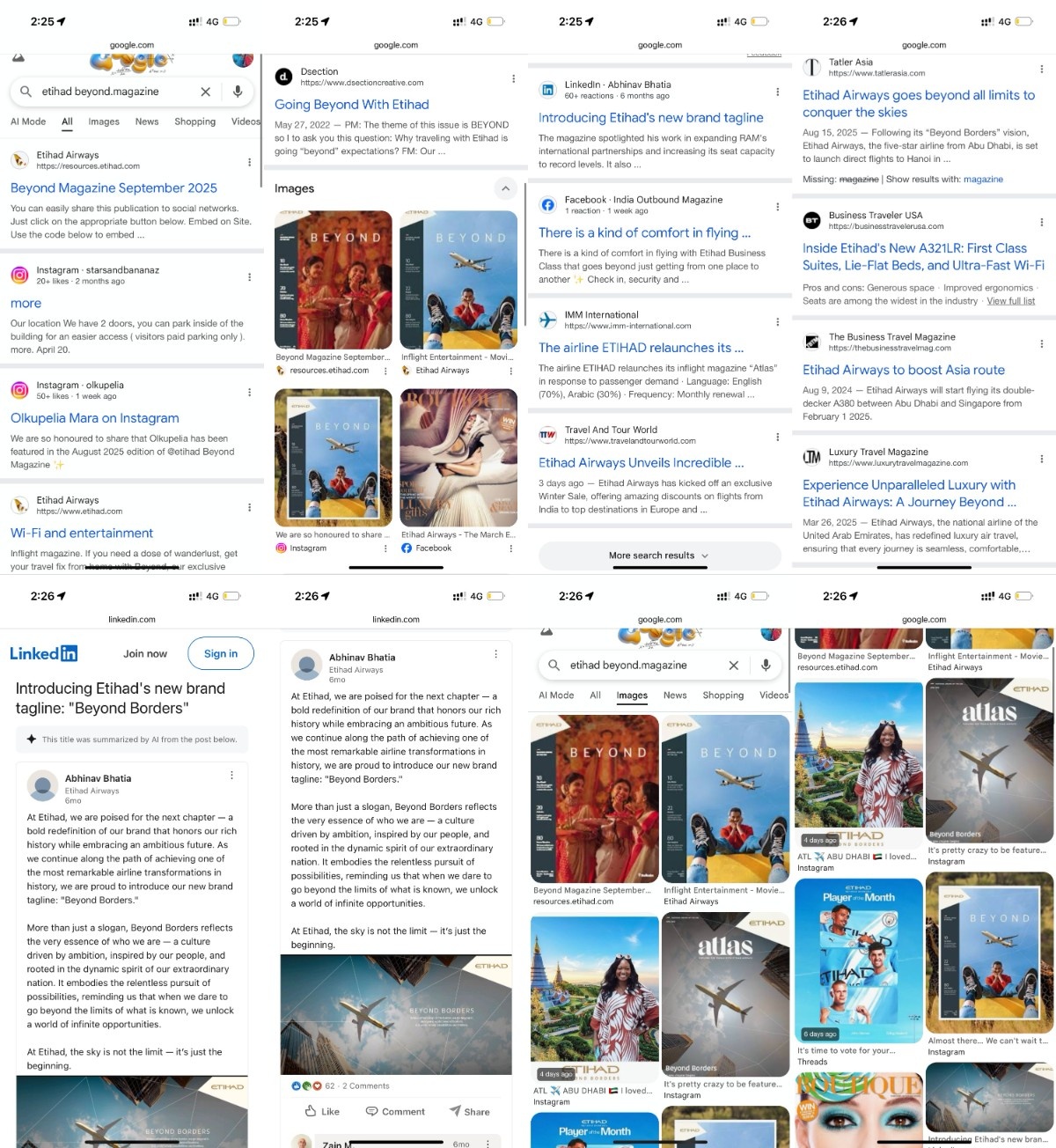
Here’s another reason I love Etihad: the physical inflight magazine, now rechristened as Beyond since the middle of 2025. Previously known as Atlas, this remains the ONLY inflight magazine in publication by a Middle Eastern airline in the mid-2020s that I’m aware of.
Unlike Southeast Asia, where airlines have slowly been bringing back physical magazines — Thai Airways resurrected Sawasdee in May 2025, when I also flew its A320 for the first time — Middle Eastern airlines have firmly and resoundingly steered clear of magazines in a postpandemic world. Emirates’ Open Skies, Qatar’s Oryx, Gulf Air’s Gulf Life, Saudia’s Ahlan Wasahlan and many others from the Gulf remain firmly confined to a pre-2020 era, not even making a digital comeback like SQ’s SilverKris website or ANA’s Tsubasa Global Wings in East Asia.
Even better, this issue of Beyond had Kolkata — the city of my birth — on the cover, with women celebrating Durga Puja, the most important festival for us Bengalis. While I’m by no means proud of Kolkata as a city (long story!), much less its horrible government-run airport (code: CCU), it was still nice to have the City of Joy (as it’s called) featured so prominently on the cover. With the magazine’s highly Westernised tone of voice and global outlook, this makes Etihad all the more worth flying.
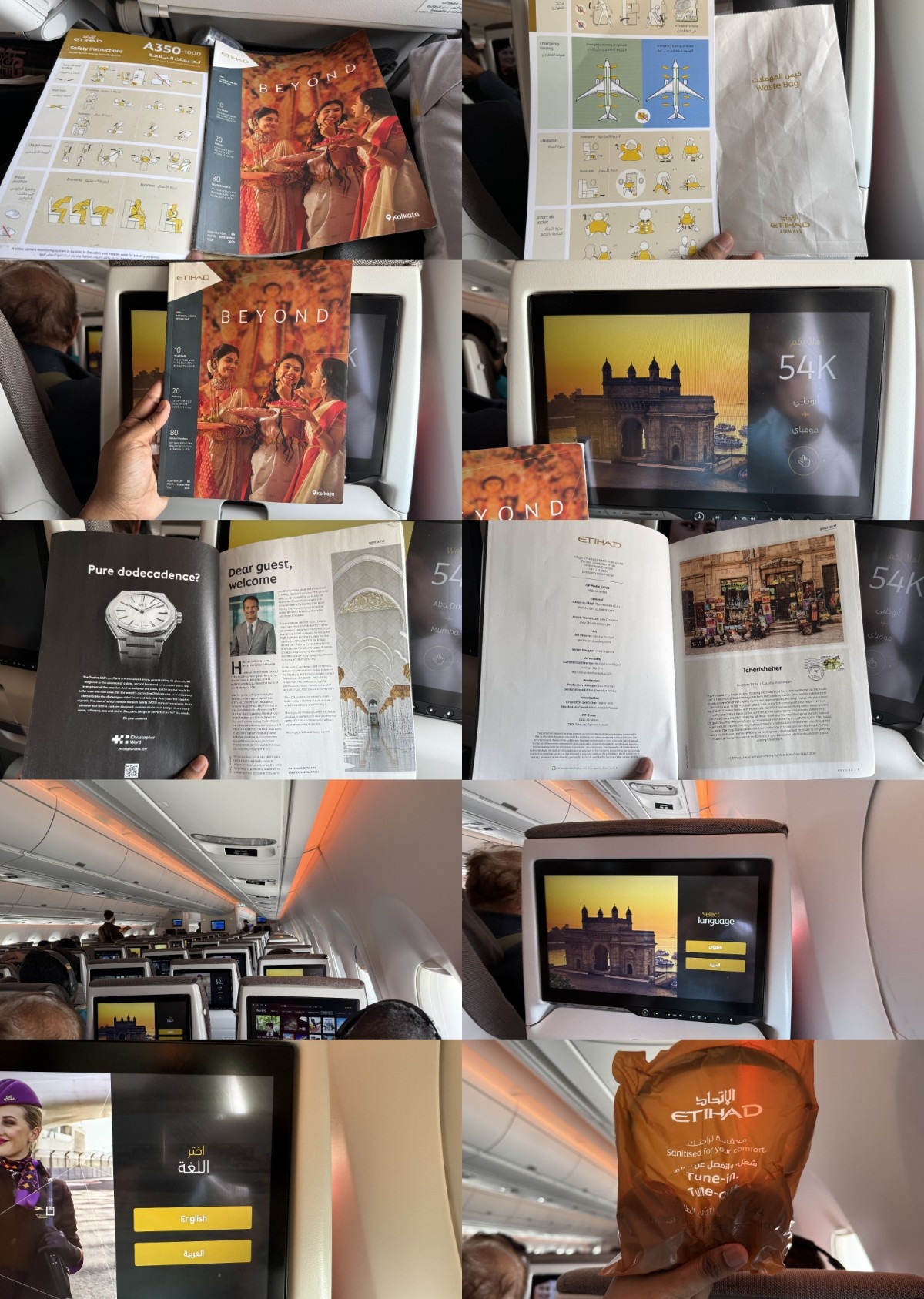
Indeed, the renaming of Etihad’s magazine from Atlas to Beyond came at the same time as its new slogan, Beyond Borders, was introduced in mid-2025. Interestingly, that’s also the name of Saudia’s IFE system, as I was to explore in two months’ time on the 787-10 from Singapore to Denpasar. Like Etihad, Saudia is another airline that has done a marvellous job in the branding and typography department since its big rebrand in 2023 — and I expect Riyadh Air to do no less. Indeed, most Gulf airlines, with the sore exception of Kuwait Airways, are masters in the fonts department.
The only small issue — personally speaking — is that Etihad’s magazine uses the exact same font as its corporate font, instead of being more creative as magazines often do. That’s exactly what both Cathay Pacific and also Air India do with their own magazines. This is the case for both the current Beyond magazine and its predecessor, Atlas, which was brought back in late 2023.
However, before the pandemic, Atlas was published by the renowned Ink Global, easily my favourite magazine publisher. Consequently it had much more exotic fonts and designs than the predictable ones used now. Not returning to Ink postpandemic was a mistake on Etihad’s part — unlike Malaysia Airlines’ Going Places magazine, which benefits excellently from it. Nevertheless, this is the minorest of minor quibbles — at least Etihad has a beautiful magazine, unlike fellow Ink magazines Qatar’s Oryx and Singapore’s SilverKris, which will probably never come back!
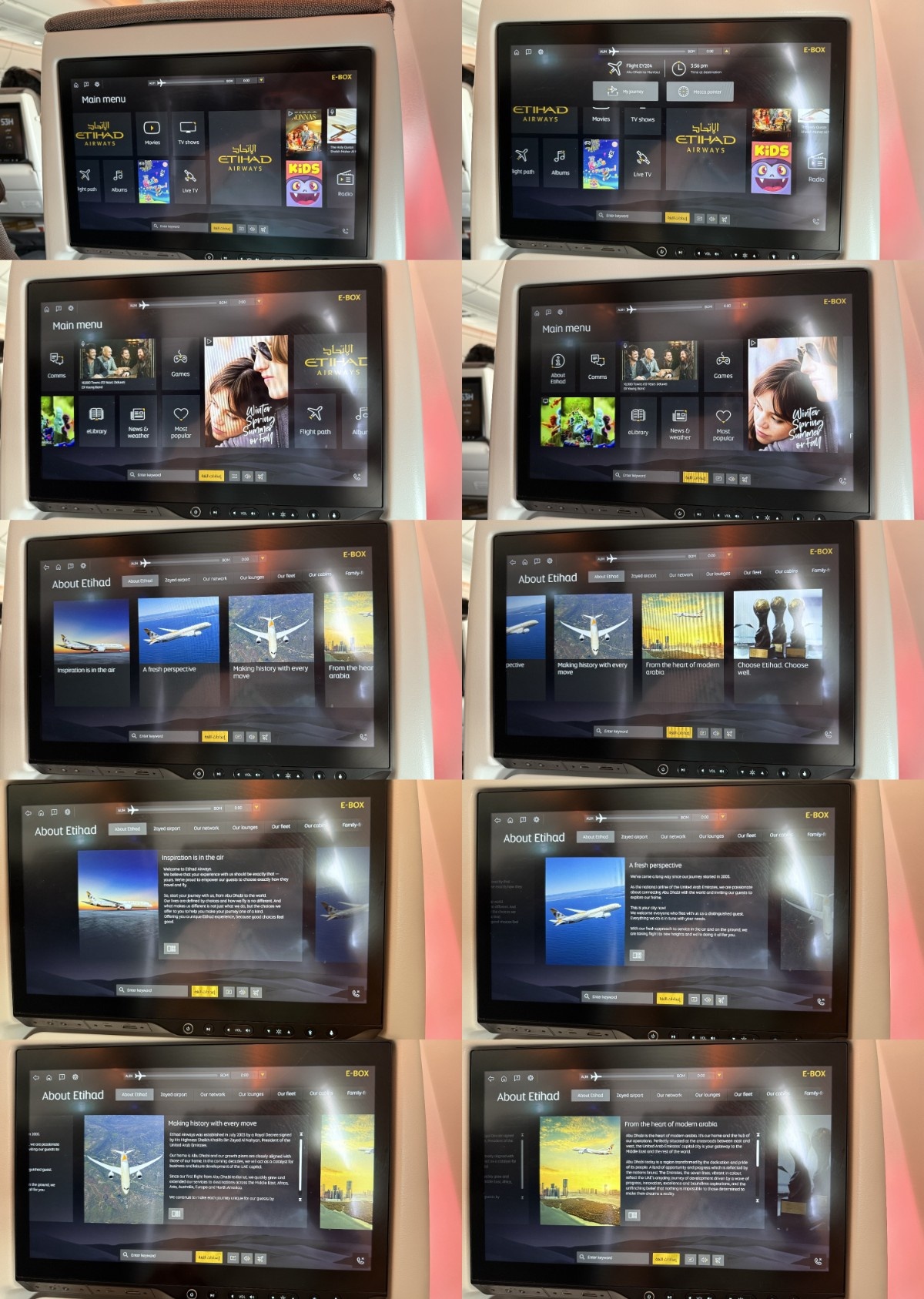
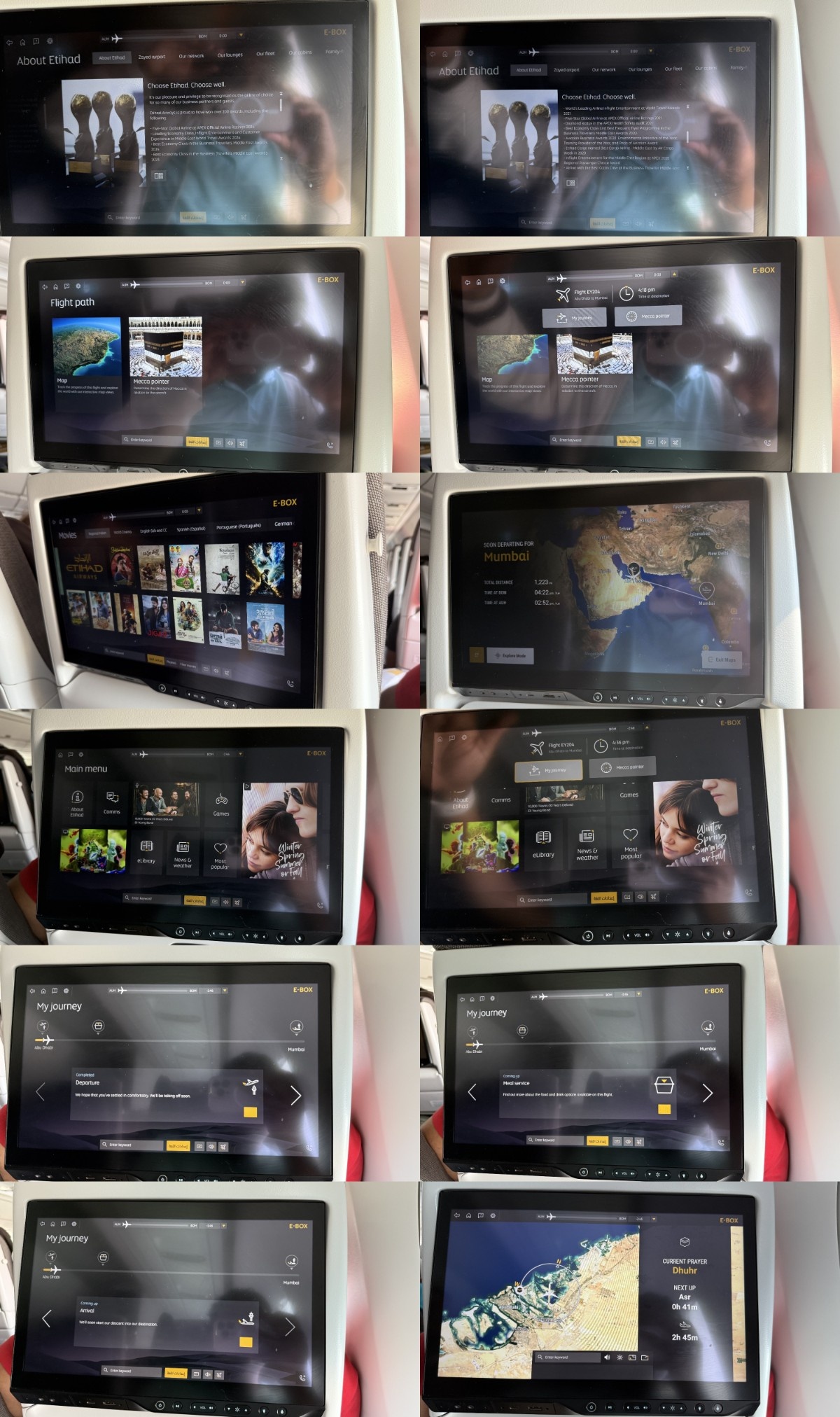
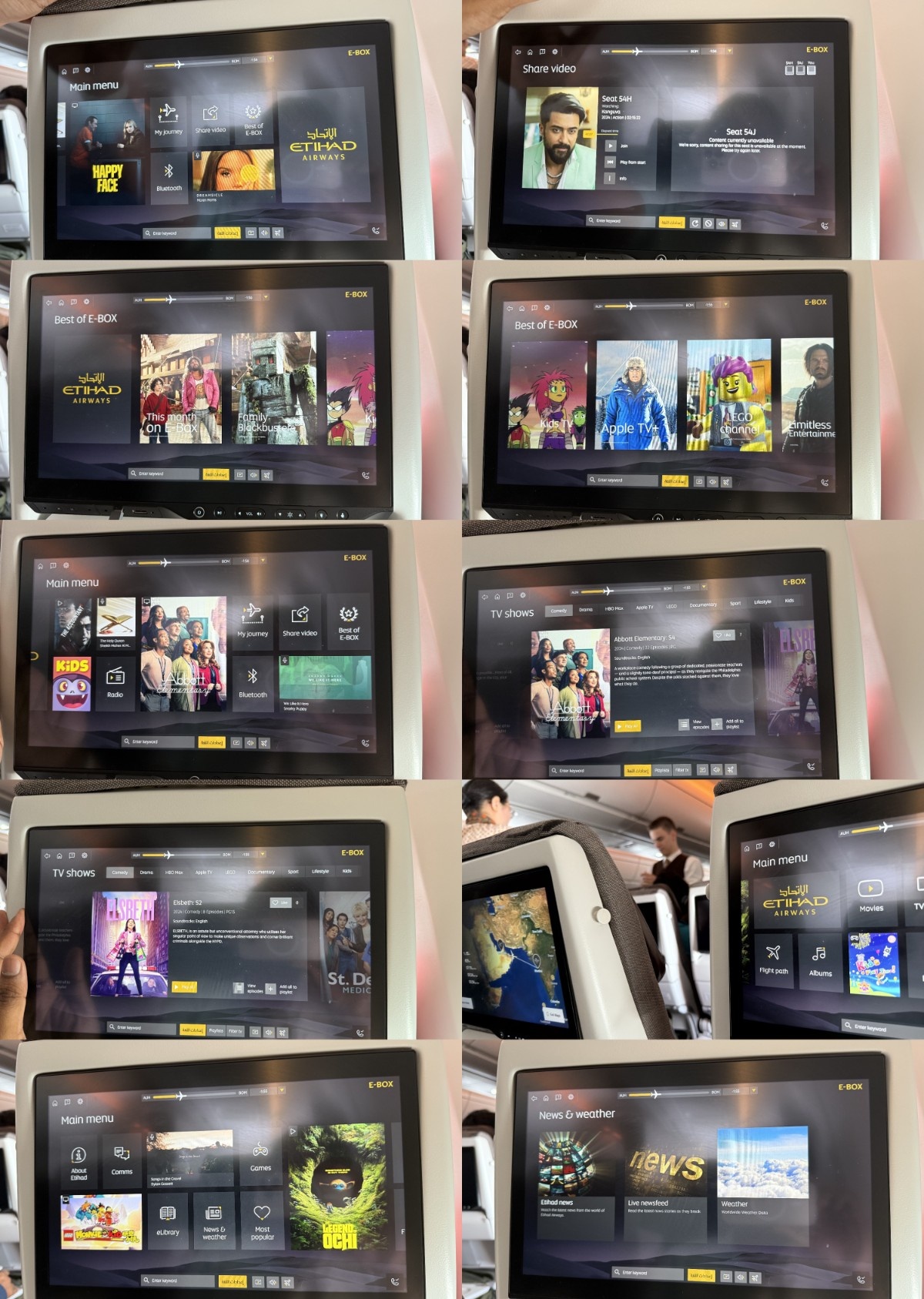
It was now time, as the captain and cabin manager made their welcome announcements, to turn to the E-Box IFE system. This was the refreshed, renewed version with the latest and greatest hardware and software, and was befitting of an aircraft as cutting-edge as the A350-1000. I ignored all the blank tiles with the Etihad Airways logo (the only problem with the IFE, really), and headed straight to the About Etihad page.
You really do get the feeling that EY is right up there among the world’s greatest airlines when it comes to telling the story of its creation and being — all the more amazing since it did not even exist until the 21st century. Much longer-established airlines, like All Nippon Airways (as I flew in May), often don’t tell that story and go for function over form. But this also comes down to the fact that the UAE, with its strong British influence among the upper crust, is far more Westernised than Japan.
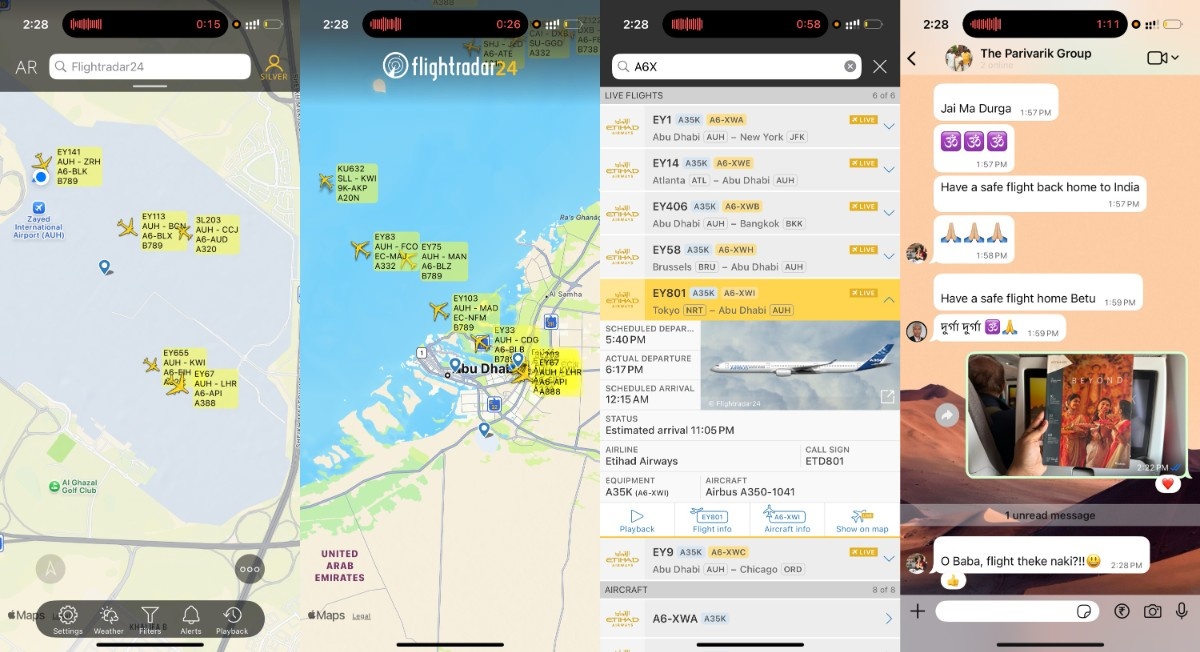
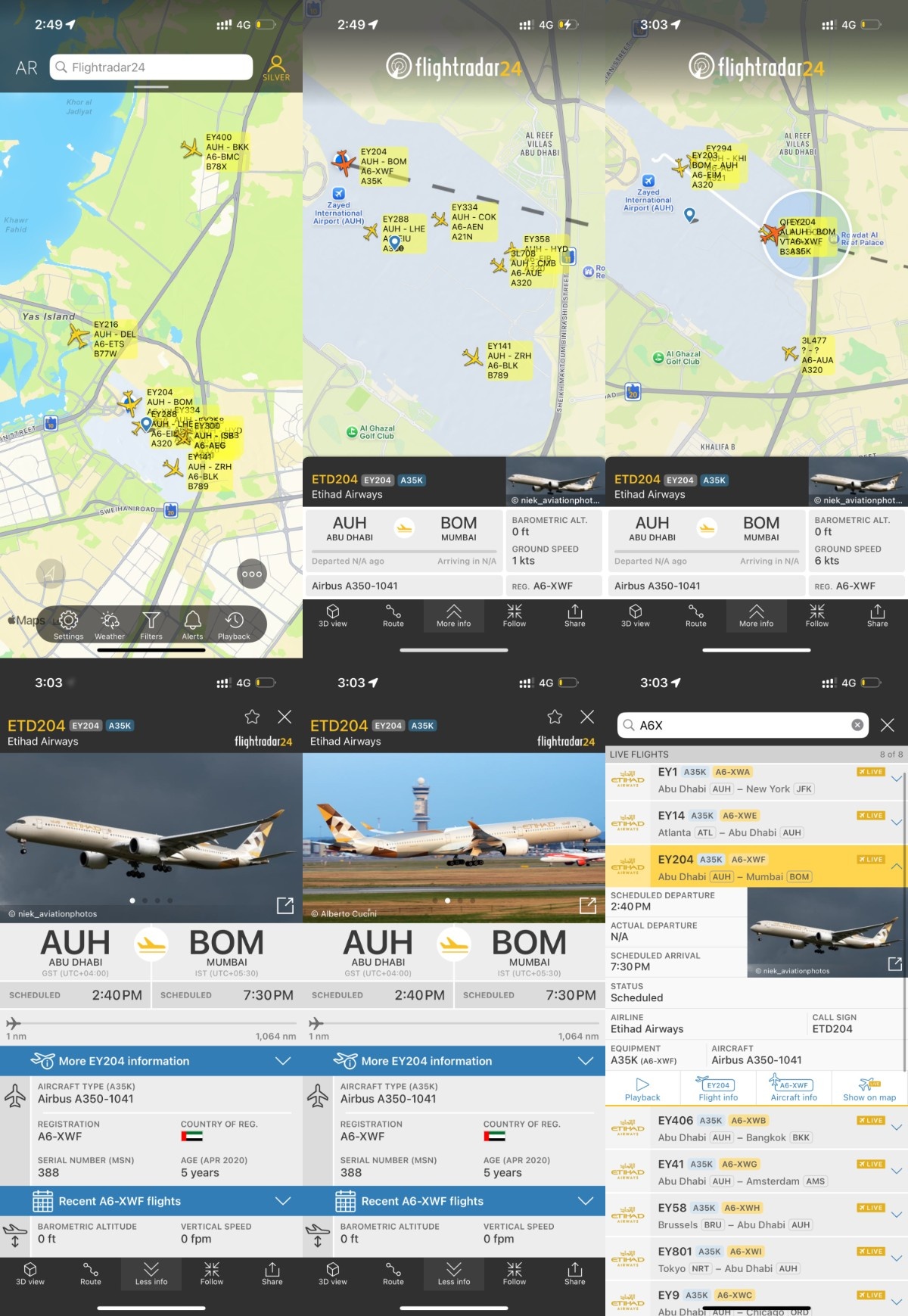
Now we were ready to roll, just as the Air Europa 787-9 operating for Etihad took off as EY103 to Madrid. We hadn’t appeared on the Flightradar24 map yet, but I did send a picture of the Durga Puja celebration on the cover to my mom, who replied, ‘Oh my, is this from the flight?!’
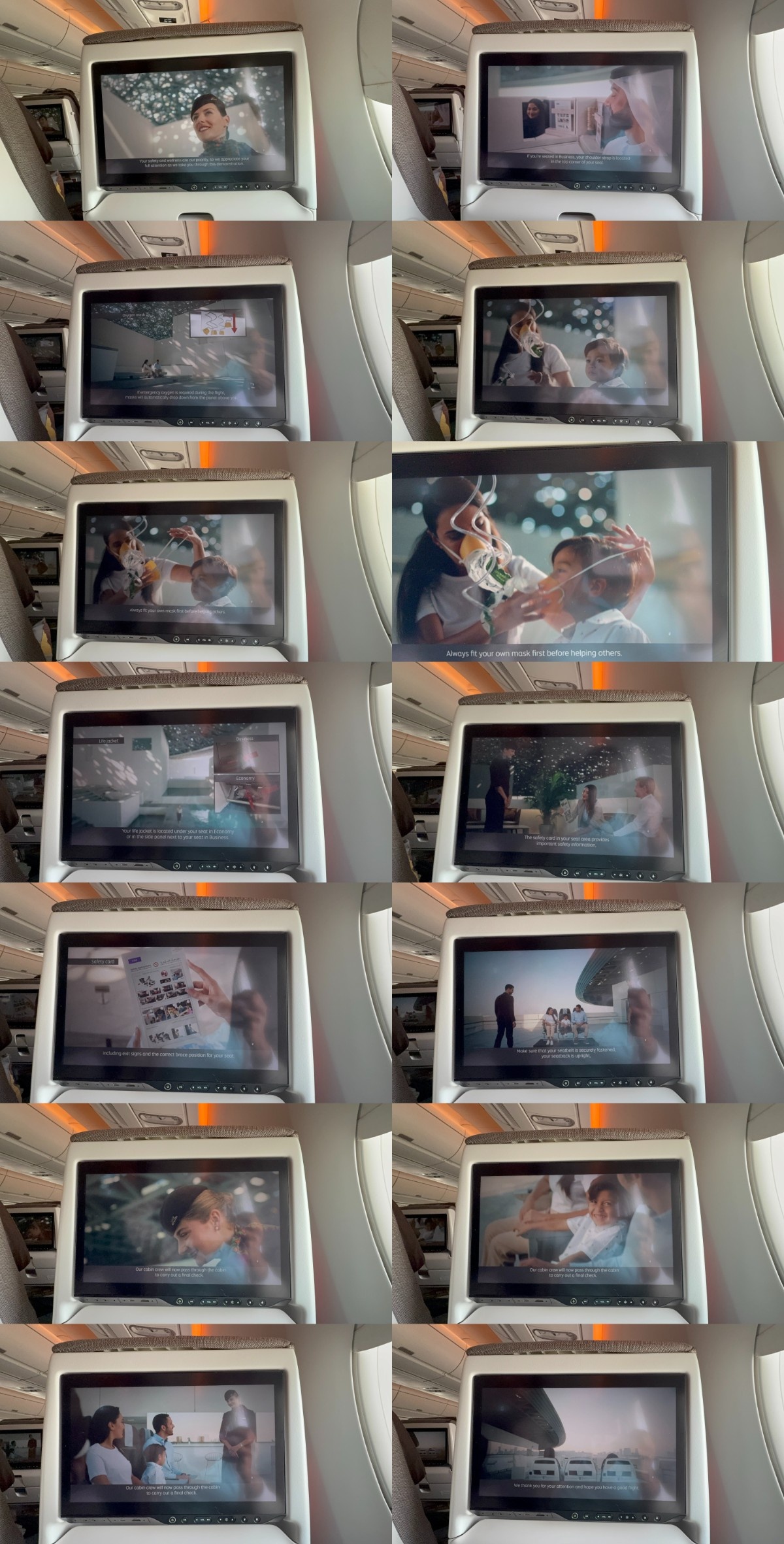
The Louvre Abu Dhabi in flight: Etihad’s simple yet sophisticated safety video
Now it was time for the safety video, set in the selfsame Louvre Abu Dhabi that I’d visited just a couple of hours before. It was as you’d expect from a premium brand like Etihad, with the quiet elegance of Singapore Airlines, and not the loud, brash comedy routine that Kevin Hart does for Qatar Airways. Indeed, there are few airlines I expect to lean into the cultural angle as much as Etihad — what will all the museums and galleries that’ve sprung up on Saadiyat Island, as I’ve said above.
This also meant that it wouldn’t be quite as memorable or cute as ANA’s Pokémon safety video. But since when did Etihad try to pander to the lowest common denominator in its messaging?
I took the opportunity to wolf down my Mexicana chicken wrap from Texas Chicken, and boy am I glad that I did!
As we rolled to the runway, I checked out the moving map — the same Arc system by Panasonic Avionics that I’d seen before on the erstwhile Vistara’s A321neo and later Air India’s A350 and Singapore Airlines’ 737 MAX. This is one of the most feature-packed moving-map systems out there, with detail-packed overviews of destinations, though recently I feel FlightPath3D — as I’ve seen on Starlux and Malaysia Airlines’ A330neos, and now United’s 787-9 on BKK–HKG — gives Arc a run for its money. (Full resolution here.)
My comments on Etihad’s brilliance in branding reflect my opinion of the airline, which is the same then as now. A global leader and trendsetter in terms of its corporate identity, going the extra mile to differentiate itself — much like Malaysia Airlines, the best in Southeast Asia (branding-wise) by a long shot, better by far than SQ.
It was only now that we appeared on Flightradar24, just as A6-ETS, the airline’s last 777-300ER — the only one left with First Class! — and the one I would’ve otherwise flown to Delhi, departed. I was simply thrilled at being able to get my money’s worth out of that swap.
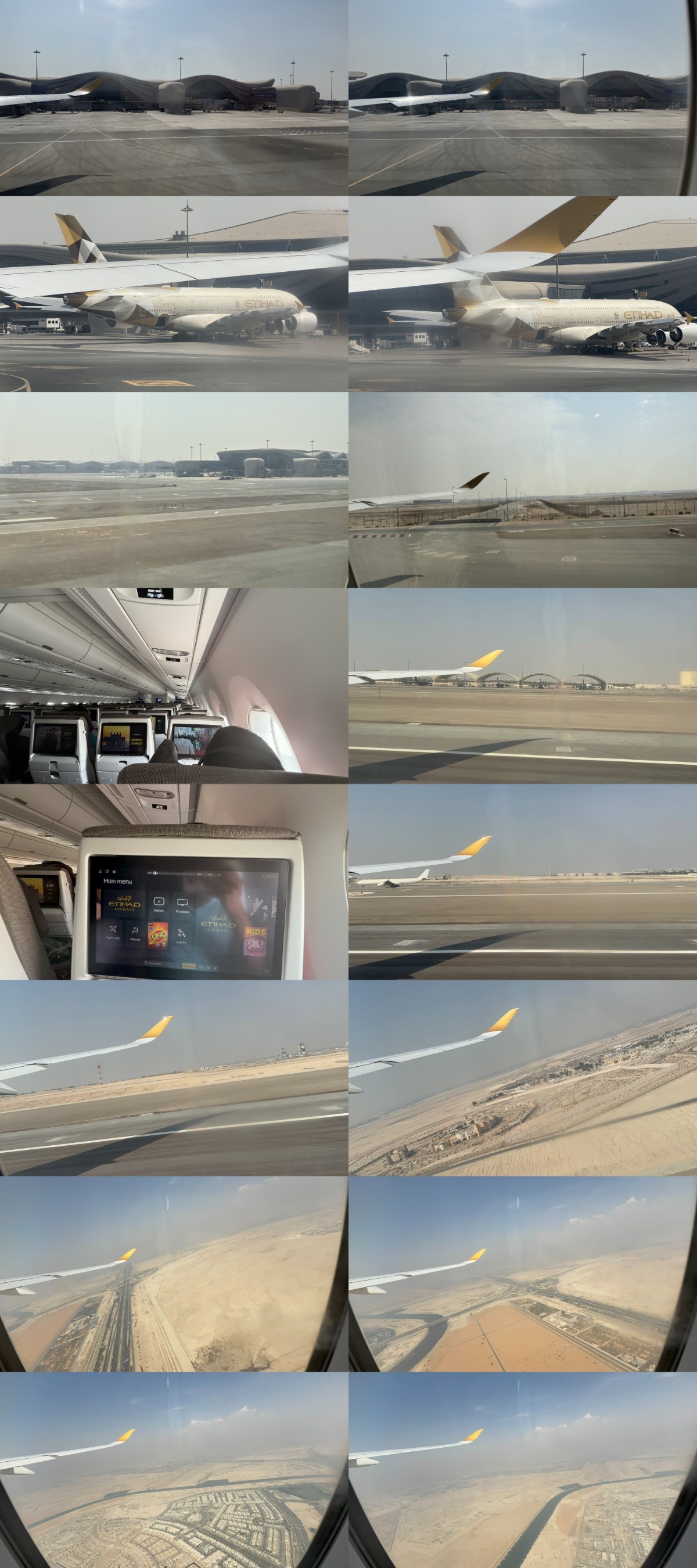
As my ‘sExY’ A350 taxied past the glittering domes of AUH Terminal A, a majestic golden A380 came into view. Etihad has done a splendid job putting its A380s back into service — what with it now expanding its services to Singapore and soon Tokyo (Narita), in addition to replacing New York–JFK with Toronto to deal with Canadian bilateral restrictions.
At last, we hit the runway, with the golden winglet leading the way for the takeoff into the sky above the golden sands of Arabia. It was only then that the one big flaw of this A350-1000 hit me. Etihad A350s do NOT have a tail camera! Too bad, or I would have enjoyed the majestic departure even more, my eyes feasting on that metallic golden livery — have I mentioned that colour one time too many already?!
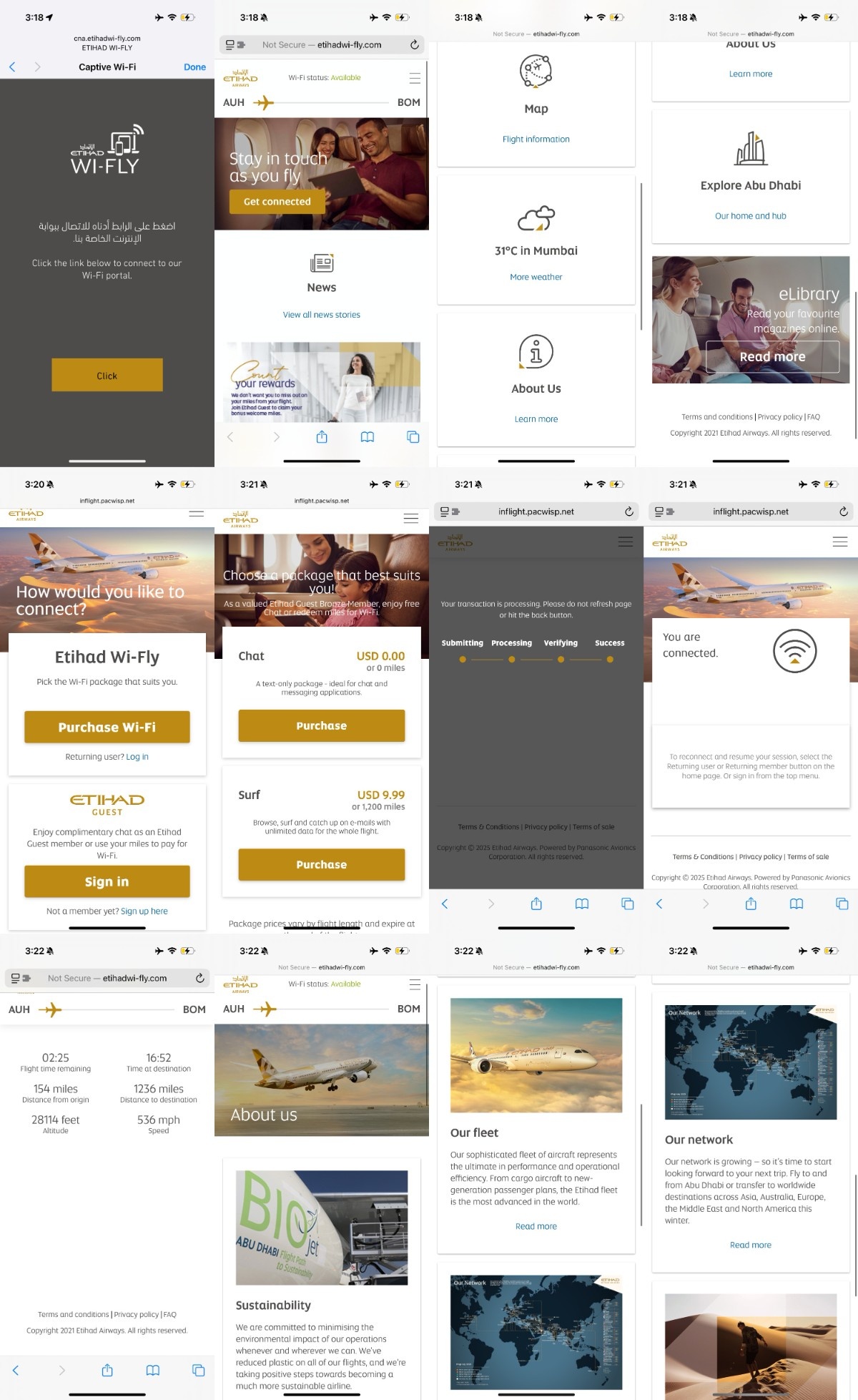
This gets vErY detailed: Wi-Fi, fleet facts, live TV, the works…
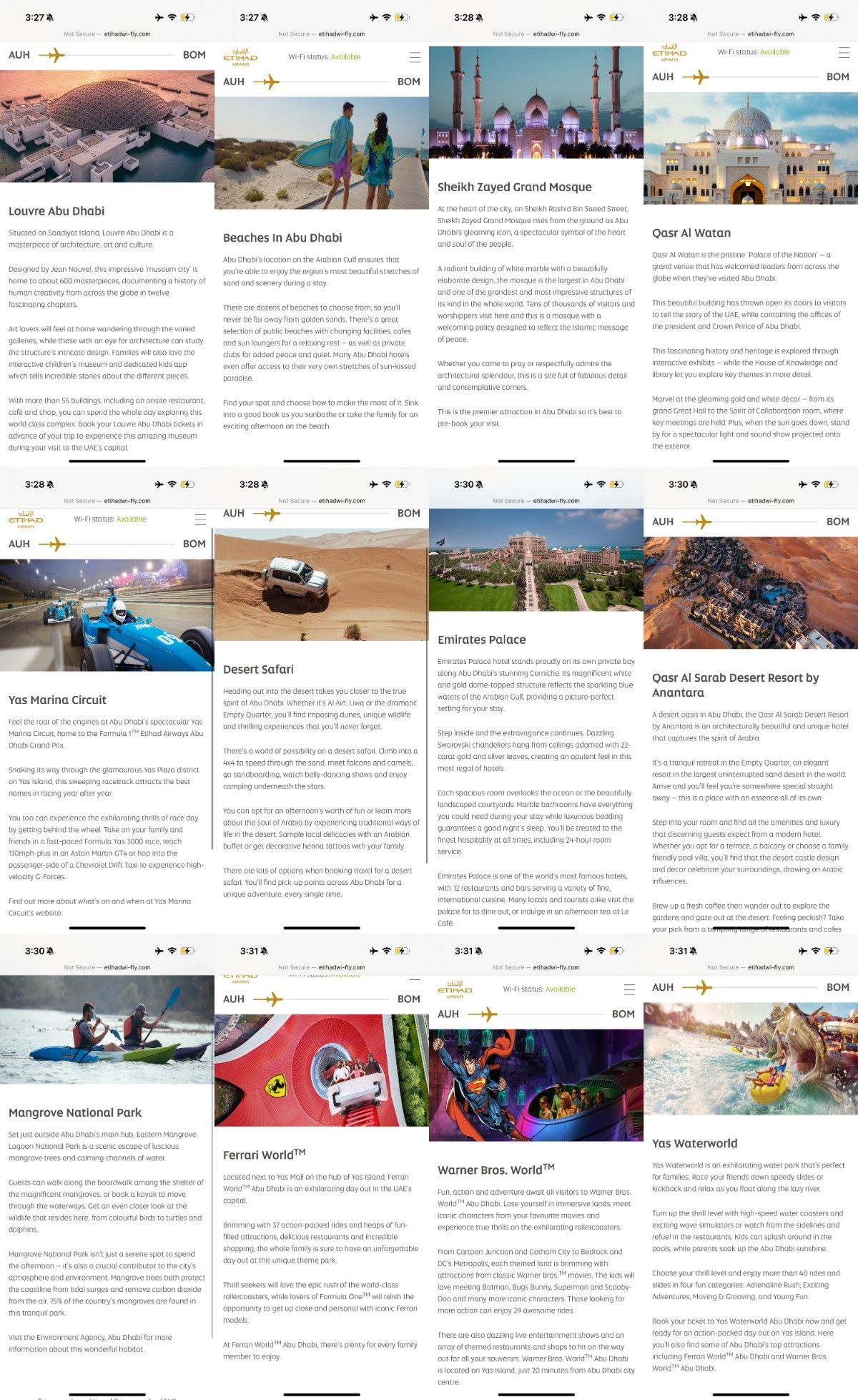
Now this is where I might lose you as a reader. I’m afraid I get ExtremelY technical when it comes to airline information pages. I was in luck today, and, after connecting to the ‘Wi-FLY’ service’s free messaging plan, proceeded to look up EVERY little detail it had on the Wi-Fi portal. Where Etihad flew, what perks it offered, how it gave back to the environment, what to see around Abu Dhabi, yada, yada, yada — all of it rendered in that exquisite Etihad Altis font!
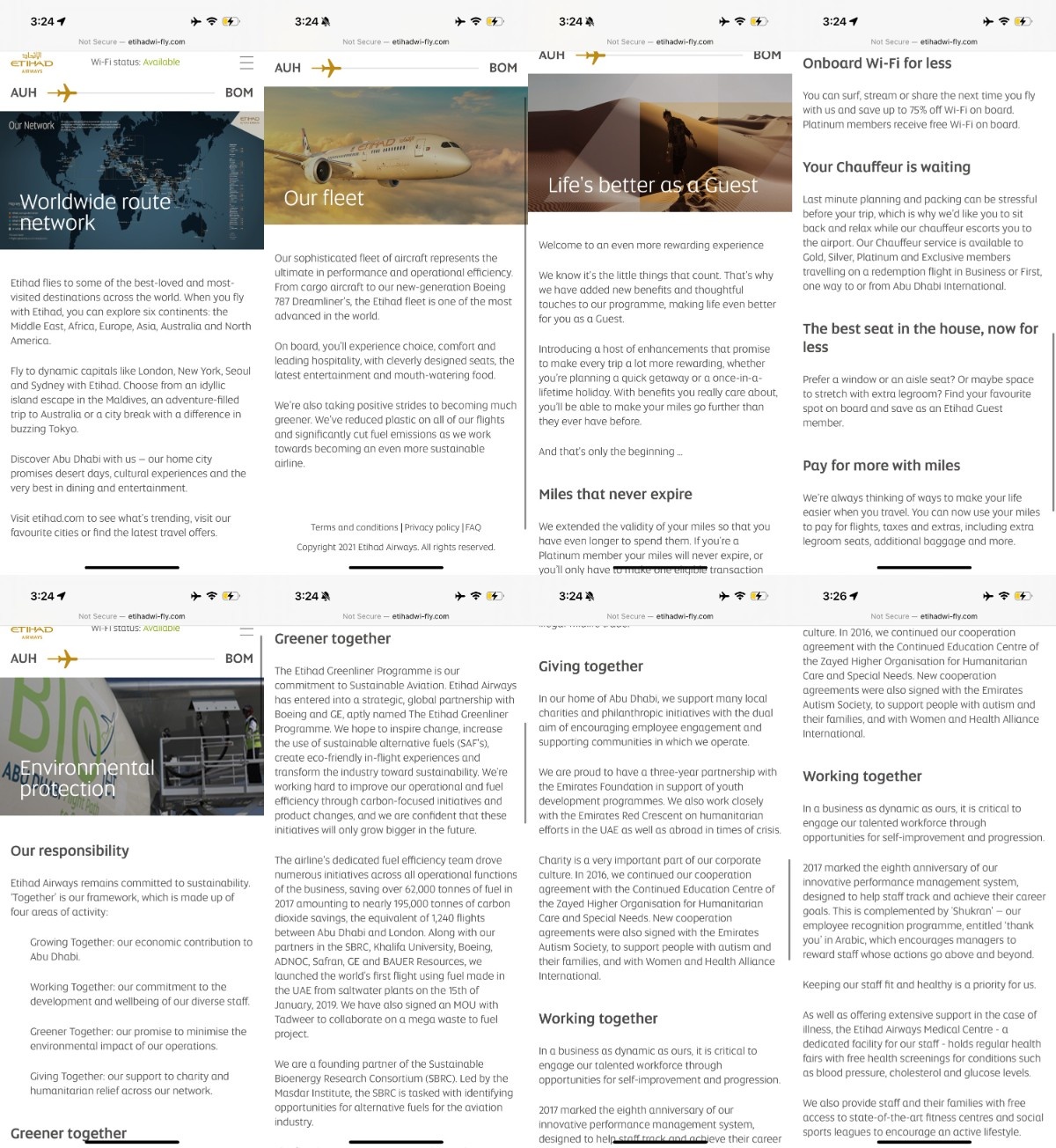
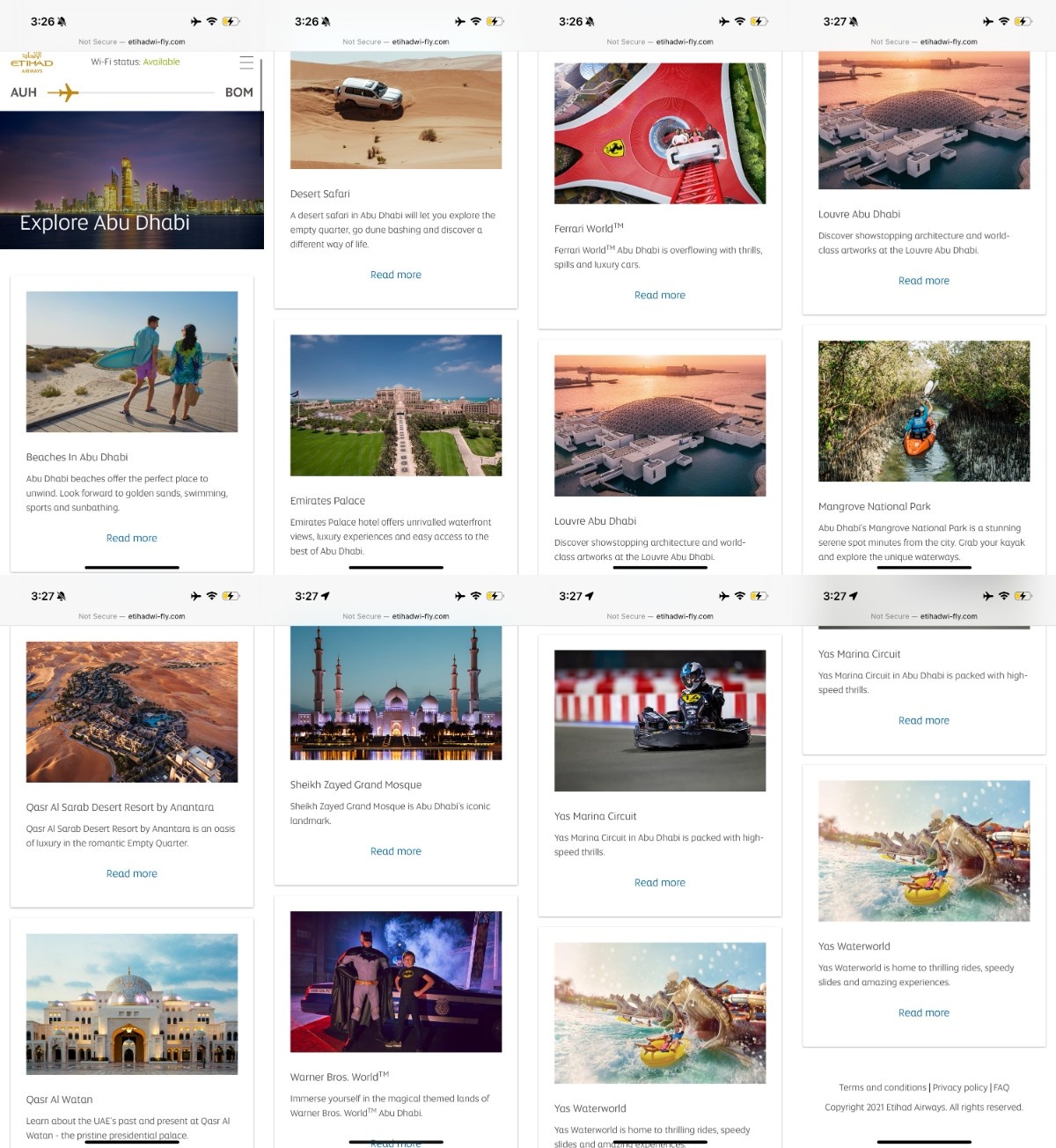
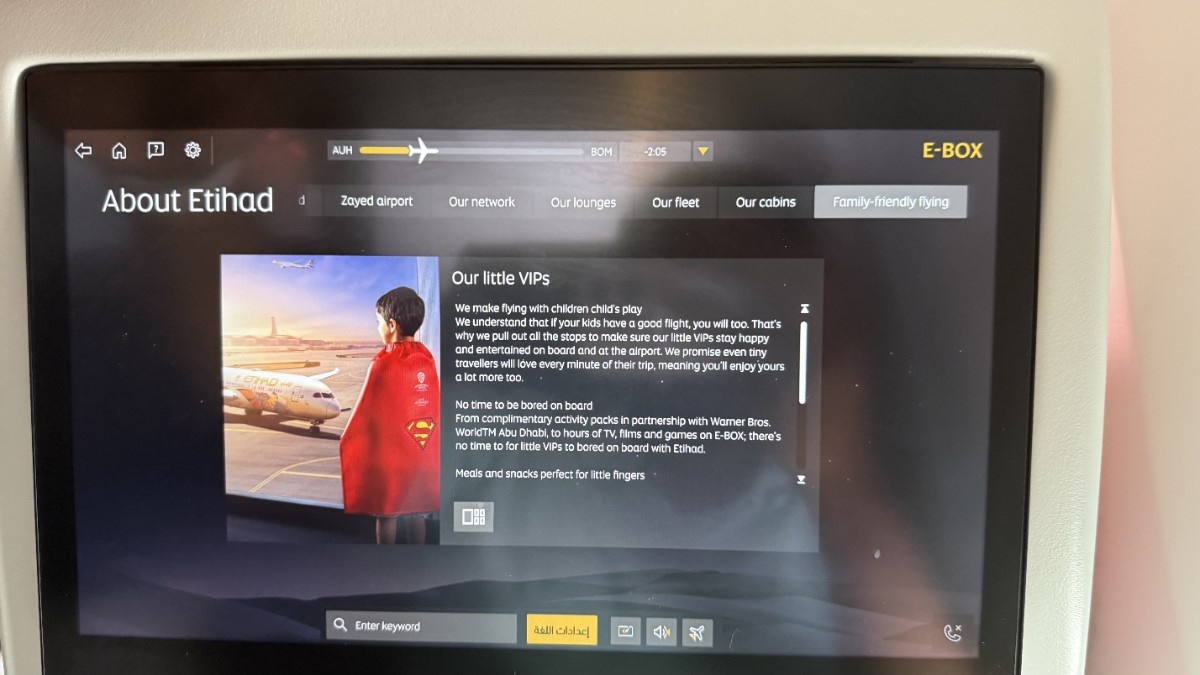
And I did the same for the seatback screen too. Not much time to do a lot else — certainly not watch a movie — so this is what I enjoyed the most. You can’t blame me. I was as fascinated by it all as this little guy looking at the window for his special-liveried 787 to arrive.
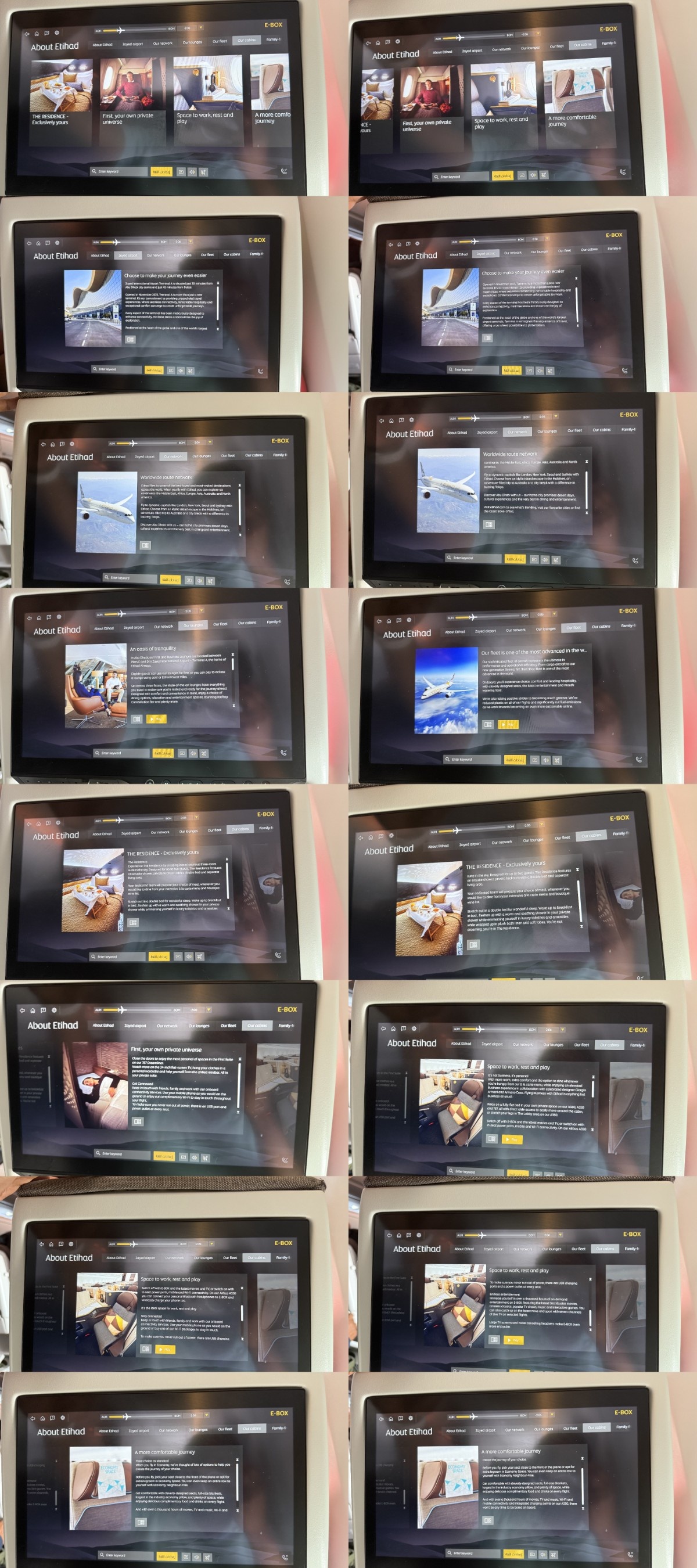
Oh yes, I was a fan all right — all the details about the airline’s cabins were taken care of, without going all high-and-mighty like Qatar Airways did in its about-us IFE pages. Goodness, there are few airlines in the world as haughty as Qatar Airways, overblowing every little detail about the airline, the airport and the entire conglomerate that it ran… (From my fifth-freedom flight on QR in November 2024, from Phnom Penh to Ho Chi Minh City.)
Etihad doesn’t do pompous, but instead opts for restrained luxury, choosing words with care and elegance. As you’d expect from this airline. (Full resolution here.)
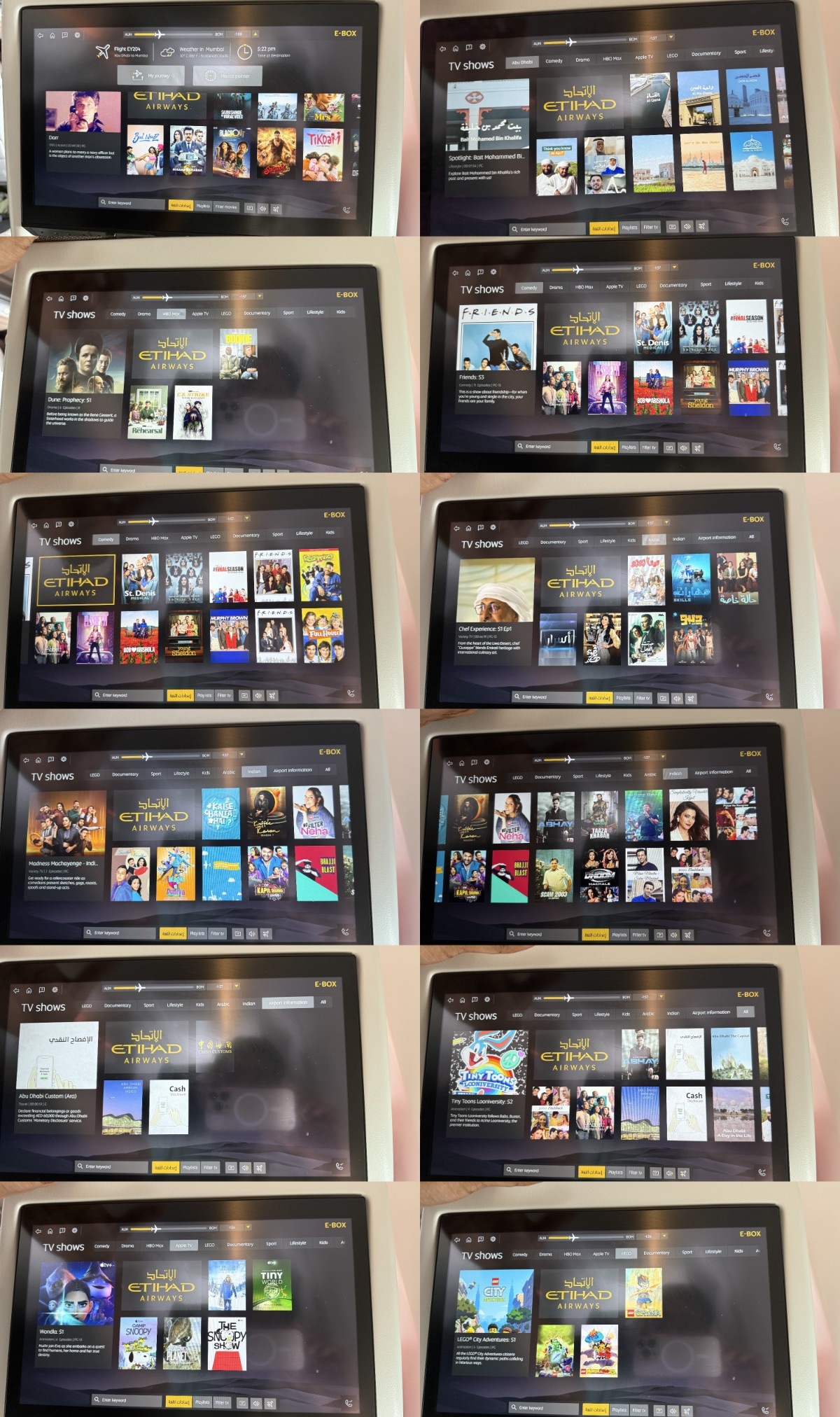
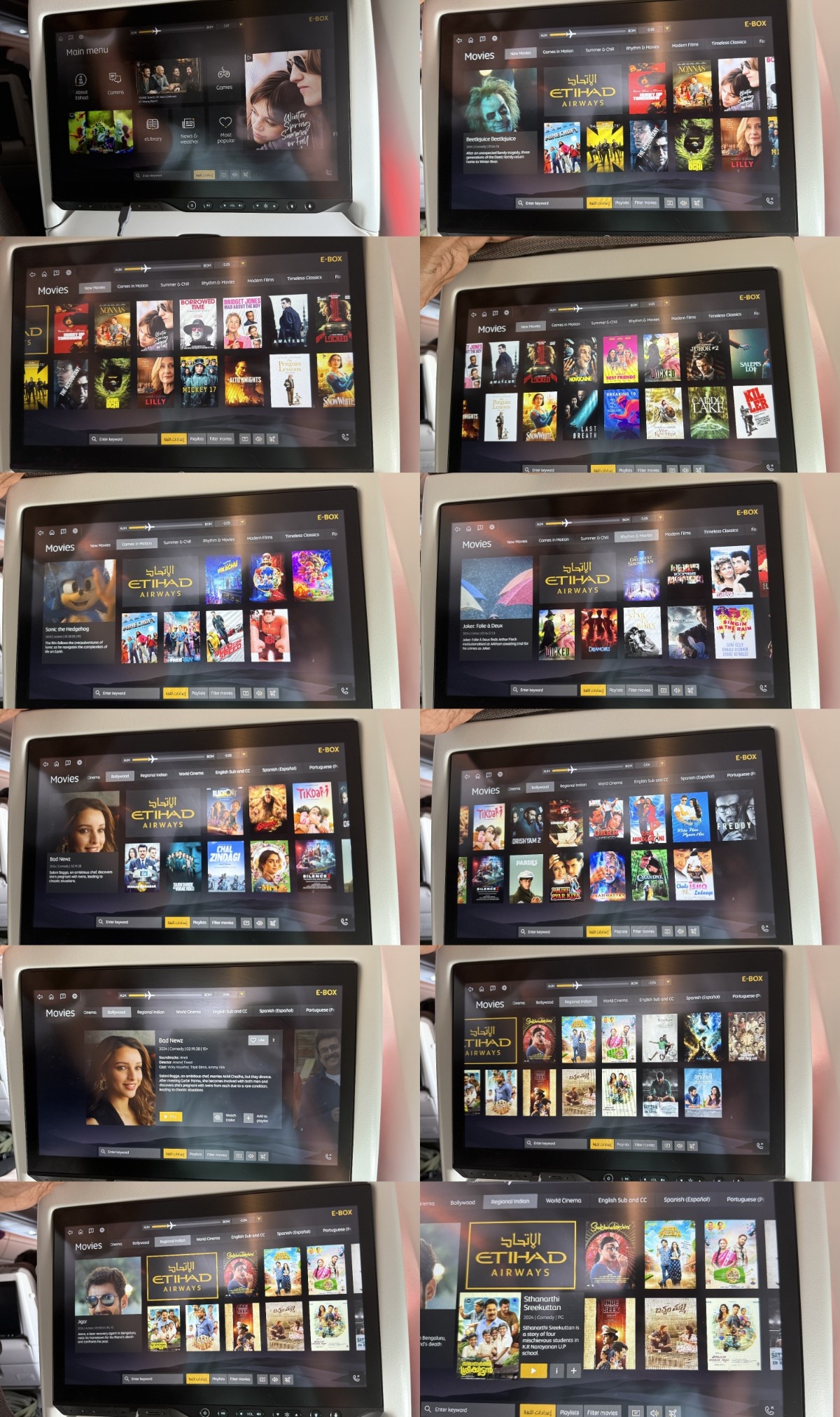
When I finally tired of it all, I turned to the main entertainment section, which is what most people go for anyway. The short 3-hour flight would be too short to watch anything, but I did have a dekko anyway, with Bollywood leaping out at me and grabbing my attention as it always does.
It’s also the in thing for in-the-know airlines like Etihad to promote streaming services, be it Disney+, HBO Max — previously Max — or, in this case, Apple TV+.
Delectable Indian cuisine + live news = the drawing room, elevated (literally)
Presently the lunch/dinner (which one?!) was served, and I predictably went for the non-vegetarian option, being a great fan of chicken in particular. I should say here that even with the packaging Etihad outdid itself, with the tray wrapped in gold foil and the cutlery in a packet labelled ‘The Good Life’. Wonder what that means? Well, travelling is the good life, if you ask me!
Best I can tell, the Indian dishes were malai chicken (in a yellow curry) with white rice and rajma dal (kidney beans), along with a potato-based chaat (tangy starter) and a sweet phirni for dessert. I disregarded the dry roll of bread and chiplet of butter, and focused on the food. Yum, yum, yum! You can never go wrong with North Indian food when done well. While most airlines I’ve flown other than SQ don’t allow you to see your menu in Economy Class, I don’t think that would have mattered here. Even SQ could have learned a thing or two about how to present Indian food.
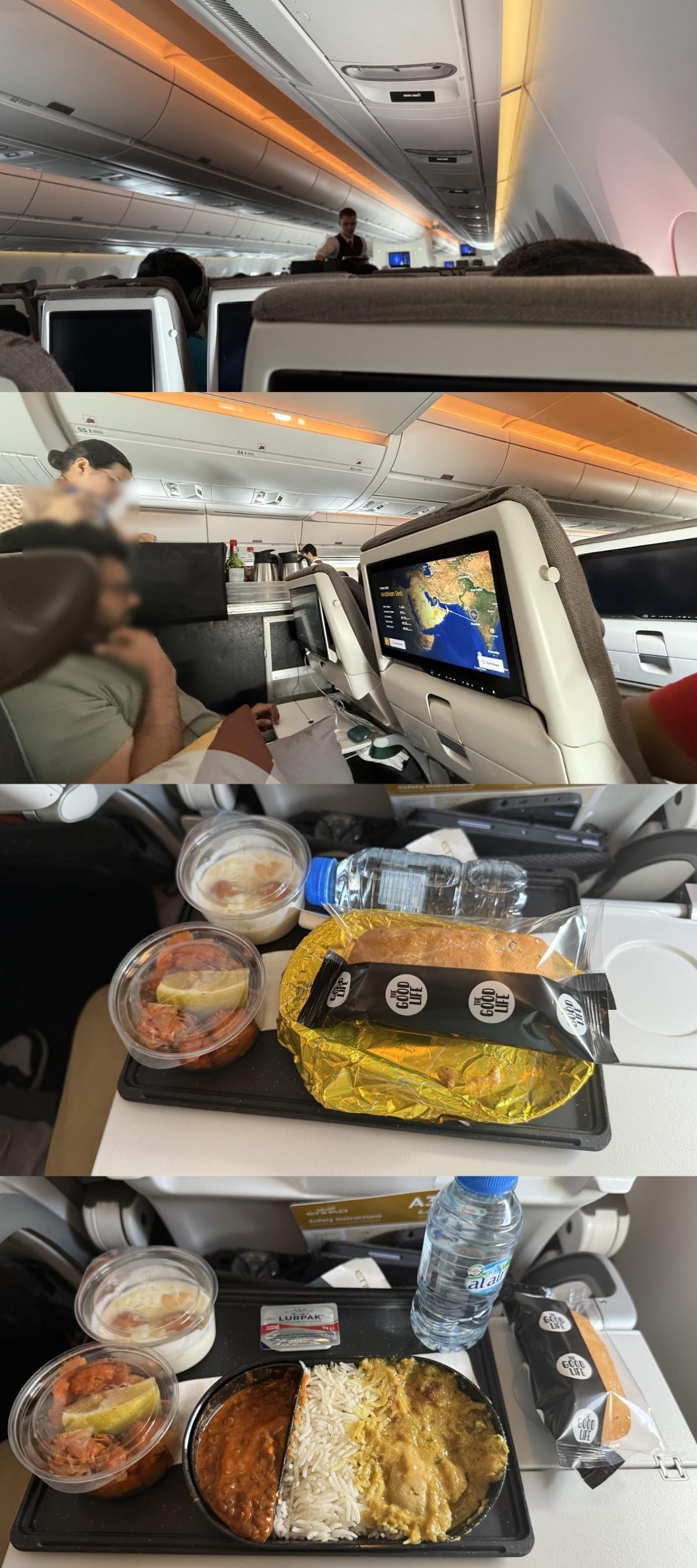
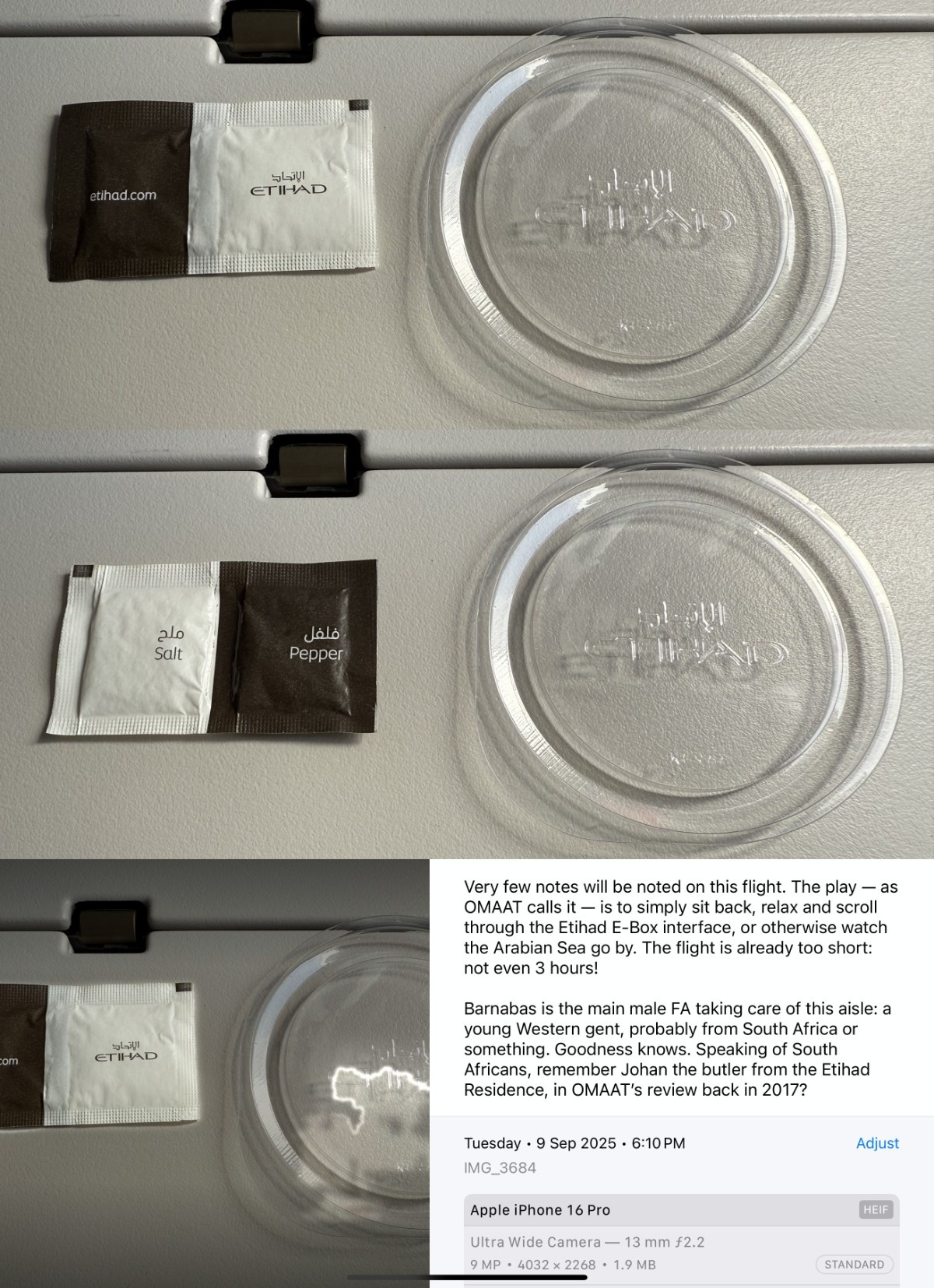
Even the salt-and-pepper sachets were so elegant and minimalist in their appearance. WOW, I thought, can airlines brand themselves any better than this?! Of course, I’ve flown Cathay Pacific enough to call them ‘eCXeptional’ — a term I coined and keep using every now and then in my flight reviews. But among all the excellent airlines in the Middle East, Etihad now takes the cake, beating my previous favourite, Gulf Air, with its sheer consistency and flawless single-font approach.
Etihad, Gulf Air, Saudia and also Riyadh Air have some of the best brand identities of any airline in the world in my book. (Qatar comes slightly behind, Emirates and Oman Air further still, with established and consistent but increasingly dated brand identities.)
I think it’s only proper that I mention one of the friendly cabin crew who was serving me, which can be tough when they’re moving past so quickly. His name was Barnabas, a young Western gentleman, and for some reason I kept thinking of South Africa when I saw him. More precisely, Johan, the rockstar butler that Ben Schlappig of OMAAT had had in his incredible Residence flight to Sydney in 2017…
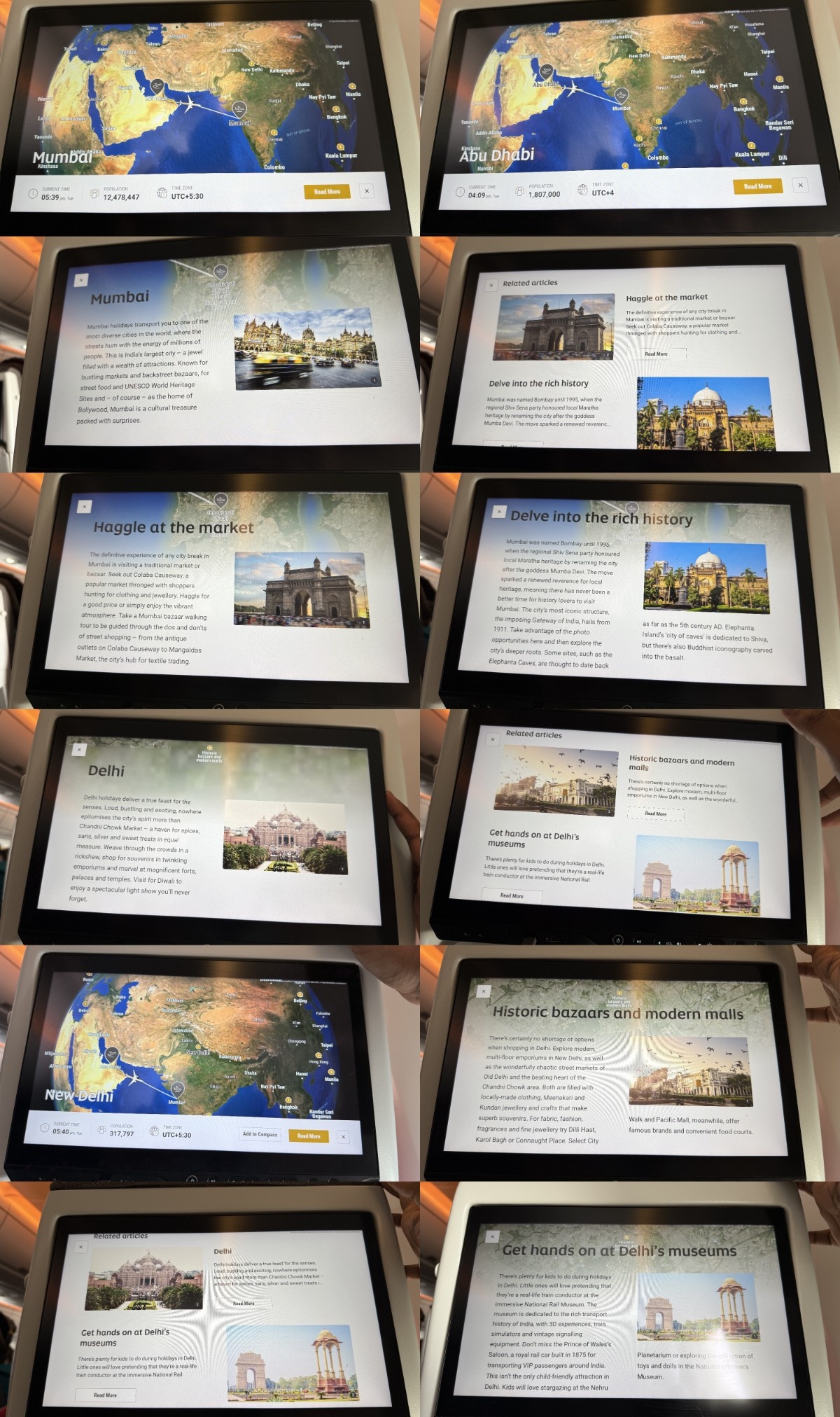
The meal done, it was now time to look at the Arc map’s overviews of Mumbai, my destination for the time being, and Delhi, where I’d be continuing to after a few hours’ rest at a transit hotel. I appreciate that it was very detailed and picture-filled indeed, but I should say that — save for the city’s name in the Etihad Altis font — the rest of the UI is exactly the same as what you’ll find in the Air India A321neo and A350 or the Singapore Airlines 737 MAX, with no other differences.
However, on some recent flights with the FlightPath3D system, I was even more impressed with the destination overviews. Starlux and Malaysia Airlines’ A330neos had it, as did United’s 787-9 as I flew on the BKK–HKG fifth-freedom in January 2026, but the one that did the most customisation in this aspect was undoubtedly Saudia. Oh, that was simply marvellous, bringing out each city’s emotions with every destination and every detail… (Too bad Saudia’s Beyond IFE doesn’t make use of its signature Saudia Sans font, instead settling for common Google Fonts — but it’s a fantastic system otherwise.)
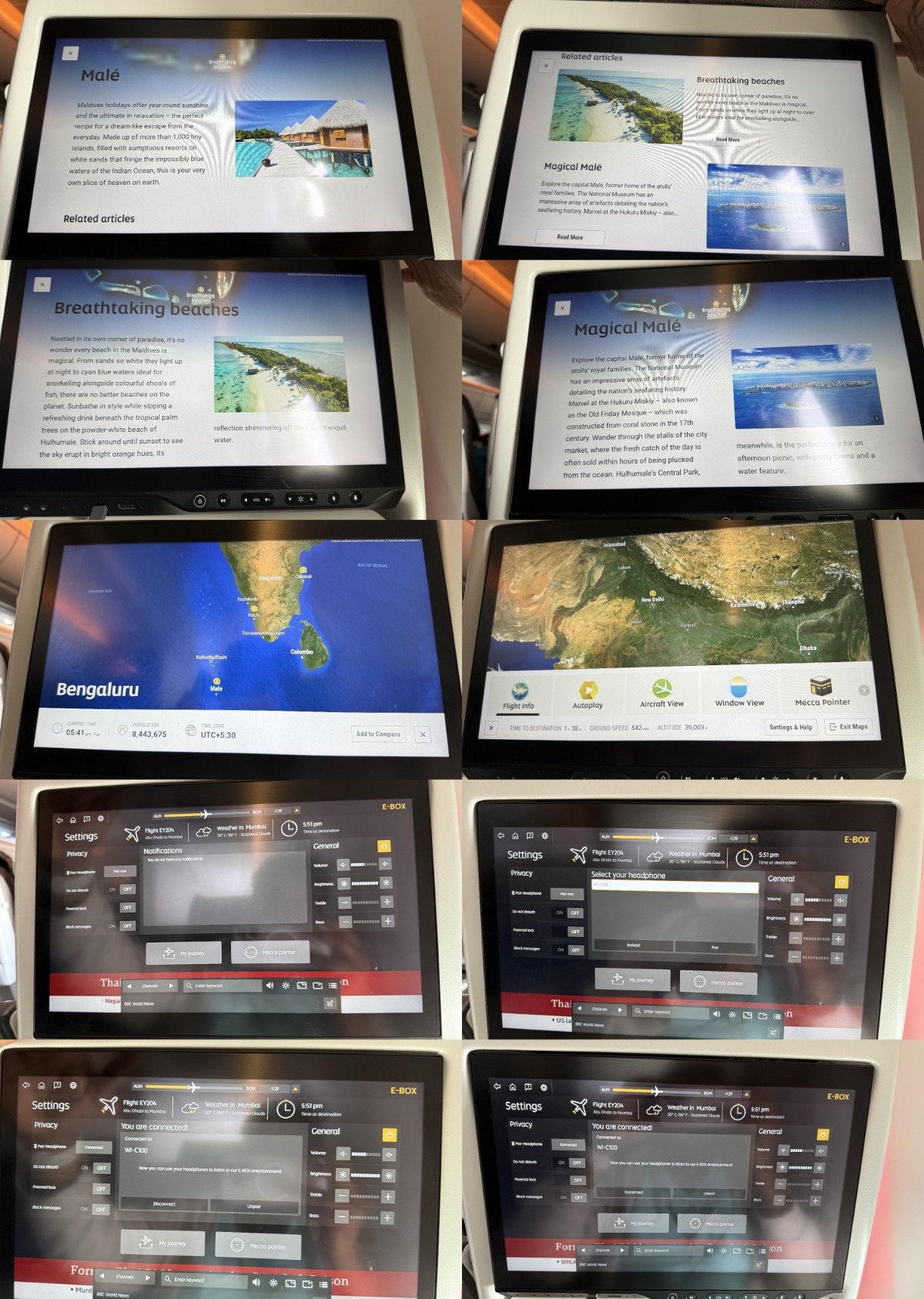
After I explored what Malé had to offer beyond overwater villas costing thousands of dollars per night, I toyed a bit with the settings and connected my Bluetooth earbuds in order to…
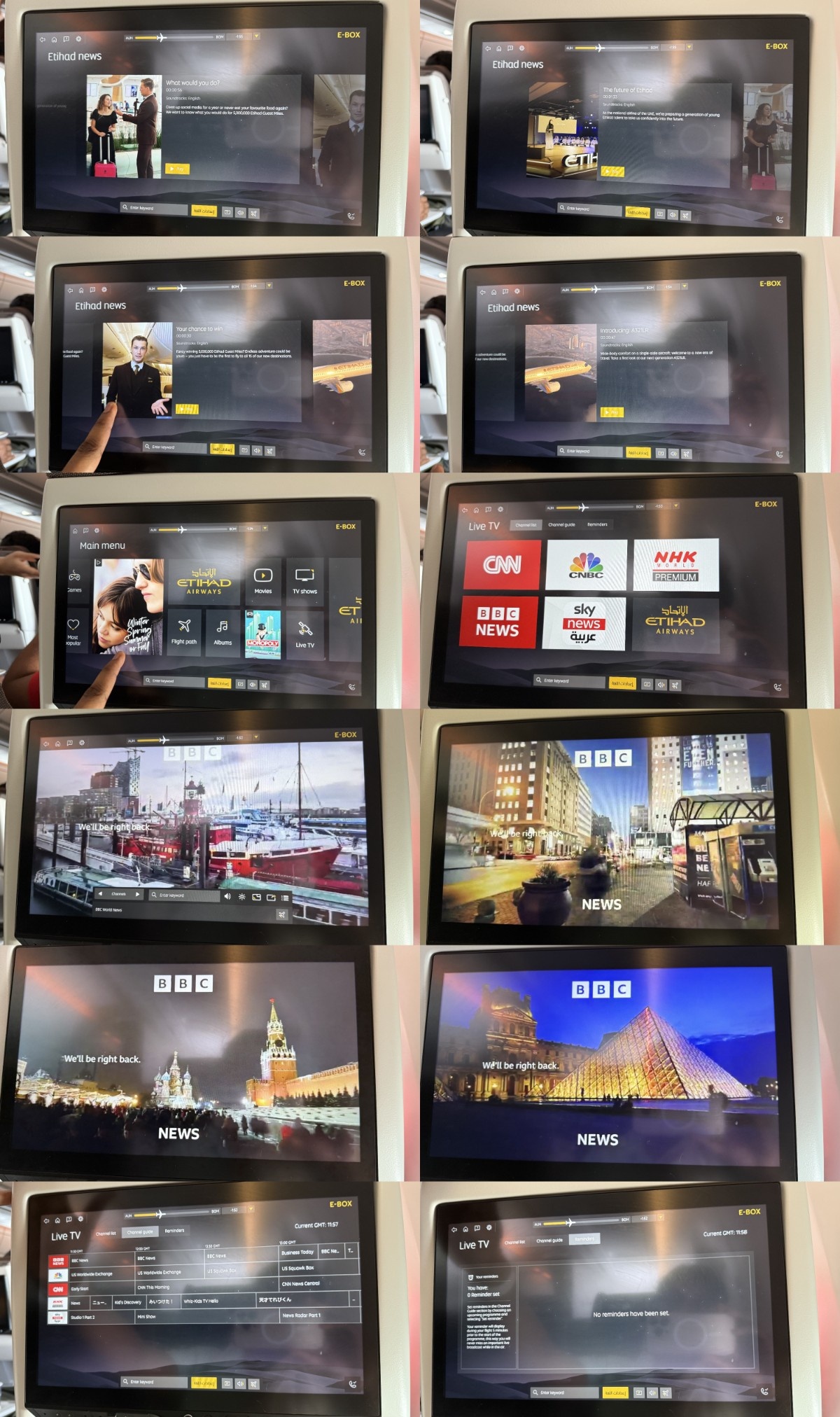
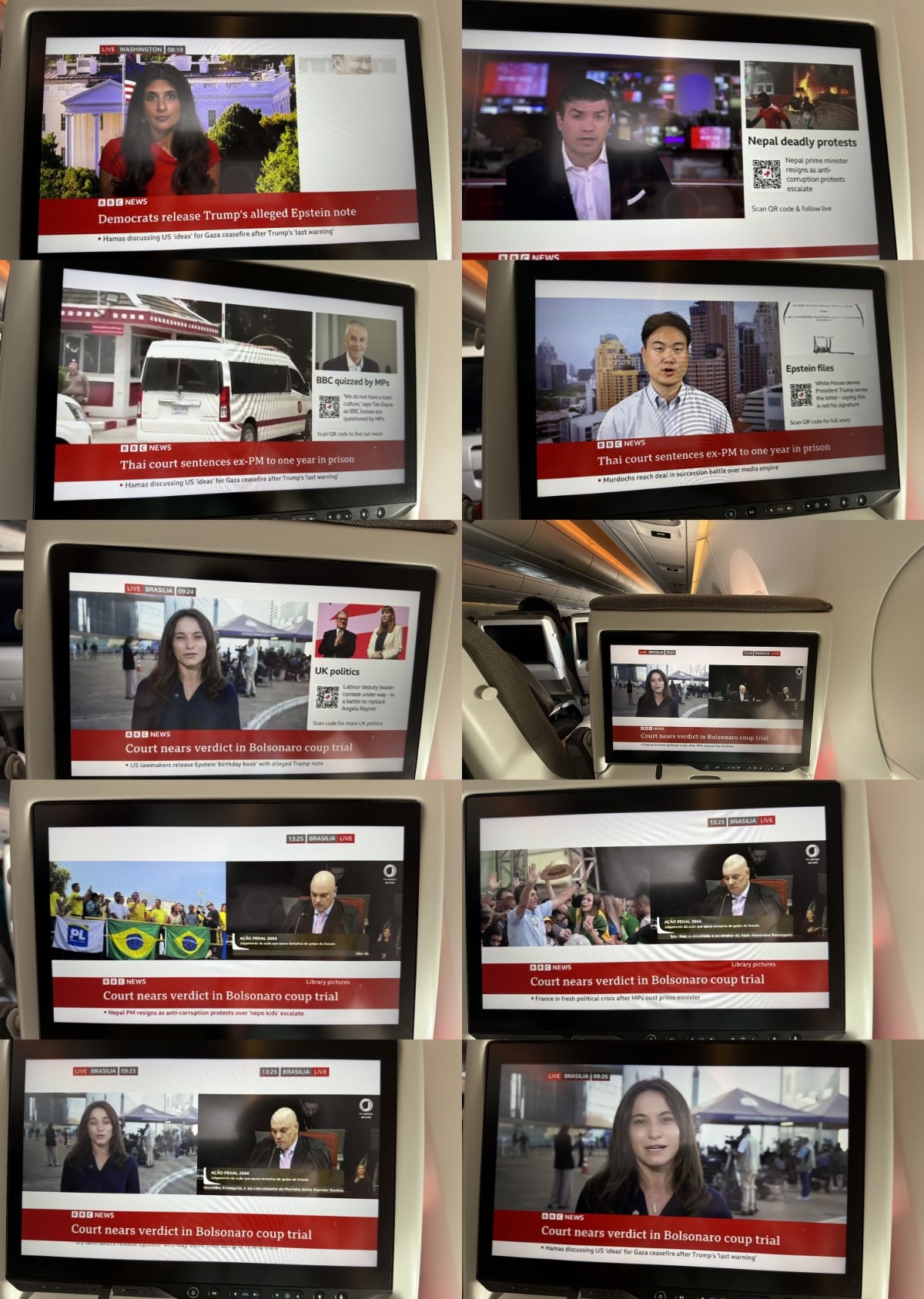
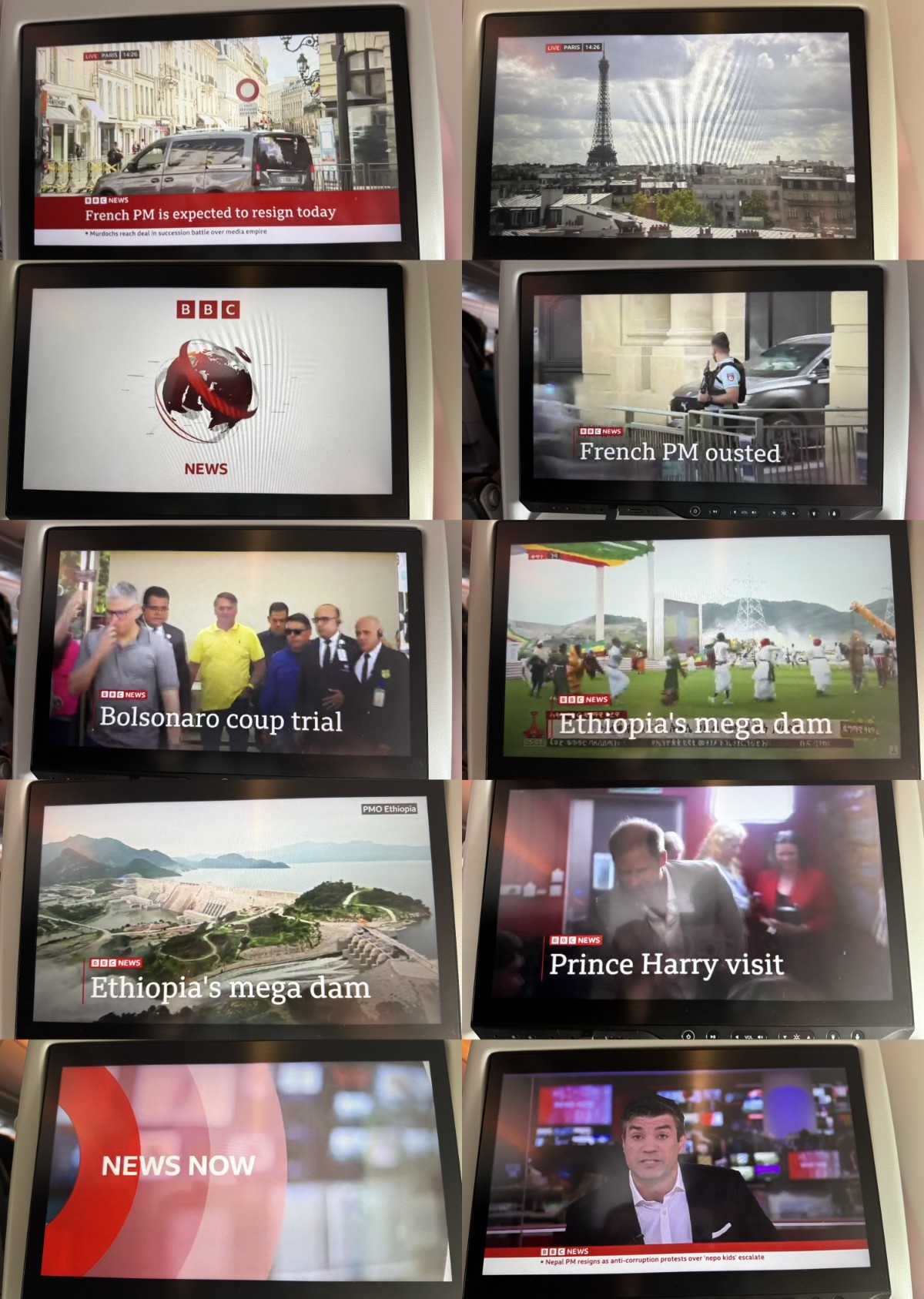
…watch BBC News live for some time, with plenty of political and judiciary action across the world, from Nepal to Thailand to Brazil. This setup really did feel like a small living room above the clouds, between the delicious food and the live news — with the only difference being a window!
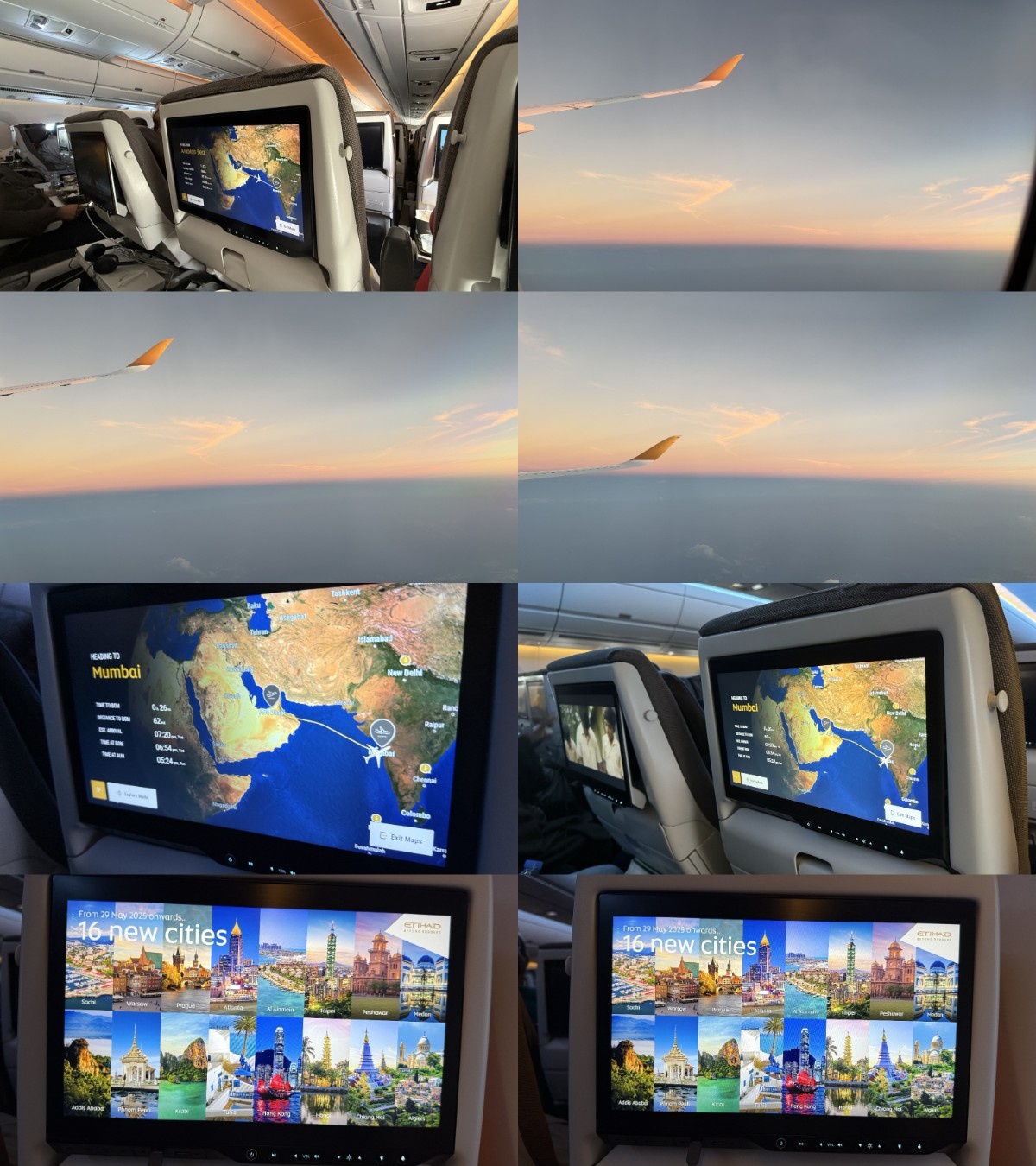
Through that window I watched the golden winglet soar into a golden sunset, flying over the Arabian Sea as we approached the western Indian coastline. All too soon, it was time to refasten seatbelts for descent, upon which Etihad screened an ad showing a whopping 16 new destinations*! They really did run the gamut, from Atlanta in the US, to Warsaw, Prague and Sochi in Central Europe and Russia, to Hong Kong and Taipei in East Asia — plus smaller East Asian cities like Hanoi, Phnom Penh, Medan and Chiang Mai that became possible thanks to the A321LR.
And to think there are even more destinations on the way, including cities as secondary and unserved as Charlotte and Calgary in North America — though EY has no intention to return to Los Angeles, San Francisco and Dallas, which it terminated before the pandemic…
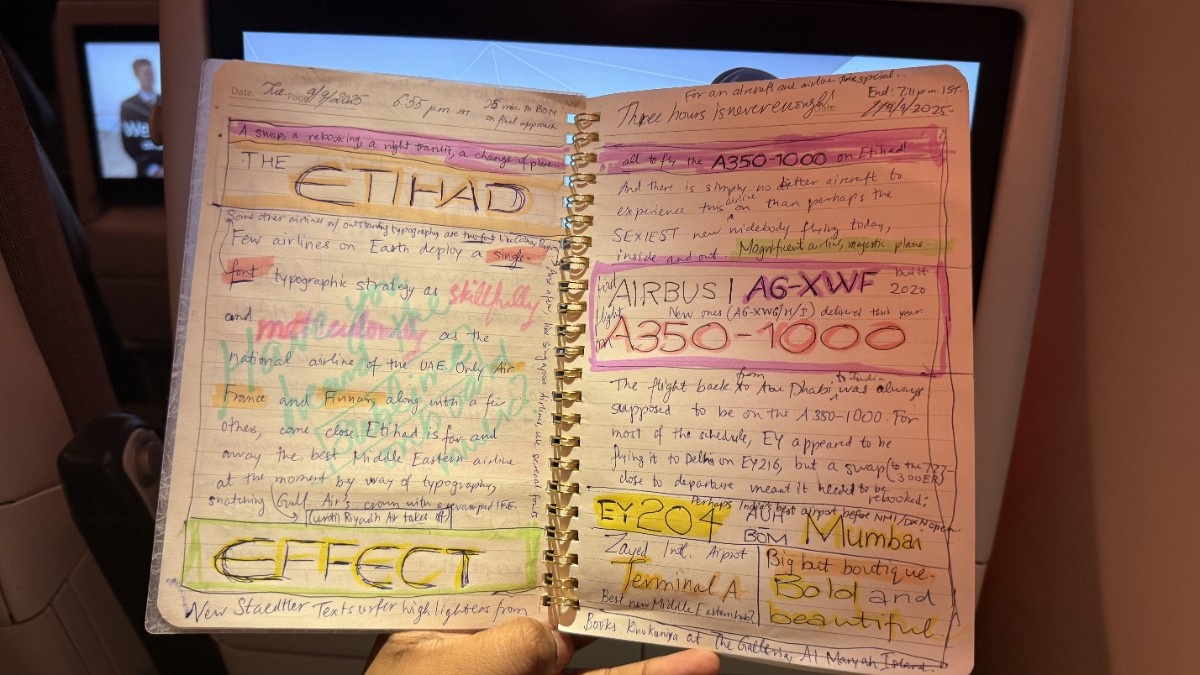
On final approach into the uniquely located Chhatrapati Shivaji Maharaj International Airport, surrounded by slums, I took the opportunity to write about the ‘Etihad Effect’, as I called it, in my journal. And what an effect it had turned out to be, between the A350-1000 hard product and everything else in the soft product… simply brilliant.
But I must of course acknowledge that those flying Etihad’s A320s and A321s (not the A321LRs) with their lack of seatback IFE, or the old 777-300ERs (which I would’ve ended up with if I were not careful), are not so lucky!
Around 7:15pm IST (not even 2h45m in the air), the graceful giant hovered above the iconic slums of Mumbai, before gently touching down amid a row of IndiGo and Air India planes taking off. Again, too bad there was no tail camera for me to enjoy the views as A6-XWF — my first time on this variant of my favourite widebody plane — landed at one of my favourite Indian airports, at a much better and lovelier terminal building than Delhi!
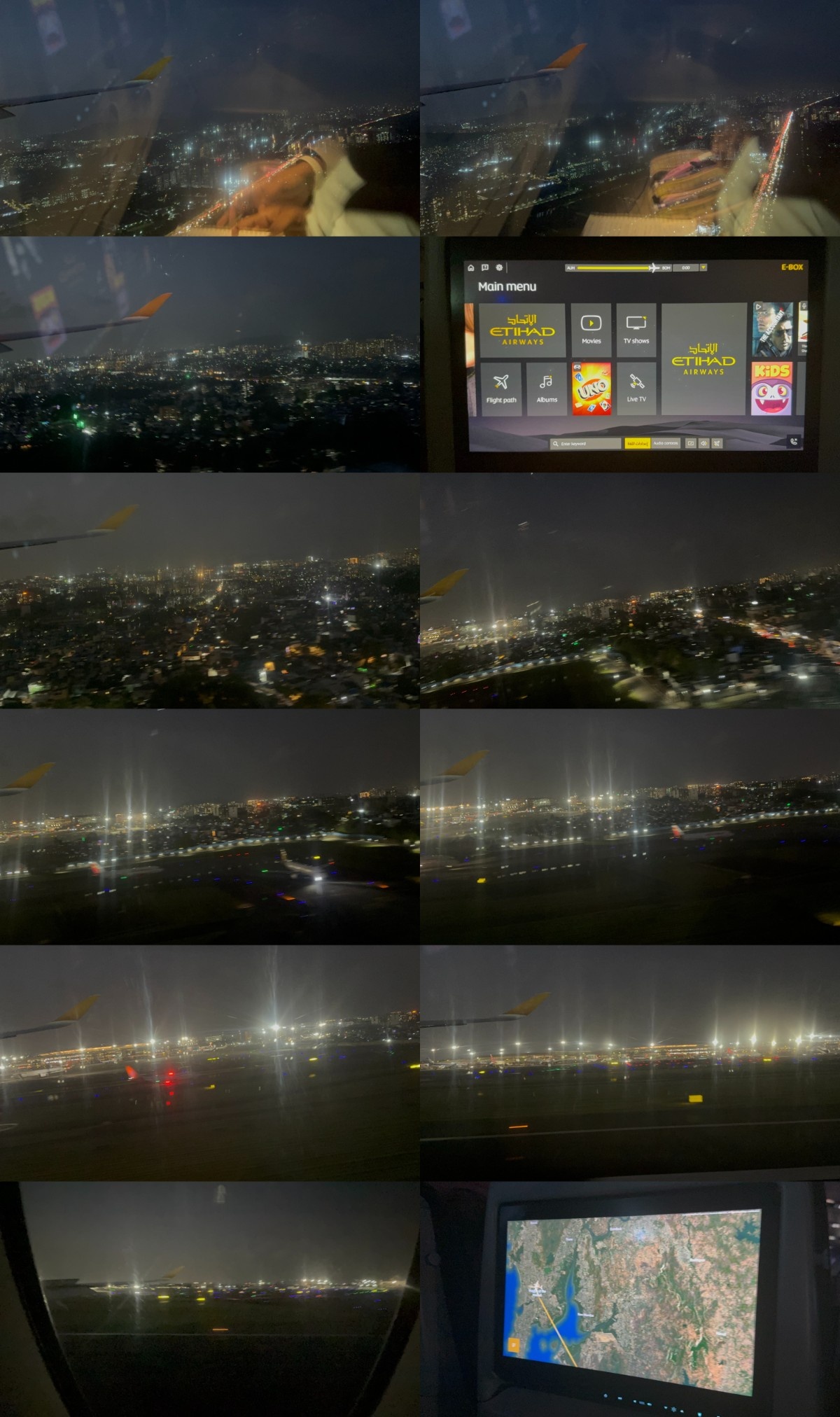
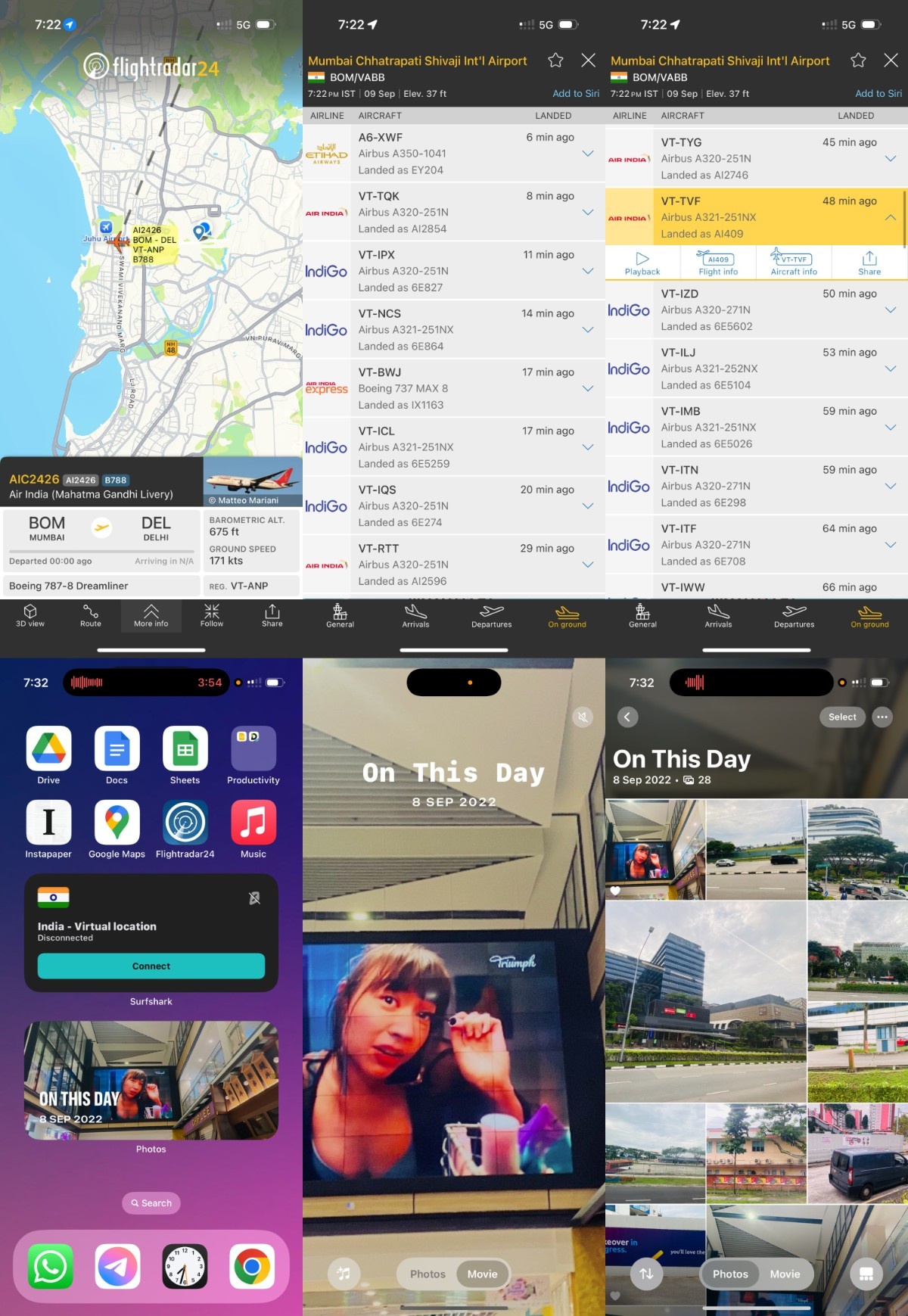
We didn’t show up on the Flightradar24 map at first, but my A350-1000 — I feel proud even writing that — did appear in the list of arrived aircraft. Among the aircraft taking off was VT-ANP, an Air India 787-8 that — along with sister-ship VT-ANT — has spent several months being repainted and refurbished with new cabins in the US. At the time of publication, she still hasn’t returned to India, though should be back by February 2026 at most.
(In the meantime, VT-AWA, Air India’s first line-fit 787-9, has entered service from January 2026 — with brand-new cabin products in all classes — marking a huge moment of pride in Air India’s transformation story. AI is also set to receive its own first A350-1000, VT-JRO, in the middle of 2026 — greatly delayed by supply-chain constraints — and it too will greatly transform the much-maligned airline’s brand image.)
We taxied for some while to the gate, all while the signature deboarding music — as I write about below — played over the speakers. The captain ended with, ‘Thank you for flying with Etihad Airways, the national airline of the UAE. It has been our pleasure to serve you today.‘ Meanwhile, my phone’s home-screen featured-photos widget showed me all the places I’d been across Singapore, where I was working, three years before. It was always nice to put this into perspective!
Incredible boarding and landing music
One more fascinating thing about Etihad, in case my obsession with its brand isn’t clear already. I LOVE, LOVE, LOOOOOVE ETIHAD’S BOARDING AND LANDING MUSIC!!! The latest track, introduced in 2021, is SO MUCH BETTER than the two versions that preceded it. This might just be the BEST AIRLINE MUSIC IN THE WHOLE WORLD. Even the elegant melodies of SQ, or Thai Airways’ brilliant The World is Always New, or for that matter Qatar Airways’ creations by Dana Al Fardan, are not a patch on this masterpiece.
I think I can get off my EY soapbox now.
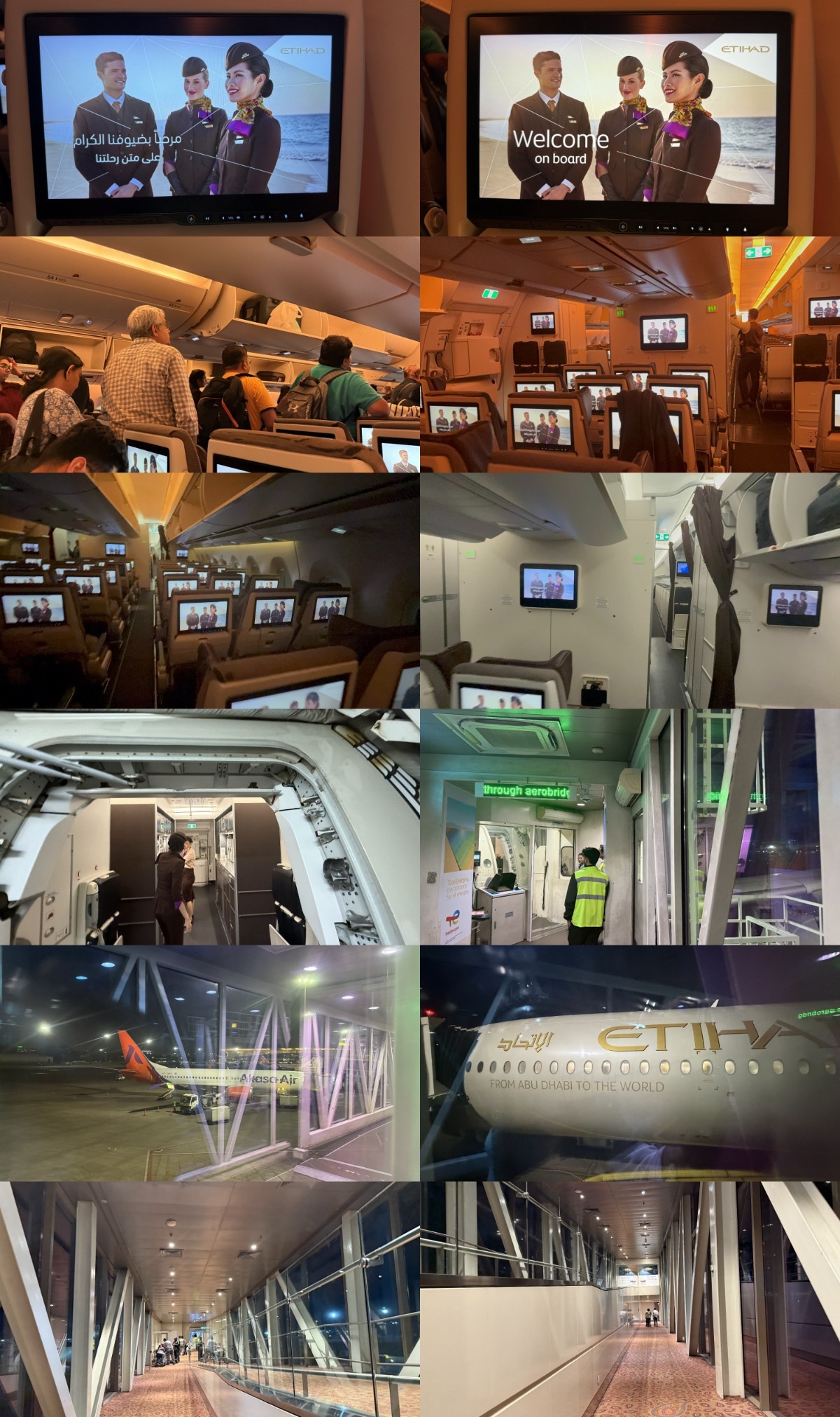
Inwardly, I was feeling bad for not being able to spend even 3 hours in the air on this magnificent airline — a perfect crossroads of Arabic and global influences, immaculately designed. As people crowded in typical Indian fashion to leave the A350-1000, I thanked the flight attendants for their wonderful hospitality and stepped off A6-XWF, taking one last glance at Etihad’s motto, From Abu Dhabi to the World. I couldn’t wait to return to Etihad, and to the A350-1000!
BOM T2: One of the world’s most artistic terminals, a museum by itself
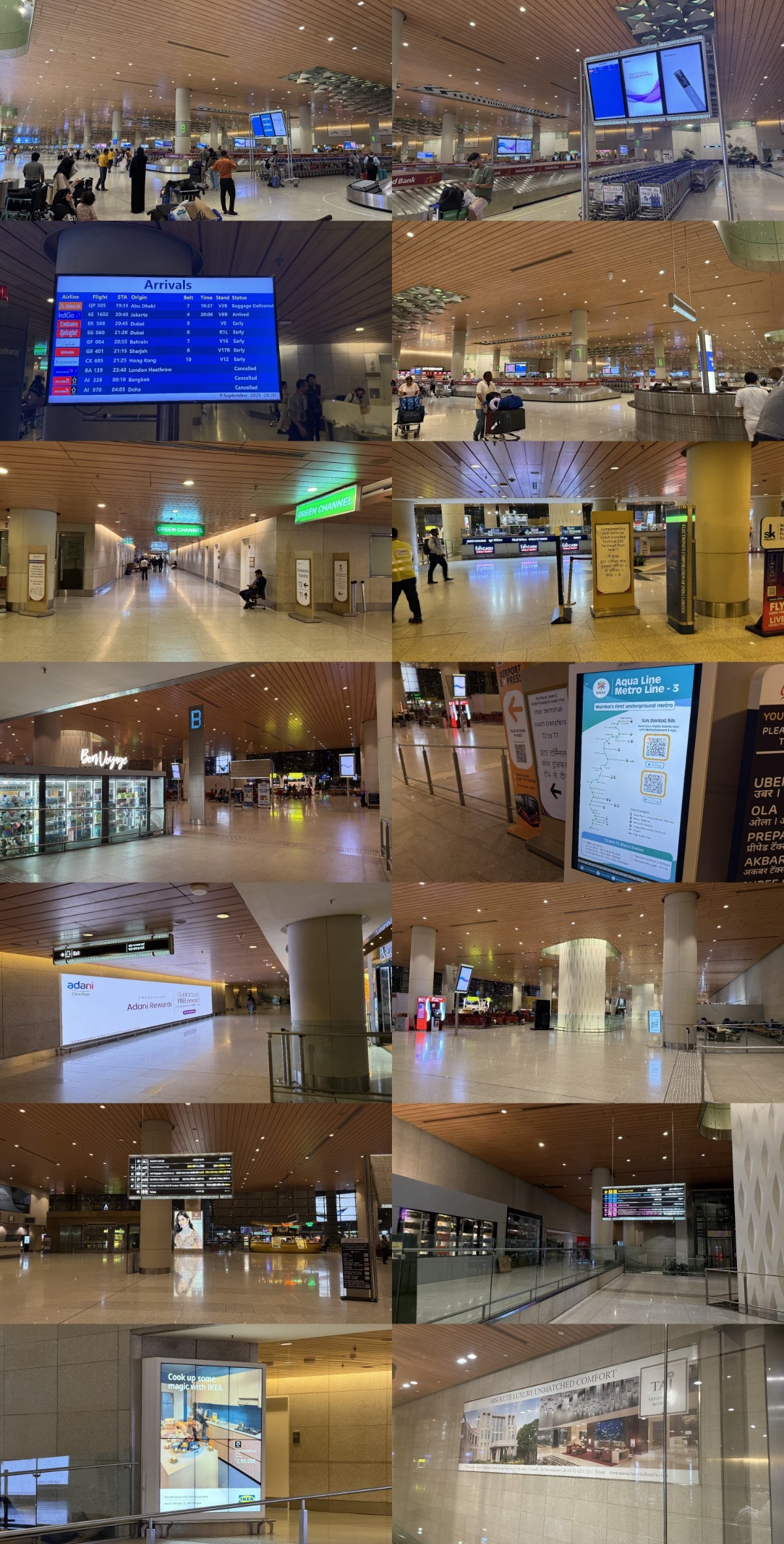
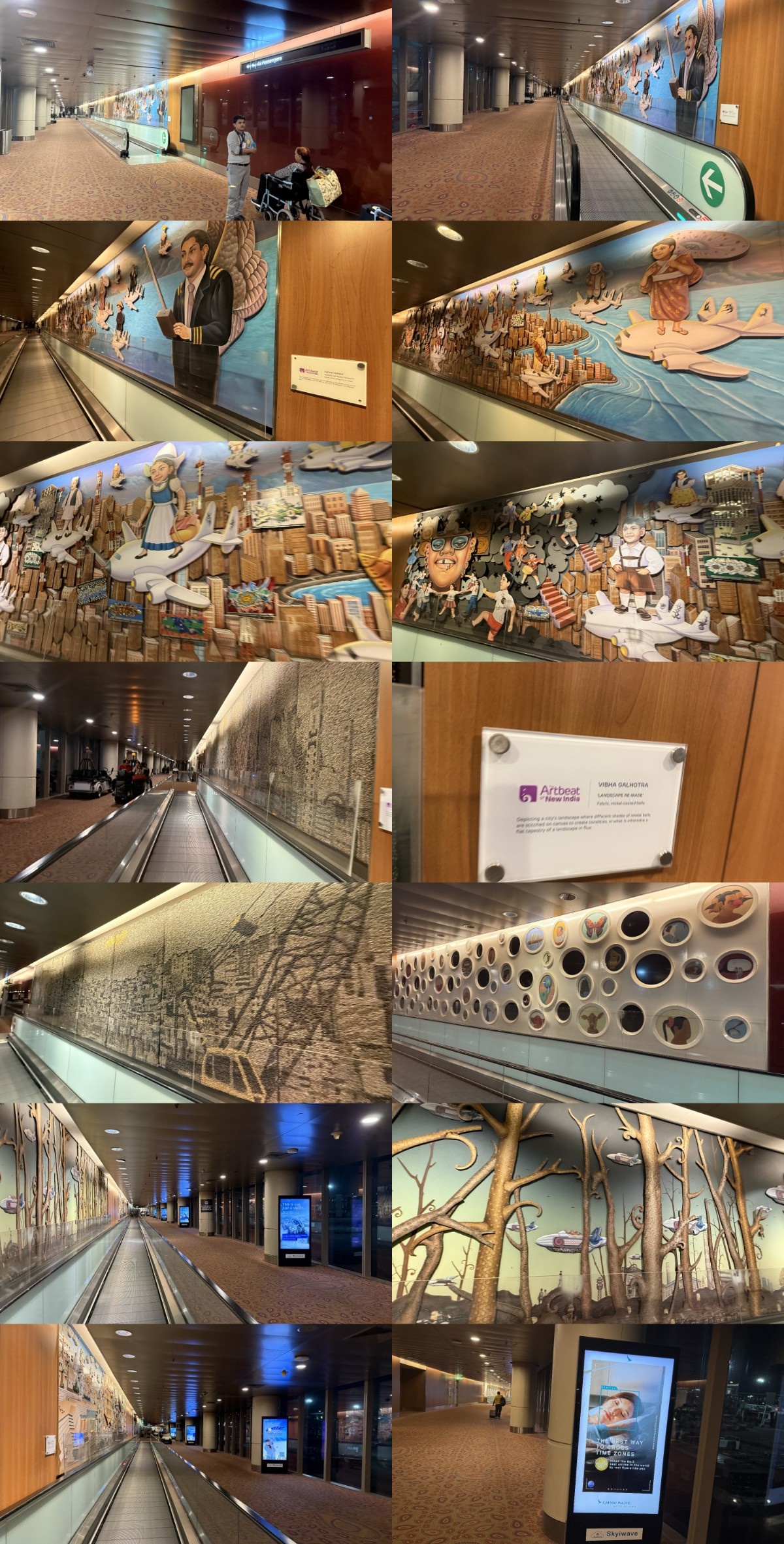
I was certainly feeling significantly upbeat as I walked the miles and miles of the arrival corridors at Mumbai, all while admiring the authentic Indian art on the walls. Artbeat of a New India, it’s called by the operator, Adani Airports — and they really mean it. This could not be more starkly different from the drab, sterile arrival corridors at DEL T3, where I would’ve originally been headed.
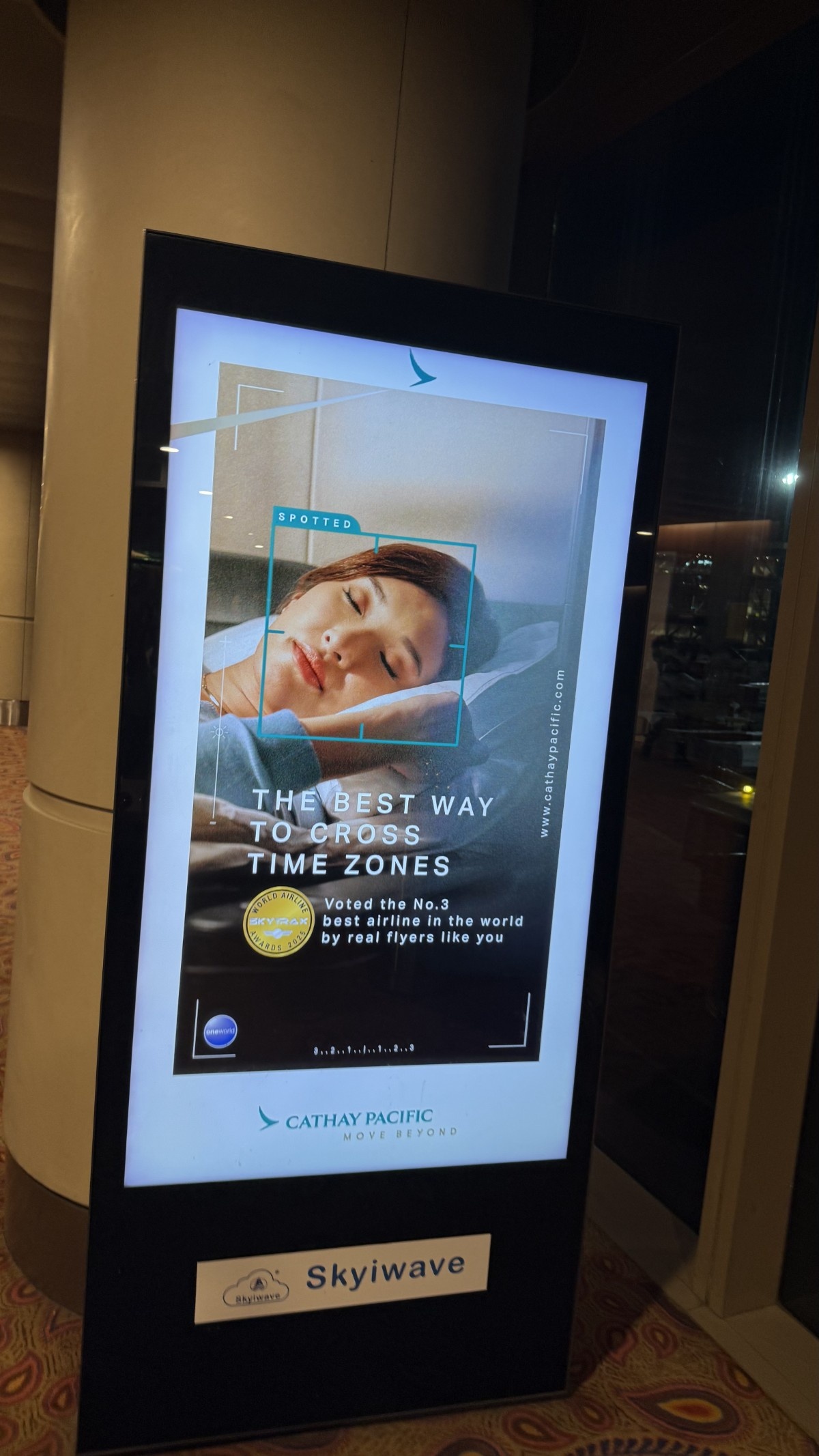
En route I saw, coincidentially, an ad for none other than Cathay Pacific, another airline I’ve praised to the skies — pun intended — in my previous reports with respect to branding. Now I think Etihad matches it beat for beat, if not outclassing it altogether. EY and CX are two of the finest airlines in the world, and it shows, leaving even heavyweights like Singapore Airlines and Emirates — established though they are in the luxury stakes — far behind.
At length, after endless walking (as is typical of BOM T2 — this isn’t Changi with its short escalators down to the immigration counters), I finally came upon the crowded transfer desks, followed by the Indian government’s desks for registering frequent travellers. And then came the immigration counters, a splendidly designed space in their own right, followed by Mumbai Duty Free.
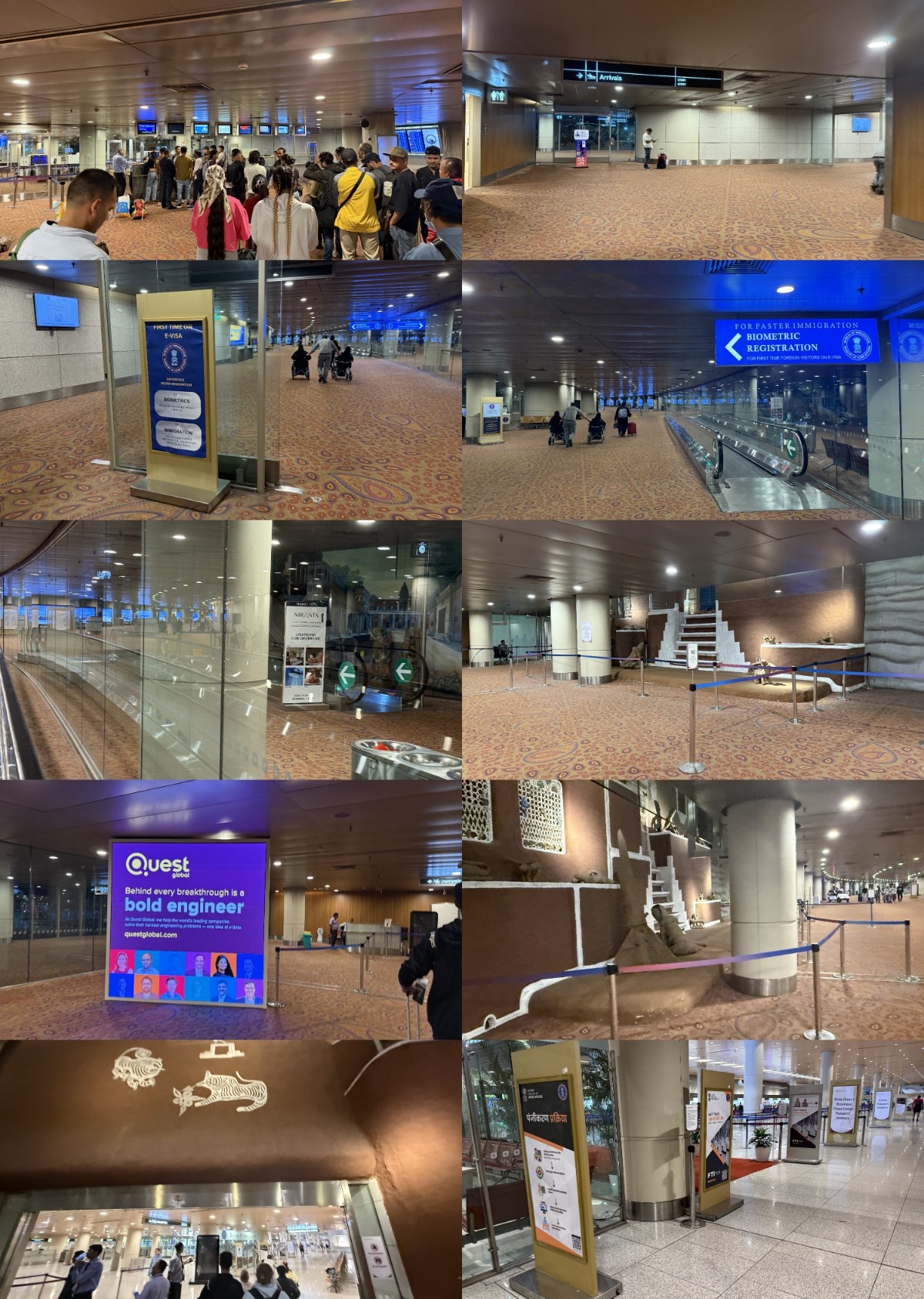
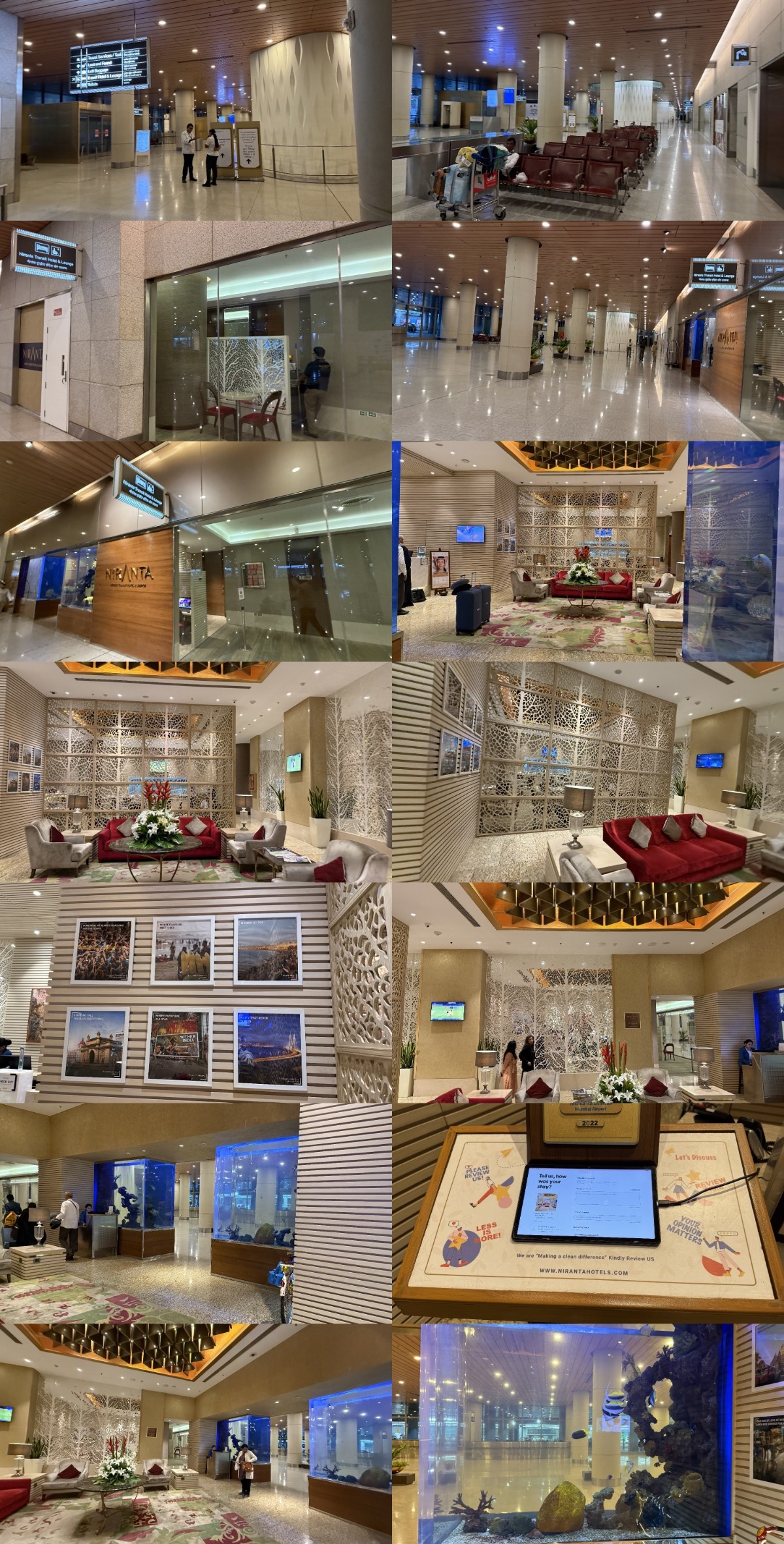
I took a few minutes to register myself for the Indian government’s new FTI-TTP programme for frequent travellers, which make immmigration a breeze with their e-gates, much like big global airports. I paid no heed to the duty-free counters, instead heading straight for the luggage belts, with both Etihad and its Indian partner Akasa having flights just arrived from AUH. In a trice, I was off with my bags to the Niranta Transit Hotel downstairs.
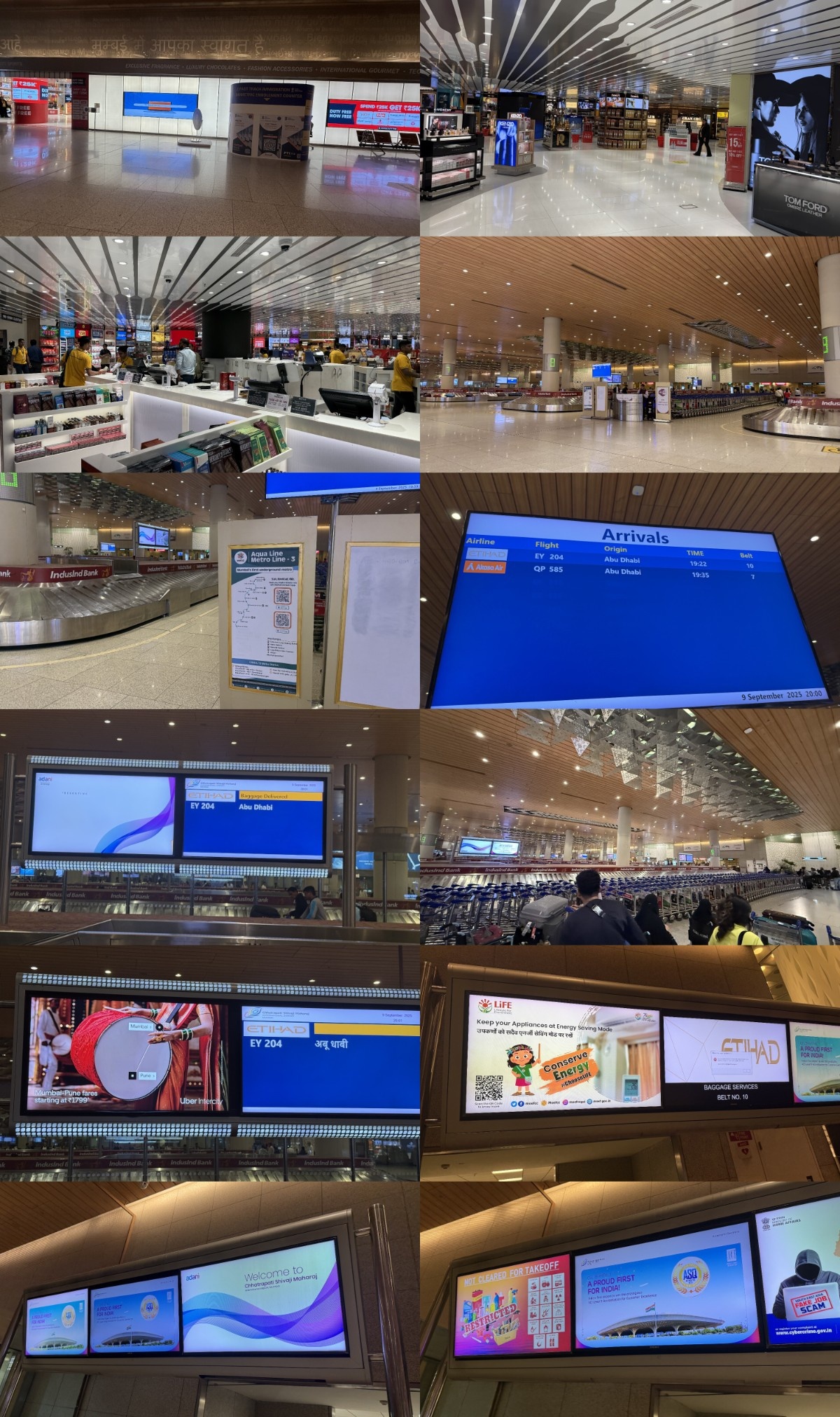
There are few airport terminals that marry fabulous décor and aesthetics with the homecoming feel of Indian warmth as well as BOM T2. Not even BLR T2, my current Indian home airport (and a globally award-winning one at that), can match BOM T2 in terms of its all-round splendour, plus its dedication to Indian arts.
Now that Navi Mumbai Airport in the southeastern suburbs has commenced operations in December 2025 — and I flew there on Akasa Air within barely days of its launch — the city has not one but two fantastic airports to enjoy, on par with the world’s best. Changi may be the world’s number one, and was my home base for years, but BOM — despite my not living in Mumbai — will always be the one I have a soft spot for!